
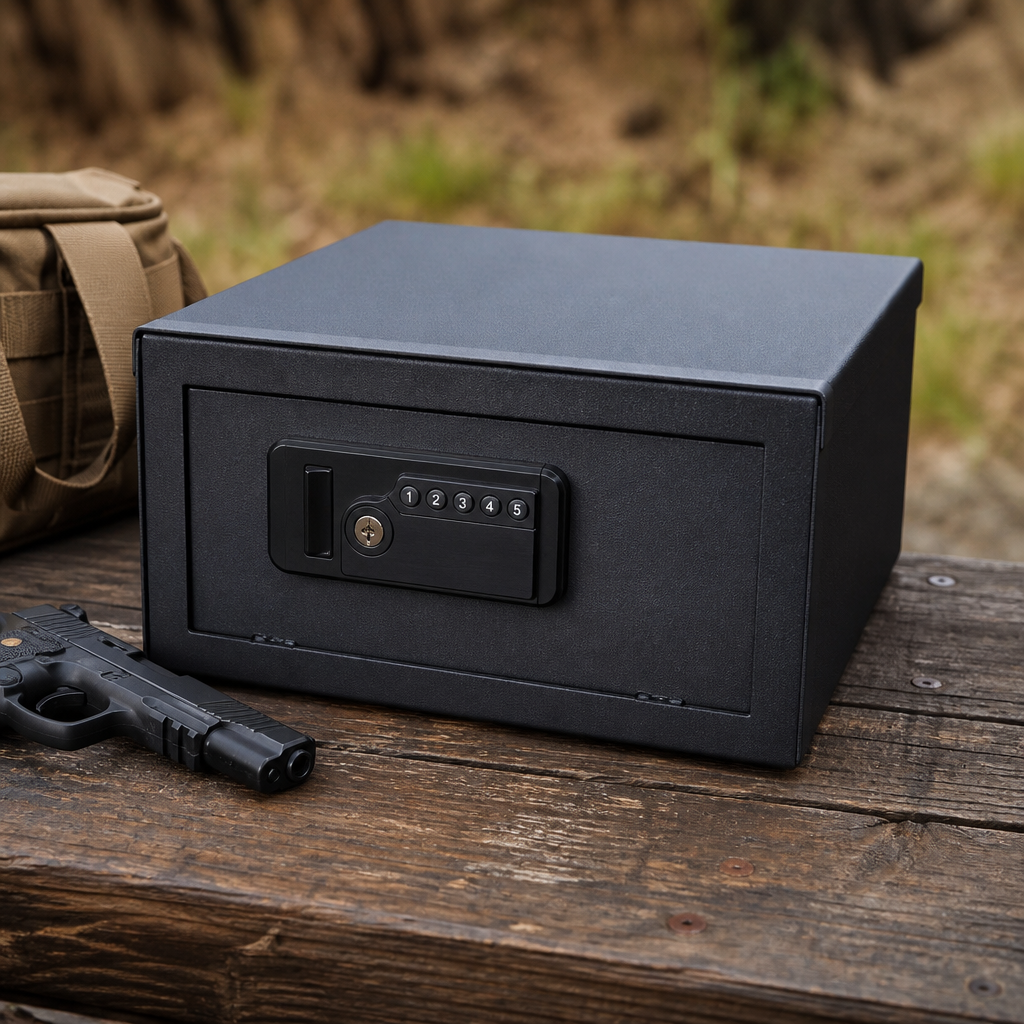
The SecureIt Tactical Fast Box Model 47 is a compact and versatile safe designed for owners who need faster access, flexible placement, and credible firearm security without dedicating space to a full-size cabinet. In the gun safes and safety category, compact fast-access storage fills a specific role: it protects a handgun, documents, valuables, or a short firearm near the point of use while supporting responsible ownership. A product review hub for this subtopic should do more than repeat specifications. It should explain what the safe is, how it works, who it suits, where it fits in a layered storage plan, and what tradeoffs buyers should expect before spending money.
In practical terms, the Model 47 belongs to the fast-access safe class. That means it prioritizes quick opening, smaller footprints, and mounting versatility over the massive steel thickness and fire lining associated with traditional full-size gun safes. I evaluate products in this category by looking at steel construction, lock reliability, interior usability, mounting strength, speed of access, tamper resistance, and day-to-day convenience. Those factors matter because the best safe is not simply the heaviest one; it is the one that people will consistently use, can access under stress, and can integrate into a broader home defense and child-safety plan. For many households, that makes a tactical fast box more relevant than a large showroom-style safe.
The importance of a review like this is straightforward. Firearm storage decisions affect safety, legal compliance, theft prevention, and emergency readiness. In many states, negligent storage can create criminal or civil liability if a child or prohibited person gains access. Beyond law, there is the basic duty to control a weapon while keeping it available to authorized users. The SecureIt Tactical Fast Box Model 47 tries to solve that tension by combining compact dimensions, a rapid opening mechanism, and the kind of modular utility that works in bedrooms, closets, vehicles, offices, or secondary living spaces. Buyers considering product reviews in this sub-pillar also want comparisons, and this article serves as a central reference point for deciding when a compact fast box is the right answer and when a larger safe, lockbox, or hidden storage solution would be better.
What the SecureIt Tactical Fast Box Model 47 Is Designed to Do
The Model 47 is best understood as a dedicated quick-access security container, not a universal replacement for a primary long-term storage safe. Its purpose is to secure a firearm or other defensive tool in a confined area where a larger safe would be impractical. That might be under a bed, on a closet shelf, inside a truck cab depending on local law and installation, or bolted to furniture in a room where access time matters. SecureIt built its reputation around practical firearm organization and rapid-access concepts, and the Model 47 follows that philosophy by emphasizing deployment speed and compact placement.
In real-world use, that design intent matters more than marketing language. A compact safe succeeds when the owner can reach it quickly in low light, open it reliably with minimal fine motor effort, and retrieve the contents without snagging. I have found that many buyers initially shop by dimensions alone, then later realize that door swing, hinge geometry, button placement, and mounting orientation can make or break the experience. A good fast-access safe should let the user establish repeatable muscle memory. That is especially important in stressful events, when people lose dexterity and simple actions outperform complex ones.
The product category also serves a broader range of owners than many assume. While handgun owners are the obvious audience, a box like this can be useful for storing a passport wallet, emergency cash, suppressor paperwork, backup medication, or a vehicle key that needs controlled access. In that sense, the Model 47 sits at the intersection of firearm safety and compact security storage, which is one reason it deserves hub-level coverage in product reviews. People shopping this segment are rarely choosing a safe in isolation; they are building a complete storage strategy for home, travel, and staged access.
Core Features, Build Quality, and Everyday Usability
When reviewing a compact safe, the first question is construction quality. Buyers should examine steel thickness, weld consistency, pry resistance around the lid or door, lock housing protection, and anchor points. A fast box will not match a heavy burglary-rated safe, but it still needs enough structural integrity to deter smash-and-grab theft and unauthorized access. SecureIt products generally appeal to buyers who want practical utility instead of decorative bulk, and that makes build execution more important than appearance. Clean fitment, dependable hinges, and solid locking engagement count more than glossy paint.
Locking method is the next key factor. In the fast-access segment, mechanical pushbutton locks, electronic keypads, and biometric readers all appear regularly. Each has tradeoffs. Mechanical systems avoid batteries and often perform better over long ownership periods. Electronic keypads can be very quick and allow easy code changes but demand battery management. Biometrics are convenient in ideal conditions yet remain vulnerable to dirty sensors, inconsistent finger placement, and failure under stress. Whatever the Model 47 configuration, the quality standard should be simple: it must open consistently on the first attempt by an authorized user and stay locked against casual tampering.
Interior layout is often overlooked, yet it shapes actual satisfaction. Compact safes can waste space through poor foam cuts, awkward depth, or doors that intrude into the opening. The better approach is a clean compartment that supports the intended firearm and accessory setup without forcing unsafe storage angles. If the box is meant for a full-size pistol with a mounted light, for example, buyers should verify fit with realistic dimensions rather than manufacturer assumptions. The same applies to spare magazines, documents, and charging cables if an electronic lock is included.
| Evaluation Area | What to Check | Why It Matters |
|---|---|---|
| Construction | Steel gauge, welds, pry gaps, hinge protection | Determines resistance to forced entry and abuse |
| Lock Access | Mechanical, electronic, or biometric consistency | Affects speed, reliability, and maintenance needs |
| Mounting | Bolt points, bracket design, orientation options | Prevents grab-and-go theft and supports flexible placement |
| Interior Fit | Firearm dimensions, optics, lights, spare magazines | Ensures the safe works with actual daily equipment |
| User Experience | Door travel, noise, low-light operation | Shapes access speed during stress or at night |
Mounting flexibility is one of the strongest reasons to consider a compact tactical safe. A box that can be bolted horizontally, vertically, or in a hidden compartment offers more real utility than one that only works on an open shelf. I recommend buyers think through the entire access path before installation: Can you kneel and reach the lock easily? Will the door clear a bed frame? Can a child see the keypad? Is the box visible to visitors or contractors? The best placement balances discretion, access speed, and structural support. Bolting into solid framing or reinforced furniture is far better than relying on sheet metal screws in particleboard.
Where the Model 47 Fits in a Complete Gun Safe Strategy
A compact safe makes the most sense as part of a layered approach. In homes I have assessed, the ideal arrangement usually involves a primary full-size safe for long guns, spare pistols, ammunition reserves, and legal documents; a secondary quick-access safe for a defensive handgun; and, where appropriate, a travel or vehicle lockbox for temporary control during transit. The SecureIt Tactical Fast Box Model 47 fits squarely into that second role. It is the bedside, closet, office, or secondary-room safe that keeps a defensive firearm both secure and realistically available.
This distinction matters because shoppers often compare products that are solving different problems. A forty-gun cabinet, a bedside handgun vault, and a truck lockbox are not direct substitutes. A large safe is better for theft resistance, inventory control, and environmental stability. A fast box is better for immediate access and discreet staging. When buyers expect a compact safe to perform like a burglary-rated room anchor, disappointment follows. Conversely, when they rely on a giant safe for emergency access, they often discover that distance and delay make it a poor fit for defensive readiness.
For households with children, guests, service workers, or shared living arrangements, the role of a quick-access safe becomes even more important. Leaving a defensive firearm unsecured because a full-size safe is too far away is a common and preventable mistake. A mounted compact safe near the bed or in a controlled room solves that problem while still keeping unauthorized hands off the gun. In apartments and smaller homes, the space savings are especially valuable. People who cannot accommodate a major safe can still dramatically improve safety with a properly installed fast-access unit.
Who Should Buy It, Who Should Skip It, and What to Compare
The best buyer for the Model 47 is someone who already understands the difference between access security and deep-storage security. If you want a compact safe for a single defensive handgun, selected valuables, or staged storage in a specific room, this format is highly practical. It also suits owners who move frequently, live in smaller spaces, or need a discreet installation that does not advertise the presence of firearms. Professionals who keep a sidearm secured in a home office and parents who want controlled nighttime access are typical examples.
Some buyers should look elsewhere. If your main concern is high-end burglary protection, broad fire protection, or storage for multiple long guns and ammunition, a compact fast box is not enough. The same is true if you need formal commercial burglary ratings or large organized capacity. In those cases, products from established safe makers in heavier classes are the correct comparison set, not a bedside tactical box. If the intended firearm has a red dot, compensator, or weapon light, you should also confirm clearance before purchase, because accessories can change fit dramatically.
When comparing alternatives, focus on lock reputation, mounting system, internal dimensions, and customer support rather than cosmetic differences. Brands such as Vaultek, Fort Knox, Hornady, V-Line, and StopBox often appear in the same shopping journey, though they occupy slightly different niches. Vaultek is known for feature-rich electronic access, V-Line for mechanical simplicity, and Fort Knox for robust construction in several handgun vault formats. SecureIt tends to attract buyers who value tactical practicality and flexible deployment. The right choice depends less on branding than on where and how the safe will actually be used every day.
One final comparison point is noise and friction under stress. In testing compact safes, I pay attention to whether the door springs open abruptly, whether foam catches on sights, and whether keypad beeps can be muted. Those details seem small in a store, but they define real-world performance at two in the morning. A good product review should surface those issues because they separate a safe that merely stores a firearm from one that supports consistent, responsible access.
Bottom Line for Product Reviews in Gun Safes and Safety
The SecureIt Tactical Fast Box Model 47 earns attention because it addresses a real storage problem that many firearm owners face: how to keep a defensive firearm secure, controlled, and quickly reachable in a limited space. Its value lies in compact dimensions, adaptable mounting potential, and the practical fast-access role it can play within a larger gun safe strategy. For the right user, that combination is more useful than buying an oversized safe that never gets installed near the point of need or, worse, leaving a firearm unsecured because no convenient storage exists.
The key takeaway is that a compact and versatile safe should be judged by purpose. If you need bedside or room-specific access, want stronger control around children or visitors, and understand that this is a secondary access safe rather than a primary collection vault, the Model 47 is the kind of product worth serious consideration. Evaluate the lock type, verify the interior fit for your actual setup, and plan the mounting location before you buy. Those steps matter more than brochure language.
As a hub article for product reviews under gun safes and safety, this page should guide the next comparison, not end it. Use the Model 47 as a benchmark for fast-access design, then compare it against other compact handgun safes, vehicle lockboxes, and full-size home safes based on your space, risk level, and access needs. Choose the safe you will install correctly and use consistently, because responsible storage is only effective when it works in real life.
Frequently Asked Questions
What is the SecureIt Tactical Fast Box Model 47 designed to do, and who is it best suited for?
The SecureIt Tactical Fast Box Model 47 is built to solve a very specific storage problem: how to keep a firearm or other important items secured, accessible, and close at hand without committing to a large traditional safe. In practical terms, it fits the needs of owners who want a compact security solution for a handgun, personal documents, valuables, or in some cases a short firearm, depending on the exact configuration and interior dimensions. Its role is not to replace a full-size gun safe for an entire collection. Instead, it fills the gap between unsecured storage and a large permanent cabinet.
This makes it especially well suited for people who prioritize faster access and flexible placement. For example, it can make sense in a bedroom, office, closet, apartment, truck setup, or other space where a full-size safe would be impractical or visually intrusive. It is also a strong option for owners who want a dedicated point-of-use storage solution rather than keeping a defensive firearm farther away in a larger safe. That “nearby but secured” function is where compact fast-access boxes tend to offer the most value.
It is also appealing to users who care about responsible ownership in tighter living environments. If you need to reduce unauthorized access by children, guests, or service workers while still keeping essential items quickly reachable, a unit like the Model 47 serves a credible purpose. The best fit is someone who understands that compact security is about balancing deterrence, access speed, and convenience. In that context, the Fast Box Model 47 is less about maximum storage volume and more about practical readiness and controlled access.
How does a compact fast-access safe like the Model 47 compare to a traditional full-size gun safe?
The biggest difference is function. A full-size gun safe is generally meant for long-term storage, larger collections, and broader protection priorities such as heavier steel, higher capacity, and in many cases more robust resistance to theft or fire. A compact fast-access safe like the SecureIt Tactical Fast Box Model 47 is optimized for immediate usability. It is intended to secure a smaller number of items near where they may actually be needed, rather than storing everything in one large centralized unit.
That difference affects nearly every buying consideration. A full-size safe usually demands dedicated floor space, careful installation planning, and a willingness to trade speed for capacity. The Model 47, by contrast, is attractive because it can be placed in tighter locations and integrated into everyday life more easily. For many owners, that means it is more likely to be used consistently, which is an important but often overlooked part of safe ownership. A security product only helps if it matches the habits and layout of the home or vehicle.
It is also important to compare them realistically in terms of protection expectations. A compact box can provide meaningful firearm security, controlled access, and a deterrent against casual tampering or opportunistic theft, especially when properly mounted. However, it generally should not be viewed as equivalent to a heavy, anchored, full-size safe designed to resist more determined attacks for longer periods. These products serve different roles. Many experienced owners use both: a larger safe for main storage and a compact fast-access unit like the Model 47 for one defensive firearm or critical valuables within reach. That layered approach is often the most practical and responsible strategy.
What kinds of items can the SecureIt Tactical Fast Box Model 47 realistically store?
The most obvious use case is a handgun, but the value of the Model 47 goes beyond that. Compact tactical lock boxes are often chosen because they can secure the items people need available but protected: a carry pistol when off-body, spare magazines, passports, cash, legal paperwork, identification, backup electronics, jewelry, and other small valuables. Depending on the exact dimensions and internal layout, some owners may also use it for a short firearm or braced platform if the fit is appropriate, but that should always be verified against the manufacturer’s specifications rather than assumed from product photos alone.
What matters most is using the interior space intentionally. A compact safe performs best when it is not overloaded. If you pack too many items inside, access becomes slower, organization suffers, and the primary benefit of a fast box can be undermined. For defensive storage, keeping the contents simple and repeatable is usually the better approach. Many owners choose a dedicated setup: firearm, spare magazine, flashlight, and perhaps one or two key documents. Others reserve it strictly for valuables and paperwork in a room where they do not want a larger safe.
Another consideration is whether the contents need protective organization. Foam inserts, padded sleeves, or document organizers can improve both security and usability, especially if the safe is mounted vertically or in a vehicle-oriented environment where movement matters. The Model 47 is most useful when the owner treats it as purpose-built storage rather than a catch-all box. If the goal is to keep one important category of items secured and easy to retrieve, it is likely to perform well. If the goal is to store numerous firearms or a large assortment of gear, a larger safe or cabinet will be the better fit.
Where can the Model 47 be installed or placed, and what should owners consider before setting it up?
One of the strongest advantages of the SecureIt Tactical Fast Box Model 47 is flexible placement. Compact safes like this are often chosen specifically because they can fit where larger units cannot: beside a bed, in a closet, inside an office, under furniture, in a utility room, or in certain vehicle or travel-related applications if the product and local laws support that use. That flexibility is a major reason why compact fast-access storage has become an important subcategory within firearm safety. It allows owners to position secure storage closer to the point of use rather than relying on a single distant safe.
Before installing it, owners should think through access path, concealment, and anchoring. The best placement is usually one that allows a consistent, unobstructed reach while keeping the unit out of obvious sight. You want a location that is natural for you in an emergency but not casually visible to visitors. Just as important, compact safes gain a great deal of real-world security when mounted correctly. An unattached lock box can still limit unauthorized handling, but fastening it to a stable structure significantly improves theft resistance and makes smash-and-grab removal much harder.
You should also consider environmental factors. Moisture, temperature swings, dust, and vibration may affect both contents and hardware over time, especially in garages, basements, or vehicles. For firearms, rust prevention and regular inspections remain important even in a secured container. Finally, setup should include a full access test under realistic conditions: lighting, body position, dominant hand use, and any obstacles nearby. A compact safe is only as good as its placement. If it is hidden so well that access becomes awkward, or installed loosely enough that it can be removed, you lose much of the product’s practical advantage.
Is the SecureIt Tactical Fast Box Model 47 a good choice for responsible firearm storage at home?
Yes, for the right use case it can be a very good choice. Responsible firearm storage is not just about buying the biggest or heaviest safe available. It is about matching storage methods to how firearms are actually used, where they need to be secured, and who may have access to the environment. In that framework, the Model 47 can be a smart option for owners who need a compact, credible, and more accessible storage solution for a single defensive firearm or a small group of high-priority items.
Its strength lies in helping owners avoid two common problems: leaving a firearm unsecured because a large safe is too far away, or relying on improvised storage that does not meaningfully restrict access. A compact fast-access safe supports better day-to-day habits by making secure storage convenient enough to use consistently. That matters in households with children, frequent visitors, shared living spaces, or any setting where unauthorized access is a real concern. Convenience and safety are often treated like opposites, but a well-designed compact safe helps bring them together.
That said, it should be viewed as part of a broader safety plan, not the entire plan by itself. Owners should still follow all applicable laws, train regularly, maintain secure access credentials, inspect mounting hardware, and think carefully about ammunition, staging, and household risk factors. If you own multiple firearms, the best long-term approach may be using the Model 47 alongside a larger safe for bulk storage. In that role, it becomes highly practical: a dedicated fast-access unit for immediate needs, supported by more substantial storage elsewhere. For many people, that is the most balanced and realistic definition of responsible ownership.