
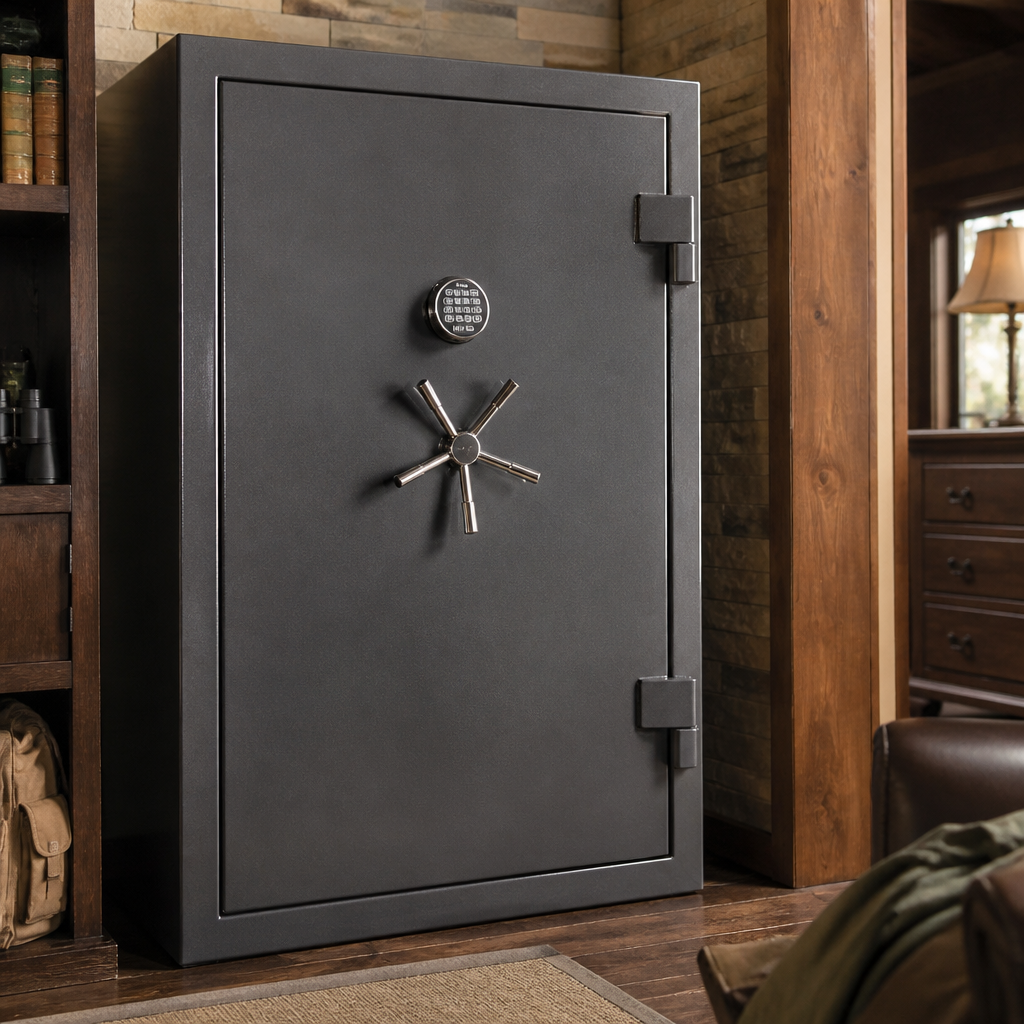
The AMSEC RF6528 High-Security Gun Safe earns attention because it is not simply a residential gun container with upgraded marketing language; it is a true high-security safe built on commercial vault principles and adapted for firearm storage. In practical terms, that means thicker steel, a concrete-based barrier material, more sophisticated boltwork, and burglary protection that goes well beyond the thin sheet-metal cabinets many buyers first encounter. For owners comparing premium options in the gun safes and safety category, this model sits in the rare space where security engineering, fire resistance, and daily usability overlap in a meaningful way.
When I evaluate a gun safe at this level, I start by separating three terms that are often blurred together: gun cabinet, residential security container, and high-security safe. A gun cabinet mainly organizes firearms and keeps out casual access. A residential security container, often tested to UL RSC standards, offers a baseline delay against simple attack tools. A high-security gun safe such as the AMSEC RF6528 is designed to resist more determined burglary attempts through heavy plate construction, reinforced barriers, protected locks, and complex locking systems. That distinction matters because the threats are different. Preventing a child from opening a cabinet is one challenge; slowing a prepared intruder with pry bars, grinders, punches, and time is another.
The RF6528 matters as a product review hub topic because many buyers reach the point where entry-level safes no longer make sense. They may own several long guns, optics, suppressors, handguns, documents, jewelry, or irreplaceable heirlooms. They may also understand that thieves commonly target the lock side, door gaps, hinges, and anchor points first. In those situations, raw weight alone is not enough. Build method, steel thickness, barrier composition, relocker design, and installation planning determine whether a safe performs like a vault or fails like a box. The AMSEC RF6528 deserves close review because it addresses those real-world attack paths with design choices borrowed from commercial burglary safes rather than decorative big-box-store products.
As the hub for product reviews under gun safes and safety, this article also helps frame what “good” looks like at the top end of the market. Buyers researching this model usually ask direct questions: What makes it different from standard gun safes? Is the extra cost justified? How much security does the body construction really add? What should you verify before purchase, delivery, and installation? Those are the right questions. The value of the RF6528 is not measured by branding alone; it is measured by how effectively it raises the time, noise, skill, and tool requirements for forced entry while still functioning as a practical firearm storage system inside a home.
What the AMSEC RF6528 Is and Who It Is For
The RF6528 is part of American Security’s high-security safe lineup and is often discussed alongside burglary safes rather than ordinary gun safes. Its format is tailored for long-gun storage, yet its engineering reflects AMSEC’s commercial safe heritage. In plain terms, this model is for owners who want a firearm safe that behaves more like a jewelers’ or pharmacy safe than a decorative cabinet. That includes collectors, competitive shooters, hunters with premium optics, homeowners in higher-risk areas, and anyone storing both firearms and valuables in one place.
In my experience, this category especially fits buyers who have outgrown the assumptions of mid-market products. They have usually learned that published “gun counts” are optimistic, external dimensions do not tell the full story, and thick-looking doors can hide comparatively light bodies. They want specifics: actual steel, actual barrier material, actual lock protection, and a layout that remains usable after rifles, cases, magazines, and accessories are added. The RF6528 enters that conversation because it is engineered first for resistance, then adapted for capacity and organization.
The safe is also relevant for mixed-use storage. Many owners use a premium gun safe to protect passports, cash, watches, family documents, and data backups in addition to firearms. That is sensible, but only if the safe’s burglary rating, fire design, and interior planning support those needs. A high-security model like this is often a stronger all-around household protection investment than buying one lighter gun safe and one small document safe that each compromise in different ways.
Construction Details That Make It “Built Like a Vault”
The phrase “built like a vault” is overused in the safe industry, but the RF6528 comes closer to earning it than most. The key reason is composite construction. Instead of relying only on folded sheet steel, high-security safes use layered body and door designs that combine heavy steel with proprietary barrier material. AMSEC is known for using dry-light or concrete-like composite fills in certain burglary safes to defeat cutting, drilling, and torch attacks more effectively than hollow-wall construction. The result is a body that behaves very differently under attack than a conventional gun safe shell.
The door is central to the security story. Attackers usually focus there because the lock, boltwork, and possible prying points are all concentrated in one assembly. A serious high-security door will include substantial plate steel, hardplate to protect the lock and spindle area, relockers that trigger during tampering, and a multi-directional bolt system engaging the frame. Those features matter because many real burglaries are opportunistic but not unsophisticated. A thief may not be a professional safecracker, yet may still use grinders, carbide bits, wedges, long pry bars, and leverage. Every reinforced layer extends delay time and increases the chance that the attempt is abandoned or interrupted.
The body deserves equal attention. In lower-tier gun safes, the body can be the weak point even when the door appears robust. Sidewall attacks, top cuts, and peeling methods exploit that imbalance. Composite body construction changes the equation by making penetration slower, hotter, louder, and far more tool-intensive. This is why experienced safe buyers ask about body architecture, not just door thickness or glossy paint. With a model like the RF6528, the body itself is part of the defensive system, not merely a shell holding the lock and shelves.
| Feature | Why It Matters | Practical Benefit |
|---|---|---|
| Composite body construction | Resists cutting and sidewall attacks better than hollow steel walls | Raises burglary delay against grinders, pry attacks, and drilling |
| Reinforced door assembly | Protects the most frequently attacked entry point | Improves resistance to prying and direct lock assault |
| Hardplate and relockers | Defends lock area from punch and drill attacks | Can keep the safe secured even after tampering |
| Substantial weight | Makes removal harder and supports denser barrier materials | Reduces smash-and-grab risk when properly anchored |
Security Performance, Locking Systems, and Real-World Threats
The most useful way to assess the RF6528 is to match its design to credible threats. For residential owners, the main burglary scenarios include hurried pry attacks, targeted theft by someone who knows guns are present, and attempts to remove the entire safe for off-site opening. The RF6528 addresses all three better than mainstream gun safes. Its door-to-frame relationship, heavy boltwork, and hardened lock area help against immediate door attacks. Its mass and construction complicate removal. Its high-security architecture makes successful opening with handheld tools much less likely within the time window most thieves have.
Lock choice also matters. Buyers typically choose between a mechanical dial and a high-quality electronic lock, often from respected manufacturers such as Sargent and Greenleaf or La Gard. I have installed and serviced enough safes to say there is no universal winner. Mechanical locks are proven, battery-free, and long-lived, but slower to operate. Electronic locks offer speed, audit-friendly convenience in some cases, and easier code changes, but require battery management and benefit from periodic function checks. On a safe of this level, the more important point is not digital versus dial alone; it is whether the lock is paired with proper hardplate, relockers, precise installation, and a door design that does not depend on the lock as the sole defense.
Another issue often missed in product reviews is anchoring. Even a very heavy safe can become vulnerable if left freestanding on a smooth floor with enough clearance for leverage equipment. Proper anchoring into a concrete slab changes the attack math. It limits tipping, reduces access to underside attack points, and makes removal dramatically harder. For second-story or framed-floor installations, load calculations and reinforcement may be necessary. A high-security safe should be treated as part of a complete physical security plan, not as a standalone magic object.
Fire Protection, Interior Layout, and Daily Usability
Fire ratings in the gun safe market can be confusing because manufacturers do not always test by the same standards. A premium buyer should ask how the fire claim was developed, what temperature and duration are stated, and whether seals and insulation are integrated without compromising burglary resistance. AMSEC’s better safes generally pair substantial door seals with engineered insulation or composite materials that contribute to thermal performance. That does not make any safe indestructible in a severe structural fire, but it does provide a stronger margin for documents, many household valuables, and firearms exposed to typical residential fire conditions.
Interior design is another area where the RF6528 must be judged honestly. High-security safes often trade some interior volume for thicker walls and doors. That is not a flaw; it is the cost of meaningful protection. Buyers moving from a lighter 60-gun-rated safe may be surprised that real usable capacity feels lower in a denser model. In practice, scoped rifles, pistol grips, slings, bipods, and soft cases consume space quickly. A realistic plan is to buy more room than your current collection requires and to use modular shelving, barrel supports, and door organizers carefully so that access remains efficient.
Daily usability matters because a safe that is frustrating to access tends to be used poorly. Interior lighting, dehumidification, outlet placement, shelf adjustability, and door swing clearance all affect owner behavior. I recommend treating this as a workflow question: how often do you access firearms, do you store documents in dedicated bins, is humidity control needed for your region, and can the door open fully without striking walls or furniture? The RF6528 is strongest when its premium security is matched by equally deliberate installation and interior setup.
How the RF6528 Compares With Typical Premium Gun Safes
Compared with many premium-looking residential gun safes, the RF6528 stands apart in philosophy. A typical premium gun safe may offer attractive paint, plush interiors, numerous locking bolts, and respectable fire claims, yet still rely on body steel and door designs that are fundamentally optimized for cost and showroom appeal. The RF6528 prioritizes burglary resistance first. That usually means less emphasis on oversized capacity claims and more emphasis on barrier construction, lock protection, and structural integrity. For the buyer who asks, “What happens when someone actually attacks this safe?” that distinction is everything.
There are tradeoffs. High-security safes cost more, weigh more, reduce net interior space, and complicate delivery. They may also look more industrial than some luxury gun safes. Those tradeoffs are justified when the contents and threat profile support them. If you store a few hunting rifles in a low-risk setting, a well-installed RSC may be sufficient. If you store a six-figure collection, transferable machine guns where legal, rare shotguns, premium night optics, or family wealth items, the RF6528 becomes easier to justify. Good product reviews should say that plainly rather than pretending one safe is right for everyone.
For a sub-pillar hub on product reviews, that broader lesson is important: compare safes by construction class, not by advertising category. Ask for steel details, barrier details, lock make, relocker count, boltwork design, fire methodology, and installation requirements. Those questions lead buyers toward models like the AMSEC RF6528 when genuine high security is needed, and away from false equivalencies when it is not.
Buying, Delivery, and Installation Considerations
Before ordering an RF6528, measure everything: doorway widths, stair geometry, hallway turns, elevator limits, floor load paths, and final placement clearances. A safe built like a vault also moves like one. Professional delivery with safe-specific equipment is not optional at this level. Reputable dealers will discuss slab condition, anchoring hardware, shim requirements, humidity control, and whether the chosen room creates concealment without increasing fire or flood exposure. Garages can work, but moisture, visibility during open-door periods, and slab slope all need attention.
Placement strategy should balance concealment, structural support, and access. A corner location can reduce pry opportunities on side surfaces, while a closet or hardened room can add another layer of delay. Keep in mind that a safe visible to guests, contractors, or social media audiences is a security leak. Also plan for maintenance: test the lock, replace electronic batteries on schedule, inspect anchor integrity, and review contents annually. Premium protection is not just what you buy; it is what you install correctly and manage consistently.
The AMSEC RF6528 High-Security Gun Safe deserves its reputation because it approaches firearm storage from the standpoint of real burglary resistance, not showroom exaggeration. Its composite construction, reinforced door, protected lock area, and vault-inspired design make it a serious option for owners who need more than a standard gun safe can deliver. Just as important, it illustrates how informed buyers should evaluate all product reviews in the gun safes and safety space: by construction quality, attack resistance, fire performance, and installation practicality rather than by cosmetic features or inflated capacity claims alone.
For many households, the best takeaway is simple. Buy according to threat level, contents value, and long-term needs. If your collection and valuables justify a true high-security platform, the RF6528 is the kind of safe that can anchor an entire protection strategy for years. If you are comparing models across this subtopic, use this review as your benchmark for what top-tier engineering looks like, then follow through with professional delivery, proper anchoring, and disciplined setup. That is how a gun safe stops being a box and starts performing like a vault. Explore the related product reviews in this hub and build your shortlist with those standards in mind.
Frequently Asked Questions
What makes the AMSEC RF6528 different from a typical gun safe?
The biggest difference is that the AMSEC RF6528 is engineered more like a commercial burglary safe than a standard residential gun container. Many gun safes on the market rely primarily on thinner sheet steel, basic door construction, and branding that emphasizes capacity or cosmetic features. The RF6528 takes a very different approach. It uses substantially heavier steel, a composite body design that incorporates a concrete-based barrier material, and a much more advanced locking and boltwork system. That construction is intended to resist serious physical attack, not just casual tampering.
In practical terms, buyers are getting a safe designed around true security performance. The door and body are built to slow down pry attacks, cutting attempts, drilling, and concentrated force in ways that ordinary cabinets and lighter safes often cannot. That matters for firearm owners who are storing not only rifles and handguns, but also optics, suppressors where legal, important documents, cash, and other valuables that make the safe a high-priority target.
Another key distinction is philosophy. The RF6528 is not trying to be the lightest, cheapest, or most spacious box for the money. It is built for owners who want vault-style protection first and storage second. If someone’s main goal is simply locking firearms away from children or guests, many lower-cost products can technically do that. But if the goal is serious burglary resistance with firearm storage capability, the RF6528 stands in a different class.
How does the RF6528’s composite construction improve burglary protection?
The composite construction is one of the defining security advantages of the AMSEC RF6528. Instead of depending only on a steel shell, the safe uses a layered design that combines steel with a dense concrete-based barrier material. That filler is important because it changes the way the safe responds to attack. Thin-walled metal enclosures can sometimes be defeated relatively quickly with aggressive tools, especially if a thief has time and privacy. A composite body is much harder to cut through, breach cleanly, or peel apart because attackers are dealing with multiple materials that behave differently under force.
This type of barrier also helps absorb and disperse energy from prying, chiseling, drilling, and other concentrated attack methods. The result is not just “more material,” but a structure designed to resist penetration in a more sophisticated way. Commercial high-security safes often use this kind of design because it forces criminals to spend more time, create more noise, and use more specialized tools. All of those factors improve the odds that the attack will be abandoned or interrupted.
For gun owners, this matters because a safe is rarely protecting firearms alone. Premium rifles, collectible handguns, night vision, magazines, hard-to-replace paperwork, and family heirlooms all increase the stakes. A composite safe like the RF6528 offers a level of resistance that better matches the value of what is stored inside. It is the difference between a container that looks substantial and one that is genuinely built to withstand determined forced entry attempts.
Is the AMSEC RF6528 a good choice for storing more than just firearms?
Yes, and that is one of the strongest arguments in its favor. Although the RF6528 is configured for firearm storage, its true strength is that it functions as a high-security safe first. That means it is well suited for protecting documents, jewelry, cash, precious metals, backup drives, legal records, passports, family archives, and other valuables that benefit from serious burglary protection. For many buyers, this is important because firearms are only part of what they need to secure.
In many homes, the gun safe quickly becomes the central security hub for all irreplaceable items. Once that happens, the quality of the burglary protection matters even more. A lighter residential safe might be acceptable when holding a few basic hunting rifles, but it can become an obvious weak point once expensive optics, tax records, estate paperwork, and emergency cash are added. The RF6528 is much better aligned with that broader use case because it was built with commercial-grade security principles in mind.
It is also a practical option for owners who want one serious safe rather than separate units for different categories of valuables. Instead of maintaining a gun cabinet plus a document safe plus a jewelry safe, the RF6528 allows users to consolidate under one highly secure enclosure. As long as the interior layout is planned intelligently, it can serve as a premium all-purpose security solution with firearm storage as a major, but not exclusive, role.
Who should consider the AMSEC RF6528, and is it worth the premium price?
The RF6528 is best suited for buyers who already understand that there is a major difference between a basic gun safe and a true high-security safe. It makes sense for firearm owners with valuable collections, owners in areas where burglary risk is a concern, collectors storing rare or customized firearms, and households using the safe for a wide mix of valuables beyond guns. It is also a strong fit for buyers who simply do not want to compromise on construction quality when the consequences of theft are high.
Whether it is worth the premium depends on what the buyer is comparing it to. If the alternative is an entry-level cabinet or a lighter residential gun safe, the RF6528 will likely seem expensive. But the more accurate comparison is to other high-security composite safes and commercial-grade burglary safes adapted for residential use. In that context, the price reflects a very different level of engineering, materials, and protection. You are paying for real structural resistance, not decorative door thickness, marketing language, or interior accessories.
For many serious buyers, the value becomes clearer over time. Firearms and optics are expensive to replace, and some items cannot truly be replaced at all. Add the cost of identity recovery, document loss, insurance complications, and sentimental items, and the premium for better protection starts to look reasonable. In short, the RF6528 is not the right safe for every budget, but for the buyer who wants vault-like security for firearms and valuables, it can absolutely justify its price.
What should buyers think about before installing an AMSEC RF6528 in their home?
Before purchase, buyers should think carefully about weight, floor support, delivery access, placement strategy, and how the safe will be used day to day. The RF6528 is a serious high-security safe, and with that comes substantial mass. This is a benefit from a security standpoint, but it also means installation is not a casual DIY project in most cases. Hallways, doorways, stair access, slab versus raised-floor construction, and room layout should all be reviewed in advance. Professional delivery and placement are strongly recommended.
Location matters as well. A good placement balances access and discretion. Owners generally want the safe in a spot that is not obvious to visitors, has a structurally appropriate floor, and allows the door to open fully for easy access to long guns and shelves. Climate considerations can also be important depending on the region and what is being stored. Firearms, paper records, and electronics may all benefit from humidity management and thoughtful interior organization.
Buyers should also plan for how they will use the safe over the long term. If the RF6528 will store both firearms and general valuables, interior layout becomes especially important. The most secure safe is still more useful when it is organized in a way that supports quick access, inventory control, and safe handling. In other words, installation is not just about getting the safe inside the house. It is about integrating a commercial-grade security product into a residential environment in a way that maximizes both protection and usability.