
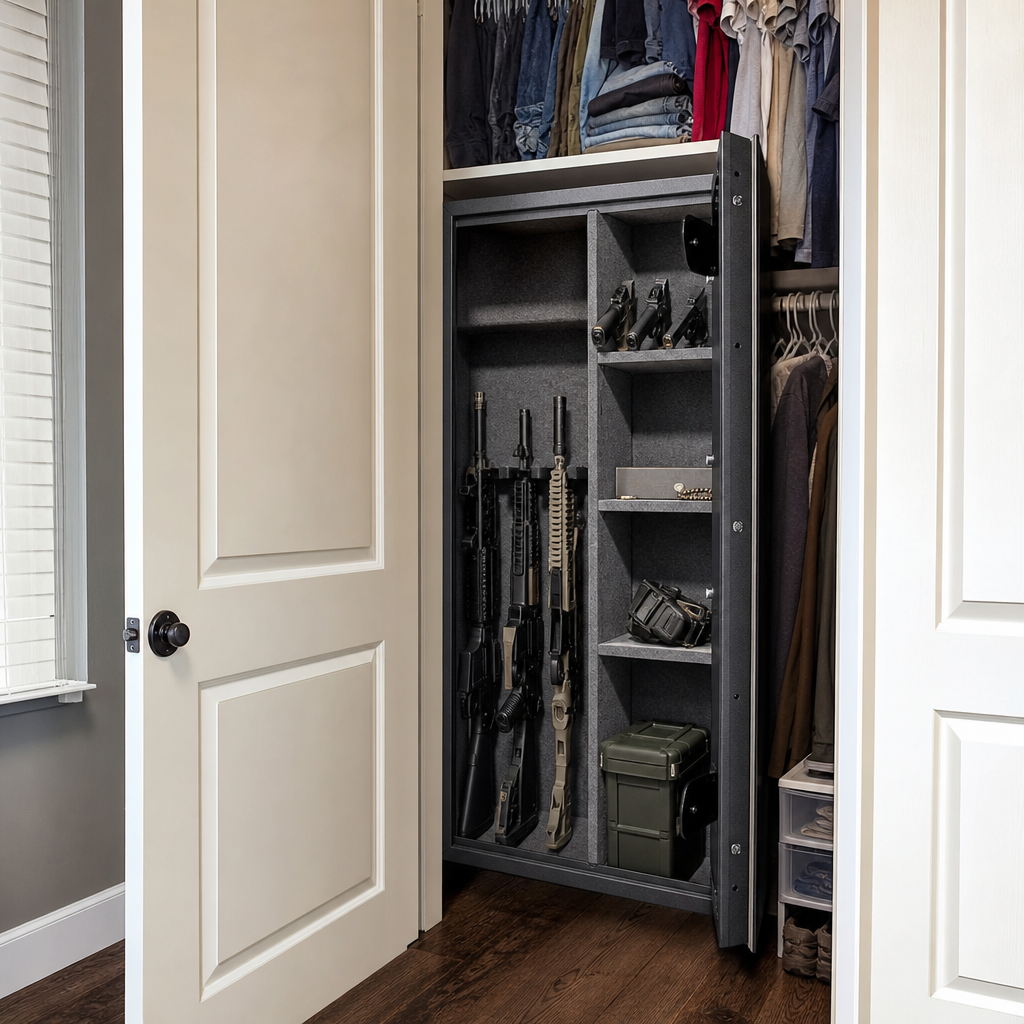
A concealed gun safe inside a closet gives firearm owners a practical way to secure weapons, limit unauthorized access, and preserve discretion in everyday living spaces. In plain terms, concealed gun storage means the safe is not immediately visible to guests, contractors, children, or opportunistic thieves, while still remaining accessible to the owner when needed. A closet is one of the best places to create that balance because it already offers enclosure, visual cover, and structural surfaces that can support anchored storage.
I have worked with homeowners who wanted more than a basic steel box pushed against a wall. They needed hidden and discreet gun storage solutions that fit real houses: reach-in bedroom closets, walk-ins with built-in shelving, hallway linen closets, and underused coat closets near entry doors. In those projects, the challenge was never just where to place a safe. The real job was combining access speed, code awareness, structural anchoring, humidity control, and concealment without creating a setup that is awkward to use or easy to defeat.
This matters because firearm theft and unauthorized access usually exploit visibility, weak installation, or routine. A visible safe can attract attention, especially during moves, renovations, or social visits. An unanchored safe can be removed entirely. A poorly planned hidden compartment may look clever but fail under stress when the owner needs quick access. The best concealed gun safe inside a closet is not a novelty feature. It is a layered security system built around a specific threat model, the household layout, and the types of firearms being stored.
For this hub on hidden and discreet gun storage solutions, the core concepts are straightforward. Concealment reduces discovery. Security resists forced entry and removal. Access control limits who can open the safe. Environmental management prevents rust, stock damage, and optic degradation. Closet integration means designing around framing, flooring, shelves, doors, lighting, and daily use patterns. When those elements work together, a closet safe becomes far more effective than a standalone purchase installed as an afterthought.
Start with threat assessment, legal requirements, and firearm inventory
Before choosing a hidden closet safe design, define what you are protecting against. In my experience, homeowners often say they want a hidden gun safe, but they mean different things. Some want to prevent children from discovering firearms. Others want burglary resistance during daytime break-ins. Some need discreet long-gun storage in a suburban home where service workers regularly enter. The build changes depending on that priority. A fast-access pistol safe behind hanging clothes serves a different purpose than a reinforced wall cavity safe for rifles and suppressors.
State and local laws also matter. Some jurisdictions impose safe storage standards when minors are present, and many gun owners rightly follow stricter practices than the legal minimum. If you use NFA-regulated items, your storage decisions should reflect the value, replacement complexity, and documentation sensitivity of those assets. At a minimum, plan for controlled access, serial number records stored separately, and a structure that cannot be easily carried away. Insurance may also require specific burglary ratings or proof of anchoring for higher-value collections.
Inventory determines dimensions and internal layout. Measure every firearm with optics, slings, magazines, and cases removed, then measure again with the accessories you actually keep attached. Closet builds fail when owners underestimate scope height, pistol grip depth, or the swing arc of a door inside tight shelving. Count ammunition separately, because storing large quantities in the same enclosure may reduce usable space and complicate organization. Document your total load, too. A safe, false wall, shelving system, ammo, and firearms can create significant weight on wood subfloors.
Choose the right closet and the right type of concealed safe
The best closet is usually one that combines privacy, structural support, and predictable access. A primary bedroom closet is common because it is low traffic and near the owner at night. A coat closet near an entry can support defensive access, but only if children and visitors do not routinely use it. Walk-in closets offer the most flexibility for hidden wall safes, floor safes under built-ins, or full-height cabinet concealment. Reach-in closets can still work well, especially for compact rifle safes hidden behind sliding panels or hanging garments.
There are four main concealed gun storage approaches inside a closet. First, a freestanding safe hidden by shelving, cabinetry, or hanging clothes. Second, an in-wall safe recessed between studs and covered by a mirror, panel, or shallow built-in. Third, a modular cabinet integrated into custom closet millwork, creating the appearance of ordinary storage. Fourth, a false-back or false-side compartment that hides a smaller safe or lockbox behind an innocuous surface. The best option depends on firearm size, framing conditions, and whether you own or rent the property.
Freestanding safes are often the most secure and practical because many models have tested steel bodies, hard plates, relockers, pry-resistant doors, and predrilled anchor holes. Brands like Fort Knox, Liberty, American Security, Vaultek, SecureIt, and SnapSafe offer products across different use cases, though feature sets vary widely. A concealed installation does not eliminate the need for robust steel and solid locking hardware. Concealment is only one layer. If discovered, the safe must still resist prying, drilling, and rapid removal long enough to defeat a typical smash-and-grab burglary.
| Option | Best Use | Main Advantage | Main Limitation |
|---|---|---|---|
| Freestanding safe behind closet finish | Mixed handgun and long-gun storage | Highest overall security potential | Requires space and floor capacity |
| In-wall safe between studs | Handguns, documents, valuables | Excellent concealment depth | Limited size due to framing |
| Built-in cabinet safe | Closet remodels and custom millwork | Blends cleanly with storage system | Higher cost and more planning |
| False panel with lockbox behind | Budget discreet storage | Low visual profile | Usually lower burglary resistance |
Plan the structure: framing, anchoring, flooring, and access clearances
A concealed gun safe inside a closet is only as strong as the structure supporting it. Start by locating studs, checking wall depth, and identifying electrical lines, plumbing, HVAC runs, and low-voltage wiring. In newer homes, closet walls often hide more utilities than owners expect. I always verify with a stud finder that detects live wires, then confirm by opening a small inspection area if a recessed installation is planned. Cutting a wall for an in-wall safe without inspection is a preventable mistake.
Anchoring is nonnegotiable. The standard approach is bolting the safe to both wall framing and the floor when the manufacturer permits it. For wood subfloors, use lag bolts into joists or install backing plates from below when accessible. For slab foundations, use concrete wedge anchors or epoxy-set anchors sized to the safe’s mounting holes and the slab condition. If the closet has plush carpet and padding, remove enough material beneath the safe to create a stable bearing surface. Soft flooring can shift under load and weaken the anchor connection over time.
Clearances deserve more attention than most buyers give them. Measure not only the footprint but also door swing, handle projection, dehumidifier routing, interior shelf pullout, and your body position while opening the safe. In a narrow closet, a safe door may block the room before it reaches a usable angle. That matters if you plan to retrieve a rifle with an optic attached. If you are integrating a hidden panel, leave enough room for the panel to open without catching on baseboards, clothing rods, shoe shelves, or bi-fold closet doors.
Weight distribution is another practical issue. A medium gun safe can exceed 500 pounds before contents; larger units can reach 1,000 pounds or more. Most modern floors can support that load if placed near bearing walls and distributed correctly, but assumptions are risky. For heavy safes on upper stories, consult a qualified contractor or structural engineer. Reinforcing from below may be simple and inexpensive during a remodel, and it is far easier than repairing sagging floors after installation.
Build concealment that looks ordinary, not theatrical
The most effective hidden and discreet gun storage solutions do not advertise themselves through gimmicks. A bookshelf that is obviously shallower than the wall behind it, a mirror with oversized trim concealing hinges, or a panel that scrapes the floor each time it moves will draw attention. Good concealment follows the visual language of the closet. If the closet has white melamine shelving, match that material. If the space uses painted MDF built-ins, continue the same reveals, hardware, and base treatment. Ordinary is safer than dramatic.
In practice, three concealment methods work especially well. The first is a fixed-looking shelving face that opens on concealed hinges with a magnetic catch or hidden mechanical latch. The second is a removable rear panel within a deep shelf tower, useful when quick access is less important than invisibility. The third is hanging-clothes concealment, where the safe sits behind garments but is still anchored and unobstructed enough for practical access. This last approach is simple, but it must not interfere with biometric scanners, keypad visibility, or the ability to open the door fully.
Hardware selection matters. Use quality concealed hinges rated for the panel weight, soft-close mechanisms to reduce noise, and positive stops so the face aligns the same way every time. Avoid weak magnetic child latches for anything carrying significant weight. If you want a hidden release, commercial touch latches, RFID cabinet locks, or rare-earth magnet actuators can work, but they should only hide the compartment, not serve as the firearm lock itself. The actual safe still needs a proper lock, ideally UL-listed where applicable, with a reliable keypad or mechanical lock body.
Lighting can either preserve concealment or ruin it. Interior LED strips triggered by motion are convenient, but they should illuminate only when the closet door is open, not glow through panel gaps. If you add power inside the enclosure area, route wiring cleanly and protect it from abrasion. Battery lighting avoids line-voltage work but requires maintenance. Any visible irregularity, from a bright seam to a mismatched hinge finish, increases the chance that a visitor notices the build.
Prioritize lock speed, reliability, and environmental protection
The locking system should fit how the safe will actually be used. For defensive handguns, I usually recommend a reputable electronic keypad or biometric-plus-keypad design from a manufacturer with a good record on false rejects, battery monitoring, and manual override procedures. Biometrics can be fast, but they are not magical. Dirty sensors, dry skin, or poor enrollment can cause failures. For larger long-gun safes, a commercial-grade electronic lock or a trusted mechanical dial remains a strong choice, especially if opening speed is secondary to long-term reliability.
Environmental protection is essential in closet gun storage because closets can trap humidity, especially on exterior walls or in humid climates. Use a hygrometer so you know the actual conditions, not just what the room feels like. For most firearm storage, keeping relative humidity around 45 to 50 percent is a practical target. Electric dehumidifier rods, rechargeable desiccant packs, and sealed door gaskets all help, but each has limits. Desiccants require regular recharging, and rods work best in reasonably sealed spaces with power access.
Interior organization also affects safe performance. Door organizers, barrel rests, pistol racks, and labeled bins reduce handling and shorten retrieval time. I encourage owners to separate defensive firearms from range gear and to avoid stacking soft cases that trap moisture. Store important documents, suppressor paperwork copies, and spare optics batteries in clearly assigned compartments. If the safe contains both firearms and valuables, maintain an inventory with photos and serial numbers stored securely off-site or in encrypted digital storage.
No concealed build is complete without testing. Open the closet, access the hidden panel, unlock the safe, and retrieve an unloaded training substitute under timed conditions. Repeat in daylight and darkness. Repeat when tired. Repeat while wearing the clothing you normally wear at home. Most design flaws show up during these drills: a shelf edge blocks your wrist, the keypad is hidden by hanging coats, the panel opens into a laundry basket, or the rifle catches on a hanger. Fixing those details is what turns a clever idea into secure daily-use storage.
Common mistakes, hub topics, and how to decide your next step
The most common mistakes I see are predictable. Owners choose concealment before choosing security. They buy a thin cabinet and assume hiding it makes it safe. They install a quality safe but never anchor it. They create a secret compartment that is too slow to access, then stop using it consistently. They ignore humidity until rust appears on screws, magazine springs, or optic mounts. They also overlook family routines. A closet used by children, guests, or cleaners is a poor candidate unless the hidden system is exceptionally well integrated and access is tightly controlled.
As a hub for hidden and discreet gun storage solutions, this topic branches into several specialized directions. You may next need guidance on in-wall gun safe installation, false-back closet compartments, fast-access handgun safes for bedroom closets, humidity control for gun safes, anchoring methods for concrete versus wood floors, or how to hide a safe inside custom cabinetry without violating manufacturer clearance requirements. Each of those subtopics deserves its own detailed treatment because the tradeoffs are different. A rental apartment solution is not the same as a full custom walk-in closet build in a permanent residence.
The key takeaway is simple: the best concealed gun safe inside a closet combines strong steel, proper anchoring, believable concealment, reliable locking hardware, and environmental control. If any one of those layers is missing, the system becomes easier to find, easier to steal, harder to use, or more likely to damage the firearms it is meant to protect. Start with your risk profile and firearm inventory, choose the closet carefully, and design for normal daily use rather than novelty.
If you are planning a build, measure the closet, map the framing, list your firearms and accessories, and decide whether your priority is defensive access, theft resistance, or deep concealment. Then choose a safe and concealment approach that serves that priority without compromise. Done correctly, a closet installation can deliver discreet storage that is safer, cleaner, and far more effective than leaving firearm security to chance.
Frequently Asked Questions
What should I consider before building a concealed gun safe inside a closet?
Before you begin, think about the project from four angles: safety, legal compliance, accessibility, and structural fit. First, the safe should prevent unauthorized access, especially if children, guests, service workers, or tenants may enter the home. That means choosing a true locking safe or secure lockbox rather than simply hiding firearms behind clothing or shelving. Concealment is useful, but it should never replace real physical security. Second, review your state and local firearm storage laws, along with any insurance requirements, because some areas have specific rules on how guns must be stored in homes. Third, decide how quickly you need access. A closet safe intended for long guns in a back bedroom may be designed differently than a quick-access handgun safe in a primary suite. Finally, evaluate the closet itself. You need enough depth, wall strength, and floor support to hold the safe and anchor it properly. It also helps to identify nearby studs, inspect for wiring or plumbing, and decide how the concealment feature will work, whether that means a false wall, built-in cabinet face, hidden shelf, or clothing-based visual cover. Planning these details early helps you create a setup that is secure, discreet, and practical for daily use.
What type of safe works best for a concealed closet installation?
The best safe depends on what you are storing, how much room the closet offers, and how hidden you want the installation to be. For handguns, a compact quick-access safe can work well when mounted low, behind a panel, or inside custom cabinetry. For rifles and shotguns, a narrow vertical safe is often the better choice because it uses closet height efficiently while keeping the footprint small. Many homeowners choose between three broad categories: freestanding safes, wall safes, and built-in cabinet-style safes. Freestanding safes usually offer the strongest overall security and more storage capacity, but they require careful concealment and solid anchoring. Wall safes are easier to disguise behind shelving or panels, but their size is limited by stud spacing and wall depth. Built-in closet safes can offer the best visual integration because they can be hidden behind finished trim, a wardrobe-style front, or shelving units that match the rest of the closet. No matter which style you choose, look for heavy-gauge steel construction, pry-resistant doors, reliable locking hardware, and anchor points for bolting it to wall studs or the floor. Fire resistance and interior moisture control can also be important depending on your climate and what else you plan to store. A concealed installation works best when the safe is not only hidden but also difficult to remove, force open, or discover during a casual glance.
How do you hide a gun safe in a closet without making it hard to access?
The key is to combine visual concealment with a clean, repeatable access path. In other words, you want the safe to disappear from casual view but still be easy for you to reach under stress or in low light. One effective method is to place the safe behind a false back panel or a section of built-in shelving that opens on concealed hinges. Another option is to disguise it behind hanging clothes, a cabinet front, or a storage bench face that blends naturally with the closet layout. Whatever concealment method you choose, avoid designs that require moving several heavy bins, pulling out a stack of shoes, or removing multiple objects before you can open the safe. That may seem discreet, but it slows access and encourages inconsistent use. A better approach is to create a hidden compartment with a simple movement pattern, such as sliding one panel, releasing a magnetic latch, or opening a shelf door that looks fixed. It is also smart to maintain enough clearance for the safe door to swing fully open and for you to retrieve items safely. Test the setup while standing, kneeling, and in low-light conditions so you know whether it truly works in real life. The most effective concealed closet safe is one that stays out of sight to others while remaining dependable and fast for the owner.
How important is anchoring and structural reinforcement for a closet gun safe?
It is extremely important. Even a high-quality safe can become much less secure if it is not properly anchored. Small and mid-size safes are often targeted for removal because thieves know they may be able to carry them away and open them later. In a closet installation, anchoring the safe to wall studs, concrete, or a strong subfloor significantly improves resistance to theft. Depending on the safe size and the closet construction, you may also need reinforcement behind the wall surface or beneath the floor to distribute weight and support the mounting hardware. This matters even more for larger safes loaded with firearms, ammunition, and accessories, since total weight can increase quickly. If your closet is on an upper floor, confirm that the structure can support the load safely. In many cases, positioning the safe along a load-bearing wall or over strong joist areas is a better choice. You should also think about how the concealment carpentry interacts with the safe. Shelves, trim, and false panels should not interfere with anchor bolts, door swing, or ventilation. A well-built concealment system should wrap around the safe visually without compromising its installation. If you are unsure about floor load, stud condition, or hidden utilities, bringing in a qualified contractor is a wise step. Proper reinforcement is not just a technical detail; it is central to the security and long-term reliability of the entire setup.
Can a concealed closet gun safe help with child safety and home security?
Yes, but only when concealment is paired with responsible storage practices. A hidden safe inside a closet adds an important layer of discretion because it reduces the chance that children, visitors, cleaners, contractors, or burglars will even know firearms are present. That alone can lower the risk of curiosity, tampering, or targeted theft. However, the real safety benefit comes from storing firearms unloaded when appropriate, securing them in a locked safe, controlling key or code access, and keeping the setup consistent at all times. A closet location is especially helpful because it naturally limits visibility and can be integrated into a private area of the home, such as a bedroom or dressing space. For families with children, this setup can be much safer than keeping firearms in obvious drawers, bedside furniture, or unsecured cases. For home security, concealed storage also helps avoid advertising valuables to opportunistic thieves who may search common areas first. To strengthen the system further, many owners add humidity control, interior lighting, silent-entry locks, and routine maintenance checks. If quick defensive access is part of your goal, practice opening the safe safely and efficiently without compromising storage discipline. In short, a concealed closet gun safe can be a strong part of a child-safety and home-security strategy, but it works best when concealment supports, rather than replaces, proper locking, placement, and responsible firearm handling.