
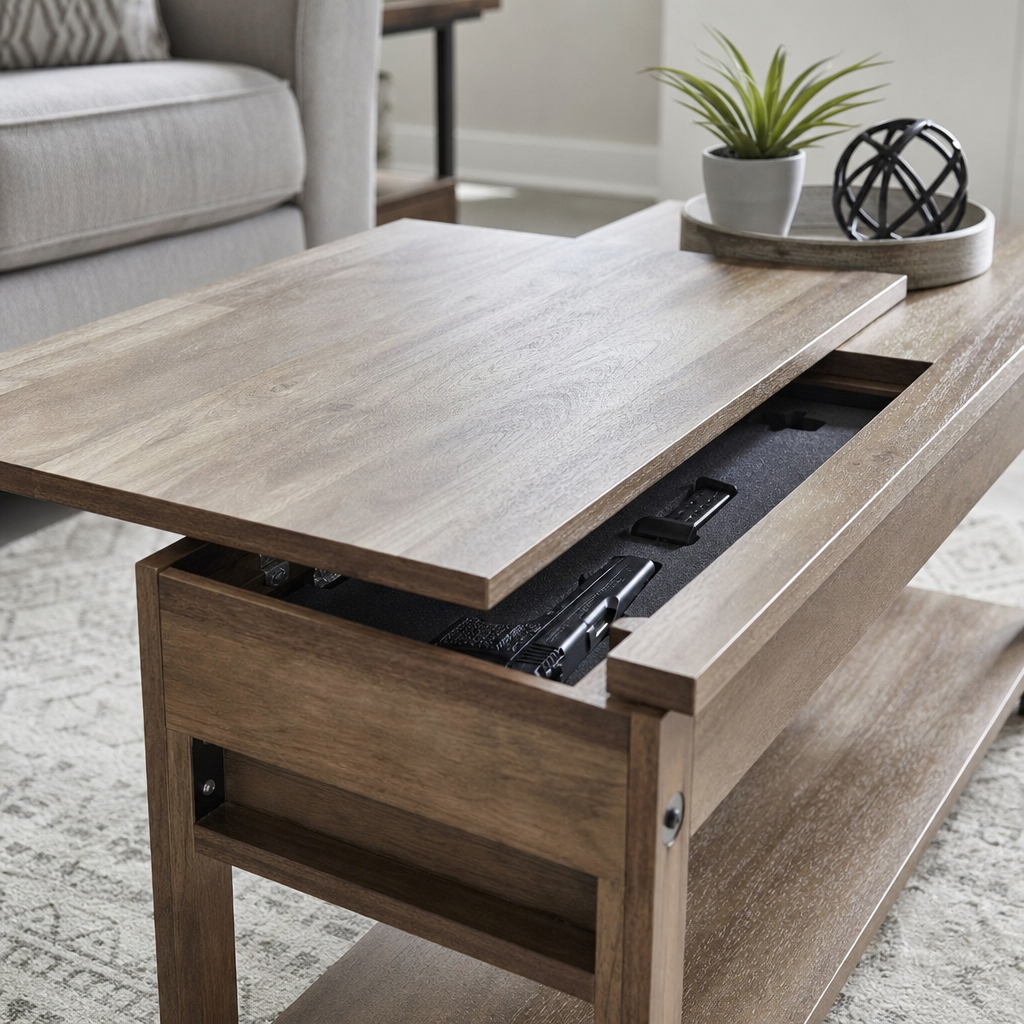
Hidden gun storage ideas for apartments and small homes must balance three priorities at once: fast access, true concealment, and lawful, responsible security. In compact living spaces, that balance is harder than it sounds because every square foot is doing double duty. A studio apartment may use one wall for sleeping, working, and entertainment. A small home may have children, guests, maintenance workers, or shared entryways that make firearm storage more complex than simply placing a safe in a closet. The best hidden gun storage solutions are designed around real floor plans, daily routines, and the legal duty to prevent unauthorized access.
Hidden storage means a firearm is placed inside furniture, architectural cavities, disguised lockboxes, or compact safes that do not immediately announce what they contain. Discreet storage is similar, but the emphasis is lower visibility rather than complete concealment. A quick-access bedside safe inside a drawer is discreet. A shelf with a concealed RFID compartment is hidden. Both can be useful, but they serve different purposes. In my experience helping homeowners and renters evaluate storage layouts, many people confuse “out of sight” with “secure.” A pistol under folded sweaters is hidden poorly and secured not at all. Effective storage requires concealment layered with locking hardware, mounting, and access control.
This topic matters because apartments and small homes present unique risk factors. Thin walls and close neighbors increase burglary exposure. Landlords may prohibit structural alterations. Weight limits can affect where heavy safes can sit. Children can move through open floor plans quickly. During a break-in, a thief often targets primary bedrooms, closets, and nightstands first, so obvious storage locations fail both security and discretion. At the same time, owners still need a practical defensive plan. A storage method that is technically secure but impossible to reach under stress is not well matched to a home-defense role.
For most people, the right approach begins with a simple framework: decide which firearms need immediate access, which are stored long term, who must be denied access, and what mounting options the property allows. Then match each need to a specific hidden gun storage product or placement strategy. Compact handgun safes, under-bed lockboxes, concealed furniture compartments, wall-mounted biometric safes, and decoy household containers all fit somewhere on that spectrum. This hub covers the full range of hidden and discreet gun storage solutions for apartments and small homes, including where each method works, where it fails, and how to build a setup that is safe, practical, and hard to discover.
What makes hidden gun storage effective in small spaces
Effective hidden gun storage in a small home follows five rules. First, it must prevent unauthorized access through a lock, not just concealment. Second, it must fit the room’s normal traffic pattern so retrieval is realistic. Third, it should resist casual theft by being anchored, integrated into furniture, or otherwise difficult to remove. Fourth, it must account for humidity, dust, and impact, especially in under-bed, garage-adjacent, or bathroom-adjacent spaces. Fifth, it should blend with the home without forcing risky habits such as leaving a compartment open for convenience.
In apartments, I usually advise people to think in zones rather than single locations. The bedroom may need one rapid-access handgun safe. A living room may support a concealed shelf safe or locking coffee table compartment. A hallway closet may hold a slim vertical cabinet for long guns if local law and household conditions permit. Zoning matters because one storage method rarely covers every use case. The defensive firearm, training pistol, and heirloom shotgun do not need the same access speed or concealment strategy.
Concealment works best when it matches the visual language of the room. In a modern apartment, a hidden compartment built into a floating shelf, mirror, or media console appears natural. In a traditional home, a concealed drawer in a nightstand or bench may blend better. The goal is not novelty. It is low detectability during normal observation and during the fast, messy search pattern typical of opportunistic burglars.
Best hidden gun storage options for apartments and small homes
The most practical category is the quick-access handgun safe. These units use biometric scanners, electronic keypads, RFID tags, or simplex-style mechanical locks. For renters, they are valuable because many can be bolted to bed frames, heavy furniture, or interior closet floors without major remodeling. Models from Vaultek, Fort Knox, V-Line, Hornady, and StopBox-style retention devices are often compared, but they serve different needs. Biometric access is fast when enrollment is done correctly and backup entry methods are available. Mechanical push-button locks sacrifice some speed but avoid battery dependence.
Under-bed gun safes are especially useful in small homes because they use dead space. A low-profile steel drawer can hold a defensive handgun, spare magazines, documents, or even a takedown long gun, depending on dimensions. The weakness is predictability: thieves know people use under-bed storage. That means an under-bed unit should be steel, lockable, and anchored. A soft zippered case under the bed is not hidden gun storage in any meaningful security sense.
Furniture-based hidden compartments are the most attractive option when aesthetics matter. Beds with locking headboards, benches with false bottoms, coffee tables with hidden lift sections, and nightstands with magnetic-release panels can all work well. The advantage is concealment in plain sight. The risk is inconsistent build quality. Many decorative concealment products are made for novelty rather than serious security. If a compartment has weak hinges, visible gaps, or no internal lock, it may hide a firearm from a guest but not protect it from a child or burglar.
Wall-mounted hidden safes can be excellent in small homes, especially behind framed art, mirrors, or utility panels. Between-stud safes are narrow but deep enough for handguns, valuables, and documents. In a rental, however, installation can be restricted, and poor placement can create visible wall repair issues later. I have seen better results with removable concealment layers, such as a mounted picture over a properly installed safe, than with improvised drywall cutouts that compromise both fire resistance and security.
| Storage option | Best use | Main advantage | Main limitation |
|---|---|---|---|
| Quick-access handgun safe | Bedside or closet defense firearm | Fast entry with real locking security | Limited capacity |
| Under-bed safe | Unused low space in tight rooms | Large storage footprint without visual clutter | Predictable target area for thieves |
| Concealment furniture | Living rooms and multipurpose bedrooms | Blends into décor | Security varies sharply by build quality |
| Wall safe behind décor | Permanent concealed storage | Excellent discretion and good theft resistance | Often difficult for renters to install |
| Closet-mounted vertical cabinet | Long guns in narrow spaces | Efficient use of height | Less hidden if closet is searched |
Room-by-room placement strategies that actually work
In bedrooms, avoid the obvious trio of top dresser drawer, nightstand shelf, and loose shoebox in the closet. Those are searched first. A better setup is a bolted quick-access safe on the bed frame’s interior rail, inside a nightstand cavity, or on the closet floor behind hanging clothes with the door swing still allowing access. If children live in or visit the home, verify that the safe opens only when intended and that the firearm can be returned to the safe one-handed if necessary.
In living rooms, concealed storage works only if the furniture is stable and the compartment can stay closed consistently. A locking side table with a hidden compartment is stronger than a decorative shelf with a simple magnetic catch. If the room receives frequent visitors, prioritize retention over speed. This is also a good place for a compact safe inside a media console, provided cables, remotes, and gaming accessories do not obstruct the opening path.
Entry areas are tempting for convenience, but they create exposure. Maintenance staff, delivery personnel, and guests may linger there. Unless the area includes a truly secured closet or bench safe, avoid placing firearms near the main door. Kitchens and bathrooms generally present moisture, grease, and temperature swings that make them poor choices. Home offices can work well because desks, credenzas, and filing cabinets naturally justify lockable compartments, but cable management and daily clutter should not interfere with access.
Closets are useful, but only when storage is elevated above “gun behind clothes.” In narrow closets, a vertical rifle cabinet anchored to studs or masonry can hold long guns efficiently. For apartments with only one closet, a shelf-level pistol safe mounted under the top shelf often gives a better mix of concealment and speed than storing a handgun near the floor, where retrieval is slower and visibility is higher during cleaning or moving.
How to choose locking mechanisms, mounting methods, and materials
The lock is the heart of discreet gun storage. Biometric locks should have capacitive sensors, multiple enrolled finger positions, and a reliable backup such as a keypad or keyway. They are best for users who practice regularly and maintain battery schedules. Mechanical simplex locks remain a gold standard for durability and low failure rates. RFID systems are fast and intuitive in furniture applications, but the tag or card itself becomes a security item that must be controlled carefully.
Mounting matters just as much as the lock. In burglaries, thieves often steal the entire container if they cannot open it quickly. A compact safe should be anchored to framing, concrete, a steel bed frame, or heavy built-in cabinetry using manufacturer-approved hardware. In rentals, that may mean using existing structural surfaces inside a closet or obtaining landlord approval for a limited installation. Adhesive mounting, light screws into particleboard, and freestanding lockboxes are poor substitutes for proper anchoring.
Material quality separates serious hidden storage from décor. Look for 12-gauge to 14-gauge steel in practical handgun safes, reinforced pry areas, protected hinges, and interior padding that does not trap moisture. Fire ratings can be useful, but many compact concealment products focus more on access speed than fire endurance. If document protection matters alongside firearm storage, separate containers are often smarter than one compromised all-in-one solution.
Legal, safety, and household considerations renters cannot ignore
Gun storage law varies by state and sometimes by city, but the trend is clear: if a prohibited person or child can access a firearm because it was not secured properly, the legal and personal consequences can be severe. Some jurisdictions impose specific locked-storage requirements, especially when minors are present. Others tie liability to negligent storage after unauthorized access. That means the right hidden gun storage idea is not just about secrecy. It must satisfy local law and the standard of reasonable care.
Landlord rules also matter. Lease agreements may restrict wall modifications, drilling, or certain security installations. Before cutting drywall for a wall safe or bolting a cabinet to framing, verify what is allowed in writing. I have seen renters solve this well by choosing bed-frame-mounted safes, closet-floor installations with patchable anchor points, and lockable furniture that can move without structural changes.
Household dynamics should drive the final choice. If children are present, concealment furniture without an internal lock is usually inadequate. If multiple adults need access, establish who knows combinations, who maintains batteries, and where backup keys are stored. If the firearm is for defense, practice retrieving it from the actual hidden storage location in low light and under time pressure, using an unloaded firearm and safe handling protocols. The test is simple: can you open it reliably, without sweeping yourself or others, and can you secure it again immediately afterward?
Building a complete hidden storage plan for this subtopic hub
A strong hidden gun storage setup rarely relies on one product. It is a layered plan built around access needs, occupancy, layout, and budget. Start with one primary quick-access safe for the defensive firearm. Add a second concealed or locked location for secondary storage, training gear, or long-term items. Use dehumidification or silica packs where needed. Keep serial numbers documented separately. Review the arrangement after any move, renovation, new roommate, child visit, or furniture change.
As the hub for hidden and discreet gun storage solutions, this topic branches into several deeper questions: how under-bed safes compare with nightstand safes, whether biometric locks are reliable enough for defensive use, which concealment furniture is worth buying, how renters can anchor safes without violating a lease, and where long guns fit in small homes. Those are distinct articles because each deserves product-level detail, installation guidance, and scenario-specific recommendations. The hub’s central point is simpler: hidden storage works when concealment supports security, not when it replaces it.
For apartments and small homes, the best solution is usually compact, anchored, fast to open, and visually ordinary. Choose a method that fits the room, complies with law, denies access to everyone unauthorized, and still lets you retrieve the firearm predictably. Then test it, maintain it, and improve it as your home changes. If you are building out your gun safes and safety plan, use this hub as the starting point and evaluate each room with the same standard: secure, discreet, accessible, and responsible every day.
Frequently Asked Questions
What should hidden gun storage in a small apartment or home prioritize first?
Hidden gun storage in a compact space should always prioritize three things in this order: legal compliance, unauthorized access prevention, and then practical access speed for the owner. In small apartments and homes, it is tempting to focus only on concealment, but a gun that is merely out of sight is not necessarily secure. True hidden storage should prevent discovery by children, visitors, cleaners, contractors, roommates, or burglars while still allowing the owner to reach the firearm quickly in a legitimate emergency.
The best setup usually combines a dedicated locking mechanism with discreet placement inside ordinary furniture or architectural dead space. Examples include rapid-access lockboxes mounted inside a nightstand, secured compartments built into a bed frame, or small safes concealed within closets, cabinets, or benches. In all cases, the storage method should be anchored when possible so it cannot be easily removed and opened elsewhere. In apartments especially, portability can be a weakness if a thief can simply carry the entire unit out.
Owners should also think in layers. Concealment keeps casual observers from noticing the firearm. Locking mechanisms prevent unauthorized handling. Smart placement protects against routine household traffic. A storage solution that balances all three is usually more effective than any single “secret” hiding place. For most people living in limited square footage, the right answer is not a gimmicky hiding spot, but a well-secured, discreetly integrated, quick-access safe that fits naturally into the room.
Are hidden furniture compartments a good option for firearm storage in apartments?
Hidden furniture compartments can be a very good option, but only when they are designed for both security and responsible storage rather than simple concealment. A coffee table with a secret drawer, a mirror with a concealed compartment, or a shelf with a hidden interior may keep a firearm out of plain view, but if it does not lock securely, it may not be appropriate in a home with children, frequent guests, or any risk of unauthorized access. In other words, hidden furniture is useful only if it functions as more than camouflage.
In apartments, furniture-based storage is often ideal because it uses space that is already serving another purpose. A bench at the entryway, a nightstand beside the bed, an ottoman in the living room, or a headboard with a locking compartment can provide discreet storage without consuming precious floor area. This matters in studios and small homes where every item must justify its footprint. The key is choosing pieces that do not draw attention to themselves and that allow access in the part of the home where defensive use would realistically matter.
It is also important to match the furniture choice to the firearm and to the access scenario. A bedside quick-access compartment may work for a handgun needed at night, while a larger hidden cabinet may be more appropriate for a long gun if local law and household conditions permit. The compartment should open reliably under stress, ideally with a proven keypad, RFID, or biometric system backed up by a mechanical override. Low-quality novelty furniture can fail when speed matters most, so durable construction and trusted locking hardware are worth prioritizing over appearance alone.
Where are the safest and most practical places to hide a gun in a small living space?
The safest and most practical places are usually the ones that combine natural concealment, limited visibility to others, and immediate relevance to your daily routine. In a small home or apartment, that often means placing a secure storage unit near the bed, inside a primary bedroom closet, within a discreet living-room furniture piece, or in another location you can access quickly without making the gun visible during normal activity. The right choice depends on who lives in the space, who visits it, and when you would realistically need access.
Bedroom-adjacent storage is one of the most common solutions because it supports quick nighttime access and generally offers more privacy than a shared living area. A compact safe bolted inside a nightstand, under a bed frame, or within a closet can work well if it remains hidden from casual view. In living rooms or studio apartments where separate rooms may not exist, dual-purpose furniture with internal lockable storage is often the most efficient path. The ideal location should not force you to handle or expose the firearm during ordinary routines like getting dressed, cleaning, or retrieving household items.
What should usually be avoided are obvious “hiding spots” that are unsecured or widely known, such as dresser drawers, under mattresses, high closet shelves, kitchen cabinets, or loose containers. These places may feel concealed, but they are commonly checked by children and thieves alike. Equally important, avoid storing firearms in spots that are hard to reach under stress, vulnerable to moisture, or likely to be discovered during maintenance visits or social gatherings. Practical hidden storage is less about cleverness and more about creating a controlled, repeatable, low-visibility access point that fits your floor plan and security needs.
How can renters use hidden gun storage without damaging walls or violating apartment rules?
Renters often need storage solutions that are secure but do not require major modifications to the property. Fortunately, there are several practical options. Many apartment residents use compact quick-access safes that can be anchored to heavy furniture, bed frames, closet interiors, or other stable structures without altering structural walls. Some models are designed for cable mounting, interior bolting to furniture components, or placement inside locking cabinets. This can provide meaningful security while keeping the installation reversible when the lease ends.
Before setting anything up, renters should review lease terms and local laws carefully. Some properties have rules about safes, modifications, or weapons on the premises, and state or local law may impose specific storage requirements, especially where minors are present or unauthorized access is foreseeable. In addition, apartment living creates special concerns such as maintenance access, shared spaces, frequent deliveries, and thinner walls that can make routine movement more visible. For that reason, low-profile storage inside ordinary furniture is often better than something large and conspicuous that immediately signals “valuables inside.”
Good renter-friendly options include lockboxes inside wardrobes, concealed safes inside storage benches, under-bed rapid-access units, and furniture-integrated compartments that can move with you. The goal is to create a setup that is stable, hidden, and compliant without relying on permanent built-ins. If a renter wants a more advanced concealed compartment, freestanding furniture pieces with internal locking systems usually make more sense than cutting into walls or modifying cabinetry. A portable solution can still be highly effective if it is quality-built, responsibly placed, and protected against easy removal.
How do you balance fast access with child safety and responsible firearm storage?
Balancing fast access with child safety is one of the most important parts of storing firearms in a small home. The answer is not to sacrifice one for the other, but to use storage designed to deliver both. A modern quick-access safe with a reliable lock mechanism allows the owner to retrieve a firearm rapidly while preventing children, guests, or unauthorized adults from handling it. In homes where space is limited, this matters even more because there are fewer truly private areas and everyday activity happens close to where items are stored.
The most effective approach is to place the firearm in a lockable, hidden, purpose-built container that you can access under stress without exposing it during routine life. Biometric safes, keypad safes, and RFID systems can all work if they are tested regularly and have a dependable backup entry method. The storage location should also reflect the household reality. If children are present, even occasionally, then simple concealment is not enough. Kids are naturally curious, and common hiding spots are often less secret than adults assume. The firearm should remain locked whenever it is not under the owner’s direct control.
Responsible storage also means planning beyond the hardware. Owners should practice access safely, maintain the locking system, secure spare keys or override tools, and follow all applicable laws regarding loaded firearms, transportation, and storage around minors. In small homes, consistency is critical because clutter, convenience, and familiarity can lead to unsafe shortcuts. The safest setup is one you will use every single time: hidden from view, physically secured, legally compliant, and fast enough to serve its purpose without creating unnecessary risk.