
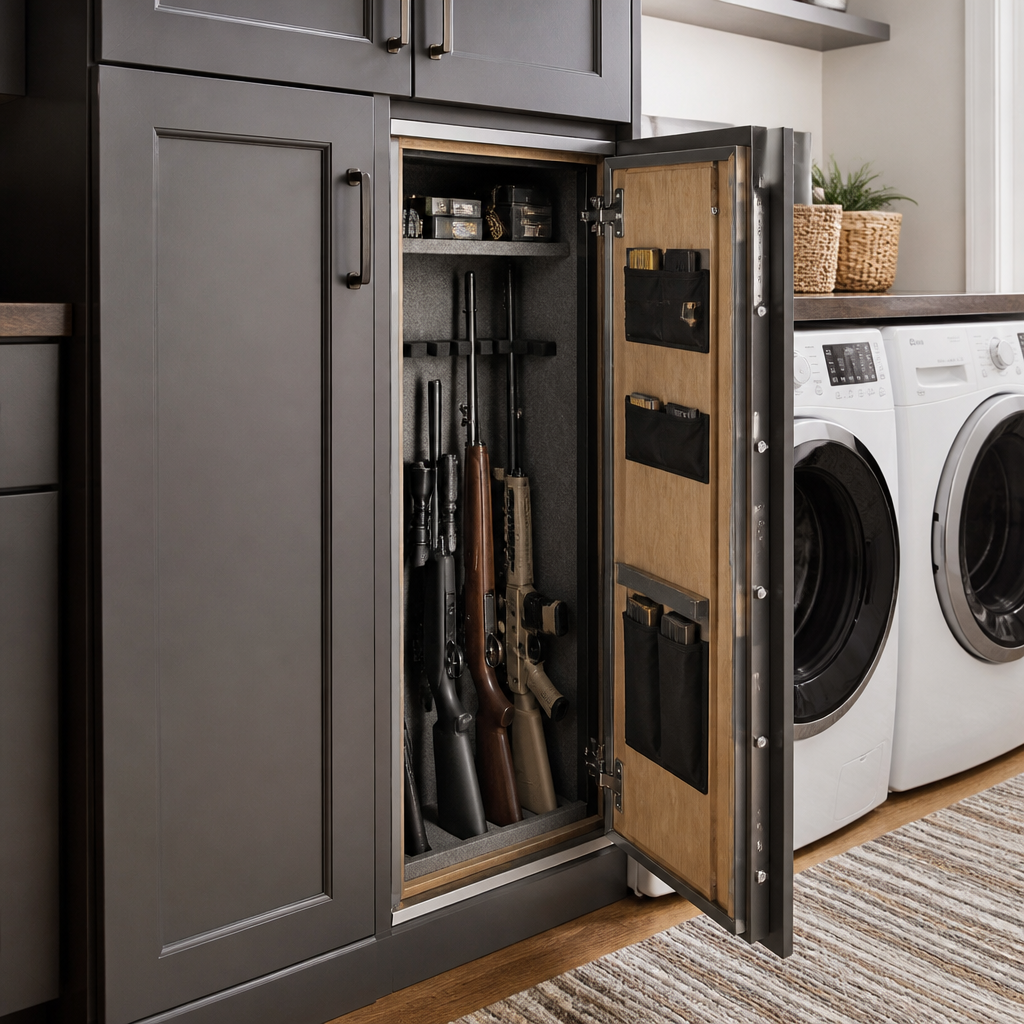
A hidden gun safe inside a laundry room cabinet offers a practical way to secure firearms while keeping them out of sight, and it solves a problem many gun owners face: balancing fast access, theft resistance, child safety, and a home layout that does not advertise where valuables are stored. In this guide, I will explain how to create a concealed storage solution that fits inside a laundry room cabinet, while also using the project as a hub for the broader category of hidden and discreet gun storage solutions. “Hidden” means the safe is visually blended into ordinary cabinetry or utility-room features. “Discreet” means the storage does not draw attention from guests, contractors, cleaners, or burglars conducting a quick search. “Gun safe” can refer to a full UL-rated safe, a lockbox, or a reinforced security cabinet, but the best choice depends on the firearms involved, the structure of the cabinet, local law, and the level of burglary protection you need.
The laundry room is especially useful because it already contains built-in cabinets, routine household traffic, appliance noise, and utility clutter that naturally masks a secure installation. In my experience, concealment works best when it looks boring. A thief searching a main bedroom closet or home office is more likely to inspect obvious “privacy” areas than a shelf above detergent or a false-backed utility cabinet beside a washer. At the same time, concealment alone is not security. A hidden gun safe should still include a hardened enclosure, quality lock, proper anchoring to wall studs or concrete, humidity control, and a storage layout that keeps unauthorized users out. This article covers planning, safe selection, cabinet modification, installation, climate control, code and legal concerns, and the strengths and limits of other hidden gun storage solutions so you can choose a setup that is secure, realistic, and maintainable.
Why a laundry room cabinet works for hidden gun storage
A laundry room cabinet is effective because it combines concealment with structure. Most laundry rooms include upper or tall cabinets attached to framing, which makes anchoring easier than in thin decorative furniture. Many also sit away from entertaining spaces, reducing casual visibility. If you own one or two defensive handguns, a compact pistol safe hidden behind cleaning supplies may be enough. If you need to secure an AR-style rifle, shotgun, or multiple long guns, a tall cabinet can sometimes conceal a vertical safe body behind a face frame or false panel. The key principle is ordinary appearance. A cabinet that still stores detergent, spare towels, dryer sheets, or cleaning bottles looks normal. A perfectly empty cabinet with a suspiciously deep back does not.
Compared with under-bed boxes or obvious closet safes, a laundry room installation can also improve environmental stability if it is designed correctly. Interior laundry rooms often have conditioned air, unlike garages that suffer from temperature swings and corrosion risk. However, there are tradeoffs. Some laundry rooms are humid, especially if dryer venting is poor or the room lacks exhaust. Vibration from washers can loosen poorly installed hardware. Access can be awkward if baskets, ironing boards, or hampers block the cabinet. I tell homeowners to test the route in real life: can you open the cabinet, unlock the safe, and retrieve the firearm safely in low light without moving clutter? If not, the concept is good but the execution is wrong.
Choosing the right safe, lock, and cabinet layout
The safest way to build a hidden cabinet system is to start with the firearm and the safe, then adapt the cabinet around it. Do not begin by cutting shelves and hoping a generic lockbox will fit. Measure overall firearm length, optic height, magazine configuration, and required clearance for your hands. For handguns, a steel lockbox made from 10- to 14-gauge steel with a pry-resistant lid and internal hinge protection can work well. For long guns, a compact vertical safe or modular security cabinet with a reinforced door is usually better than an improvised wooden compartment. Look for mechanical Simplex locks if you want reliability without batteries, or a quality electronic lock from established safe manufacturers if quick access matters more and you can maintain power discipline. Biometric locks are convenient, but many cheap models fail under wet fingers, poor enrollment, or dead batteries. I have replaced several because owners trusted speed over consistency.
Cabinet layout should support concealment and function. In upper cabinets, a false back can hide a shallow handgun safe while preserving visible shelf storage in front. In tall cabinets, a side-access compartment can be hidden behind a removable cleaning-supply panel mounted on rare-earth magnets and alignment pins. Avoid making the concealment method clever at the expense of speed. Hidden latches, magnetic touch releases, and secret triggers are attractive in theory, but every extra step is another failure point under stress. Also think about noise. Metal shelves rattling against a safe body, loose detergent bottles, or a magnetic panel snapping into place can reveal the installation. Felt pads, edge gaskets, and tighter tolerances matter more than most DIY builders expect.
Planning the build: dimensions, structure, and placement
Before cutting anything, inspect the cabinet, surrounding wall, and floor. Confirm whether the cabinet is stock particleboard, plywood, or solid wood. Particleboard can hold visible shelves but is a poor anchoring surface for a heavy safe. Ideally, the safe bolts through the cabinet and into wall studs, blocking, or concrete. Use a stud finder, inspection mirror, and small pilot holes in concealed areas to verify framing. Check depth carefully. Many laundry cabinets are only 12 to 24 inches deep, and washer hookups, drain lines, vent ducts, and electrical boxes can occupy rear space. Never place a safe where mounting hardware may hit plumbing or electrical runs. If the room is on a slab, a base cabinet or tall cabinet may allow direct anchoring into concrete with wedge anchors or concrete screws. If on a raised floor, distribute load and avoid relying on thin subfloor alone.
Placement should match your purpose. For home-defense access, choose a reachable height and direct line of movement, but still maintain child resistance. For long-term storage, a higher or deeper concealed position may be acceptable. Leave enough door swing for both cabinet and safe doors, especially if front-loading washer or dryer doors compete for space. I also recommend thinking through maintenance. Can you change lock batteries, inspect bolts, wipe condensation, and verify firearm condition without disassembling the concealment system? Good hidden storage should still be serviceable. Many failed builds hide the safe so well that owners neglect it.
| Component | Best Practice | Why It Matters |
|---|---|---|
| Safe body | Use steel construction with pry-resistant door design | Concealment delays discovery, but steel resists forced entry |
| Anchoring | Bolt into studs, blocking, or concrete | Prevents thieves from removing the entire unit |
| Cabinet front | Maintain normal household storage appearance | Ordinary visuals reduce attention during quick searches |
| Humidity control | Add desiccant or a dehumidifier rod if power is available | Protects firearms from rust in a moisture-prone room |
| Access method | Choose a reliable mechanical or quality electronic lock | Fast access is useless if the lock fails under pressure |
| Interior lining | Use foam, felt, or barrel supports as needed | Prevents movement, finish wear, and noise |
How to create the hidden compartment inside the cabinet
The cleanest approach is usually one of three designs: a false back, a false side, or a disguised lower compartment. A false back works for shallow pistol storage. Build a new interior panel from 1/2-inch plywood finished to match the cabinet interior, then mount it several inches forward of the actual back wall using cleats attached to the cabinet sides. Behind that cavity, install the safe bolted into studs or blocking. Make the visible shelves stop short of the true depth so bottles and towels sit naturally in front. A false side compartment works better in a tall cabinet if one vertical bay can be sacrificed. You preserve normal shelving on one side while the narrow hidden side houses the safe. A disguised lower compartment can be built behind what appears to be a fixed toe-kick or hamper base, though this is generally better for documents or compact handguns than rapid defensive access.
Whichever design you choose, the concealment panel should be stable, repeatable, and not dependent on fragile cabinet hardware. I prefer concealed magnetic catches paired with dowel pins or metal alignment sleeves so the panel seats precisely every time. For more robust builds, use a piano hinge hidden behind a face-frame stile with a touch-latch opening sequence, but only if the reveal lines remain natural. Matching finishes matters. If the cabinet interior is white melamine, a stained plywood secret door will stand out immediately. If the cabinet shelves show wear, an obviously newer panel can be just as revealing. Age and texture should be consistent. In one effective installation, the visible panel was simply another detergent storage divider with manufacturer labels on the front-facing bins. It looked so mundane that even informed visitors missed it.
Installation details that determine real security
Most hidden gun storage projects succeed or fail at installation. A quality safe loosely screwed to thin cabinet walls is not secure; it is packaging. Use the mounting holes supplied by the safe manufacturer whenever possible. For stud anchoring, 3/8-inch lag screws with washers into solid framing are common for smaller safes, but always follow the safe maker’s guidance and verify edge distances. For concrete, wedge anchors or heavy-duty masonry screws can provide strong pullout resistance. If studs are not ideally located, add a concealed plywood or steel backer plate fastened across multiple studs, then bolt the safe to that structure. Keep fasteners inaccessible once the safe door is closed. Exposed bolt heads outside the safe defeat the point.
Pay attention to clearances, door operation, and interference. Some safes require extra side clearance for keypad overhangs or hinge travel. Dry-fit everything before final drilling. Add thin neoprene or rubber isolation pads where the cabinet might vibrate against the safe body, but do not create wobble. If the safe interior stores a ready firearm, use a consistent orientation and retain it with purpose-built handgun racks, barrel cradles, or hook-and-loop retention accessories so it does not shift. Label battery replacement dates for electronic locks inside the hidden compartment, not on the visible cabinet. Finally, test from a cold start. Walk into the room, open the cabinet, expose the safe, unlock it, and access the firearm. Time matters less than smooth repetition and muzzle-safe handling.
Moisture control, maintenance, and safe firearm condition
Laundry rooms create a unique environmental challenge because hidden does not mean dry. Warm air, vent leaks, and damp clothing can increase relative humidity enough to accelerate rust, especially on blued steel, magazine springs, and optics fasteners. A small desiccant canister works for compact spaces if you recharge it regularly. In larger cabinets, a low-watt dehumidifier rod may be better if a power source is available and safely routed. A digital hygrometer is inexpensive and more useful than guessing; try to keep storage humidity moderate, not extreme. Silicone-treated gun socks can add another layer of surface protection for long guns, but they should not replace proper oiling and inspection.
Maintenance should follow a schedule. Inspect the safe monthly at first, then adjust based on actual conditions. Look for condensation, rust specks, lint buildup, lock errors, and loose anchors. Laundry rooms collect dust and fabric fibers that can migrate into hinges and keypads. Keep the dryer vent clean and properly sealed because vent leaks can dump moist air directly into the room. If the hidden cabinet stores cleaning chemicals, never let solvents, bleach, or leaking detergent contact firearm finishes or ammunition packaging. The most durable hidden storage setups treat the cabinet as a controlled micro-environment, not a random household shelf with a gun behind it.
Legal, safety, and household considerations
A hidden gun safe must comply with your state and local storage laws, especially where minors or prohibited persons may be present. Some jurisdictions require locked storage whenever firearms are not under direct control, and civil liability can be severe if negligent storage leads to unauthorized access. If your purpose is defensive readiness, understand the tradeoff between speed and security. A chambered handgun in a quick-access safe may be appropriate in one household and unacceptable in another. Training, household makeup, and legal requirements decide the answer, not internet bravado. Ammunition storage is another consideration. Some owners separate loaded magazines from firearms; others store a ready setup inside the same locked compartment. Whatever you choose, be consistent and train with that configuration.
Household secrecy matters too. Hidden storage loses value when too many people know it exists. Installers, visiting relatives, and older children notice more than owners assume. Keep the project discreet during construction, remove packaging from safe brands before curb disposal, and avoid discussing concealment methods casually. If you use smart-home cameras or alarm contacts near the laundry room, position them to support security without recording lock codes or sensitive handling procedures.
Other hidden and discreet gun storage solutions to consider
As a hub for hidden and discreet gun storage solutions, this topic extends beyond laundry room cabinets. Common alternatives include closet wall safes behind hanging clothes, under-stair compartments, bed-frame safes, furniture safes concealed in end tables or benches, mirror safes, bookshelf compartments, and garage workbench installations. Each has strengths and weaknesses. Wall safes are space-efficient but often limited by stud spacing and shallow depth. Furniture safes can blend beautifully but are easier to remove if not anchored. Under-bed boxes provide fast access yet are among the first places thieves check. Mirror and picture-frame safes offer visual disguise, but many commercial models prioritize novelty over steel thickness and lock quality.
From projects I have seen perform well over time, the best hidden storage shares four traits: it uses a real locking steel container, it anchors to structural material, it matches everyday household patterns, and it remains maintainable. The laundry room cabinet often scores well on all four, which is why it deserves serious consideration as a sub-pillar within gun safes and safety. If you are planning broader concealed storage across the home, assign roles: one quick-access safe for daily defense, one higher-capacity anchored safe for primary storage, and one hidden location only if it truly improves discretion without weakening safe handling practices.
Creating a hidden gun safe inside a laundry room cabinet is not about gimmicks. It is about combining concealment, anchoring, climate control, and disciplined access into one practical system. Start with the firearm, select a real safe, confirm structure, and design a concealment panel that looks ordinary and operates reliably. Keep the cabinet believable, control humidity, inspect the installation, and follow storage laws that apply where you live. Most important, remember that hidden storage is a layer, not a substitute for steel, locks, and responsible habits.
For many homes, the laundry room is one of the smartest places to build discreet firearm storage because it offers natural camouflage without forcing you into weak furniture-based solutions. When done correctly, it reduces casual discovery, improves organization, and supports a broader home security plan built around safe access and unauthorized-user prevention. Review your cabinet dimensions, evaluate your safe options, and map the installation carefully before you drill a single hole. A well-planned hidden gun safe should disappear into the room, but its security should be very real.
Frequently Asked Questions
Is a laundry room cabinet actually a good place for a hidden gun safe?
A laundry room cabinet can be a very effective location for a hidden gun safe when the design is planned carefully. One of the main advantages is that a laundry room is usually a low-interest area for guests, delivery workers, and even burglars who tend to focus first on bedrooms, closets, home offices, and obvious storage spaces. That makes it a strong candidate for discreet firearm storage. A cabinet in this area also gives you a fixed structure to work with, which makes it easier to anchor a safe securely to wall studs or the floor framing instead of relying on a freestanding concealment piece.
That said, the location only works well if you address the practical realities of the space. Laundry rooms often have humidity, vibration, heat, and plumbing nearby, so moisture control matters. A good hidden safe setup in this environment should include a dehumidifier, desiccant packs, weather-resistant finishes, and enough separation from water supply lines, drain hoses, and appliance exhaust areas. You also want to avoid placing the safe where detergent spills, bleach fumes, or washer movement could affect the installation over time. If the cabinet shares a wall with plumbing, inspect carefully before cutting or modifying anything.
From a security standpoint, a laundry room cabinet should be viewed as concealment plus controlled access, not concealment alone. The cabinet door may hide the safe, but the safe itself still needs real theft resistance, a reliable locking system, and solid anchoring. If children are in the home, the project should never depend on secrecy by itself. A proper hidden gun safe in a laundry room cabinet works best when it combines discreet placement, a true locking safe, and a layout that allows quick adult access without exposing firearms to unauthorized users.
What kind of safe works best inside a laundry room cabinet?
The best safe for a laundry room cabinet is usually a compact, purpose-built firearm safe that fits the cabinet dimensions while still leaving room for ventilation, access, and secure mounting. In most cases, that means choosing between a vertical rifle safe for long guns, a low-profile quick-access handgun safe, or a modular cabinet safe if you want mixed storage. The right option depends on what you are storing, how fast you need access, and how much usable depth and height the cabinet actually provides. Measuring the cabinet interior precisely is essential, including door swing, hinge clearance, and any shelves, trim, or plumbing obstacles.
For this type of hidden installation, quick-access lock options are often preferred over traditional dial locks because they are easier to operate in a confined cabinet space. Biometric locks can be convenient, but they should be treated as one layer of access rather than the only one, since fingerprint performance varies with moisture, detergent residue, and hurried use. Electronic keypad safes are popular because they balance speed and reliability, while mechanical push-button locks are valued by many owners for simplicity and reduced dependence on batteries. Whatever locking method you choose, test it repeatedly in the exact cabinet position before final installation.
Construction quality matters just as much as size. Look for a safe with solid steel construction, reinforced door edges, pry-resistant design, interior mounting holes, and enough weight to discourage removal. In a concealment project, the goal is not just to hide the safe but to make forced removal difficult and time-consuming. Interior organization is also worth considering. Foam supports, barrel rests, magazine shelves, and pistol racks can help you use a compact safe more efficiently without creating clutter that slows access. A well-chosen safe should fit the cabinet naturally, mount securely, resist moisture, and allow you to retrieve the firearm quickly and safely when needed.
How do you make the cabinet look normal while still allowing fast access to the gun safe?
The key is to design the cabinet so it blends into the laundry room without looking modified, oversized, or more heavily built than the surrounding storage. In most successful projects, the outside remains visually ordinary: standard cabinet doors, matching paint or finish, normal hardware, and no visible signs that one section is treated differently. The more the concealed safe area looks like routine household storage for detergent, cleaning products, linens, or utility items, the less attention it draws. A false back panel, concealed compartment, or secondary interior door can help hide the safe itself while preserving the look of a functional cabinet.
Fast access comes from what happens after the exterior cabinet door opens. Instead of burying the safe behind clutter, create a dedicated pathway to the lock face and handle. That might mean installing a hinged false shelf, a magnetically retained panel, or a removable interior cover that can be moved quickly with one hand. Some people use soft-close hardware or touch-latch systems to reduce noise and speed up entry, but these features should never interfere with reliability. The most important test is whether you can open the cabinet, reach the safe, unlock it, and retrieve the firearm smoothly in low light and under stress.
It is also smart to think through daily use patterns. If the concealment element is too complicated, people tend to leave doors unsecured or skip safety steps. The best hidden laundry room cabinet setups are simple, repeatable, and discreet. Keep the outer cabinet organized so the space always appears normal, but avoid stacking common household items directly in front of the safe. In other words, aim for believable concealment, not clutter. A cabinet that looks completely ordinary from the outside and remains efficient on the inside gives you the best balance of discretion, access speed, and long-term usability.
What safety and legal issues should you consider before building a hidden gun safe in a laundry room cabinet?
The first and most important issue is that hidden storage is not a substitute for responsible firearm security. If children, teenagers, guests, contractors, or vulnerable individuals may be in the home, the safe must provide true restricted access. That means a lockable safe, secure anchoring, and a consistent habit of keeping firearms stored properly when not in use. Depending on your preferences and local laws, that may also include storing firearms unloaded, using a chamber flag or trigger lock, and keeping ammunition in a separate locked container. The exact setup should reflect both legal requirements and realistic household risk.
State and local firearm storage laws vary widely, and some jurisdictions impose specific rules when minors can access the home, when firearms are left unattended, or when a stored firearm is used in an unauthorized way. Before starting the project, review the laws that apply where you live, including any child access prevention statutes, safe storage mandates, landlord or lease restrictions, and insurance requirements. If your home includes shared walls, rental modifications, or utility access limitations, there may also be building and property rules that affect what you can alter inside a cabinet or wall structure.
Safety also includes the physical installation environment. Laundry rooms involve electrical outlets, water supply lines, drains, appliance vibration, and occasionally elevated humidity. You should confirm that your chosen cabinet location does not compromise plumbing access, dryer vent maintenance, or emergency shutoff reach. Avoid any installation that could weaken a load-bearing surface, obstruct utility servicing, or place the safe where water leaks would go unnoticed. A smart project treats the laundry room as both a concealment opportunity and a utility zone that must remain safe and functional. When in doubt, get advice from a qualified contractor for structural concerns and from a knowledgeable firearms professional for storage best practices.
How can you improve theft resistance and moisture protection for a hidden gun safe in a laundry room cabinet?
To improve theft resistance, start by anchoring the safe to something stronger than cabinetry alone. The cabinet may hide the safe, but the safe should be bolted into wall studs, concrete, or solid floor framing whenever possible. If the cabinet itself is custom-built, reinforce the interior with structural backing so the safe cannot be ripped out with a few fastener failures. Concealment features such as false panels and hidden compartments help delay discovery, but real security comes from making removal and forced entry slow, noisy, and difficult. The harder it is for a thief to identify, access, pry, and carry away the safe, the better the setup will perform.
Layered security adds a lot of value here. You can place the cabinet within a locked laundry room, use alarm contacts on the room or cabinet door, install motion sensors, and position cameras to cover approach points without making the cabinet itself obvious. Interior cabinet lighting tied to a motion switch can improve access for you while remaining invisible from outside. For some homeowners, using decoy storage in nearby cabinets also helps keep attention away from the concealed compartment. The point is not to rely on one trick but to combine concealment, physical anchoring, controlled access, and home security measures into one coordinated plan.
For moisture protection, assume the laundry room will experience more humidity swings than a bedroom closet or office. Use a dehumidifier rod if the safe supports one, or place rechargeable desiccant packs inside and monitor them regularly. Choose rust-resistant finishes where possible, keep firearms lightly protected with appropriate corrosion-prevention products, and inspect the safe interior on a routine schedule rather than forgetting about it because it is hidden. If the cabinet is tight and enclosed, ensure there is still enough airflow to prevent stale damp conditions. A concealed gun safe inside a laundry room cabinet can work extremely well, but long-term success depends on treating environmental protection as seriously as concealment and access.