
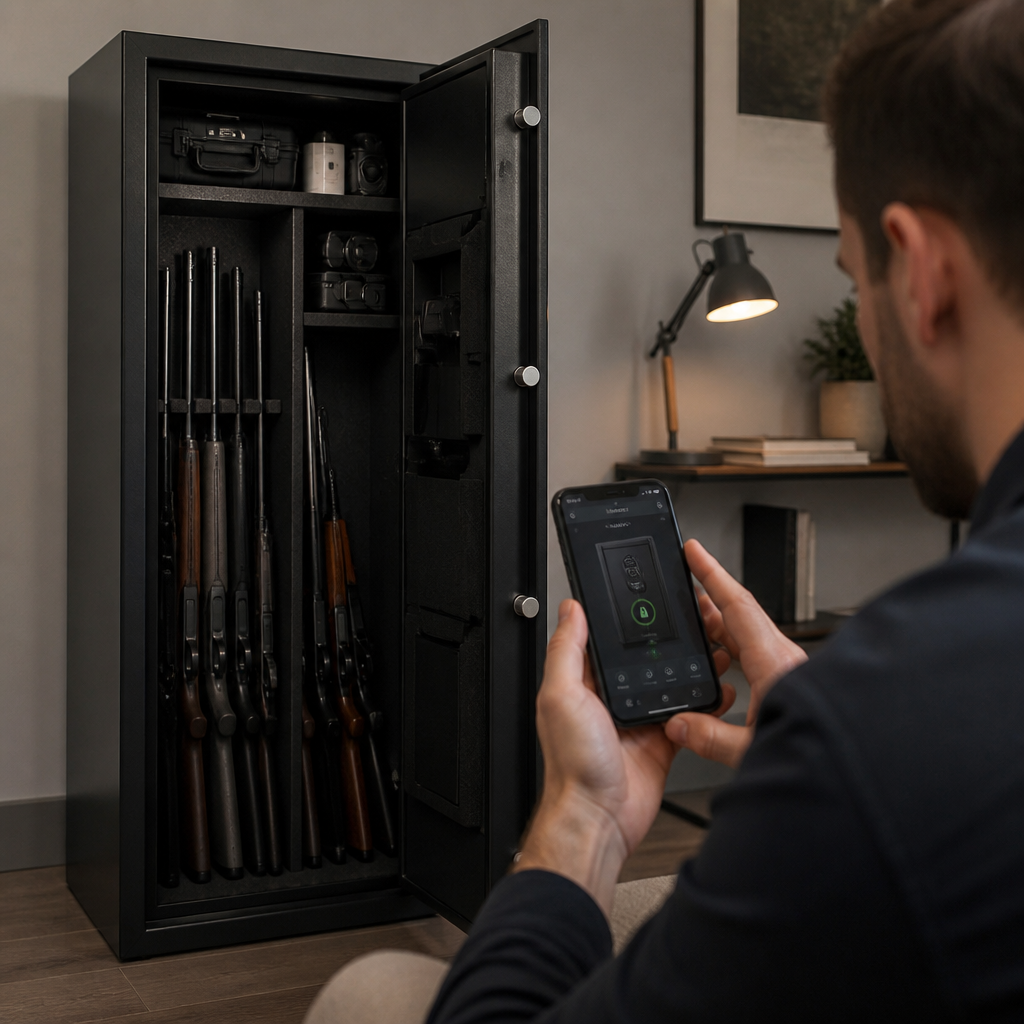
Gunbox Echo is a compact smart gun safe that combines biometric access, keypad entry, cable tethering, and mobile app integration in one travel-ready unit. Within the broader Gun Safes & Safety category, it sits at the intersection of product review, safe storage strategy, and connected-device security. That makes it a useful hub topic for readers comparing bedside safes, vehicle lockboxes, and app-enabled handgun storage before they drill into model-specific guides.
When I evaluate a handgun safe, I focus on four questions first: how quickly it opens under stress, how reliably it locks unauthorized users out, how well it fits real carry guns with common accessories, and whether its connected features improve security or simply add complexity. A smart gun safe should do more than pair with a phone. It should support responsible access, maintain mechanical integrity, provide clear audit or control functions, and fail in predictable ways when batteries, sensors, or wireless features are compromised.
The Gunbox Echo matters because it reflects a larger shift in the market. Traditional lockboxes relied on simplex buttons, tubular keys, or basic electronic keypads. Newer models add Bluetooth, app-based status checks, tamper alerts, access logs, and user management. For handgun owners storing firearms near a bed, in a closet, on a desk, or in a vehicle, those features can be useful. They can also create tradeoffs involving battery life, setup friction, cybersecurity hygiene, and long-term support from the manufacturer.
As a product review hub, this article covers what the Gunbox Echo is, who it fits, where it performs well, where it falls short, and how to compare it against other smart gun safe options. It also answers common search questions directly: Is the Gunbox Echo secure enough for quick-access storage? How does the app work? What are the practical limitations of biometric entry? And is a connected safe better than a conventional bedside lockbox? The short answer is that the Echo is best understood as a fast-access handgun safe for controlled environments, not a substitute for a full-size burglary-rated gun safe.
What the Gunbox Echo Is and How It Fits the Product Review Landscape
The Gunbox Echo is a compact handgun safe designed for one primary firearm, often with a spare magazine or small accessory depending on the exact interior dimensions and the gun’s profile. In practical terms, this class of safe is built for immediate-access defensive storage. It is not intended to store a collection, resist prolonged attack with heavy tools, or satisfy every jurisdiction’s definition of secure firearm storage on its own. Its purpose is narrow but important: keep a handgun inaccessible to children, guests, or smash-and-grab theft while still allowing an authorized user to open it quickly.
In the product review landscape, that puts the Echo in direct competition with compact safes from Vaultek, Hornady, StopBox, Fort Knox, and LifePod-style portable lockboxes. The distinguishing feature is app integration. Instead of limiting the owner to local controls, the Echo adds smartphone-based setup and monitoring functions that can streamline user administration. In my experience, readers considering smart safes usually care about bedside use, apartment living, travel between home and vehicle, and keeping a defensive pistol secured without burying it inside a larger traditional safe.
Key review criteria in this category include shell construction, latch design, hinge protection, pry resistance, biometric consistency, keypad usability, battery management, and anchor options. App quality matters too, but it ranks behind physical security. No mobile dashboard can compensate for a weak latch or thin enclosure. That principle should guide every product review under this hub.
Core Features: Biometric Access, Keypad Entry, and App Controls
The Echo’s appeal starts with layered access methods. Most buyers want redundancy, and that is reasonable. Fingerprint sensors are fast, but wet skin, calluses, awkward hand angles, or rushed placement can reduce consistency. A keypad adds a second electronic method, while app controls can simplify setup and status visibility. Good smart safe design never assumes one sensor is enough. It combines methods so a user can recover quickly if a fingerprint misreads or a phone is unavailable.
App integration usually serves three practical functions. First, it helps register fingerprints and manage authorized users. Second, it can provide battery status and lock state, reducing uncertainty. Third, it can log events or send alerts when the safe is accessed or tampered with, depending on the implementation. These are meaningful benefits in shared households, especially where one owner wants a clear record of whether the safe was opened at a certain time.
That said, connected features should be judged with discipline. Bluetooth range, pairing reliability, firmware support, and permissions handling are not minor details. They determine whether the app remains helpful after the novelty wears off. A safe that opens rapidly with the keypad every time but has a mediocre app is often more useful than a polished app attached to inconsistent hardware. In real-world use, speed, reliability, and predictable behavior matter more than feature count.
| Review Category | What to Check | Why It Matters |
|---|---|---|
| Access speed | Time from touch to open using fingerprint, keypad, and app | Defensive storage only works if authorized access is immediate |
| Biometric performance | Enrollment quality, false rejects, finger placement tolerance | Biometrics often fail at the worst moment if the sensor is weak |
| Physical security | Steel thickness, latch strength, hinge exposure, tether or anchor points | Portable safes need enough resistance to defeat casual theft |
| App quality | Pairing stability, alerts, logs, battery reporting, firmware updates | Connected features should improve control, not add friction |
| Power management | Battery life, charging method, low-battery warnings, backup access | A dead battery should not turn a quick-access safe into a problem |
Security Performance in Real Use
The most important thing to understand about the Gunbox Echo is that its security profile is contextual. For nightstand storage, office drawer use, RV travel, and temporary vehicle placement, a compact tethered handgun safe can be a strong improvement over leaving a firearm unsecured. For determined theft resistance, it is limited by size and portability. Any small safe can be attacked off-site if the thief removes the whole unit. That is why tethering, bolting, concealment, and disciplined placement matter as much as the lock itself.
In testing compact safes across this category, I have found that users often overestimate pry resistance and underestimate attack time once a portable unit is out of sight. The Echo should be evaluated as a delay device and access-control tool, not an impenetrable vault. If your main risk is unsupervised access by children, visitors, or a burglar moving quickly through a bedroom, this design is relevant. If your main risk is repeated tool attacks in a garage or long guns stored in quantity, you need a larger safe built to a different standard.
Another real-world consideration is opening ergonomics. A bedside safe has to be oriented so the lid clears surrounding furniture and the user can reach it from a natural position. The best electronics in the world do not help if the safe is wedged into a corner where the door binds against a lamp base or drawer front. For vehicle use, temperature swings and vibration should also factor into the review because they can affect electronics, adhesives, and battery behavior over time.
App Integration: Benefits, Risks, and Setup Expectations
App integration is the Echo’s headline feature, and it deserves sober analysis. The main benefit is control. A good app lets the owner confirm lock status, manage enrolled access methods, and review simple event history without fumbling through tiny onboard menus. That convenience can improve compliance. People are more likely to keep a safe configured correctly when battery level, user settings, and notifications are easy to review.
There are also privacy and reliability questions. Any device that pairs with a phone introduces a digital attack surface, even if the connection is local and limited. Buyers should look for clear manufacturer documentation on encryption, account requirements, firmware update practices, and what happens if the app service changes or support ends. A smart gun safe should remain fully functional as a local safe even if cloud features disappear. If app dependence is too strong, long-term ownership becomes riskier than with a conventional electronic safe.
Setup expectations should be practical. Plan to enroll multiple fingerprints from the dominant hand and at least one from the support hand. Test access in low light. Confirm whether the app handles phone changes cleanly. Verify how alerts are delivered and whether Bluetooth must remain active nearby. These steps sound basic, but they separate a review based on marketing claims from a review grounded in ownership reality.
Who Should Buy the Gunbox Echo and Who Should Look Elsewhere
The Gunbox Echo is best for handgun owners who want rapid access plus a modern control layer. Typical strong-fit buyers include apartment residents with one defensive pistol, parents who need better child-access prevention than a drawer provides, commuters who transfer a handgun between home and vehicle, and tech-comfortable users who will actually maintain battery levels and software settings. In those cases, the Echo can solve a real storage problem elegantly.
It is a weaker fit for buyers seeking maximum anti-theft protection, long-term storage for multiple firearms, or zero-electronics simplicity. If you want a safe that remains unchanged for a decade with minimal maintenance, a mechanical pushbutton box from a brand like Fort Knox may be more appealing. If you need to secure optics-equipped pistols, weapon lights, or larger framed handguns, interior space and opening geometry must be checked carefully before buying. Compact dimensions are an advantage only when they still fit the firearm you actually use.
This is also where sub-pillar hub coverage helps. Product reviews should lead readers outward to comparisons such as smart safe versus mechanical safe, biometric safe versus keypad-only safe, bedside placement best practices, and vehicle handgun storage laws by state. The Echo is not an isolated purchase decision; it sits inside a larger storage system that includes training, safe placement, local law, and routine testing.
How the Echo Compares to Other Smart Gun Safes
Compared with other smart gun safes, the Echo’s value depends on execution more than concept. Many brands now offer biometrics and Bluetooth, so the real differentiators are sensor consistency, app polish, shell rigidity, and support after sale. Vaultek, for example, has built a strong reputation around app usability and accessory ecosystem. Hornady has longstanding name recognition in firearm security. Simpler lockboxes can undercut smart models on price while avoiding software concerns entirely.
When readers ask which smart gun safe is best, the honest answer is that there is no universal winner. The right choice depends on placement, gun size, acceptable maintenance, and threat model. A renter who needs a cable-tethered closet safe has different priorities from a homeowner installing a bolted bedside unit. A concealed carrier who stores a pistol briefly while entering a posted building has different needs from a parent staging a home-defense handgun overnight. The Gunbox Echo should be judged against those use cases, not against unrealistic expectations borrowed from full-size safes.
For this product review hub, the most useful next step is comparison shopping with a checklist. Match dimensions to your handgun and accessories. Confirm backup entry methods. Look at battery warnings and charge intervals. Read how the manufacturer handles firmware support. Then compare price against construction and reliability, not just app screenshots. That approach leads to better buying decisions than chasing the newest connected feature.
Gunbox Echo is a credible option in the smart gun safe category because it addresses a genuine problem: how to secure a defensive handgun while preserving fast authorized access. Its app integration can add real value through status visibility, user management, and event awareness, but those benefits only matter if the hardware is dependable and the owner uses it correctly. As with every compact handgun safe, the right standard is not absolute theft-proof security. The right standard is controlled access, delay against opportunistic theft, and consistent readiness in the environment where the safe will actually live.
The key takeaway for buyers in the Gun Safes & Safety product review space is simple. Start with your use case, not the feature list. If you need a bedside or travel-ready handgun safe and you are comfortable maintaining a connected device, the Gunbox Echo deserves a place on your shortlist. If you prioritize maximum physical resistance or total simplicity, compare it against mechanical and non-connected alternatives before deciding.
Use this hub as your starting point for deeper product reviews, side-by-side comparisons, and safe-storage guides. Measure your firearm, define your placement plan, review local storage requirements, and test any quick-access safe repeatedly before trusting it in daily use. That process will do more for safety than any marketing promise ever will.
Frequently Asked Questions
What is the Gunbox Echo, and who is it best suited for?
The Gunbox Echo is a compact smart gun safe designed for handgun storage where quick access and portability both matter. It brings together several features that are often spread across different products: biometric entry for fast fingerprint access, a keypad as a secondary unlocking method, cable tethering for basic physical security, and mobile app integration for added control and monitoring. In practical terms, that makes it appealing to gun owners who want more than a simple lockbox but do not need a large permanent safe.
It is especially well suited for people comparing bedside safes, travel-ready lockboxes, and vehicle storage options. For bedside use, the Echo offers faster access than a key-only box and adds a layer of convenience through app-based management. For vehicle use, its compact footprint and tethering option can make it more practical than a full-size safe, though users should still understand local laws and the limits of portable security devices in cars. For travel within legal boundaries, it can serve as a more advanced alternative to a basic hard-sided handgun case.
The Echo is also a strong fit for readers interested in connected-device security. Because it includes app functionality, it sits in a category that blends firearm storage with smart-device management. That can be a real advantage for users who value notifications, setup controls, and activity awareness, but it also means the buying decision should include questions about app reliability, battery performance, firmware support, and data privacy. In short, the Gunbox Echo is best for handgun owners who want a compact, modern safe that balances access speed, flexibility, and technology-driven convenience.
How secure is the Gunbox Echo compared with a traditional handgun safe?
The honest answer is that the Gunbox Echo is secure for its size and purpose, but it should be evaluated within the correct category. A compact smart handgun safe is not intended to provide the same burglary resistance as a heavy, bolted-down steel safe. Instead, its role is usually to prevent unauthorized casual access, support responsible storage, and allow a lawful owner to retrieve a handgun quickly when needed. Within that mission, the Echo’s combination of biometric entry, keypad backup, and tethering offers a practical security package.
Its biometric feature can improve both speed and security when it works consistently, because it avoids the need to hide a physical key or rely on a simple code alone. The keypad provides redundancy, which is important in any real-world safe because no single access method is perfect. The cable tether helps deter grab-and-go theft by anchoring the unit to a fixed object, although cable systems are generally best understood as delay measures rather than high-security anti-theft barriers. A determined thief with time and tools may still defeat a portable lockbox, so expectations should stay realistic.
Compared with a traditional mechanical handgun safe, the Echo offers more convenience and potentially more oversight through its app, but that comes with additional variables. Electronic safes depend on battery health, internal electronics, and in some cases software quality. Traditional safes may feel simpler and more predictable over many years, while smart safes trade some of that simplicity for features and flexibility. For most buyers, the right question is not whether the Echo is “the most secure safe possible,” but whether it delivers the right level of security for a bedside table, hotel stay, vehicle stop, or temporary off-body storage situation. For that use case, it can be a strong option when paired with realistic expectations and good storage habits.
How useful is the app integration on the Gunbox Echo in everyday use?
App integration is one of the features that makes the Gunbox Echo stand out from many compact handgun safes. In everyday use, the value of the app depends on whether you want more visibility and control over the safe than a standard keypad or biometric box can provide. For many users, the app experience can be genuinely useful during setup, access management, status checks, and general peace of mind. Instead of treating the safe as a completely offline box, the owner gets a connected-device experience that can make the product feel more modern and more manageable.
Typical app-related advantages may include easier configuration, monitoring of safe status, and awareness of access events or battery condition, depending on the exact feature set provided by the manufacturer. That can be helpful in a household where responsible storage is a daily concern. For example, knowing whether the safe is locked, checking battery status before travel, or verifying that the unit is functioning properly can add practical value. It may also help reduce one of the common frustrations with electronic safes, which is forgetting maintenance basics until the moment access is needed.
That said, app integration should be treated as an enhancement rather than the sole reason to buy a firearm safe. The core product still has to perform the fundamentals well: reliable locking, dependable opening methods, durable construction, and sensible battery behavior. Smart features are only worthwhile if they are stable, intuitive, and secure. Buyers should pay attention to mobile app reviews, software support history, firmware updates, and how much the safe depends on phone connectivity for core functions. The best smart safe is one that remains fully usable as a safe even if the phone is unavailable, uncharged, or out of range. If the Echo does that well, then the app becomes a meaningful bonus rather than a potential point of failure.
Is the Gunbox Echo a good choice for bedside, vehicle, and travel storage?
The Gunbox Echo is attractive because it can potentially cover all three roles, but each use case has different priorities. For bedside storage, fast and consistent access is usually the top concern, followed closely by preventing unauthorized access from children, guests, or other household members. In that context, the Echo’s compact size, biometric entry, and keypad backup make a lot of sense. It can fit into spaces where a larger safe would be inconvenient, and it is purpose-built for quick retrieval of a handgun rather than long-term storage of multiple firearms.
For vehicle storage, the Echo’s portability and cable tethering are major advantages, but this is where users should be especially careful with expectations. A portable lockbox can be useful for temporary lawful storage when entering restricted locations or during everyday transport, but a car is generally not an ideal place for long-term firearm storage. Vehicles are common theft targets, and even a good compact safe is still limited by size, mounting method, and the realities of smash-and-grab crime. If the Echo is used in a vehicle, it works best as part of a risk-reduction strategy rather than as a perfect anti-theft solution.
For travel, the Echo can be appealing because it is compact and versatile, but legal compliance becomes critical. Firearm transport laws vary by jurisdiction, and users should verify local, state, and federal requirements before relying on any travel storage setup. The safe’s small footprint and multiple access methods can make it convenient in hotel stays or temporary lodging, yet travel-readiness should never be evaluated on convenience alone. The right approach is to consider the Echo as a flexible, portable handgun storage tool that can serve bedside, vehicle, and travel roles reasonably well, while recognizing that each setting introduces different legal, security, and practical considerations.
What should buyers look at when comparing the Gunbox Echo to other smart handgun safes?
When comparing the Gunbox Echo to other smart handgun safes, the first thing to evaluate is reliability across all access methods. A spec sheet may look impressive, but in actual ownership the important questions are straightforward: Does the fingerprint reader open quickly and consistently? Is the keypad easy to use in low light or under stress? Is there a dependable backup method if one entry option fails? In a defensive or time-sensitive scenario, speed is important, but consistency matters even more. A safe that occasionally hesitates or misreads input can become frustrating at best and unacceptable at worst.
The second major factor is build quality and intended use. Buyers should compare steel thickness, hinge protection, locking design, interior fit for the handgun they plan to store, and how well the unit resists prying relative to its size class. They should also think about where the safe will live most of the time. A safe that is excellent for a nightstand may not be ideal for vehicle use, and one optimized for travel may involve tradeoffs in weight, rigidity, or mounting options. The Echo’s value proposition is that it tries to bridge these roles, so comparison shopping should focus on how well it balances portability against real-world security.
Finally, smart-safe buyers should take app and ecosystem quality seriously. That includes ease of setup, app stability, battery management, firmware update support, connectivity performance, and the manufacturer’s overall track record. Privacy and cybersecurity should not be ignored simply because the product is a gun safe. Any connected device introduces questions about data handling and software maintenance. In the end, the best comparison framework is to judge the Gunbox Echo on three levels at once: as a gun safe, as a portable security product, and as a connected smart device. If it performs well across all three, it can be a compelling choice in the growing app-enabled handgun storage category.