
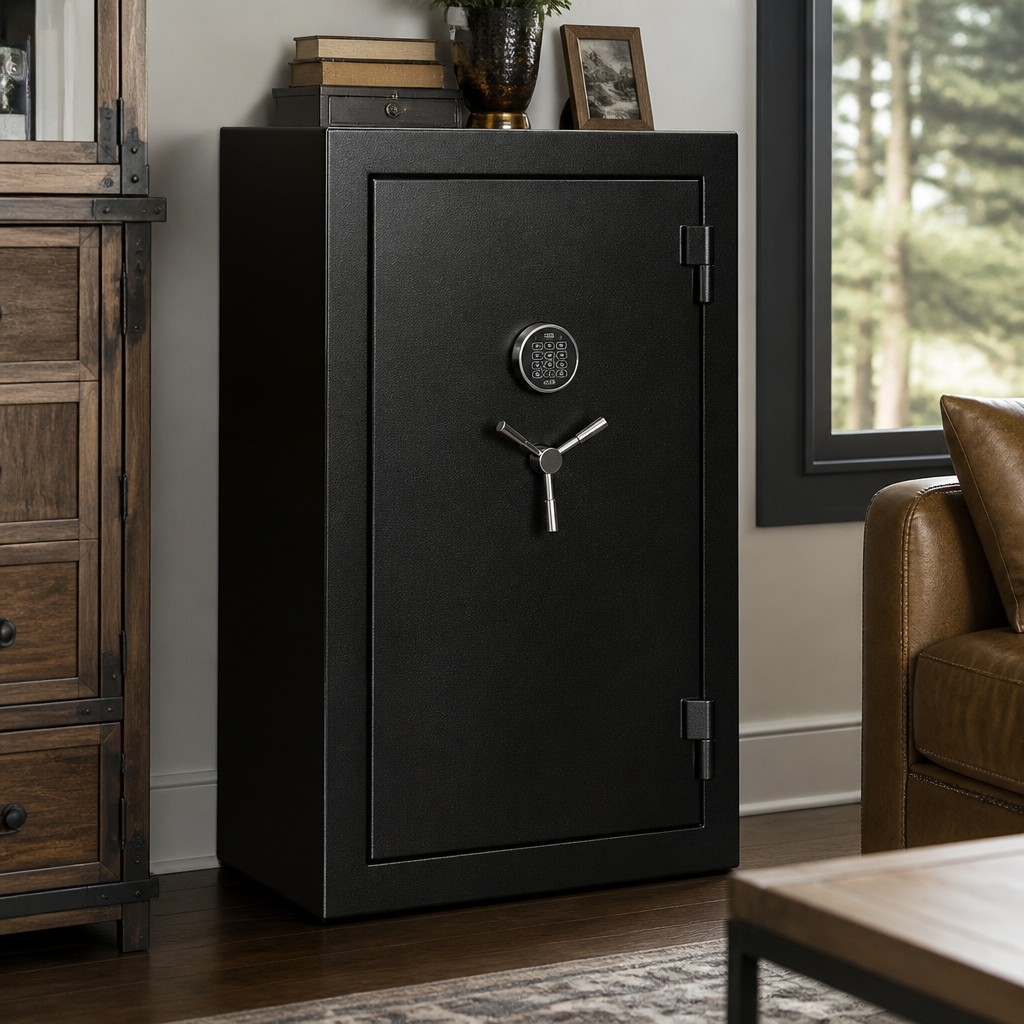
The Bighorn 24ECB Safe sits in a useful middle ground: large enough to serve as a serious home gun safe, compact enough to fit in a bedroom, closet, office, or garage without dominating the space. In practical terms, a mid-sized safe like the 24ECB is designed for owners who need real burglary resistance, organized storage, and fire protection, but who do not need the oversized footprint or budget of a full commercial-style vault. As a hub page for gun safe product reviews, this article uses the Bighorn 24ECB Safe as a reference point for what buyers should evaluate across the category: steel construction, locking systems, fire ratings, interior flexibility, installation demands, and long-term value.
When people search for a gun safe review, they usually want direct answers to a few specific questions. Is it secure enough for firearms and valuables? How much can it actually hold compared with the stated capacity? Is the lock reliable? Does the fire rating mean anything in real conditions? I have worked through these questions with many homeowners comparing models from Bighorn, Liberty, Winchester, Browning, and Cannon, and the same pattern appears every time: headline specifications matter, but the details behind those numbers matter more. A safe can look impressive in a listing and still fall short if the door flexes, the bolts are poorly supported, or the interior wastes space.
The Bighorn 24ECB Safe matters because it represents a common decision point in the market. Buyers moving beyond a basic cabinet often land in this tier, where they expect stronger materials, a more serious door, and a better fire seal, yet still want manageable delivery and installation. Understanding this safe helps readers assess the wider product review landscape within Gun Safes & Safety. It also creates internal context for comparing compact safes, long-gun safes, fireproof home safes, and electronic versus mechanical lock options. In other words, reviewing the Bighorn 24ECB properly is not only about one model; it is about establishing a method for judging the entire product category with confidence.
What the Bighorn 24ECB Safe Is Designed to Do
The Bighorn 24ECB Safe is positioned as a residential security container intended for firearm storage, document protection, and secure household valuables. The “24” in the name signals its nominal gun capacity, but experienced safe buyers know that manufacturer capacities assume slim, unscoped long guns stored closely together. In real-world use, especially if you own rifles with optics, slings, bipods, or modern chassis stocks, the functional capacity is usually lower. For most households, that means the 24ECB performs more realistically as a flexible storage unit for perhaps a dozen to eighteen long guns, plus handguns, ammunition, passports, jewelry, and hard drives, depending on the interior layout.
This role is important because a safe should match both present and near-future needs. I usually tell buyers to purchase more capacity than they think they need, because collections expand and storage becomes more complex over time. A mid-sized model like the Bighorn 24ECB works well for first serious safe buyers, growing families who need secure firearm access control, and homeowners who want one central location for regulated or high-value items. It is especially suitable where local space constraints rule out a 40-gun class safe but where a thin metal cabinet would be inadequate for theft deterrence.
Another core purpose of this safe is layered protection. No residential gun safe is invulnerable, and it should not be marketed as such. What better models do is delay attack, increase noise and effort, and discourage opportunistic theft while also protecting contents from heat and smoke for a defined period. In practical home security planning, that delay is what matters. If a burglar has to fight a reinforced door, active locking bolts, anchored weight, and a relocking mechanism, the odds of abandoning the attempt rise sharply, especially in occupied neighborhoods or homes with alarms and cameras.
Security Construction and Anti-Theft Features
Security begins with the body and door. On a safe like the Bighorn 24ECB, buyers should look closely at steel thickness, door edge design, hinge protection, and the number and depth of locking bolts. Many mid-sized safes advertise multiple large bolts, but bolt count by itself is not proof of strength. The real issue is how well the door frame resists prying, whether the boltwork engages securely on several sides, and whether the lock is protected by a hardened plate or other drill-resistant barrier. A good review should always separate cosmetic heft from structural security.
In this class, Bighorn generally aims to deliver visible anti-pry features and a more substantial door assembly than entry-level cabinets. That matters because pry attacks remain one of the most common real-world burglary methods against residential safes. A long pry bar applied to a weak upper corner can defeat a poorly designed door even when the lock itself never fails. A stronger door return, better frame reinforcement, and closely fitted tolerances reduce that vulnerability. If the safe also includes internal relockers, the lockwork may seize when a tamper attack is detected, adding another layer of resistance.
Electronic lock performance is another major review point. The Bighorn 24ECB uses an electronic lock configuration in many retail listings, and that offers speed and convenience. For families who need regular access while keeping children out, an electronic keypad is often easier than a dial. The tradeoff is maintenance and quality variation. A reliable electronic lock from a recognized maker can perform very well, but buyers should confirm battery access, lock brand, warranty terms, and override policies. The best practice is simple: replace batteries on a schedule, test the lock monthly, and keep the door open when changing codes. Those habits prevent the most common lockout scenarios.
| Review Factor | Why It Matters | What to Check on a Mid-Sized Safe |
|---|---|---|
| Steel body and door | Determines resistance to pry and cut attacks | Gauge rating, door thickness, reinforced frame |
| Locking bolts | Supports door retention during forced entry | Number of bolts, bolt diameter, multi-side engagement |
| Lock type | Affects speed, reliability, and maintenance | Electronic vs mechanical, battery access, brand quality |
| Fire protection | Protects paper and valuables during a house fire | Time and temperature rating, seal quality, test standard |
| Interior layout | Controls usable gun capacity and organization | Adjustable shelves, barrel supports, door storage |
| Anchoring options | Prevents thieves from tipping or removing the safe | Anchor holes, hardware access, suitable floor base |
Anchoring is non-negotiable. Even a heavy safe can be tipped for leverage or loaded onto a dolly if it is not bolted down. The 24ECB’s value improves significantly when installed on a concrete slab with proper anchors or on a reinforced floor system using manufacturer-approved hardware. In my experience, one of the biggest mistakes safe owners make is evaluating burglary protection without accounting for installation. A well-anchored mid-sized safe is materially harder to defeat than a larger unanchored one. That single detail often matters more than a few extra advertised locking bolts.
Fire Protection, Insulation, and What Ratings Really Mean
Fire protection is one of the most misunderstood parts of any gun safe review. A stated fire rating is not a universal guarantee, because manufacturers may use different testing methods, internal temperature targets, and rating durations. For paper documents, the common benchmark is keeping interior temperature below about 350 degrees Fahrenheit, since paper chars around that point. Media such as hard drives, USB devices, photographs, and some ammunition components can be more heat-sensitive, which means a gun safe with a residential fire rating should not be treated as equal to a purpose-built data safe.
For the Bighorn 24ECB Safe, the important question is not only the advertised fire duration but how the safe achieves it. Buyers should examine whether the insulation is drywall-based composite fireboard, whether the door includes an expanding heat seal, and whether the seams and lock area are built to reduce hot gas intrusion. In a house fire, smoke and steam can damage contents before direct flame penetrates the body. Better fire sealing helps mitigate that risk. This is why a balanced product review should discuss both the rating and the construction approach behind it.
Context also matters. According to the National Fire Protection Association, home fires can reach flashover conditions rapidly, but burn patterns vary by room contents, ventilation, and firefighting response time. A safe located on a concrete slab in a first-floor interior room may experience a different thermal exposure than one on an upper story surrounded by collapsing structure. Placement affects survivability. If fire protection is a primary concern, store critical documents in sealed sleeves inside the safe and avoid placing the unit where a fall through burned joists is likely. Good reviews should connect ratings to realistic home conditions rather than repeating brochure language.
Interior Space, Organization, and Everyday Usability
Usable storage is where many mid-sized safes win or lose value. The Bighorn 24ECB Safe is attractive because it promises enough room for a moderate firearm collection while still leaving shelf space for valuables. The catch is that advertised capacity rarely reflects actual ownership patterns. Scoped bolt rifles, AR-platform rifles with optics, shotguns with side saddles, and padded cases consume more room than old capacity formulas assume. A thoughtful review therefore focuses on shelf adjustability, barrel rest spacing, door pockets, and whether the interior can be split between long-gun storage and general household protection.
In daily use, organization matters almost as much as raw security. A crowded safe encourages careless stacking, stock damage, and slower access. Better interiors use adjustable shelving and fabric-covered panels to reduce scuffs while allowing owners to reconfigure storage as needs change. If you store passports, wills, estate documents, watches, cameras, and handguns alongside long guns, modular shelving becomes more valuable than one or two extra claimed rifle slots. This is one reason mid-sized safes remain popular: they function as hybrid security centers for the home, not just firearm boxes.
Usability also includes access ergonomics. Consider the swing of the door, the handle clearance, interior lighting compatibility, and whether dehumidifier access is straightforward. In humid climates, a GoldenRod-style dehumidifier or rechargeable desiccant system is strongly recommended to prevent rust, especially if firearms enter the safe after range use. I advise owners to think in terms of workflow: can you retrieve important papers during a power outage, can you reach a handgun shelf without moving rifles, and can you inspect the back corners easily? Those practical details determine whether the safe remains organized and secure over years of ownership.
How the Bighorn 24ECB Compares Within Product Reviews
As a hub for product reviews, this page should help readers compare the Bighorn 24ECB with the broader field. In the mid-sized residential segment, buyers are typically weighing tradeoffs among price, steel thickness, interior refinement, lock reputation, and dealer support. Bighorn often competes by offering a strong feature list for the money, especially for buyers who want visible anti-pry design and a usable fire rating without moving into premium pricing. Competing brands may offer stronger dealer networks, upgraded interiors, or more established lock packages, but often at a higher cost.
The best way to compare is by intended use. If your priority is maximum burglary resistance for the budget, inspect body gauge, door construction, boltwork, and anchor strategy before focusing on luxury finishes. If your priority is mixed household storage, interior flexibility may matter more than a few specification differences on paper. If fast access is critical, evaluate electronic lock responsiveness, keypad placement, and battery replacement design. This framework applies across all gun safe product reviews and helps prevent buyers from overvaluing marketing phrases while missing core performance issues.
The main takeaway is that the Bighorn 24ECB Safe fits a very common need exceptionally well: it provides a meaningful step up from entry-level storage without demanding the money, floor loading, or footprint of a giant safe. That makes it a strong reference model for the Product Reviews subtopic within Gun Safes & Safety. Use it as a benchmark when reading related reviews on compact safes, larger 36-gun and 48-gun models, biometric handgun safes, and fire-rated home safes. Compare construction, fire strategy, real capacity, and installation requirements side by side before you buy. If you are building a safer home storage plan, start by listing what you need to protect, measure your space carefully, and shortlist the Bighorn 24ECB against two or three direct competitors.
Frequently Asked Questions
What makes the Bighorn 24ECB Safe a good fit for homeowners who want strong security without buying an oversized safe?
The Bighorn 24ECB Safe is appealing because it fills a very practical niche. Many buyers want more protection and better storage than a small cabinet or entry-level lockbox can provide, but they do not have the room, need, or budget for a massive commercial-style vault. That is where a mid-sized safe like the 24ECB stands out. It is large enough to function as a serious home gun safe, yet compact enough to fit in common residential spaces such as a bedroom, closet, office, or garage without overwhelming the room.
From a security standpoint, this size category often makes the most sense for households that want meaningful burglary resistance and fire protection in a manageable footprint. A safe in this class is typically easier to position in the home, easier to integrate into a daily access routine, and often easier to install in a way that improves security, such as placing it in a corner or bolting it down to a concrete slab or reinforced floor. In other words, the safe is large enough to protect valuable firearms and related gear, but not so large that it becomes impractical for average homeowners.
The 24ECB is especially well suited to owners who want organized internal storage for rifles, handguns, ammunition, documents, and accessories while still maintaining a reasonable balance between cost and protection. Instead of paying for unused capacity, buyers in this category are usually investing in a more efficient layout and stronger protection than they would get from lower-tier storage options. For many people, that makes the Bighorn 24ECB one of the most sensible “middle ground” choices in the gun safe market.
How much can the Bighorn 24ECB Safe realistically store, and is it only useful for firearms?
Although the exact usable capacity always depends on the dimensions of your firearms and how the interior is configured, a safe like the Bighorn 24ECB is generally designed to hold a meaningful collection without requiring a dedicated vault room. That makes it a strong choice for gun owners who need space for several long guns, handguns, optics, magazines, ammunition, and important accessories. In real-world use, the stated capacity on safes is often based on tightly packed firearm counts, so buyers should think in terms of practical storage rather than advertised maximums. Scoped rifles, slings, wider stocks, and shelves used for gear can all reduce the number of long guns that fit comfortably.
One of the biggest advantages of a mid-sized safe is that it is not limited to firearms. In fact, many owners use a safe like the 24ECB as a central security hub for a range of valuables. That can include passports, legal papers, backup drives, jewelry, emergency cash, family records, collector items, and sentimental keepsakes. If the safe includes adjustable shelving or interior storage features, it becomes much easier to separate firearms from smaller valuables and keep everything accessible instead of stacked in a way that wastes space.
This versatility is one reason mid-sized safes remain so popular. They offer enough room to support a growing firearm collection while also replacing the need for multiple smaller lockboxes throughout the home. For buyers trying to improve both security and organization, the 24ECB can serve as more than a gun safe; it can become the primary protected storage point for the household’s most important possessions.
How secure is the Bighorn 24ECB Safe against burglary, and what should buyers look for beyond the basic lock?
Burglary protection is about far more than whether a safe has a locking door. A well-designed safe in this category is intended to slow down unauthorized entry with reinforced steel construction, a solid door, internal locking components, and a design that resists quick pry attacks. For most homeowners, the goal is not absolute invulnerability but meaningful delay and deterrence. In a real break-in, thieves often want the fastest route to valuables. A substantial safe that is properly installed can make that route significantly harder.
When evaluating the Bighorn 24ECB or any comparable model, buyers should consider several factors together. Steel thickness matters because it influences how resistant the body and door are to forced entry attempts. Locking bolt coverage is important because it helps secure the door across multiple points rather than relying on a single latch area. Door fit and frame design also matter, especially in terms of how much pry resistance they provide. Relockers, hardened plates, and protected lock areas are useful security features because they add another layer of difficulty if someone attempts to attack the lock directly.
Just as important is installation. Even a good safe becomes more vulnerable if it is left freestanding and unanchored. Bolting the safe down is one of the smartest steps an owner can take because it helps prevent thieves from tipping, moving, or removing the unit to attack it elsewhere. Placement matters too. A safe installed in a tight corner, closet, or recessed area can reduce access to pry bars and tools. So while the Bighorn 24ECB’s built-in security features are important, its real-world effectiveness depends heavily on setup, location, and how well the owner uses the safe as part of a broader home security plan.
Does the Bighorn 24ECB Safe offer meaningful fire protection for important items?
For many buyers, fire protection is one of the biggest reasons to step up from a simple steel cabinet to a true safe. A safe like the Bighorn 24ECB is intended to provide a protective barrier during a residential fire, helping shield firearms, documents, and valuables from heat exposure for a specified period under rated conditions. That added protection can be extremely valuable because house fires often develop quickly, and even items that survive flames can be damaged by intense heat, smoke, or the collapse of nearby materials.
That said, fire protection should always be understood realistically. Fire ratings are based on testing standards and controlled conditions, which means real-world outcomes can vary depending on the intensity of the fire, how long it burns, where the safe is located, and whether firefighting efforts introduce water and steam into the environment. A safe with a fire rating offers an important layer of defense, but it is not a guarantee that every item inside will emerge untouched under every possible scenario.
Buyers who plan to store critical paperwork, digital media, photos, or other sensitive materials should think carefully about layering protection inside the safe. Fire-resistant document sleeves, sealed containers, and media-specific storage solutions can be useful additions. Placement can help as well; for example, locating the safe on a lower floor and away from highly combustible storage areas may reduce certain risks. In practical terms, the Bighorn 24ECB’s fire protection is best viewed as an important benefit that adds real value, especially for homeowners who want one secure place to protect both firearms and irreplaceable household records.
Where should the Bighorn 24ECB Safe be installed, and what setup steps help it perform at its best?
The best installation location for the Bighorn 24ECB Safe is one that balances accessibility, discretion, structural support, and security. Because it is a mid-sized model, it can fit in several practical areas that would be difficult for a larger vault-style safe. Common choices include a master bedroom closet, a home office, a secured garage area, or a low-visibility room that is convenient for the owner but not obvious to guests or intruders. The right location depends on how often you need access, what you are storing, and whether the surrounding space helps limit visibility and physical attack angles.
Floor strength matters, especially if the safe will be installed on an upper level. Many homeowners prefer ground-floor or concrete-slab placement because it simplifies anchoring and provides strong support. In garages, owners should consider temperature swings, moisture, and the possibility of increased humidity, which may make dehumidification or protective interior accessories important. In closets or offices, the advantage is often better concealment and more stable indoor conditions.
Bolting the safe down is one of the most important setup steps you can take. Proper anchoring makes the safe substantially harder to remove or tip over during a burglary attempt. It is also wise to leave enough room to fully open the door and access shelves comfortably while still keeping the safe positioned in a way that limits tool access to the sides. Inside the safe, thoughtful organization improves both usability and long-term protection. Store firearms with enough spacing to avoid damage, separate important documents from heavier gear, and consider moisture control products to protect metal items from rust.
Ultimately, the Bighorn 24ECB performs best when it is treated not just as a purchase, but as part of a complete storage strategy. Smart placement, proper anchoring, interior organization, and routine maintenance all help the safe deliver the mix of security, convenience, and protection that makes a mid-sized model so useful in everyday home ownership.