
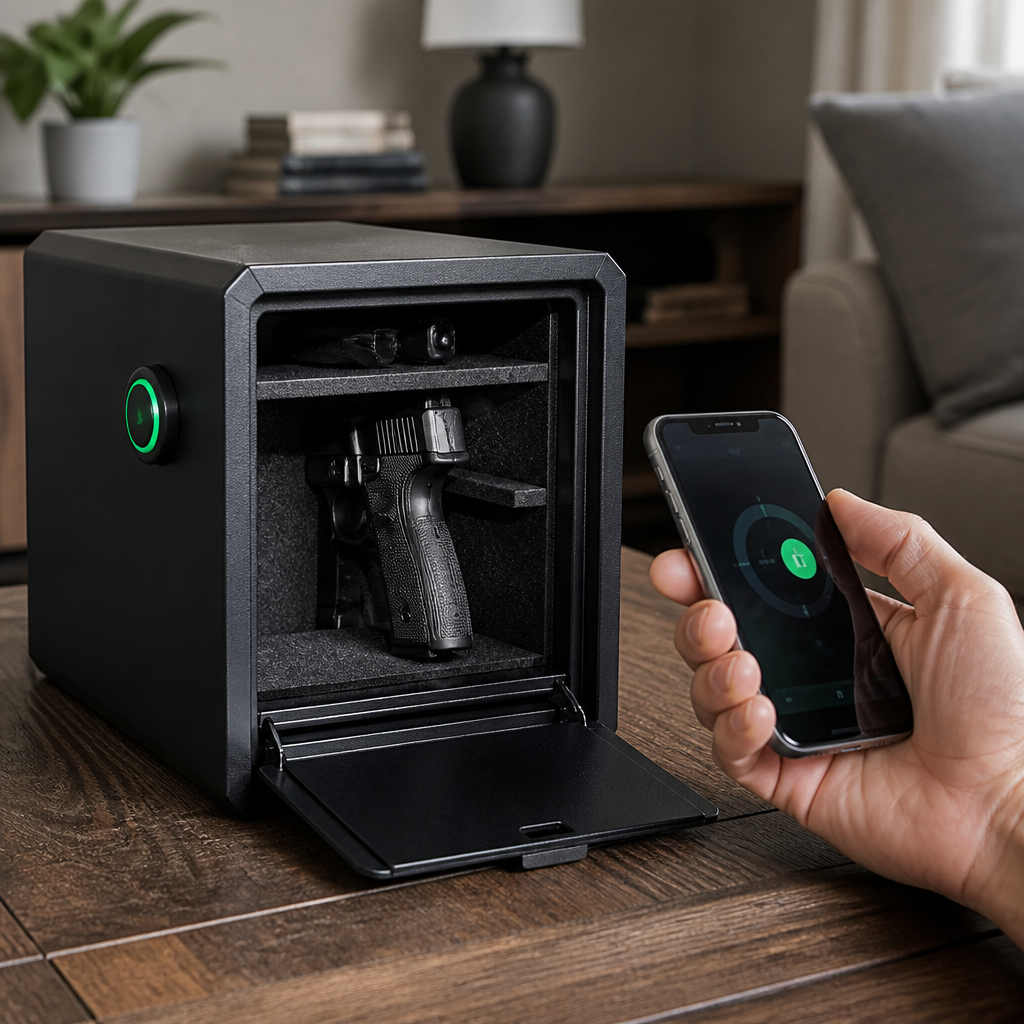
Gunbox 2.0 is a compact, app-controlled handgun safe designed for owners who want faster access, modern monitoring, and stronger day-to-day security than a basic lockbox can provide. In the gun safes and safety category, it sits at the intersection of product review, safe storage guidance, and connected-home technology. That matters because handgun storage is no longer judged only by steel thickness and lock type. Buyers now compare biometric speed, mobile alerts, tamper response, battery resilience, portability, and whether a safe fits the realities of a nightstand, vehicle, office, or travel routine. I have tested enough handgun safes to know that the biggest difference between a good product and a frustrating one is not marketing language; it is whether the safe works reliably when a user is under stress at two in the morning.
As a hub article for product reviews in the broader gun safes and safety topic, this guide looks at what Gunbox 2.0 is, how it works, where it performs well, where it has limitations, and how to evaluate it against competing pistol safes. A handgun safe is a small secure container built to prevent unauthorized access while allowing the owner to retrieve a firearm quickly. App-controlled means the unit pairs with a smartphone to manage settings, review events, and in some cases receive alerts. The appeal is obvious: owners want responsible storage without adding too much delay. The challenge is equally obvious: any connected security device must balance convenience with reliability, cybersecurity, and mechanical durability.
Gunbox 2.0 has drawn attention because it packages several premium features into a small form factor. Depending on configuration, users may get biometric access, keypad or button entry, Bluetooth or mobile app connectivity, location-oriented features, internal battery power, and portable mounting options. Those features make it relevant not just to first-time buyers but also to experienced handgun owners comparing bedside safes, vehicle safes, and travel-ready lockboxes. Product reviews in this segment should do more than list features. They should explain how lock methods behave in real use, what tradeoffs come with electronics, and which buyer profiles benefit most. That is the goal of this review hub: to provide a practical, technically grounded overview you can use before reading deeper model-by-model comparisons.
Why does this matter beyond one product? Because the stakes of handgun storage are high. The U.S. Centers for Disease Control and Prevention, the American Academy of Pediatrics, and major firearm safety organizations all emphasize secure storage as a core risk-reduction practice, especially in homes with children, teenagers, guests, or vulnerable adults. A modern handgun safe should reduce unauthorized access, discourage smash-and-grab theft, and still remain usable in an emergency. Gunbox 2.0 is part of a broader shift toward smarter safes, and understanding it helps buyers judge the entire product review landscape more clearly.
What Gunbox 2.0 Is and How It Fits the Handgun Safe Market
Gunbox 2.0 is best understood as a premium personal-access safe rather than a full theft-resistant home safe. Its core purpose is rapid-access storage for one handgun and small essentials such as a spare magazine, ID, or compact valuables. In market terms, it competes with portable biometric lockboxes from brands such as Vaultek, Hornady, LifePod, and StopBox, though each brand approaches access speed and security differently. Gunbox focuses on connected features and compact design, which makes it especially relevant for bedside use, office storage, and controlled transport.
That positioning matters because many buyers confuse storage categories. A portable handgun safe is not equivalent to a heavy residential security container bolted into a closet floor. The former prioritizes access and convenience; the latter prioritizes burglary resistance and capacity. Gunbox 2.0 belongs in the first category. That does not make it unimportant. In fact, for owners who carry daily or keep a home-defense pistol accessible, a compact quick-access safe is often the product used most often. In my experience, frequent-use safes expose design flaws quickly. A lid that opens awkwardly, an app that disconnects, or a fingerprint reader that fails with damp hands will stop earning trust within days.
Gunbox 2.0 also fits the product review landscape because it pushes the question many buyers now ask: should a gun safe be smart? For some users, app connectivity is a genuine upgrade. Notifications can confirm when the safe was opened, battery status can be checked remotely, and settings can be managed without physically reprogramming the unit. For others, every wireless feature is another possible failure point. A strong review does not take either side as dogma. It asks whether the smart features are implemented in a way that supports the primary mission of secure, dependable handgun storage.
Core Features Buyers Evaluate in a Gunbox 2.0 Review
The feature set is the main reason Gunbox 2.0 stands out in handgun safe reviews. Buyers generally evaluate five areas: access methods, construction, power system, connectivity, and mounting or portability. Access methods can include biometric unlocking, app-based controls, and physical input options. A good safe must provide more than one way in. Biometrics can be fast, but no fingerprint sensor is perfect. Backup access is essential if fingers are wet, dirty, cut, or misaligned. The best rapid-access safes let users build redundant entry paths without compromising security.
Construction quality matters just as much as electronics. Reviewers should look at shell material, pry resistance at the lid seam, hinge protection, interior padding, and latch design. Compact safes do not need to survive a prolonged professional burglary attempt to be useful, but they should resist casual tampering and forced entry long enough to deter opportunistic theft. In practical terms, a safe kept loose in a car is less secure than one tethered or mounted, regardless of electronics. That is why mounting hardware and anchor compatibility deserve attention in any product review.
Battery design is another major factor. Rechargeable internal batteries can be convenient, but buyers need clarity about run time, charging frequency, and what happens if power is depleted. Good designs provide low-battery warnings well in advance and preserve local access during charging. Connectivity is the final differentiator. If the app is polished, stable, and transparent about permissions, it can add real value. If pairing is inconsistent or controls are buried in a poor interface, the safe becomes harder to trust. In connected products, software quality is part of security quality.
| Review Criterion | Why It Matters | What to Check on Gunbox 2.0 |
|---|---|---|
| Access speed | Determines emergency usability | Fingerprint recognition consistency, lid opening time, backup entry options |
| Build quality | Affects tamper resistance and lifespan | Shell rigidity, hinge protection, latch strength, interior fit and finish |
| App performance | Shapes daily user experience | Pairing stability, alert reliability, settings clarity, firmware support |
| Power management | Prevents lockouts and downtime | Battery life, charge indicators, low-power behavior, charging method |
| Mounting and portability | Defines theft resistance in real environments | Cable options, bracket quality, vehicle fit, nightstand footprint |
Real-World Performance: Bedside, Vehicle, Office, and Travel Use
Gunbox 2.0 should be judged by context, because no handgun safe performs identically in every environment. At a bedside, speed and quiet operation matter most. A safe that can open quickly in low light without loud beeps or awkward hand placement has an advantage. Owners with spouses or children in the home also benefit from access logs and status awareness, because a connected app can confirm whether the safe is closed and secured. In this role, compact footprint matters. A bulky unit often gets moved to a less useful location, which defeats the point of fast-access storage.
Vehicle use is more complicated. A portable safe inside a car can reduce unauthorized access during short stops, but a car is not a good long-term firearms storage environment. Heat, cold, humidity, vibration, and theft exposure are all higher than inside a home. Reviews should therefore focus on whether Gunbox 2.0 can be secured effectively to the vehicle structure, whether its finish and electronics tolerate temperature swings, and whether access remains reliable when the safe is mounted in a tight console or under-seat space. In my testing across compact lockboxes generally, the products that look sleek on a desk can become inconvenient in a cramped vehicle install if cable routing and lid clearance were not thoughtfully engineered.
For office use, discretion becomes important. A handgun safe kept in a drawer or personal office should open smoothly without attracting attention, fit within employer policies and local law, and protect the firearm from unauthorized access by cleaning staff, visitors, or coworkers. Here, app alerts may be especially useful because they create accountability. For travel, Gunbox 2.0 must be assessed against airline rules, hotel use realities, and state or local transport laws. Travelers should remember that portable does not automatically mean compliant in every setting. Review articles should always separate convenience claims from legal and procedural requirements.
Security Strengths and Important Limitations
Gunbox 2.0 offers meaningful security advantages over leaving a handgun in a drawer, backpack, glove compartment, or under a mattress. That should be stated clearly. Even a compact safe creates a physical barrier, slows access by unauthorized users, and reinforces consistent storage habits. For many households, that alone is a major safety improvement. The combination of controlled access and event awareness can also help owners spot misuse quickly. If a unit records openings or sends alerts, users gain more visibility than they would with a simple keyed box.
Still, buyers should understand the limitations of this product class. A compact app-controlled handgun safe is not designed to defeat determined thieves equipped with time and tools. Its job is delay, deterrence, and access control, not vault-level protection. Thin-gauge portable safes can be attacked if they are not anchored, and any electronic lock depends on battery health and component quality. Wireless features introduce another layer of risk. Reputable design can minimize practical exposure through encrypted communication, secure pairing, and sane permission controls, but buyers should still keep firmware updated and avoid treating connectivity as a substitute for physical security.
The most balanced conclusion is that Gunbox 2.0 is strongest when used as intended: quick-access controlled storage in a managed environment. It becomes weaker when users expect it to perform like a large burglary-rated container. That is not a flaw unique to Gunbox; it is the central tradeoff of nearly every rapid-access pistol safe. Product reviews that ignore this distinction usually mislead readers. The right question is not whether Gunbox 2.0 is invincible. The right question is whether it materially improves secure access for the specific way you store and use a handgun.
How Gunbox 2.0 Compares with Other Product Review Categories
As a sub-pillar hub for product reviews, this page should also help readers understand where Gunbox 2.0 fits among adjacent review categories. Compared with non-electronic lockboxes, Gunbox 2.0 typically offers faster repeat access and more convenience features, but it also demands more from the user in charging, setup, and software trust. Compared with biometric-only safes that have no app layer, it can provide more oversight and customization. Compared with larger bedside vaults, it often sacrifices brute-force resistance and interior capacity for portability and footprint.
That comparison framework is useful when planning internal review paths. Readers interested in Gunbox 2.0 often also want breakdowns of the best biometric handgun safes, vehicle gun safes, travel gun cases, bedside pistol safes, and app-enabled smart safes. They also benefit from articles on mounting methods, battery maintenance, and safe placement in homes with children. In other words, a Gunbox review is rarely a standalone decision. It is a gateway to a broader buying process shaped by use case, budget, and tolerance for electronic complexity.
From an editorial standpoint, the strongest product review hubs answer three practical questions directly. Who is this safe for? What compromises does it require? What alternatives should be considered before buying? For Gunbox 2.0, the likely fit is the owner who values compact size, modern controls, and monitoring features, and who understands that daily-use handgun storage is about disciplined habits as much as hardware. The compromises are clear: electronics require upkeep, app ecosystems vary in polish, and portability reduces absolute theft resistance compared with larger anchored units.
Buying Advice, Setup Priorities, and Final Evaluation
If you are considering Gunbox 2.0, start with your environment before you start with the spec sheet. Measure the intended location, decide whether the safe will be mounted or portable, and choose your preferred access sequence under stress. Register multiple fingerprints if biometrics are available, test backup entry methods, and run practice opens in darkness and from awkward angles. If the app is part of your reason for buying, review its permissions, confirm alert behavior, and check whether the manufacturer provides firmware updates and support documentation. A handgun safe that is easy to configure correctly is usually safer in daily life than a technically impressive model with a confusing setup process.
Also decide what problem you are solving. If your main concern is keeping a defensive handgun accessible but away from children or visitors, Gunbox 2.0 may be a strong option. If your main concern is smash-and-grab theft from a vehicle, prioritize secure mounting and understand the limits of any portable pistol safe. If your main concern is long-term storage for multiple firearms, a larger cabinet or residential security container is the better product category. Matching the safe to the threat model is the most important buying principle I have learned from reviewing handgun safes over time.
Gunbox 2.0 earns attention because it reflects where handgun safe design is heading: compact hardware paired with software, alerts, and user personalization. Its value is real when buyers use it for quick-access storage and maintain it properly. Its weaknesses are equally real when portability is mistaken for high theft resistance or when connected features are trusted without regular testing. The best takeaway is simple. Evaluate Gunbox 2.0 as a serious rapid-access handgun safe with smart features, not as a one-size-fits-all answer. Then compare it against your actual routine, read model-specific product reviews, and choose the safe you will secure, test, and use consistently.
Frequently Asked Questions
What makes Gunbox 2.0 different from a traditional handgun lockbox?
Gunbox 2.0 stands out because it combines physical firearm storage with smart, connected security features that a standard lockbox usually does not offer. A traditional lockbox typically focuses on basic containment: steel construction, a keyed or mechanical lock, and a simple way to keep unauthorized users out. Gunbox 2.0 adds another layer by giving handgun owners faster access options, app-based controls, real-time monitoring, and tamper-aware functionality that better fits modern daily use.
For many buyers, the difference comes down to convenience and awareness. With a basic lockbox, you generally do not know whether the box has been moved, opened, or tampered with unless you physically inspect it. With an app-controlled safe like Gunbox 2.0, owners may be able to receive alerts, check status, review access activity, and manage settings from a mobile device. That makes it especially appealing for people who want more than storage alone and prefer an active role in monitoring their firearm security.
Another major distinction is access speed. In emergency-access scenarios, many owners want a solution that opens more quickly than digging for a key or spinning a mechanical combination. Depending on configuration, connected and biometric-style safes can reduce friction while still helping restrict access from children, guests, or unauthorized adults. In short, Gunbox 2.0 is not just a container for a handgun. It is designed as a technology-enabled storage system that prioritizes quick access, modern oversight, and practical day-to-day usability.
Is an app-controlled handgun safe like Gunbox 2.0 actually secure?
Yes, an app-controlled handgun safe can be secure, but the right way to evaluate it is to look at the full security picture rather than focusing on the app alone. Security starts with the safe’s physical construction, locking mechanism, resistance to tampering, and ability to prevent unauthorized access inside the home. A connected app is best understood as an added control layer, not the only layer. If Gunbox 2.0 is well built and designed with strong local access controls, the app can improve security by adding monitoring, notifications, and user management.
That said, smart safes should be judged by both physical and digital security standards. On the physical side, buyers should consider how the safe handles forced-entry attempts, whether it can be secured to a fixed surface, and how it responds if someone tries to move or pry it open. On the digital side, it is wise to review account protections, pairing methods, firmware update support, and whether the manufacturer has a track record of maintaining connected features over time. Mobile access can be a genuine advantage, but only when the product is designed with modern cybersecurity practices in mind.
For most responsible handgun owners, the biggest real-world benefit is that app integration can encourage better habits. Alerts can make owners aware of suspicious activity, status checks can reduce uncertainty, and configurable access can help streamline secure storage as part of a daily routine. No handgun safe should be considered invulnerable, but a well-executed connected safe can absolutely be a secure and practical option when it balances strong physical design with dependable smart protections.
How fast and reliable is biometric or smart access on Gunbox 2.0 for everyday use?
Speed and reliability are two of the most important considerations when choosing a handgun safe, especially for owners who need a balance between rapid access and responsible storage. A product like Gunbox 2.0 is designed to improve access time compared with older lock-and-key solutions, and that can be a meaningful advantage in real life. Fast entry matters most when the safe is being used routinely, such as at bedside, on a desk, or in another controlled location where authorized access may need to happen under stress or low light.
Reliability, however, matters even more than raw speed. A biometric reader or smart-access system is only valuable if it performs consistently across repeated use. Factors such as finger placement, moisture, dirt, battery level, and app connectivity can all affect user experience. That is why owners should think beyond marketing claims and focus on whether the safe offers dependable backup entry methods, clear status indicators, and a setup process that allows access methods to be tested thoroughly before relying on the unit day to day.
In practice, the best approach is to treat any smart safe as a system that should be trained with and tested regularly. Users should enroll prints carefully if biometrics are involved, practice opening the safe under realistic conditions, and confirm that backup access works every time. A high-tech safe like Gunbox 2.0 can offer excellent convenience, but its real value comes from consistent performance under normal household conditions. For many buyers, that combination of quick access plus routine verification is what makes a smart handgun safe worth considering.
What should buyers know about battery life, power loss, and backup access?
Battery resilience is a critical part of evaluating any electronic handgun safe, and it is one of the first things practical buyers should examine before purchasing. Because Gunbox 2.0 relies on electronic features such as app connectivity and potentially biometric access, owners need confidence that the unit will remain dependable over time and will not become a liability when power runs low. A quality smart safe should make battery status easy to track and should provide enough warning before power becomes an access problem.
Power loss planning is where better-designed safes separate themselves from gadget-first products. Buyers should look for clear low-battery alerts, predictable charging or replacement requirements, and a backup entry method that does not depend on perfect app performance. In a defensive-storage product, redundancy is not optional. Whether that backup is a secondary code, a manual override, or another built-in access path, it should be easy to understand and test. Owners should never assume that because a safe is connected, it will always be ready without maintenance.
The most responsible way to use Gunbox 2.0 is to build power management into your routine. Check battery levels regularly, follow the manufacturer’s maintenance guidance, and test every available entry method before you need it in a high-stress moment. Smart monitoring features are valuable, but dependable access during ordinary use and during edge cases is what really matters. If Gunbox 2.0 delivers strong battery warnings and sensible failover options, it can offer both convenience and peace of mind without sacrificing preparedness.
Who is Gunbox 2.0 best for, and is it a good choice for safe handgun storage at home?
Gunbox 2.0 is best suited for handgun owners who want more than simple lock-and-key storage and who value fast access, connected monitoring, and modern convenience as part of their safety plan. It can be a strong fit for people who keep a handgun for home defense, store a firearm in a bedroom or office, or want a compact safe that integrates better with daily routines than a heavier, more traditional box. Its appeal is especially strong for buyers who are already comfortable using smart-home or app-based security products.
As a home-storage option, it can be a very good choice when used correctly and in the right setting. Compact handgun safes are typically designed for quick access and access control rather than long-gun storage or high-volume theft resistance. That means Gunbox 2.0 should be evaluated based on its intended role: helping secure one handgun from children, visitors, and opportunistic access while still allowing authorized users to open it quickly. For many households, that is exactly the problem they are trying to solve.
Still, no single safe is right for every owner. Buyers with larger collections, higher burglary concerns, or a need for maximum fire and theft protection may still want a full-size gun safe for primary storage, using a compact smart safe only for rapid-access purposes. The best way to think about Gunbox 2.0 is as a specialized solution for accessible, controlled handgun storage. If your priority is a blend of speed, monitoring, compact design, and everyday usability, it may be an excellent match. If your priority is deep long-term storage or broad collection protection, it is better viewed as part of a larger firearm security strategy rather than the entire solution.