
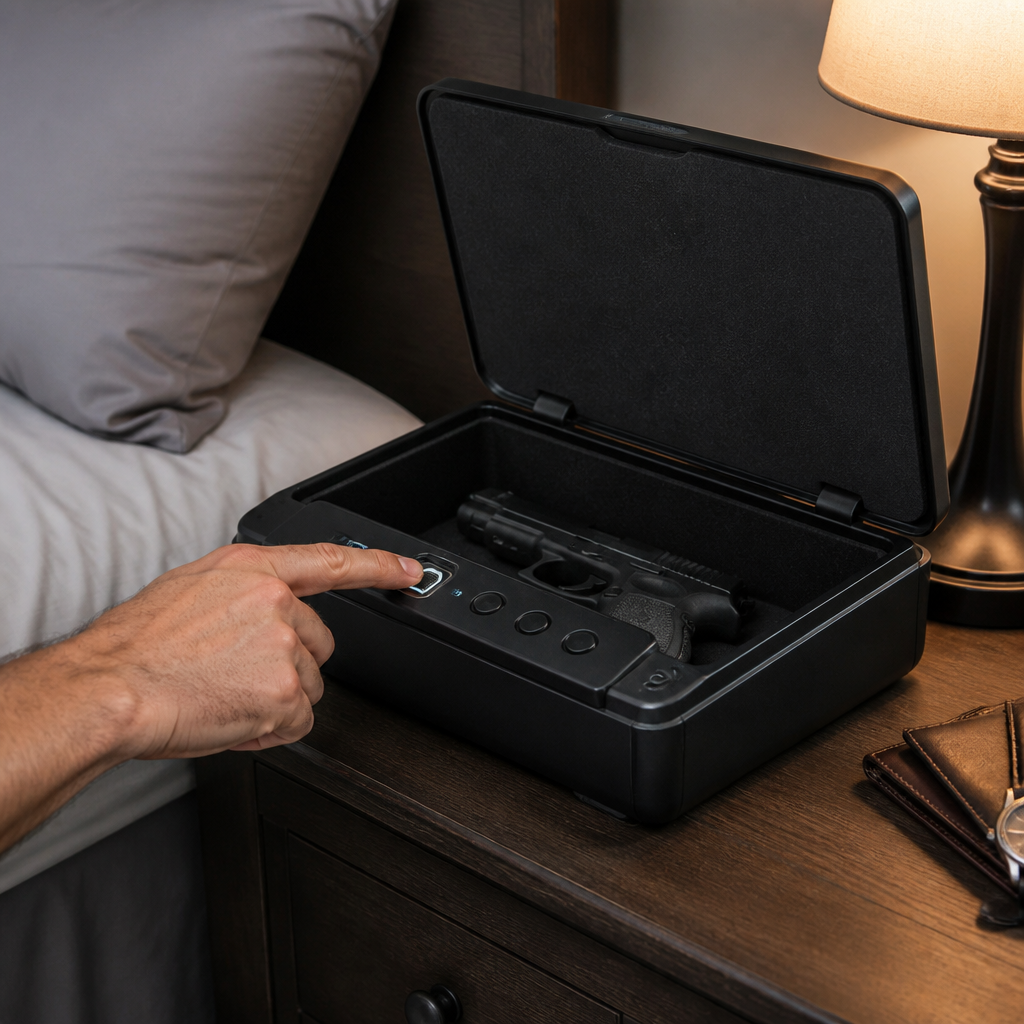
The SentrySafe QAP1BE is a compact biometric handgun safe built for one job: keeping a defensive pistol secured while making it available in seconds when speed matters most. In the broader world of gun safes and safety, quick-access handgun storage sits at the intersection of home defense, child safety, theft deterrence, and responsible ownership, which is why this category deserves more scrutiny than many buyers give it. A biometric handgun safe uses a fingerprint reader to release the lock, usually alongside backup entry methods such as a keypad or override key, and the promise is simple: faster access than a traditional key lock without leaving a firearm unsecured in a drawer or nightstand. I have evaluated many bedside and vehicle-style pistol safes over the years, and the QAP1BE represents a familiar design philosophy from a major brand: prioritize immediate access, compact placement, and straightforward setup over high-capacity storage or heavy burglary resistance.
That framing matters because buyers often confuse different safe categories. A full-size gun safe is designed for long-gun storage, fire protection, and longer attack resistance. A handgun lockbox may be portable but slow to open. A quick-access biometric safe like the SentrySafe QAP1BE is a niche product intended for a loaded defensive handgun, spare magazine, and little else. Understanding that intended use prevents disappointment and improves safety planning. If you want a bedside safe for a Glock 19, SIG Sauer P365, Smith & Wesson M&P, or similar pistol, the QAP1BE enters the conversation because it offers biometric entry, gas strut-assisted opening, steel construction, and a footprint small enough for a dresser, closet shelf, or vehicle mounting position. As a sub-pillar hub for product reviews within Gun Safes & Safety, this guide explains what the QAP1BE does well, where it falls short, who it fits, and how to evaluate comparable handgun safes with the same discipline you would use for any other life-safety product.
What the SentrySafe QAP1BE Is Designed to Do
The SentrySafe QAP1BE is best understood as a fast-entry pistol safe rather than a true burglary safe. It stores a single primary handgun and typically accommodates one spare magazine, small flashlight, or compact valuables depending on the firearm’s dimensions. The biometric reader is the headline feature, but the real value is the system around it: a tamper-resistant steel body, pry-resistant door design, compression gas strut for assisted opening, interior lighting in many units, and silent-access options that matter in low-light conditions. Buyers looking for a biometric handgun safe for quick access usually ask three practical questions: How fast does it open, how reliably does it read fingerprints, and can it be secured to furniture or a vehicle? Those are the right questions, because no bedside safe is useful if it fails in a stress event or can be carried off easily.
In day-to-day use, the QAP1BE aims to solve a real household problem. Many owners want a loaded handgun nearby for lawful defensive use but do not want children, guests, or unauthorized adults to reach it. Leaving a pistol loose in a drawer is negligent. Using a keyed box can be too slow under pressure and introduces key control problems. A biometric safe addresses both issues if the scanner is consistent and if the user practices access. The QAP1BE is especially relevant for apartment dwellers, parents with young children, shift workers who need a predictable storage routine, and travelers moving between temporary residences where a full gun safe is impractical. It is not a replacement for deep storage; it is an access-control device for a single critical firearm.
Core Features, Build Quality, and Everyday Usability
SentrySafe has long operated in the consumer security market, and its handgun safes typically follow a conservative design that emphasizes usability over novelty. The QAP1BE uses a steel housing with a lift-open lid and foam-lined interior to protect the handgun from shifting and cosmetic wear. The biometric scanner is positioned for natural hand placement, and most users can program multiple fingerprints, which is important for redundancy. In my experience, the best practice is to enroll the same finger several times at slightly different angles, then add at least one finger from the support hand. That approach improves real-world reliability more than any marketing claim about scanner speed. Quick-access safes are used in darkness, under stress, and often with dry skin, sweat, or minor finger placement errors, so setup quality directly affects performance.
The opening mechanism is another meaningful part of the user experience. On the QAP1BE, the lid rises with gas strut assistance, reducing the fumbling that can happen with spring-only lids that snap open awkwardly or require two-handed repositioning. Interior space is enough for many compact and full-size handguns, but fit depends on sights, mounted optics, and weapon lights. That limitation is common across the category. Owners of optic-ready pistols or lights such as the Streamlight TLR-7 or SureFire XSC should verify dimensions before buying, because compact external measurements can hide restrictive interior geometry. The QAP1BE generally suits traditional handgun profiles better than heavily accessorized setups. If your bedside gun includes a red dot, suppressor-height sights, and a rail light, you should confirm compatibility instead of assuming all one-gun biometric safes fit modern carry configurations.
| Evaluation Area | What to Check | Why It Matters |
|---|---|---|
| Biometric scanner | Enroll one finger multiple times, test with dry and damp hands | Improves access reliability under stress |
| Interior dimensions | Measure gun with magazine, optic, and light installed | Prevents fit issues after purchase |
| Mounting method | Use factory hardware into solid wood or approved anchor points | Reduces smash-and-grab theft risk |
| Backup entry | Confirm keypad or key access works in darkness | Provides redundancy if scanner fails |
| Placement | Test reach from bed, dresser, or vehicle position | Speed depends on location as much as lock type |
Biometric Performance: Speed, Reliability, and Limitations
Fingerprint access is the feature that sells the QAP1BE, but it is also the feature buyers should evaluate most critically. Biometric locks are fast when conditions are favorable and setup is done correctly. They are not magic. Fingerprint sensors can struggle with dirty fingers, cuts, heavy calluses, extreme dryness, or rushed placement. The better question is not whether the safe opens instantly in a controlled demonstration, but whether it opens consistently at 2 a.m. with adrenaline, poor lighting, and imperfect technique. From that perspective, the QAP1BE performs like many mainstream biometric handgun safes: acceptable when properly enrolled and practiced, but strongest when treated as one access method within a layered system rather than the sole point of confidence.
That is why backup entry options matter. A serious quick-access safe should allow alternate access through a code or physical override key, and the owner should rehearse those methods. I advise buyers to run repeat drills after setup: scanner access with dominant hand, scanner access with support hand, keypad access in darkness, and retrieval from the exact place the safe will live. This reveals practical issues immediately. For example, some users discover their nightstand height changes wrist angle enough to reduce scanner consistency. Others find the lid opens into a wall or lamp. These details sound small until they affect a defensive access sequence. The QAP1BE can work very well in routine conditions, but any biometric handgun safe is only as reliable as the owner’s setup, maintenance, and repetition.
Security Expectations: What It Protects Against and What It Does Not
One of the most important points in any handgun safe review is setting realistic security expectations. The SentrySafe QAP1BE is designed to prevent unauthorized access and opportunistic theft, not to resist a prolonged attack with heavy tools. That distinction is essential. In a home with children, teenagers, housekeepers, contractors, or frequent visitors, a secured bedside safe dramatically reduces the chance of negligent access. If bolted down correctly, it also frustrates quick grab-and-go theft. Those are major benefits. But no compact quick-access safe should be mistaken for a heavyweight TL-rated commercial safe or even a large residential gun safe with substantial steel thickness and anchored mass.
The practical test is simple: what threat are you trying to defeat? If the answer is a child opening a drawer, an untrained guest handling a firearm, or a burglar spending seconds in a bedroom, the QAP1BE addresses that threat profile reasonably well. If the answer is a determined thief with privacy, leverage tools, and time, you need a different class of storage. Responsible owners often use both: a full-size safe for primary storage and a quick-access handgun safe for one staged defensive pistol. This layered approach aligns with accepted firearms safety practice because it balances accessibility with control. For many households, that is the correct answer rather than pretending one product solves every storage problem.
Where the QAP1BE Fits in the Product Review Landscape
As a hub for handgun safe product reviews, this page should help readers compare categories, not just one model. The QAP1BE sits in the mainstream consumer segment alongside other single-pistol biometric safes from brands such as Vaultek, Hornady, Barska, and SnapSafe. Compared with budget no-name lockboxes, a recognized brand offers better support, clearer instructions, and more predictable quality control. Compared with premium connected safes, the QAP1BE is simpler and less feature-heavy. It is not trying to be a Bluetooth-managed smart safe with app alerts, audit logs, or modular interiors. That simplicity can be an advantage for buyers who want fewer failure points and a familiar hardware-first design.
Comparative reviews in this subtopic should examine six factors every time: access speed, biometric consistency, backup access, mounting security, interior compatibility, and long-term durability. Fire protection is usually not a meaningful selling point in this size class, and marketing language around “tamper proof” should always be read skeptically. Good reviews also separate convenience from security. A safe can be easy to use and still weak against tools. Another can be stronger but too slow for bedside use. The QAP1BE generally earns attention because it targets the convenience-security balance that many new handgun owners need, especially those transitioning from unsafe drawer storage to a structured, locked solution.
Installation, Placement, and Best Practices for Safe Ownership
Placement determines whether any quick-access handgun safe succeeds. The best location is secure, reachable, and predictable. For bedside use, the QAP1BE should be mounted where the user can access it without major posture changes, yet where children cannot casually interact with it. For closet shelf or dresser installations, anchoring is nonnegotiable. In vehicles, local law, heat exposure, theft risk, and mounting integrity require special caution. I have seen too many owners spend time comparing scanner specs while ignoring the fact that an unbolted safe can simply be stolen. Hardware installation into solid wood, approved anchor points, or manufacturer-recommended mounting surfaces is part of the product’s security performance, not an optional extra.
Maintenance is equally important. Replace batteries on a schedule instead of waiting for warnings. Clean the scanner according to manufacturer guidance. Re-test enrolled fingerprints after seasonal skin changes, especially in dry climates. Confirm that your chosen firearm still fits if you change magazine baseplates, sights, or mounted accessories. Most of all, practice access safely with an unloaded firearm until movement is smooth and consistent. The central benefit of the SentrySafe QAP1BE is controlled speed. To get that benefit, owners need disciplined setup and realistic expectations. If you are building out a broader Gun Safes & Safety plan, use this review as a starting point, then compare other product reviews in the category, measure your handgun carefully, and choose the quick-access safe that matches your actual storage environment.
The key takeaway is straightforward: the SentrySafe QAP1BE is a credible biometric handgun safe for quick access when evaluated within the limits of its class. It is well suited to owners who need a compact, accessible bedside or closet solution for one defensive pistol and who understand that fast-access storage is different from long-term burglary protection. Its strongest advantages are convenience, familiar operation, and the ability to reduce unauthorized access far more effectively than insecure drawer or shelf storage. Its main limitations are the same ones found across the category: biometric systems require proper enrollment and practice, compact interiors can restrict accessorized handguns, and lightweight safes must be mounted to resist easy theft.
For shoppers researching handgun safe product reviews under the larger Gun Safes & Safety topic, the QAP1BE deserves consideration because it addresses the most common real-world use case clearly and competently. Buy it for speed, controlled access, and practical placement, not because you expect vault-level protection from a one-gun bedside safe. If that use case matches your needs, the next step is simple: measure your handgun, confirm your preferred mounting location, and compare this model against other quick-access safes before making a final choice.
Frequently Asked Questions
What is the SentrySafe QAP1BE designed to do, and who is it best for?
The SentrySafe QAP1BE is built for a very specific purpose: secure, rapid-access storage for a defensive handgun. Unlike a traditional full-size gun safe that prioritizes long-term storage and maximum capacity, this model is meant to keep a single pistol close at hand while still protected from unauthorized access. That makes it especially relevant for people who keep a firearm for home defense and want a practical way to balance readiness with safety.
It is often a strong fit for bedside use, placement in a closet, or installation in another discreet location where immediate access matters. The biometric entry system is intended to reduce the time and motion required to open the safe, which is one of the main reasons buyers consider this category in the first place. Instead of fumbling for keys or remembering a combination in the middle of the night, the goal is to open the safe in seconds with a registered fingerprint.
For many owners, the real value of the QAP1BE is not just convenience. It is the combination of child safety, theft deterrence, and responsible defensive storage. If you need to prevent children, guests, or intruders from accessing a handgun while still keeping it available for lawful emergency use, this type of safe addresses a very important gap between leaving a gun unsecured and locking it too far away to be useful when needed.
How reliable is the biometric fingerprint reader for quick access in real-world use?
Biometric handgun safes are popular because they promise speed, but fingerprint reliability depends on both the technology and the user’s setup habits. In the case of the SentrySafe QAP1BE, the fingerprint reader is designed to provide fast entry without requiring a key or code as the primary method of access. When properly configured, that can be a major advantage during high-stress situations where fine motor skills and memory may be compromised.
That said, no biometric system should be treated as flawless under every condition. Finger placement, dirty hands, moisture, skin condition, and inconsistent enrollment can all affect performance. The best way to improve real-world reliability is to register the same finger multiple times if the system allows it, enroll more than one finger, and test the safe repeatedly under normal and less-than-ideal conditions. Practicing access in the dark and from your actual storage position is also important, because speed on paper does not always translate to speed in a bedroom or hallway at 2 a.m.
Responsible owners should also confirm what backup entry options are available and keep the unit maintained according to the manufacturer’s guidance. Biometric access is best viewed as a fast primary method, not a reason to ignore contingency planning. In practical terms, the QAP1BE makes the most sense for buyers who want faster access than a traditional keyed or dial-only safe, but who also understand that any quick-access safe should be tested regularly and integrated into a broader home-defense plan.
Is the SentrySafe QAP1BE secure enough to protect against children, guests, and smash-and-grab theft?
For its intended category, the QAP1BE is meant to provide meaningful protection against casual unauthorized access, especially by children and visitors, which is one of the most important reasons to own a handgun safe in the first place. A properly locked biometric handgun safe creates a barrier between a firearm and anyone who should not be able to touch it. That alone can significantly reduce the risk of negligent handling or impulsive access.
It is also useful as a deterrent against quick theft, particularly when the unit is installed properly. Many compact handgun safes offer pre-drilled mounting points so they can be secured to a solid surface. That step matters. A small safe that is simply left loose in a drawer or on a shelf is easier to remove and attack elsewhere. A bolted-down safe is much more effective because it forces a thief to spend time and create noise, both of which work against opportunistic break-ins.
At the same time, buyers should keep expectations realistic. A compact quick-access safe is not the same thing as a large, heavy burglary-rated safe. Its job is to control access, improve safety, and resist simple theft attempts, not to defeat a determined attacker with unlimited time and tools. If you understand that role, the QAP1BE fits well as a defensive handgun storage solution. It is most valuable when used exactly as intended: close by, locked, maintained, and secured to a fixed surface.
What should you consider before using the QAP1BE for a bedside or home-defense setup?
Placement and routine matter just as much as the safe itself. If the SentrySafe QAP1BE is being used for bedside storage, you want it positioned where you can reach it naturally under stress but where it is not exposed, easily bumped, or accessible to children. Think through how you would actually wake up, orient yourself, move your hand to the safe, and open it in low light. This is not the place for guesswork. A quick-access safe only delivers on its promise if the location supports fast, repeatable access.
You should also consider what else needs to be stored with the handgun, such as a spare magazine, a small light, or other essentials allowed by the safe’s dimensions. Interior space in a compact model is limited, so fit and organization are important. A firearm with a weapon-mounted light, taller sights, or a larger frame may require extra attention to ensure proper fit. Before relying on any setup for defense, confirm that the pistol, any accessories, and the door operation all work smoothly inside the safe.
Beyond hardware, there is the human factor. Owners should practice opening the safe safely and consistently, while following all firearm safety rules. Family members should understand safety boundaries, and the owner should have a plan for maintenance, battery checks, and periodic function testing. In short, the QAP1BE can be a strong bedside option, but only when it is paired with deliberate placement, realistic practice, and a responsible storage routine.
How does the SentrySafe QAP1BE compare with other quick-access handgun safes?
The QAP1BE sits in a category where buyers are usually comparing three main access styles: biometric, keypad, and key-only systems. Its biggest appeal is the biometric quick-access approach, which is aimed at reducing delays during urgent situations. Compared with key-only designs, it can be faster and more intuitive, especially in darkness or under stress. Compared with keypad models, it may feel more natural because it does not require entering a code sequence before the door opens.
Where comparisons become more nuanced is in consistency, fit, and installation quality. Some buyers prefer biometric safes because they can be extremely fast when the fingerprint reader performs well. Others prefer keypads because codes can be more predictable across different hand conditions. The right choice often comes down to which system you personally trust after repeated testing. A safe is only as useful as your confidence in opening it quickly and reliably when it matters.
In practical shopping terms, the SentrySafe QAP1BE should be evaluated based on how well it supports your particular firearm, where you plan to mount it, how comfortable you are with biometric access, and whether its size and layout suit your storage goals. For many households, the value proposition is clear: it offers a compact, purpose-built way to secure a defensive handgun while preserving the speed advantage that makes quick-access safes so important. If that balance of security and immediacy is what you need, it is a model worth serious consideration.