
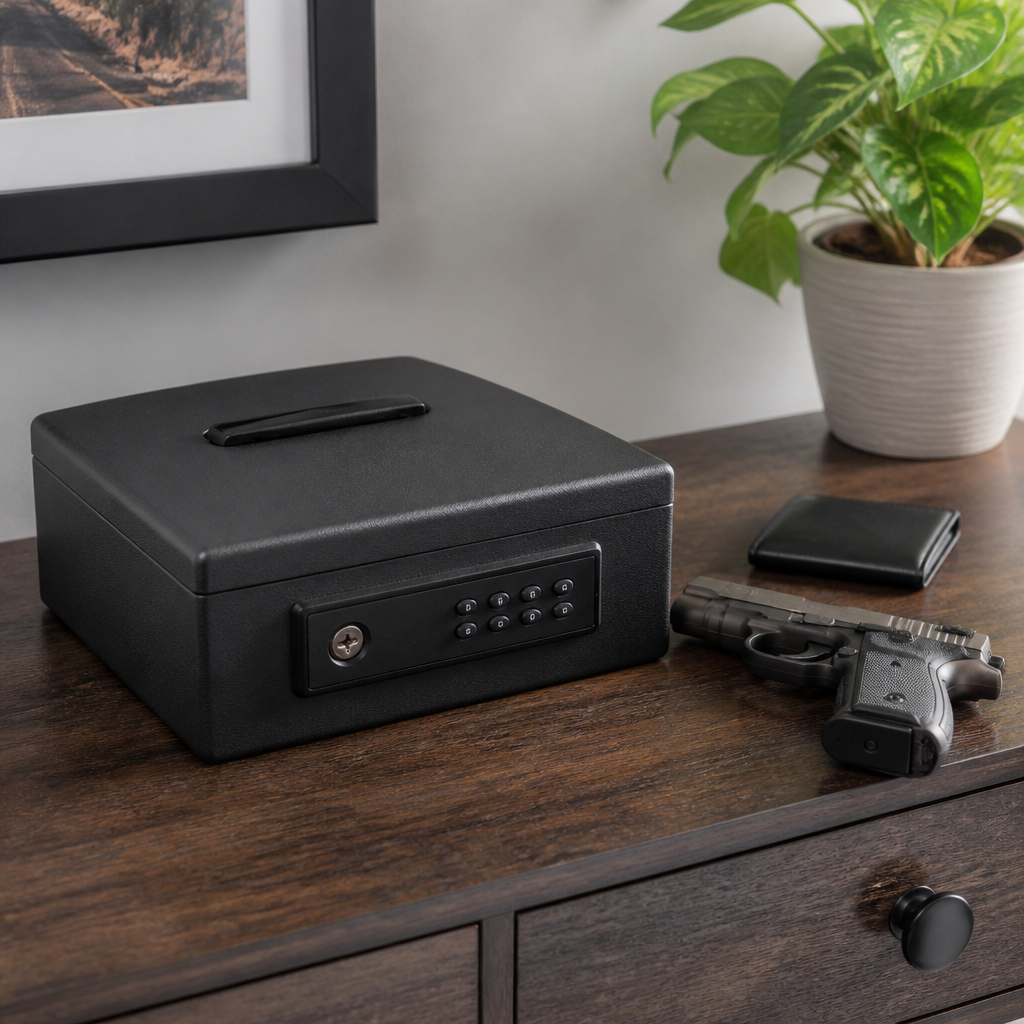
Choosing a first gun safe is usually harder than choosing the firearm itself, because new owners must balance security, quick access, cost, legal responsibilities, and the realities of small living spaces. The Winchester Bandit 14 sits squarely in that decision zone: it is a compact gun safe aimed at first-time gun owners who need better protection than a locking cabinet but are not ready for a heavy, premium vault. In practical terms, this safe is often considered by apartment dwellers, young families, and buyers setting up a basic home-defense or range-storage system. Understanding what it does well, where it compromises, and how it fits into a broader product review landscape matters because a poor safe choice can undermine safety habits, expose firearms to theft, and create frustration that leads owners to stop using secure storage consistently.
When reviewers call a safe “compact,” they usually mean it has a reduced exterior footprint, a manageable internal capacity, and a weight that still allows delivery into tighter spaces. When they call a safe “first-time owner friendly,” they usually mean the setup is straightforward, the locking system is familiar, and the price falls into the entry-level or lower-midrange segment. The Winchester Bandit 14 checks many of those boxes. It is designed to store up to fourteen long guns under ideal conditions, though that figure should be treated as a marketing capacity, not a realistic daily-use number. Like most safes in this class, real capacity depends on optics, slings, pistol grips, barrel lengths, and whether you use shelves for documents or handguns. That distinction is important, because first-time buyers often overestimate how much any “14-gun” safe will truly hold once rifles are configured for actual use.
This article serves as a hub for product reviews within gun safes and safety, using the Winchester Bandit 14 as a practical anchor. I have worked with entry-level residential security containers in homes, garages, and retail environments, and the same pattern appears repeatedly: buyers do not fail because they ignored expensive features; they fail because they misunderstood the basics of steel thickness, fire ratings, anchoring, humidity control, and access speed. A useful review, especially for new gun owners, should answer simple questions directly. Is it secure enough for the average home? How much can it really store? Is the fire protection meaningful? Can one person install it? How does it compare with alternatives? The sections below address those questions in plain language, while also showing how this model fits into the wider category of compact safe reviews.
What the Winchester Bandit 14 Is Built to Do
The Winchester Bandit 14 is best understood as an entry-level long-gun safe intended for basic residential firearm storage. Its job is not to defeat a determined professional burglary crew with power tools and unlimited time. Its job is to slow unauthorized access, secure firearms from children and casual intruders, organize a starter collection, and provide a step up from closets, cases, or sheet-metal cabinets. That is a meaningful role. For many first-time gun owners, the biggest risk is not a Hollywood-style safe attack but poor daily storage discipline. A compact safe that is easy to use every day often provides better real-world safety than a larger, more intimidating unit left unlocked because the owner finds it inconvenient.
In the field, I look at this class of safe through four lenses: security construction, interior usability, fire protection, and installation reality. The Bandit 14 generally appeals because it offers all four in a familiar package. The body and door are built to deliver residential security container performance rather than commercial burglary resistance. The interior is usually laid out to support long guns plus an upper shelf for accessories. The footprint is small enough for many closets, spare rooms, or corners of a garage. And the price normally stays within reach for buyers who just spent money on a firearm, ammo, training, and other required gear. That full budget picture matters. A safe purchase rarely happens in isolation, especially for a first-time owner.
Security Features, Construction, and Real-World Protection
Security is the first issue most buyers ask about, and it should be. In this segment, the most useful question is not whether the Winchester Bandit 14 is “good” in the abstract, but whether it offers adequate protection relative to common risks. Entry-level safes typically use formed steel bodies, reinforced doors, internal hinges or protected external hinge designs, and active locking bolts driven by an electronic lock or mechanical system. What matters in practice is how those pieces work together. A safe with acceptable steel thickness but poor anchoring can be tipped and attacked more easily. A safe with multiple locking bolts but a weak frame can still fail at the door edge. The entire security system has to be evaluated as a package.
For first-time owners, one of the most overlooked truths is that anchoring is not optional. Even a decent compact safe becomes far more effective when bolted to a concrete slab or substantial wood subfloor. I have seen lightweight safes moved, pried, or even carted away because owners assumed the lock itself was the main defense. In reality, mass and anchoring are part of the lock system. The Bandit 14’s manageable size makes proper installation especially important. Once anchored, it forces a thief to attack on site, increasing time, noise, and exposure. That alone significantly improves the odds that the safe will do its job during a typical smash-and-grab burglary.
Another important point is lock choice. Many safes in this class use electronic keypad locks because they are faster for new owners, easier to teach to a spouse, and simpler to operate in low light. A quality electronic lock is convenient, but it also depends on battery maintenance and disciplined code management. Change the default code immediately, replace batteries on a schedule, and test the lock monthly with the door open. Those habits matter more than brand loyalty when you are buying in the compact-safe category.
Capacity, Interior Layout, and Everyday Use
The advertised “14-gun” label should be treated as a maximum under ideal storage conditions with slim, unscoped long guns placed tightly together. In real homes, owners often store fewer firearms because modern rifles are wider, optics add bulk, and shelves compete for space with ammunition, documents, and handguns. For most first-time buyers, a realistic expectation is that the Winchester Bandit 14 will comfortably store a smaller starter collection with room for selected accessories if you plan the layout well. That still makes it useful. Buying based on realistic interior capacity prevents the classic mistake of filling a safe on day one and then regretting the purchase after adding only one or two more firearms.
Interior layout affects owner behavior more than most reviews admit. If rifles bang into one another, if shelves block practical access, or if the door opens into a cramped corner, people start leaning firearms elsewhere “temporarily.” That is exactly how safe habits break down. The Bandit 14 works best when used intentionally: long guns in the primary slots, documents or valuables on the shelf, and handguns stored in a way that does not interfere with retrieving a rifle safely. If you expect to store multiple scoped rifles, tactical shotguns, chest rigs, and bulk ammunition, you are already at the upper edge of what this size category handles gracefully.
| Review Factor | What First-Time Owners Should Expect | Why It Matters |
|---|---|---|
| Stated capacity | Fourteen guns is a marketing maximum, not a practical everyday loadout | Prevents overspending on accessories for space you do not actually have |
| Best use case | Starter collection, mixed long-gun storage, basic valuables protection | Aligns the safe with realistic household needs |
| Installation | Must be bolted down on a stable surface | Improves resistance to theft and pry attacks |
| Access style | Traditional full-door access, not instant bedside speed | Helps buyers match the safe to home-defense plans |
| Growth potential | Limited if you add optics-heavy rifles or bulk accessory storage | Encourages planning for future upgrades |
Fire Protection, Moisture Control, and Environmental Limits
Fire protection is one of the most misunderstood parts of any gun safe review. Manufacturers may publish a time-and-temperature rating, but first-time owners should understand what that means and what it does not. Fire ratings in the consumer market are not always directly comparable across brands because testing methods, pass criteria, and published details vary. A compact safe like the Winchester Bandit 14 may provide useful thermal buffering in a residential fire, but it should not be mistaken for guaranteed survival of every firearm, document, or electronic device in every fire scenario. Heat duration, ventilation, location in the house, and post-fire water exposure all affect outcomes.
Moisture is the second half of the protection story. In actual ownership, rust causes more long-term damage than fire for many households. A safe placed in a garage, basement, or exterior-wall closet can trap humidity if the owner ignores environmental control. Add a desiccant canister, a renewable silica system, or an electric dehumidifier rod if the safe design supports it. Use a hygrometer if possible. Keep firearms lightly protected with appropriate corrosion-preventive products. New owners sometimes assume that because a firearm is in a locked safe, it is automatically safe from environmental harm. That is false. Secure storage and climate management are separate tasks.
Location also matters. A compact safe is easier to place than a full-size model, but placement should not sacrifice conditions. Avoid direct contact with consistently damp concrete unless you are using a proper barrier system. Avoid spots where floodwater would accumulate first. If the safe goes in a garage, consider temperature swings and the effect on lubricants, optics, and wood stocks. The right location can add years to the life of both the safe and its contents.
How the Bandit 14 Compares With Other Compact Safe Options
As a hub article for product reviews, it is important to place the Winchester Bandit 14 within the broader compact-safe market. Buyers usually compare it against stack-on style cabinets, budget safes from sporting-goods retailers, and step-up models from brands such as Liberty, Cannon, Sports Afield, and Hornady. The clearest distinction is between a cabinet and a true compact safe. A cabinet is lighter, cheaper, and easier to move, but generally offers thinner steel and much lower pry resistance. A compact safe costs more and weighs more, yet usually delivers better locking-bolt engagement, stronger door construction, and at least some fire insulation. For households with children or theft concerns, that upgrade is often worth the additional cost.
Compared with heavier premium safes, however, the Bandit 14 is a compromise product. You do not buy this model for top-tier steel thickness, deluxe interiors, or broad expansion capacity. You buy it because it makes secure firearm storage attainable now. In my experience, that is a rational decision when buyers are honest about their timeline. If you expect to own two or three long guns, one or two handguns, and a modest supply of accessories for several years, a compact safe can be a smart fit. If you already know you will build a larger collection, a bigger safe purchased once is often the better value. The old rule still applies: buy more safe than you think you need, if your budget and space allow it.
Buying Advice for First-Time Owners and Product Review Readers
The best way to evaluate the Winchester Bandit 14 is to match it to your actual storage plan, not to an idealized future collection. Measure the installation site, including door swing, baseboards, and hallway turns. List every firearm and accessory you intend to store in the next twenty-four months. Decide whether your primary priority is child access prevention, theft delay, fire buffering, or collection growth. Then verify lock type, warranty terms, delivery logistics, and anchoring hardware before purchase. Also check whether local law or insurance requirements affect storage expectations in your area. Those details decide whether a safe works in real life.
As the hub for product reviews under gun safes and safety, this article points readers toward the right review path. If you need faster handgun access, look for dedicated bedside or quick-access pistol safe coverage. If your concern is document survival, fire-rated home safe reviews deserve equal attention. If you need larger long-gun storage, compare full-size models with heavier construction and better interior flexibility. The Winchester Bandit 14 belongs in the conversation because it covers the most common beginner need: a compact, more protective-than-basic safe that can establish good security habits from day one.
The core takeaway is simple. The Winchester Bandit 14 is a practical compact safe for first-time gun owners when expectations are realistic. It offers a meaningful upgrade over unsecured storage and lightweight cabinets, fits many small spaces, and supports the daily routine that responsible firearm ownership requires. Its limits are equally clear: true capacity is lower than the label suggests, anchoring is essential, and buyers with rapid collection growth may outgrow it quickly. Those are not deal-breakers. They are the normal tradeoffs of this product class.
If you are building a safe, compliant storage setup for your first firearms, start by measuring your space, defining your risks, and comparing this model against the next size up. A well-chosen safe does more than protect guns. It protects habits, households, and peace of mind. Use this review hub as your starting point, then move deeper into the product reviews that match your budget, home layout, and long-term storage goals.
Frequently Asked Questions
Is the Winchester Bandit 14 a good first gun safe for new gun owners?
Yes, for many first-time gun owners, the Winchester Bandit 14 fits the role of a practical entry-level safe very well. One of the biggest challenges for beginners is finding a safe that offers more real protection than a basic locking cabinet without jumping straight to the size, weight, and price of a premium vault. The Bandit 14 is often considered appealing because it sits in that middle ground. It gives new owners a dedicated place to secure firearms, ammunition, and some related valuables while staying compact enough for smaller homes, apartments, spare closets, or modest garage setups.
For someone buying a first safe, that balance matters. New owners are usually juggling several priorities at once: keeping firearms away from children or unauthorized adults, improving burglary resistance over simple sheet-metal storage, staying within budget, and making sure the safe actually fits where they live. The Bandit 14 is commonly viewed as a step up from the most basic cabinet-style options because it is built specifically as a safe, not just as a lockable box. At the same time, it is not so large or expensive that it becomes unrealistic for a young family, first-time homeowner, or renter.
That said, whether it is the right first safe depends on expectations. If the buyer wants a manageable, compact safe for a modest firearm collection and understands that entry-level safes still benefit from proper placement and bolting down, the Bandit 14 can be a smart starting point. If the goal is maximum fire resistance, very large storage capacity, or top-tier burglary protection, then a heavier and more expensive safe may be a better fit. In other words, the Bandit 14 is best understood as a solid first step for responsible ownership rather than a forever-safe for every situation.
How much can the Winchester Bandit 14 realistically hold?
The stated gun capacity on compact safes like the Winchester Bandit 14 should be treated as a general estimate rather than a guaranteed real-world number. Manufacturers typically rate safes under ideal conditions, often assuming slimmer firearms, minimal optics, and very efficient arrangement. In actual use, most owners find that storage capacity depends heavily on the types of guns being stored. Rifles with scopes, pistol grips, slings, bipods, or other accessories take up more room than a standard long gun, and that can reduce how many firearms fit comfortably and safely.
For a first-time gun owner, this is important because many buyers assume a “14-gun” safe will neatly store 14 modern firearms with room to spare. In practice, the Bandit 14 is usually better thought of as a compact safe for a smaller collection with some flexibility. It may work well for a handful of long guns, a few handguns, important documents, and basic accessories, especially if the owner is organized about layout. Interior shelving can also influence usability, since adjustable or removable sections can make the space more practical for mixed storage rather than just trying to hit a maximum gun count.
The smarter approach is to buy based on your likely near-future needs, not just your current firearm count. Many first-time owners purchase one handgun or one rifle and assume they will never need more space, only to add another firearm, extra magazines, hearing protection, paperwork, and personal valuables within a year or two. If you are considering the Bandit 14, think of it as a compact storage solution for a beginner collection rather than as a spacious long-term safe for a growing arsenal. That mindset leads to fewer surprises and a better ownership experience.
How secure is the Winchester Bandit 14 compared with a locking cabinet or a larger premium safe?
The Winchester Bandit 14 is generally positioned between a basic locking cabinet and a heavier premium gun safe, which is exactly why it draws attention from first-time buyers. Compared with a standard cabinet, it typically offers a more serious level of security through stronger construction, a more substantial locking system, and a design intended to resist casual unauthorized access and opportunistic theft better than lightweight cabinet storage. For households where the main concern is preventing easy access by children, guests, or smash-and-grab intruders, that difference can be meaningful.
At the same time, it is important to keep expectations realistic. A compact entry-level safe is not the same as a high-end, extra-heavy safe designed for advanced burglary resistance and extended fire protection. Premium safes often use thicker steel, more robust door construction, advanced relocking features, stronger bolt systems, and much greater overall mass. That weight alone can become part of the security equation, because it makes removal far more difficult. The Bandit 14 offers a better level of protection than the lowest-cost alternatives, but it still benefits greatly from correct installation and smart placement.
For best results, owners should anchor the safe securely according to manufacturer guidance, place it somewhere discreet if possible, and avoid advertising its location or contents. Security is never just about the box itself. It is also about making unauthorized access slower, louder, and more difficult. In that broader sense, the Winchester Bandit 14 can be a strong practical choice for a first safe, especially when used as part of an overall safe-storage plan. It is not designed to outperform premium vaults, but it can absolutely provide meaningful security improvement for a new gun owner who wants responsible, compact, and affordable protection.
Will the Winchester Bandit 14 work well in an apartment or other small living space?
Yes, compact safes like the Winchester Bandit 14 are often especially attractive to apartment dwellers and people living in smaller homes because they address one of the most common first-time buyer concerns: limited space. A large, extra-heavy safe may offer more capacity and stronger protection, but it can also create practical problems in apartments, condos, and starter homes where floor space is tight and room layouts are less flexible. The Bandit 14 is frequently considered because it is easier to place in a closet, bedroom corner, office, or other low-profile area without dominating the room.
That said, small-space installation still requires planning. Buyers should measure doorways, closet openings, and the final installation area carefully before purchasing. They should also think about floor support, access to the door swing, and whether the safe can be anchored appropriately. For renters, lease restrictions and property rules may matter if drilling or permanent mounting is involved. It is also wise to think about visibility. Even in a compact home, the best location is usually one that is both discreet and convenient enough that the owner will consistently use the safe rather than leaving firearms unsecured.
Another advantage in small spaces is that a compact safe encourages disciplined storage habits. Instead of becoming a catch-all for clutter, it tends to remain focused on firearms, key documents, and a manageable set of valuables. For first-time owners, that simplicity can be helpful. The main tradeoff, of course, is room to grow. If you expect your firearm collection or valuables storage needs to expand quickly, a compact safe can feel crowded sooner than expected. But for many apartment residents and new buyers, the Bandit 14 offers a realistic blend of footprint, usability, and improved security that larger safes simply cannot match in day-to-day living.
What should first-time gun owners consider before buying the Winchester Bandit 14?
Before buying the Winchester Bandit 14, first-time gun owners should start by thinking beyond the purchase price. A safe is part of a larger responsibility framework that includes secure storage, local legal requirements, child access prevention, theft deterrence, and practical daily use. The first question is whether the safe matches the owner’s actual needs. How many firearms need to be stored right now? Are they mostly handguns, long guns, or a mix? Will optics or accessories require extra clearance? Is there a need to store documents, passports, cash, or jewelry alongside firearms? The answers help determine whether a compact model will remain useful over time.
Buyers should also think carefully about where the safe will go. Space limitations, ease of installation, and anchoring options are all major factors, especially in apartments or multi-use homes. A safe that seems perfect on paper can become frustrating if it does not fit through a hallway, cannot open fully in the chosen corner, or ends up in a location that is too visible or too inconvenient. Access matters as much as storage. A first safe should be easy enough to use consistently, because even a well-built safe does little good if firearms are regularly left outside it for convenience.
Finally, it is important to match expectations to the product category. The Winchester Bandit 14 is generally considered a compact, accessible option for buyers who want a meaningful step up from a cabinet without moving into premium-safe pricing and weight. That makes it a strong candidate for beginners, but not necessarily the final word in security or capacity. If you want a sensible first safe that supports responsible ownership, fits smaller spaces, and offers more protection than the most basic alternatives, it is worth serious consideration. If your priorities lean toward maximum long-term capacity or top-tier construction, it may be wiser to size up now rather than replace it later.