
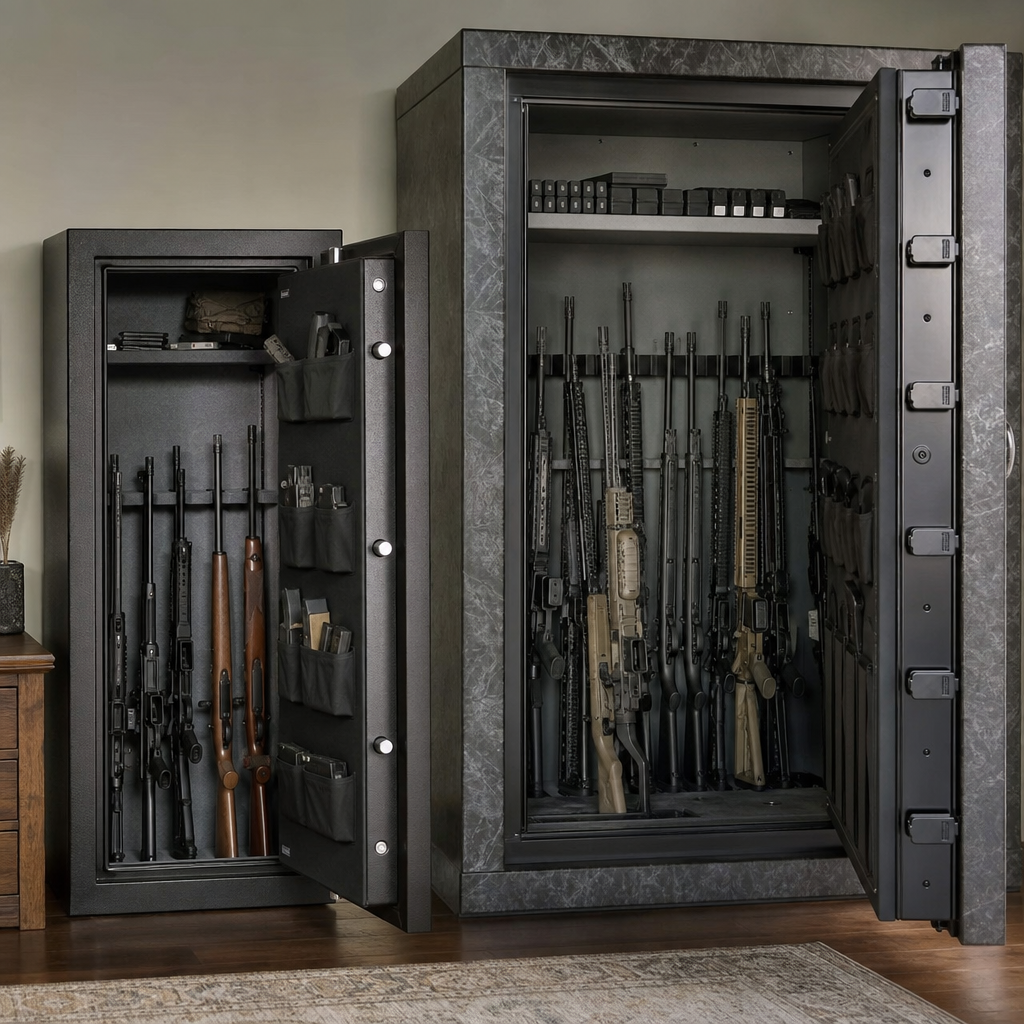
Choosing between home gun safes and commercial gun safes is not simply a matter of size or price; it is a decision about security level, fire resistance, access control, insurance expectations, compliance, and how firearms are actually stored and used day to day. In the gun safes and safety category, this comparison matters because many buyers start with a residential need, then discover overlap with retail, range, armory, workshop, farm, or small business requirements. I have helped buyers evaluate both classes of safes, and the same pattern appears repeatedly: people focus first on capacity and lock type, but the real difference is duty cycle, construction standard, and exposure to risk.
A home gun safe is typically designed for private ownership in a residence, garage, basement, or workshop. It usually prioritizes burglary deterrence, moderate fire protection, interior organization, and manageable delivery. Common examples include long-gun safes from Liberty Safe, Browning, Winchester, Sports Afield, Rhino Metals, and Cannon. A commercial gun safe, by contrast, is built for a business or institutional environment where repeated access, higher liability, stricter audit trails, larger inventories, or more determined theft threats are expected. These units can include TL-rated burglary safes, high-capacity vault cabinets, modular armory systems, and commercial-grade gun storage from manufacturers such as American Security, Brown Safe, Graffunder, Fort Knox, and SecureIt’s higher-capacity systems.
The phrase gun safe comparisons often gets used loosely, so it helps to define the core criteria. Construction includes steel thickness, body design, door plate structure, hardplate, relockers, boltwork, and anchor provisions. Fire protection includes tested duration, insulation type, heat-expanding seals, and whether ratings come from an independent test or an internal protocol. Access includes mechanical dial locks, electronic keypad locks, biometric systems, redundant locks, and audit-capable commercial access hardware. Capacity means actual usable space, not the inflated rifle counts commonly used in marketing. The best comparison also includes installation logistics, floor load, humidity management, and after-sale service.
This hub article covers the full map of gun safe comparisons and brand spotlights so readers can move from broad understanding to focused research. If you are deciding between a safe for a house and one for a storefront, FFL operation, range, or collector inventory, the essential question is straightforward: what level of protection do your firearms, documents, optics, and liability exposure truly require? Answer that correctly, and the right category becomes much easier to identify.
How Home Gun Safes and Commercial Gun Safes Differ at the Structural Level
The most important difference is construction philosophy. Most home gun safes are residential security containers or heavy cabinets marketed as safes. Many use 12-gauge to 14-gauge steel bodies, formed rather than continuously thick plate, with decorative interiors and external finishes that fit a living space. Better home models step up to 10-gauge or 7-gauge bodies, thicker doors, and stronger hinge-side reinforcement. In practical terms, a solid residential unit can defeat casual smash-and-grab theft and force an intruder to spend time, make noise, and use tools. That delay is the point.
Commercial gun safes are built around a different threat model. Businesses may face targeted burglary, insider risk, repeat access, employee turnover, and insurer scrutiny. For that reason, commercial units often use heavier plate steel, composite barriers, more robust boltwork, glass relockers, drill-resistant hardplate, and independently recognized burglary ratings such as UL RSC, TL-15, or TL-30 depending on the model. A true TL-rated safe is evaluated against concentrated tool attack for a specified net working time, which is a meaningful distinction from broad marketing language like “military style” or “tactical.”
Door design also separates the categories. Many home gun safes have relatively thin door shells with cosmetic paneling over a composite fill. That can still be effective if the locking mechanism, door frame, and relockers are competent. Commercial safes, however, commonly have substantially thicker door structures, better support against prying, and hardware intended for frequent cycling. In a retail store or armory, a safe may be opened many times per day. That repeated use affects lock selection, hinge wear, and service planning in ways that rarely matter in a low-access residential setup.
Anchoring is another structural point buyers underestimate. A 700-pound home safe that is not bolted down can still be tipped, pried, or moved with appliance dollies. Most commercial installations treat anchoring as nonnegotiable and pair it with placement strategy, surveillance, and controlled key or code management. In my experience, installation quality often matters as much as the safe class itself.
Security Ratings, Fire Protection, and What the Labels Really Mean
One of the biggest mistakes in gun safe comparisons is treating all ratings as equal. UL RSC, or Residential Security Container, indicates a baseline burglary-resistance test against limited hand tools. It is common in better home gun safes and can be appropriate for many households, especially when combined with alarm monitoring and hidden placement. But it is not the same as a commercial burglary safe rating. TL-15 and TL-30 indicate tested resistance against more serious attack using common mechanical and portable electric tools. If you are storing a high-value firearm collection, transferable machine guns, premium optics, suppressors, or serialized inventory for sale, that difference matters.
Fire ratings are even more confusing because testing methods vary widely. Some manufacturers perform proprietary furnace tests; others cite independent standards. A label claiming 60 or 90 minutes at a given temperature is useful only when you understand the protocol, the pass criteria, and whether interior temperature was measured at document-safe thresholds. Fireboard layers, poured insulation, and heat seals can all help, but no fire rating makes contents invulnerable. In house fires, location matters. A safe on a garage slab may fare differently than one on an upper wood-framed floor exposed to collapse and prolonged heat.
Commercial buyers should think beyond paper fire ratings. In a business, post-fire recovery includes continuity, access records, insurance documentation, and whether heat or suppression systems damaged optics, wood stocks, or ammunition packaging. Home buyers usually care most about protecting the firearms themselves and perhaps passports, cash, and family records. The safe that is ideal for one use case may be mismatched for the other.
| Factor | Typical Home Gun Safe | Typical Commercial Gun Safe |
|---|---|---|
| Burglary rating | Often unrated or UL RSC | RSC, TL-15, TL-30, or heavier specialty builds |
| Body steel | Commonly 14- to 10-gauge | Heavier plate or composite construction |
| Fire protection | Consumer-focused duration claims | Usually stronger documentation and higher-duty insulation systems |
| Access frequency | Low to moderate | Moderate to high, often daily multi-user access |
| Audit capability | Rare | Common with advanced electronic locks |
| Best fit | Households, collectors, hobby use | Retail, FFLs, ranges, armories, institutional storage |
Capacity, Interior Layout, and the Reality Behind Rifle Counts
Advertised capacity is one of the least reliable numbers in this category. A “36-gun safe” often assumes slim, unscoped long guns packed tightly together with no slings, bipods, lights, or oversized bolt handles. In real use, once you add AR-platform rifles with mounted optics, precision rifles, shotguns, suppressor hosts, and handguns in pouches or racks, usable capacity can drop by 30 to 50 percent. That applies to both home and commercial gun safes, but the consequences are more serious in a business where inventory handling efficiency matters.
Home gun safes tend to prioritize mixed storage. Many include shelving for documents, jewelry, handguns, and ammunition, along with barrel rests and carpeted interiors. That flexibility is helpful for family use, but it can waste space for a collector or enthusiast with many accessorized long guns. Commercial solutions often use configurable racking, pull-out systems, tagged slots, and clearer separation between firearms, records, and high-value accessories. SecureIt popularized modular interiors that many serious owners now prefer over traditional plush layouts because they make inventory visible and reduce stock-to-stock contact.
If your goal is clean organization at home, think in terms of current inventory plus five years of growth. I routinely advise buyers to purchase at least one size larger than they think they need. For commercial settings, calculate based on actual SKU count, intake spikes, consignment flow, and law-enforcement hold requirements if they apply. Space planning should include room for dehumidifiers, power outlets, desiccant, and door swing clearance. A safe that technically fits the collection but forces awkward stacking is harder to use correctly, and misuse leads to dings, moisture pockets, and unsafe handling.
Access Control, Locks, and Daily Use Requirements
For many residential buyers, lock choice comes down to mechanical versus electronic. Mechanical dial locks from established makers such as Sargent and Greenleaf or La Gard are durable and time-tested, but slower. Electronic keypad locks are faster and more convenient, especially for owners who access the safe regularly. High-quality electronic locks are reliable when installed correctly, though they require battery management and occasional service. Biometric options can be useful on quick-access handgun safes, but on large gun safes I still view biometrics as a secondary convenience feature rather than the primary buying reason.
Commercial gun safes demand more. Multi-user environments benefit from manager-level code administration, time delay features, dual control, opening history, and lockouts after repeated failed attempts. Those features reduce insider risk and support accountability. In some FFL or range contexts, being able to document who accessed storage and when is not optional from a management standpoint. A residential owner almost never needs that level of control unless multiple adults or staff are involved.
Daily use also changes what “good” looks like. In a home, a heavy manual door with rich interior trim may feel premium. In a business, it may become a nuisance if employees need repeated access throughout the day. Commercial operators often value smooth door action, predictable relocking service, and standardized procedures over decorative finishes. The safe is a working asset, not furniture.
Cost, Delivery, Insurance, and Brand Spotlights That Matter
Price gaps between categories are substantial because the materials, ratings, and service expectations are different. A common home gun safe may range from several hundred dollars to a few thousand, while premium residential plate safes climb much higher. Commercial gun safes and TL-rated units can quickly move into five figures before freight, rigging, and installation. Buyers are sometimes surprised that delivery can cost hundreds or thousands depending on stairs, crane work, slab conditions, and whether the unit must be moved through narrow residential hallways or secured after hours in a business.
Insurance often clarifies the choice. Homeowners insurance may place sublimits on firearms or collections unless specifically scheduled. Commercial property policies may require certain burglary ratings, alarm integration, or documentation standards. Before buying, ask your insurer what level of protection changes premiums, claim handling, or coverage terms. That conversation can save more money than chasing a sale price.
As for brand spotlights, Liberty Safe and Browning are widely recognized in the residential market for broad dealer networks, configurable interiors, and mainstream fire-rated models. American Security, often called AMSEC, spans both residential and commercial categories and is especially relevant when buyers want a path from RSC-level storage to serious burglary protection. Fort Knox and Graffunder are strong references for heavier custom or semi-custom builds. Brown Safe is well known for premium vault-style products with strong fit and finish. SecureIt stands out for organizational design, modularity, and fast visual access, especially where traditional rifle-count marketing fails to match real use. The right brand depends less on reputation alone and more on matching the manufacturer’s core strengths to your threat profile, inventory type, and budget.
How to Choose the Right Safe for Your Use Case
The practical way to choose is to start with risk, not features. If you are a homeowner with a modest collection, monitored alarm, solid doors, and a discreet installation location, a quality home gun safe with good anchoring and humidity control is often the right answer. If you own collectible firearms, NFA items, expensive optics, or a rapidly growing collection, move up to thicker steel, better burglary ratings, and more realistic interior planning. If you run a store, FFL, training facility, or institutional armory, buy for auditability, repeated access, insurer expectations, and higher attack resistance from the beginning. Retrofitting later is usually more expensive.
Also consider environment. Garages create temperature swings and humidity issues. Basements can be ideal structurally but may invite moisture if not conditioned. Upper floors raise load concerns; many large safes exceed what buyers assume, especially once firearms and ammunition are added. A structural review is wise for heavy installations. Use a goldenrod-style dehumidifier or equivalent, maintain clear serial number records, and test lock batteries on schedule if using electronic access.
The main benefit of comparing home gun safes vs. commercial gun safes carefully is simple: you avoid paying for the wrong kind of protection. Residential owners should not automatically buy industrial storage they will never fully use, and commercial operators should not trust consumer-grade construction with business-critical inventory. Match the safe to the threat, the frequency of access, and the value at stake. From there, narrow the field by rating, layout, lock system, and installation plan. Use this hub as your starting point, then move into brand-specific and feature-specific comparisons to choose with confidence.
Frequently Asked Questions
What is the main difference between a home gun safe and a commercial gun safe?
The biggest difference is the level of protection each safe is designed to deliver under real-world conditions. A home gun safe is typically built for residential firearm storage, with an emphasis on theft deterrence, basic to moderate fire protection, interior organization, and convenient daily access. These safes are often ideal for households that need to secure hunting rifles, handguns, heirloom firearms, or general sporting equipment while keeping unauthorized users, children, or opportunistic burglars out. In many cases, they offer a practical balance between cost, capacity, and peace of mind.
A commercial gun safe, by contrast, is usually engineered for more demanding environments where security expectations are higher and usage is heavier. That can include gun shops, shooting ranges, armories, farm operations, workshops, security companies, or small businesses that store firearms, ammunition, records, or high-value gear. Commercial units often feature thicker steel, stronger locking systems, more robust boltwork, heavier doors, higher cycle-rated locks, and construction better suited to repeated opening and closing throughout the day. They may also align more closely with insurance requirements, internal policy standards, or regulatory expectations depending on how the firearms are stored and who has access.
In practical terms, the choice comes down to risk profile. If the safe will sit in a private residence, be opened a few times a week, and primarily serve a family storage role, a well-built home gun safe may be enough. If the safe will be used by multiple people, located in a business setting, contain higher-value inventory, or need to stand up to stricter oversight, a commercial gun safe is often the better long-term fit. The key is not just asking how many guns you own today, but how much protection, accountability, and durability your situation actually requires.
Are commercial gun safes always more secure than home gun safes?
Not automatically, but they often are when you compare truly equivalent quality tiers. The term “commercial” suggests a higher-duty application, yet security depends on the actual specifications of the safe rather than the label alone. Some premium residential safes are built exceptionally well and can outperform lower-end units marketed for business use. That is why buyers should look beyond category names and focus on factors such as steel thickness, body construction, door design, locking mechanism, hard plate protection, relockers, hinge design, bolt coverage, anchoring options, and any verified burglary or fire ratings.
Commercial gun safes are frequently designed with more aggressive threats in mind. In a retail or business environment, a safe may be expected to resist more determined attacks, protect higher concentrations of value, and support tighter key control or multi-user access procedures. Because of that, commercial models often include heavier construction and more advanced access-control options. They may also be better suited for environments where the safe cannot simply be hidden in a closet or low-visibility room. In a storefront, range office, or back-room inventory space, visibility alone can increase the need for stronger physical protection.
That said, a residential owner should not assume a commercial safe is necessary in every case. True security is about fit. A well-anchored home gun safe placed in a low-profile location, supported by alarms, cameras, good door hardware, and responsible access control may provide excellent protection for a private owner. On the other hand, if the firearms have very high value, if there is frequent public traffic in and out of the property, or if the owner is storing items that could attract targeted theft, stepping up to commercial-grade construction can make sense even in a home. The smart approach is to match the safe to the threat level, not just the setting.
How important are fire ratings when comparing home and commercial gun safes?
Fire protection is extremely important, but it needs to be interpreted carefully. Many buyers focus on burglary resistance first, then treat fire protection as a secondary feature. In reality, fire can be just as destructive, especially when a safe is holding not only firearms but also optics, documents, suppressor paperwork, photos, titles, cash, and other sensitive contents. Both home and commercial gun safes may advertise fire ratings, but those claims are not always tested under the same standards or methods, which is why buyers should read the details instead of relying on the number printed in marketing materials.
For a home gun safe, a fire rating may be intended to reflect common residential fire conditions for a stated number of minutes at a stated temperature. That can be useful, especially if the home is in a rural area with longer fire department response times or if the safe is installed in a garage, workshop, or outbuilding. For commercial applications, the fire question often expands beyond firearms themselves. A business may also be protecting records, electronics, inventory logs, licensing documents, and serialized item documentation. In those cases, the acceptable level of heat exposure may be lower, and the need for verified, more rigorous protection may be greater.
The best way to evaluate fire resistance is to ask how the safe was tested, what temperature and duration were used, whether the rating was independently verified, and what internal temperature threshold the contents are expected to remain under. Also consider placement. A safe in a climate-controlled interior room may face a different fire exposure than one in a detached shop or warehouse. Ultimately, fire protection should be viewed as part of a complete storage strategy. A safe with strong theft resistance but weak fire performance may leave major gaps, while a well-balanced unit can better protect both the firearms and the valuable items that often accompany them.
When does it make sense for a homeowner to buy a commercial gun safe instead of a residential model?
It makes sense when the homeowner’s real needs start to look more like a business or high-risk storage environment than a typical household setup. This happens more often than people expect. A private collector may own a substantial number of firearms with significant total value. A competitive shooter may need to secure firearms, optics, ammunition, and accessories that are accessed frequently. A ranch or farm owner may store guns in a workshop or outbuilding with greater exposure to theft or environmental stress. A home-based firearms instructor, gunsmith, FFL-related operator, or security professional may also have storage needs that go well beyond the assumptions built into many standard home safes.
Another reason to consider a commercial gun safe is durability. If the safe is going to be opened many times per day, shared among authorized users, or expected to support stricter accountability, commercial-grade hardware can be worth the investment. Heavier doors, stronger lock components, better boltwork, and more robust hinges tend to hold up better under high-use conditions. In addition, some homeowners want access-control features that are more common in commercial products, such as audit capability, dual control options, or more structured user credential management.
Insurance and liability can also push the decision. If the firearms represent a high-dollar collection, if rare or NFA-related items are involved, or if an insurer expects a higher level of protection, a commercial safe may provide stronger support for that risk profile. The same is true if the owner wants a safe that can grow with changing needs rather than be replaced in a few years. In short, a homeowner should consider a commercial gun safe when security expectations, usage patterns, content value, or accountability demands exceed what a standard residential unit is designed to handle comfortably.
What should buyers evaluate besides size and price when choosing between home and commercial gun safes?
Buyers should evaluate the safe as a complete security system, not just a metal box with a capacity number. Construction quality should be near the top of the list. That includes steel thickness in the body and door, how the seams are formed, the quality of the locking bolts, whether there are relockers and drill-resistant features, and whether the safe can be securely anchored to the floor or structure. A large safe with weak construction can create a false sense of security, while a smaller but better-built safe may offer significantly better real protection.
Access control is another major factor. Think about who needs entry, how often the safe will be opened, and how quickly authorized access must happen. A household may do fine with a straightforward lock setup, while a business, shared property, or high-traffic environment may need stronger credential management and tighter control over who can open the safe and when. Interior layout also matters more than many people realize. Long guns, scoped rifles, handguns, ammunition, paperwork, valuables, and accessories all compete for space, and poor organization can create daily frustration or even increase the risk of damage to the contents.
Buyers should also consider fire performance, insurance expectations, compliance needs, installation logistics, and future growth. A safe that barely fits current needs is often outgrown quickly. Delivery path, floor load, stair access, humidity control, and room location all affect long-term satisfaction. Finally, think honestly about the environment where the safe will live: private home, detached garage, storefront, range office, farm shop, or mixed-use property. That context shapes the right answer more than marketing labels do. The best purchase is the one that aligns with actual risk, actual usage, and the level of protection the owner may need not only today, but several years from now.