
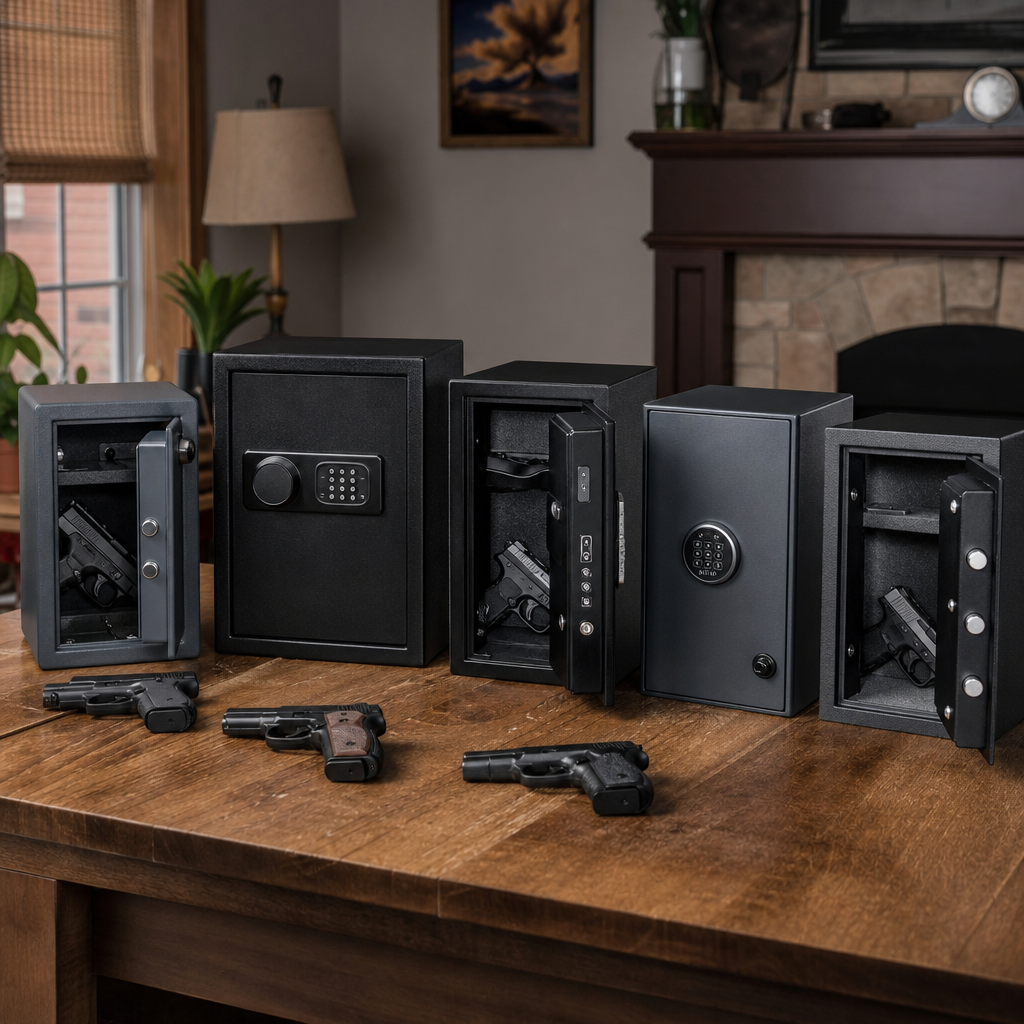
The best compact gun safes for handguns balance fast access, reliable lock construction, secure mounting, and dimensions that fit real homes, vehicles, and bedside setups. In practical terms, a compact handgun safe is a small lockbox or vault designed to store one to four pistols while preventing unauthorized access by children, guests, burglars, or anyone who should not handle a firearm. This category matters because many handgun owners are not choosing between a safe and no safe in the abstract; they are choosing between a full-size gun cabinet in another room and a compact safe they will actually use every day. After years of evaluating handgun storage products for apartments, nightstands, closets, work vehicles, and travel cases, I have found that usability determines safety as much as steel thickness does. If opening the safe is awkward, if the keypad is inconsistent, or if the lid geometry fights your hand under stress, owners start leaving firearms unsecured.
That is why brand comparisons are useful. On paper, most compact gun safes advertise pry resistance, quick access, foam interiors, and multiple entry methods. In real-world use, major differences appear in biometric sensor quality, backup key design, mounting hardware, tamper alerts, hinge protection, and whether the safe survives repeated daily cycles without failure. For buyers researching gun safe comparisons and brand spotlights, the goal is not simply to find the cheapest lockbox. The goal is to match a specific storage need to a product line with proven strengths and known limitations. A bedside owner prioritizes one-handed access, interior lighting, and silent keypad operation. A vehicle owner needs cable attachment, low-profile dimensions, and resistance to smash-and-grab theft. A family with children needs dependable relocking, audit features, and enough capacity to store the pistol with a holster or spare magazine.
This hub article covers the compact handgun safe segment through the brands most often considered together: Vaultek, Fort Knox, V-Line, Hornady, SnapSafe, SentrySafe, and StopBox. Some use electronic keypads, some use simplex mechanical locks, some use biometrics, and some are intentionally minimalist. Throughout the handgun safe brand showdown, I will focus on construction, access speed, ideal use case, and where each brand fits in a larger Gun Safes & Safety buying plan. If you are comparing bedside safes, vehicle lockboxes, travel safes, or child-resistant quick-access vaults, this page gives you the framework to evaluate them with confidence.
What makes a compact handgun safe worth buying
A compact handgun safe is worth buying when it improves both security and compliance with daily habits. The first screening factor is construction. Look for formed steel bodies, recessed doors, welded seams where possible, protected hinges, and mounting points that allow the safe to be anchored to furniture or a vehicle frame. Thin gauge steel alone is not an automatic failure in this category because compact safes trade mass for portability, but the difference between a casual deterrent and a serious security container is obvious when you inspect the lid overlap, latch engagement depth, and resistance to flex near the lock. In testing, the best models do not rely on one impressive spec. They combine decent steel, intelligent geometry, and lock placement that prevents easy prying from the front lip.
The second factor is access method. Electronic keypads are common because they are fast and easy to use in darkness, but quality varies enormously. Better units have tactile buttons, responsive processors, low-battery warnings, and backup access that does not compromise the front face. Biometric readers can work very well when the sensor is high quality and fingerprints are enrolled correctly, yet cheaper sensors often struggle with dry skin, partial prints, or hurried placement. Mechanical simplex locks remain a benchmark because they do not require batteries and are exceptionally durable, though they usually add size and cost. RFID access, offered by brands such as Hornady, can be excellent for users who want a bracelet, sticker, or key fob opening method, but it adds another object that must be managed securely.
Capacity and interior layout are just as important. Many buyers underestimate handgun dimensions once an optic, weapon light, threaded barrel protector, or spare magazine is added. A safe advertised for two pistols may only hold one full-size handgun comfortably if it has a red dot and mounted light. Foam interiors protect finishes, but fixed foam can waste space. Removable shelves, adjustable racks, and open layouts provide more flexibility. When readers compare compact gun safes for handguns, I advise measuring the actual firearm configuration they intend to store, not the catalog dimensions of a bare pistol.
Brand showdown: strengths, weaknesses, and best fits
Vaultek has become one of the most recognized names in compact electronic handgun safes because it combines modern features with consistently better fit and finish than many low-cost imports. Models such as the LifePod 2.0, VT Series, and Slider are popular for bedside and office use. Vaultek’s strengths include responsive keypads, app connectivity on selected models, biometric options, interior lighting, and clean industrial design. The better models also include anti-impact latches and decent mounting provisions. The tradeoff is price. You are paying for electronics, interface, and user experience, not just steel. I recommend Vaultek for users who will benefit from frequent access, battery status monitoring, and premium features, but I remind buyers that electronics increase complexity. If you want maximum simplicity with minimal failure points, another brand may fit better.
Fort Knox remains the benchmark for buyers who prefer overbuilt steel construction and a mechanical simplex lock. The Fort Knox Pistol Box has a strong reputation because it does not pretend to be ultralight or tech-forward. It is heavy, boxy, and secure for its size. The simplex lock is fast with practice, battery-free, and durable. Fort Knox also offers thicker steel than many mass-market competitors. The downside is obvious: the product is less sleek, less compact relative to capacity, and often more expensive once shipping is considered. For owners who want a bedside safe that will likely outlast several generations of electronic products, Fort Knox is one of the safest recommendations in this entire category.
V-Line occupies a similar lane. Its Brute series and top-draw models use mechanical locks and emphasize straightforward construction. In my experience, V-Line performs best for buyers who want robust child resistance and quick access without dependence on batteries or smartphone integration. Door fitment and finish can feel more utilitarian than luxury, but reliability is the selling point. Hornady stands out for its RAPiD line, which uses RFID, keypad, and key access in various combinations. For households that want very fast access with a wristband or fob, Hornady can be excellent. The caveat is that RFID convenience only helps if users maintain disciplined control over the tags. In family homes, that issue deserves serious attention.
| Brand | Best Known For | Main Advantage | Main Tradeoff | Best Use Case |
|---|---|---|---|---|
| Vaultek | Feature-rich electronic safes | Fast access, modern interface, biometrics/app options | Higher cost and more electronic complexity | Bedside, office, premium daily access |
| Fort Knox | Mechanical simplex handgun vaults | Heavy steel construction and long-term durability | Bulkier size and premium pricing | Permanent bedside or closet mounting |
| V-Line | Mechanical quick-access boxes | No batteries, proven lock design | Plain aesthetics and fewer convenience features | Family homes prioritizing reliability |
| Hornady | RFID-enabled RAPiD safes | Very fast access with multiple opening methods | Tag management and mixed value by model | Nightstand access with wristband or fob |
| SnapSafe | Portable lock boxes | Good travel and vehicle flexibility | Less theft resistance than anchored vaults | Cars, luggage, temporary storage |
| SentrySafe | Mainstream retail availability | Accessible pricing and easy purchase | Quality varies widely by model line | Entry-level secondary storage |
| StopBox | Non-battery retention device | Fast access and simple operation | Not equivalent to a true locking safe | Controlled environments, niche use |
SnapSafe is commonly considered for vehicle use, travel, and temporary storage because its lock boxes and cable-secured units are practical and widely available. They are useful, especially where legal transport requirements matter, but buyers should be realistic: a portable lock box with a cable is not in the same security class as a bolted steel handgun vault. It delays theft; it does not defeat a determined attack with time and tools. SentrySafe serves the mass market and can work for budget-conscious buyers, yet its catalog spans multiple quality tiers. Some models are acceptable for basic storage, while others feel too lightly built for serious defensive handgun duty. StopBox is different from every other brand here because it is a retention device rather than a conventional safe. It can restrict access and improve safety in certain controlled settings, but it should not be confused with a pry-resistant locked container.
Choosing by use case: bedside, vehicle, travel, and child access prevention
The best compact gun safe depends less on brand prestige than on where and how it will be used. For bedside storage, speed and consistency matter most. A safe should open reliably from muscle memory, stay put when you enter the code one-handed, and present the handgun in a predictable orientation. In this role, Vaultek Slider models, Hornady RAPiD night guard styles, and mechanical boxes from Fort Knox or V-Line all make sense, but for different users. If you value silent entry and tactile repetition, simplex mechanical locks are hard to beat. If you want interior light, code flexibility, and a narrower footprint, an electronic design may work better.
For vehicle storage, compactness and attachment strength are the priority. A console vault designed specifically for a vehicle model is generally more secure than a generic cable box under a seat, though it is less portable. If a dedicated console unit is not available, a compact steel lock box from SnapSafe or Vaultek can still be useful, especially when looped to a substantial anchor point. The limitation is clear: thieves often attack vehicles opportunistically and quickly. A small safe in a car should be viewed as a delay device, not an excuse to leave a handgun unattended for long periods. Heat, humidity, and vibration also punish electronics over time, so mechanical designs deserve extra consideration in this environment.
Travel adds another layer. Flyers in the United States often use hard-sided locked pistol cases inside checked luggage under TSA transport rules, but that is not the same as relying on a bedside quick-access safe at your destination. A LifePod-style case can be practical because it is light and organized, yet travelers should confirm airline, state, and local legal requirements before every trip. For child access prevention, the standard rises. The safe must be consistently locked, physically anchored if possible, and resistant to code guessing or accidental opening. This is where dependable latch engagement, hidden backup keyways, and disciplined owner behavior matter more than marketing language. The safest product still fails if it is left open for convenience.
How to compare specs without getting fooled by marketing
Compact handgun safe marketing often emphasizes one flashy feature while minimizing structural weaknesses. I compare products using six checkpoints: steel construction, lock quality, lid geometry, mounting method, power management, and long-term support. Steel gauge is useful, but it can be misleading if the body flexes at the opening. A 12-gauge panel in a poor design may resist less than a slightly thinner panel with better reinforcement and overlap. Lock quality should be judged by the entire access system, not just the keypad or sensor alone. Fast biometric opening means little if the latch binds after a few months or if the emergency key is easy to exploit.
Mounting deserves more attention than it gets. Any compact handgun safe that is not anchored can be stolen whole and attacked elsewhere. A good safe includes predrilled mounting holes, solid hardware, and enough base rigidity to stay secure when bolted down. For drawers and nightstands, I prefer through-bolting with washers and backing plates where possible. Battery design also matters. Better electronic safes provide external power backup, clear low-battery warnings, and nonvolatile memory retention. Finally, check warranty and parts support. Established brands with responsive customer service are worth paying for because replacement keys, gas struts, sensors, and firmware support become relevant over years of ownership, not just on day one.
Building your handgun safe comparison hub and next-step shortlist
As the central guide to Gun Safe Comparisons & Brand Spotlights, this page should help you narrow the field before you dive into model-specific reviews. Start with your primary environment: bedside, vehicle, travel, or secondary storage. Then choose your preferred access method: mechanical simplex, electronic keypad, biometric, or RFID. Finally, set a realistic security expectation. If you need the strongest compact bedside vault, Fort Knox and V-Line belong on the shortlist. If you want premium features and sleek daily usability, Vaultek deserves close attention. If RFID access appeals to your household, compare Hornady carefully by model. If your priority is legal transport or temporary vehicle storage, SnapSafe can be practical. If you are shopping on a tighter budget, scrutinize SentrySafe model construction rather than buying by brand name alone. If you are considering StopBox, understand exactly what it is and what it is not.
The key takeaway is simple: the best compact gun safe for handguns is the one that matches your risk level, access needs, and installation reality without encouraging unsafe shortcuts. No single brand wins every category. Mechanical safes usually offer the best durability and simplicity. Electronic safes often offer the best convenience and feature set. Portable lock boxes serve a purpose, but they are not substitutes for anchored home storage. Use this hub as your starting point, then move to detailed brand and model comparisons with a clear checklist in hand. Measure your firearm setup, decide where the safe will live, and choose the product you will lock every single time.
Frequently Asked Questions
What should I look for first when comparing compact gun safes for handguns?
The most important starting point is how the safe performs in real-life use, not just how it looks on a product page. For a compact handgun safe, the key factors are access speed, lock reliability, construction quality, mounting options, interior fit, and overall size. A good model should open quickly under stress, especially if it is intended for home-defense access near a bed or desk. That means the lock type matters a lot. Biometric safes can be fast and convenient, but the better models are the ones with consistent fingerprint recognition and a dependable backup entry method such as a keypad or key override. Electronic keypad safes are often a strong middle ground because they can be fast, simple, and less temperamental than low-end biometric units.
Build quality is just as critical. Look for steel construction, a reinforced lid or door, solid locking bolts, and resistance to pry attacks around the seams. In the compact category, no safe is invincible, but a better-built unit can dramatically raise the difficulty for a smash-and-grab thief or unauthorized person. Mounting is another major consideration that buyers often underestimate. A compact handgun safe that is not bolted down or cable-secured can be carried away and opened later, so check whether the model supports secure mounting in a closet, nightstand, vehicle, or under a bed frame.
Capacity should also be realistic. Many safes advertised for two or four handguns can feel tight once you add optics, extended magazines, weapon lights, or spare magazines. Internal dimensions matter more than marketing labels. Finally, think about where the safe will actually live. The best compact handgun safe for a vehicle is not always the best one for a bedroom or apartment. A strong buying decision comes from matching the safe’s strengths to your actual routine, space limitations, and access needs.
Are biometric handgun safes better than keypad or key-lock compact safes?
Biometric safes can be excellent, but they are not automatically better than keypad or traditional locking designs. Their biggest advantage is speed and ease of use. A properly made biometric safe can allow one-handed access in seconds, which is appealing for bedside or quick-access defensive storage. That said, biometric performance varies widely by brand and by price tier. High-quality fingerprint scanners tend to be more reliable, while cheaper units may struggle with partial finger placement, dry skin, moisture, dirt, or inconsistent enrollment.
Keypad safes are often preferred by buyers who want predictability. A good keypad model typically offers consistent access if the buttons are responsive and the code is easy for the owner to enter under pressure. Many handgun owners like keypad safes because they avoid the potential recognition issues that can affect biometric models, while still being faster than using a physical key. Traditional key-lock safes, on the other hand, are usually the simplest and often the least expensive, but they are not always ideal for urgent access situations. Keys can be misplaced, accessed by the wrong person, or difficult to use quickly in low light.
In a brand showdown, the best answer is usually not that one lock type always wins. It is that the best execution wins. A well-built keypad safe from a reputable brand may outperform a poorly made biometric model. Likewise, a premium biometric safe with a proven scanner, solid battery performance, and backup access can be an outstanding option. Buyers should focus on lock consistency, battery alerts, emergency entry methods, and hands-on reliability testing rather than choosing based only on lock category. If possible, prioritize safes that combine quick access with a backup method and a strong reputation for dependable daily use.
How secure are compact handgun safes compared with full-size gun safes?
Compact handgun safes serve a different purpose than full-size gun safes, and they should be judged accordingly. A compact safe is primarily designed for controlled access, fast retrieval, and practical placement in everyday locations such as a nightstand, closet shelf, office, or vehicle. It is usually meant to keep one to four handguns secured from children, visitors, roommates, and opportunistic thieves while still allowing the owner to reach the firearm quickly. In that role, a good compact safe can be extremely valuable.
However, compact safes generally do not offer the same level of burglary resistance, fire protection, or storage capacity as a heavy full-size safe. Because they are smaller and lighter, they can be more vulnerable to theft if not mounted securely. They also tend to use thinner steel and simpler construction than premium residential security containers or full gun safes. That does not make them ineffective. It simply means they are best understood as quick-access security devices rather than long-duration burglary fortresses.
The practical way to think about it is this: a quality compact handgun safe materially improves safety and access control, especially in homes where a pistol cannot responsibly be left unsecured. It is one of the most useful solutions for daily handgun storage. But to get the most security from it, buyers should choose a model with reinforced construction, concealed hinges where possible, anti-pry features, and secure mounting capability. In many households, the ideal setup is a compact safe for immediate-access handgun storage and a larger safe elsewhere for broader firearm storage and long-term protection.
Do I really need to bolt down or secure a compact handgun safe?
Yes, in most cases securing the safe is strongly recommended and is one of the most overlooked parts of responsible setup. A compact safe can have a good lock and sturdy steel body, but if someone can simply pick it up and remove it, the security value drops significantly. Bolting the safe to a solid surface such as furniture framing, a floor, a wall stud location approved by the manufacturer, or another stable anchor point helps prevent quick theft and forces unauthorized users to defeat the safe on-site, which is much harder and more time-consuming.
This is especially important in vehicle use, apartment living, and homes with regular guest traffic. In a car or truck, many owners use a steel security cable routed around a seat frame or other fixed structure when a hard-mounted option is not practical. While a cable is not as strong as bolting, it is still better than leaving the safe loose. For bedside use, under-desk installation, or closet storage, direct mounting is usually the better choice if the design allows it. Some of the best compact safes include pre-drilled mounting holes, hardware, or brackets intended specifically for discreet installation.
Securing the safe also improves day-to-day usability. A mounted safe is less likely to shift during access, which can make keypad entry, lid opening, and one-handed retrieval easier. In other words, mounting is not just about theft resistance; it also helps the safe function the way it was intended. When comparing brands, buyers should check how easy the safe is to install, whether the mounting holes are sensibly placed, and whether the shell design still protects the lock area after installation. A compact handgun safe is most effective when it is both well-built and properly anchored.
What size compact gun safe is best for one to four handguns?
The right size depends on what you actually plan to store, how quickly you need to access it, and whether your handguns have accessories. On paper, a safe rated for two or four pistols may sound adequate, but those numbers often assume relatively slim handguns without optics, lights, or oversized controls. In the real world, a red dot sight, mounted light, taller suppressor-height sights, or extended magazine base plates can significantly change the interior fit. That is why checking internal dimensions is more useful than relying on the manufacturer’s stated pistol count alone.
For one handgun, a very compact single-pistol safe may be ideal for a nightstand, drawer, or vehicle if the goal is minimal footprint and immediate access. For two handguns, stepping up slightly in size usually provides a much better user experience, especially if you want room for a spare magazine or if one pistol is full-size. For three to four handguns, the best compact safe is often one that still gives each firearm enough space to avoid crowding, interference with the lid, or awkward positioning during retrieval. Foam interiors, trays, and shelf layouts can help, but only if the usable space is truly there.
It is also smart to think beyond today’s exact inventory. If you may add a second handgun, swap to optics-equipped pistols, or use the safe in a different room later, a little extra interior space can prevent an early upgrade. At the same time, oversized storage defeats the purpose if the safe no longer fits the intended location. The best compact size is the one that balances realistic handgun capacity, accessory clearance, and the physical dimensions required for your home, vehicle, or bedside setup. In a brand comparison, the strongest products are usually the ones that make efficient use of interior space without compromising access speed or structural strength.