
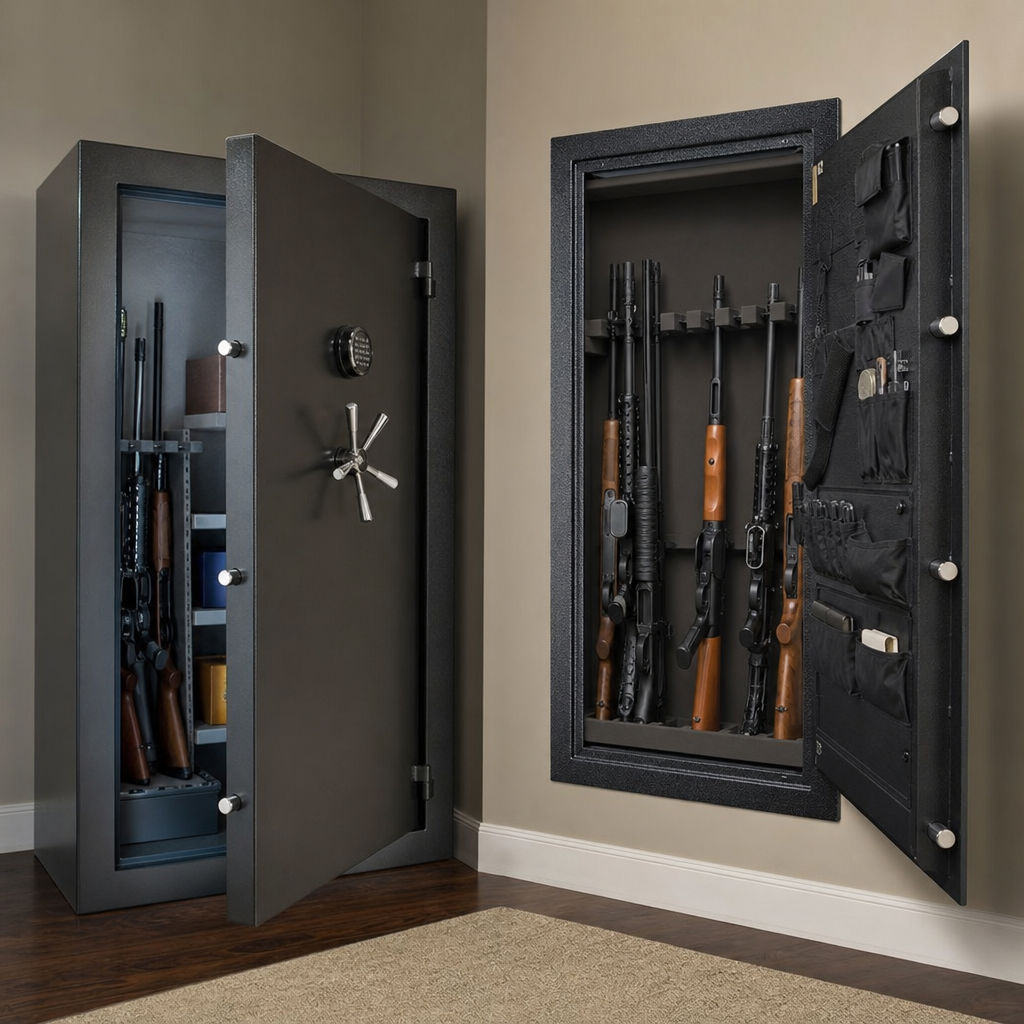
Tactical wall gun safes and traditional freestanding safes solve the same core problem—preventing unauthorized access to firearms—but they do it with very different security models, installation demands, and day-to-day tradeoffs. In practical terms, a tactical wall gun safe is a recessed or surface-mounted storage unit designed to fit inside or against a wall cavity, usually for quick access to one or two long guns, handguns, or defensive gear. A traditional safe is typically a heavier cabinet or vault-style unit placed on the floor, built to store more firearms and valuables with thicker steel, more locking bolts, and higher fire ratings. When buyers ask whether tactical wall gun safes are more secure than traditional safes, the accurate answer is no in absolute terms, but yes in specific use cases where concealment, access speed, and room placement matter more than bulk resistance.
This distinction matters because firearm storage is not one-dimensional. Security includes burglary resistance, child access prevention, fire protection, tamper detection, anchoring strength, and the ability to keep a defensive firearm accessible under stress. After evaluating wall safes, full-size gun safes, RSC-rated residential containers, and several fast-access models for clients and home layouts, I have found that most confusion comes from comparing unlike products. A slim hidden wall safe is often judged against a 700-pound 10-gauge safe, when the better comparison is between a quick-access wall unit and a bedside handgun safe. The right question is not simply which category is stronger; it is which design best matches the threat profile in your home, your local building structure, and how many guns you need to secure.
As a hub article for gun safe comparisons and brand spotlights, this guide explains how tactical wall gun safes compare with traditional safes, where each type excels, what standards and features actually matter, and how recognized brands fit into the decision. If you want a clear answer before buying, start here: traditional safes are generally more secure against brute-force attack and fire, while tactical wall gun safes can be highly effective for discreet, fast-access storage when properly installed and realistically matched to their limits.
What “more secure” really means for gun storage
Security is not a single specification on a product sheet. For firearm storage, it usually breaks into five measurable categories: unauthorized access prevention, burglary resistance, fire protection, access speed for the owner, and installation resilience. A safe that performs well in only one category may still fail your real-world needs. For example, a biometric wall safe may open in two seconds, but if it is mounted in standard drywall between studs with short lag screws and thin 16-gauge steel, an intruder with pry tools can defeat it faster than a heavier safe anchored into concrete.
Industry language also matters. Many products sold as “gun safes” are not TL-rated burglary safes. Most consumer gun safes fall into the residential security container category under UL 1037, which is a lower burglary-resistance benchmark than commercial vaults. That does not make them useless; it simply means buyers should separate marketing language from tested performance. A traditional RSC from Liberty, Fort Knox, Browning, Rhino, or AMSEC often provides better steel thickness, door construction, and boltwork than a hidden wall unit. In direct attack resistance, weight and structure usually win.
That said, concealment is a legitimate security layer. A tactical wall gun safe hidden behind a mirror, panel, or furniture may never be discovered during a fast smash-and-grab burglary. In homes where most thefts are opportunistic and short in duration, a concealed safe can outperform a visible but poorly anchored cabinet. This is why the most accurate framework is layered security, not category loyalty.
Tactical wall gun safes: strengths, weaknesses, and ideal use cases
Tactical wall gun safes are designed around space efficiency and rapid retrieval. Many models fit between 16-inch-on-center wall studs, use electronic keypad or biometric access, and include vertical storage for an AR-pattern rifle, shotgun, or carbine plus shelves for pistols, magazines, and medical gear. Companies such as Tactical Walls, Hornady, SnapSafe, and several custom fabricators focus on this niche, often blending concealment furniture with lockable steel compartments.
Their biggest strength is discretion. In bedrooms, offices, hallways, or closets, a recessed wall safe can remain invisible to guests, children, contractors, or thieves who only scan obvious targets. I have seen homeowners place a compact defensive setup in a primary bedroom wall safe while keeping the larger collection elsewhere. That division reduces retrieval time without exposing an entire arsenal to immediate access. Another advantage is footprint. In apartments, upstairs rooms, or houses with limited closet depth, a wall-mounted option may be the only practical way to secure a ready firearm.
Weaknesses are structural and predictable. Wall safes are limited by stud spacing, wall depth, and load-bearing realities. Most interior walls are framed with 2×4 studs, leaving roughly 3.5 inches of cavity depth before drywall, which constrains both steel thickness and interior capacity. Attack surfaces are also narrower and less massive than on full-size safes. If an intruder finds the safe and has time, surrounding drywall, trim, or even the section of wall can become part of the attack path. Fire protection is typically minimal unless the unit is specifically insulated and tested, which many tactical wall products are not.
Best use cases include one or two defensive long guns, a compact staging setup near a sleeping area, hidden storage in low-space homes, and secondary storage that complements a primary safe. They are not the best choice for large collections, heirloom guns, or high-value mixed storage that includes cash, documents, optics, and suppressors.
Traditional gun safes: why they still set the benchmark
Traditional gun safes remain the benchmark because they can combine mass, thicker steel, multi-point locking, interior capacity, and fire insulation in ways wall designs usually cannot. A freestanding gun safe may weigh from 300 pounds for an entry model to well over 1,000 pounds for premium units. That weight is not cosmetic. It resists removal, stabilizes the cabinet during prying attacks, and usually correlates with larger locking bolts, reinforced door edges, and harder-to-defeat hinge-side protection.
Good traditional safes also scale better. A buyer storing six rifles today may own twelve in five years once optics, slings, magazine storage, and handguns are added. Interior organization from brands like SecureIt, Liberty, and Browning has improved considerably, with configurable racks, door panels, dehumidifier ports, and lighting kits that make larger safes more usable. For households prioritizing full inventory control, a traditional safe is simply more practical.
Fire protection is another major differentiator. While fire ratings vary and should be read critically, many traditional safes use layers of gypsum-based fireboard or proprietary insulation and provide stated time-and-temperature ratings such as 30, 60, 75, or 120 minutes. Serious buyers should look for transparent testing methods rather than inflated brochure claims, but even imperfectly rated full-size safes usually provide more thermal mass than wall safes. If your risk profile includes wildfire exposure, older wiring, detached garages, or rural fire response times, that matters.
Head-to-head comparison: wall safe versus traditional safe
The most useful way to compare categories is across concrete buying criteria, not marketing claims. The table below reflects how these products typically perform in residential settings.
| Criterion | Tactical Wall Gun Safe | Traditional Gun Safe |
|---|---|---|
| Burglary resistance | Moderate when concealed; lower if discovered and attacked directly | Higher due to mass, thicker steel, larger boltwork, and stronger anchoring options |
| Concealment | Excellent, especially behind decor or integrated furniture | Limited; usually visible unless placed in a closet or hidden room |
| Access speed | Very fast for staged defensive firearms | Moderate; depends on location, lock type, and interior organization |
| Capacity | Low to moderate | Moderate to very high |
| Fire protection | Usually limited | Usually better, especially midrange and premium models |
| Installation complexity | High; depends on wall structure, stud layout, and concealment planning | Moderate; heavy delivery plus floor anchoring are main issues |
| Best role | Secondary quick-access storage | Primary long-term storage for full collections and valuables |
If you strip away appearance and focus on direct forced-entry resistance, traditional safes are more secure. If you focus on avoiding detection and placing a defensive firearm exactly where it is needed, tactical wall gun safes can be more effective in that narrower mission. Security depends on the threat you are actually trying to defeat.
Features that matter more than category
Some buying factors matter so much that they can outweigh the broad category difference. Steel thickness is one of them. A well-built compact safe with thicker steel can outperform a larger but thinner cabinet. Look for body and door gauge details, reinforced door frames, anti-pry tabs, hard plates protecting the lock, and relockers on better units. Lock type also matters, but not in simplistic ways. Mechanical dial locks are proven and durable, electronic keypads are faster and usually more convenient, and biometric systems are useful only when they are consistent across dry, wet, and stress conditions. Any biometric model should have a keypad or override method that you have personally tested.
Anchoring is equally critical. A 600-pound safe that is not bolted down can still be tipped, pried, or moved with appliance dollies. A wall safe installed only into drywall and trim is not truly secure no matter how hidden it looks. Proper installation should tie into studs, blocking, masonry, or concrete as appropriate. In retrofit work, I strongly prefer opening the wall and reinforcing the cavity rather than trusting surface-level screws on decorative framing.
Environmental control is another overlooked issue. Traditional safes often support dehumidifier rods, rechargeable desiccants, and better airflow management. Wall safes in exterior walls can face condensation risk due to temperature differences and insulation gaps. That can damage blued finishes and optics over time. If you store firearms in a wall unit, monitor humidity and avoid exterior wall placement when possible.
Brand spotlights and how to evaluate them
In gun safe comparisons and brand spotlights, buyers often look for one “best” brand, but the better method is to match brands to product strengths. AMSEC has a strong reputation in higher-security containers and offers options that move closer to true burglary-safe construction than many mass-market competitors. Liberty is widely available and known for broad model selection, dealer networks, and user-friendly interiors, though buyers should compare steel and feature tiers carefully across its range. Fort Knox is often chosen by buyers who want customization, heavier builds, and premium fit. Browning emphasizes storage organization and accessibility. Rhino and Vaultek appeal to different segments, with Rhino covering traditional safe formats and Vaultek standing out in modern quick-access electronic storage.
For tactical wall gun safes, Tactical Walls is prominent for concealment-focused furniture and hidden compartments rather than vault-level burglary resistance. Hornady’s Rapid Safe line and SnapSafe’s in-wall products serve users who prioritize access and discreet placement. SecureIt deserves mention because its products bridge categories: lighter modular cabinets are not traditional heavy safes, yet their organization and fast deployment appeal to practical firearm owners.
When evaluating any brand, ignore glamour shots and read the specifications in this order: steel thickness, lock type, boltwork, independent test claims, fire methodology, anchor provisions, warranty, and service responsiveness. Then read owner feedback for lock failures, finish quality, delivery damage, and customer support. Brand reputation matters, but the exact model matters more.
The best strategy for most homes
For most households, the most secure answer is not choosing between tactical wall gun safes and traditional safes, but using both in a layered plan. Store the majority of firearms, important documents, serialized accessories, and bulk ammunition in a properly anchored traditional safe located on the lowest practical floor, ideally on a concrete slab or reinforced structure. Then use a tactical wall gun safe or another fast-access safe for a limited defensive setup where speed matters. This arrangement reduces exposure, keeps daily-use firearms controlled, and prevents the common mistake of leaving a defensive gun unsecured because the primary safe feels too slow or too far away.
Placement and habits complete the system. Use quality locks, keep combinations private, change default codes, test batteries on a schedule, and rehearse access in darkness. If children are present, add redundant controls and education. If theft risk is high, integrate alarms, cameras, and monitored entry points. A safe is one layer, not a complete security plan.
So, are tactical wall gun safes more secure than traditional safes? In overall physical protection, no. Traditional safes remain the stronger choice for resisting attack, storing more guns, and surviving fire. In targeted roles—especially hidden, quick-access home-defense storage—a tactical wall gun safe can be the smarter and more effective tool. The best result comes from matching the safe to the mission, the room, and the risks in your household. Review your storage goals, compare specific models rather than broad labels, and build a layered setup that protects both access and safety.
Frequently Asked Questions
Are tactical wall gun safes actually more secure than traditional safes?
Not inherently. A tactical wall gun safe is not automatically more secure than a traditional safe just because it is hidden in a wall, and a traditional freestanding safe is not automatically better just because it is larger and heavier. The real answer depends on what kind of threat you are trying to defend against. Tactical wall gun safes tend to excel at discreet storage and fast access. When installed correctly, they can keep firearms out of sight, limit casual discovery, and prevent unauthorized access by children, visitors, or opportunistic intruders. Their concealment can be a genuine security advantage because something a burglar never finds cannot be attacked.
Traditional safes, however, usually provide better resistance to brute-force attacks because they are built with more steel, heavier doors, more substantial locking mechanisms, and greater total mass. Many are also designed to be bolted down, making removal far more difficult. In a direct comparison of physical attack resistance, a quality traditional safe usually has the advantage over a typical wall safe, especially against prying, cutting, or smash-and-grab theft attempts. So if “more secure” means stronger against forced entry, the traditional safe often wins. If “more secure” means harder to notice and quicker to reach in an emergency, the tactical wall safe may be the better fit. Security is not one-dimensional; it is a mix of concealment, access control, construction quality, and installation.
What are the biggest security advantages of a tactical wall gun safe?
The biggest advantage is concealment paired with accessibility. A tactical wall gun safe can be placed behind a mirror, picture frame, cabinet door, or other cover, making it much less obvious than a large safe sitting in a garage, closet, or bedroom corner. That lower profile matters because many residential burglaries are fast and opportunistic. Intruders often search obvious locations for valuables and may spend limited time on-site. A recessed or visually disguised wall unit can reduce the chance that the firearm storage is even discovered.
Another major benefit is speed. Tactical wall safes are often chosen for defensive firearms because they can be placed in strategic locations such as a bedroom, hallway, home office, or dressing area. That makes them practical for owners who want controlled access without storing a firearm in the open. Many models also include quick-access keypad, RFID, or biometric entry systems, which can be useful in situations where seconds matter. In addition, because these safes are usually designed for a smaller number of firearms and essentials, they encourage organized storage and can reduce fumbling under stress. That said, these advantages depend heavily on proper installation, reliable lock performance, and realistic expectations. A concealed wall safe is an excellent layer of home defense planning, but it is not a substitute for the heavier physical security of a full-size safe when theft resistance is the top priority.
Where do traditional safes outperform tactical wall gun safes?
Traditional safes outperform wall safes most clearly in physical durability, storage capacity, and broad protection features. A traditional safe is generally larger, heavier, and built with thicker steel or reinforced body panels. That makes it harder to pry open, harder to carry away, and often better suited for long-term storage of multiple firearms, ammunition, documents, and valuables. When bolted into concrete or otherwise anchored properly, a good traditional safe becomes a much more difficult target for a burglar using common hand tools.
They also tend to offer more robust internal layouts and better long-gun capacity. If you own several rifles, shotguns, handguns, optics, suppressor accessories where legally allowed, or other important equipment, a traditional safe is usually the more practical and secure option. Many traditional safes also include fire protection ratings or at least more meaningful fire resistance than a typical wall unit, which can be important if your storage goals go beyond access control and theft deterrence. In short, traditional safes are usually stronger for comprehensive firearm security planning: protecting more items, resisting more aggressive attacks, and serving as a central, dedicated storage solution. For households focused on collection storage, regulatory compliance, or maximum theft resistance, a traditional safe often provides the stronger overall security profile.
Does installation make a big difference in how secure a tactical wall gun safe is?
Yes, installation is absolutely critical. A tactical wall gun safe is only as secure as the structure holding it in place. Because wall safes are typically fitted between studs or mounted to framing members, they are constrained by the dimensions and strength of the wall itself. If the unit is poorly anchored, installed in weak material, or mounted in an exposed area with minimal structural support, its security can be compromised quickly. Even a well-built safe can become vulnerable if an attacker can pry it away from the wall, expose the cavity, or exploit flimsy surrounding construction.
Proper placement matters just as much as hardware. A wall safe installed in a discreet, low-traffic area with solid framing and a concealment strategy is generally more secure than one mounted in an obvious location at eye level. Professional installation can help ensure the safe is fastened correctly, aligned properly, and integrated into the wall in a way that minimizes weak points. It can also help avoid problems with wiring, plumbing, insulation, or code-related issues. By contrast, traditional safes are also installation-sensitive, but the process is often more straightforward: anchor the safe to the floor or slab and position it where leverage attacks are limited. With wall safes, the margin for error is smaller, which means installation quality plays an outsized role in actual security performance.
Which option is better for most homeowners: a tactical wall gun safe or a traditional safe?
For most homeowners, the better option depends on how the safe will be used. If the goal is quick access to a home-defense firearm while still preventing unauthorized access, a tactical wall gun safe can be an excellent solution. It works especially well for people who want a firearm stored discreetly in a bedroom or similarly strategic location without leaving it exposed. It is also a strong choice when space is limited and a large freestanding safe is not practical.
If the goal is securing an entire firearm collection, increasing resistance to theft, adding some level of fire protection, and storing valuables in one hardened location, a traditional safe is usually the better investment. In many homes, the most effective approach is not choosing one over the other, but using both. A traditional safe can handle primary storage for most firearms and valuables, while a tactical wall safe can serve as a secondary, quick-access option for a defensive setup. That layered approach matches different security needs to different storage tools. Ultimately, homeowners should evaluate the number of firearms they own, the likely risks in their area, whether children are present, how important rapid access is, and whether the installation environment truly supports a secure wall-safe setup. The best choice is the one that aligns with your threat model, your home layout, and your day-to-day use case.