
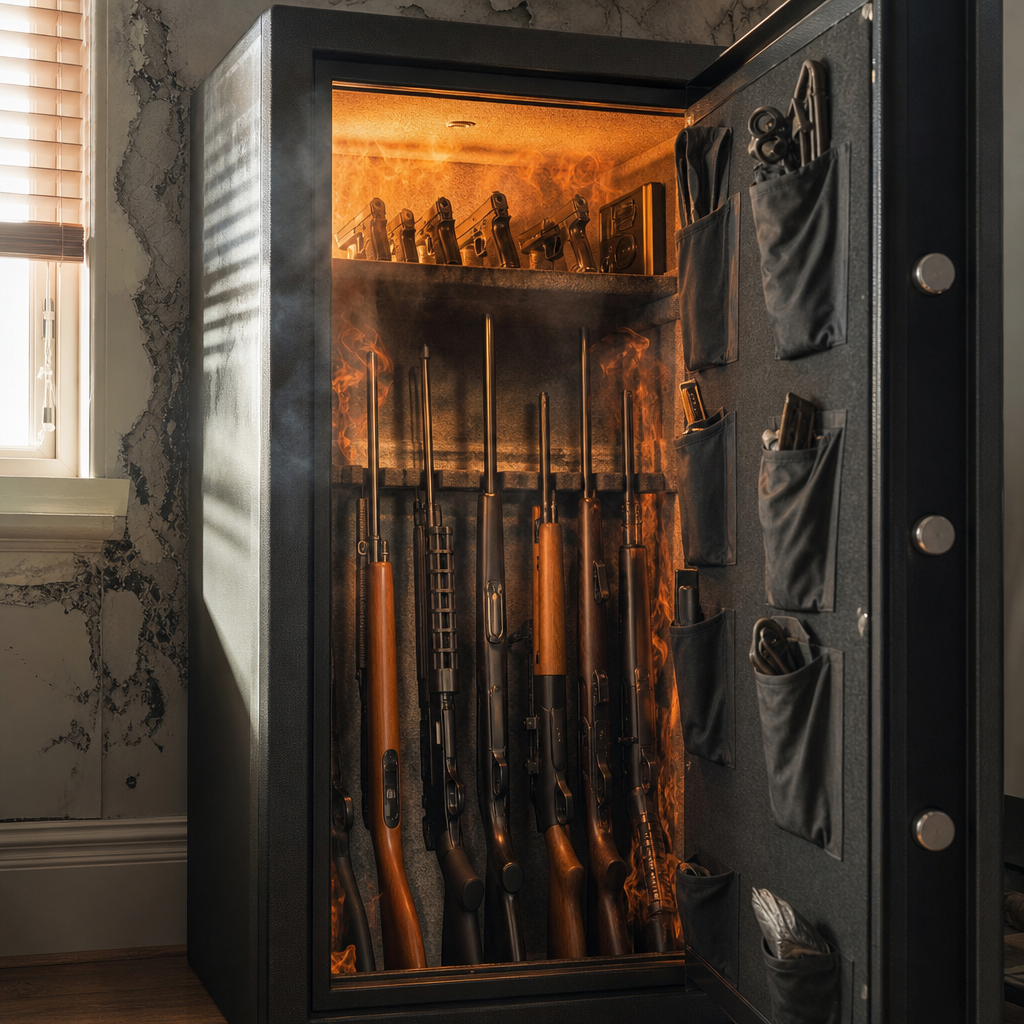
Firearm owners often ask whether extreme heat inside a gun safe can make a gun fire by itself, especially during summer heat waves, garage storage, or after hearing stories about ammunition “cooking off.” The short answer is that a firearm in a hot gun safe is extraordinarily unlikely to discharge unless a cartridge reaches temperatures high enough for the primer or propellant to ignite and the gun’s firing mechanism is somehow in a condition that allows movement or release. Understanding why requires separating myth from mechanism. Heat, ammunition sensitivity, chamber conditions, primer chemistry, and safe construction all matter, but they do not matter in the simplistic way internet rumors suggest.
In practical terms, a gun safe is a locked storage container designed to prevent unauthorized access, reduce theft risk, and in some models provide rated fire resistance. A firearm discharge means a loaded cartridge fires because the primer ignites the powder charge, generating pressure that propels the bullet. “Cook-off” is the technical term for ammunition igniting because of elevated temperature rather than because a firing pin struck the primer. That distinction is central. Most accidental shootings associated with storage are caused by loaded guns handled unsafely, poor administrative controls, or unauthorized access, not by ambient heat inside a safe. I have worked with safes stored in non-climate-controlled shops, attics, and garages, and the issues I see repeatedly are corrosion, degrading optics batteries, and stock warping long before spontaneous discharge becomes a credible hazard.
This topic matters because myths can lead owners to focus on the wrong risk. Someone worried that a rifle might suddenly fire in a 110-degree garage may ignore the much more probable problems: moisture buildup, ammunition deterioration from humidity cycling, unsecured loaded chambers, or overestimating a safe’s fire protection rating. A sound safety plan starts with what actually causes ignition, how modern ammunition behaves under heat, and what conditions a residential gun safe can realistically reach. Once those basics are clear, the question becomes less alarming and more manageable: reduce heat exposure, store firearms unloaded when practical, use chamber flags or separate ammunition storage if appropriate, and choose a safe and location based on environmental control as much as burglary resistance.
How a Firearm Actually Fires and Why Heat Alone Rarely Does It
A modern centerfire cartridge fires when the primer compound in the cartridge base is crushed by the firing pin. That impact initiates a flame front into the smokeless powder, which burns rapidly and produces gas pressure. Without that mechanical strike, the primer is surprisingly resistant to ordinary environmental heat. Smokeless powders and primers are engineered for stability across broad handling temperatures. SAAMI, the Sporting Arms and Ammunition Manufacturers’ Institute, publishes standards that assume ammunition may be transported, stored, and used in hot and cold conditions. Military testing protocols are similarly built around temperature extremes far beyond ordinary indoor conditions.
Could heat ignite a round eventually? Yes, but the threshold is much higher than the temperatures found in a typical gun safe sitting in a house, garage, or shed during summer. Ammunition can cook off when exposed to sustained high temperatures, especially in a chamber or near direct flame. That is why machine guns used in continuous automatic fire can experience cook-offs if a round remains chambered in a superheated barrel. The chamber acts as a heat sink directly contacting the cartridge case. A loose cartridge on a shelf in a hot environment behaves very differently. It warms more slowly, loses heat to surrounding air, and is not trapped inside a pressure vessel designed to direct gas against a projectile.
The key takeaway is simple: ambient heat inside a gun safe is not equivalent to chamber heat during sustained firing or direct fire exposure during a structure fire. In normal civilian storage conditions, the temperatures are nowhere near the levels needed for spontaneous ignition of modern ammunition. If a gun safe becomes hot enough to approach those levels, the owner is no longer dealing with a storage nuisance but with a severe fire event.
How Hot Can a Gun Safe Get in Real Conditions?
In real homes, gun safe temperatures track the surrounding environment with some lag. In an air-conditioned interior room, the safe may remain close to room temperature. In a garage or shed, interior temperatures can climb significantly, often 10 to 30 degrees above outdoor air depending on solar gain, insulation, and the safe’s color and mass. In desert climates, a garage can exceed 120 degrees Fahrenheit. Inside a sealed steel cabinet, localized temperatures may rise higher during the hottest part of the day, especially near sun-facing walls. Even so, these numbers remain far below ignition temperatures for primers and smokeless powder.
Fire-rated safes complicate the discussion. Their insulation is intended to slow heat transfer during a fire, often by using gypsum-based board or proprietary composites that release moisture as temperature rises. In ordinary summer conditions, that insulation can actually moderate internal swings. During an actual house fire, however, internal temperatures can eventually rise enough to damage guns, optics, wood stocks, lubricants, and ammunition. Fire ratings like 30, 60, or 90 minutes at specified external temperatures are not promises that contents emerge unharmed. They are controlled-test benchmarks, and the exact performance depends on door seals, mass, installation, and fire dynamics in the room.
| Scenario | Typical Temperature Range | Discharge Risk | Primary Concern |
|---|---|---|---|
| Climate-controlled interior room | 65 to 80 F | Negligible | Routine maintenance |
| Hot garage in summer | 90 to 130 F | Extremely low | Humidity cycling, corrosion, lubricant breakdown |
| Vehicle trunk in sun | 120 to 160 F | Still very low | Ammunition aging, legal and theft issues |
| Near direct flame or structure fire | Hundreds of degrees | Possible cook-off | Life safety, total property loss |
The table shows the practical hierarchy. Heat inside a safe matters, but mostly because it affects material longevity and moisture behavior, not because it turns stored guns into self-firing hazards.
Can Ammunition Cook Off Inside a Safe?
Ammunition can cook off if exposed to enough heat for long enough, but context is everything. Unchambered ammunition stored in boxes or magazines does not behave like chambered ammunition in a firearm. When a loose round ignites, the brass case usually ruptures and releases energy inefficiently because it is unsupported. Testing by fire services, ammunition manufacturers, and sporting organizations has repeatedly shown that loose ammunition in fires presents a hazard, but generally not the same directional projectile threat as ammunition fired from a gun barrel. The pressure is not contained in the same way.
Inside a loaded firearm, the mechanics are different. If a chambered round somehow ignited from heat, the barrel and action would channel pressure, and the firearm could discharge. That is the reason many long-term storage protocols recommend storing firearms unloaded, with magazines removed and chambers verified clear. It is also why relying on a mechanical safety alone is not a substitute for an unloaded storage condition. Safeties block or interrupt trigger or sear movement; they do not make a loaded firearm immune to every conceivable mechanical or thermal failure.
For ordinary household heat, though, cook-off remains a theoretical rather than practical storage risk. The scenarios that produce it are severe fire exposure, direct radiant heat, or a weapon already heated by firing. A properly stored gun sitting in a warm safe is not approaching those conditions.
Common Gun Safe Myths and the Reality Behind Them
Myth one is that any hot metal safe becomes an oven that can ignite ammunition. The reality is that ordinary environmental heat is far below ignition thresholds. Myth two is that a fire-rated safe guarantees ammunition and firearms inside will never reach dangerous temperatures. In reality, ratings are limited-duration tests and do not equal indefinite protection. Myth three is that if ammunition ignites inside a safe, bullets will blast through the steel walls. In most documented fire incidents involving loose cartridges, unsupported rounds fragment or split cases rather than launching bullets with full barrel velocity. Myth four is that storing magazines loaded in heat is inherently unsafe. Spring fatigue comes primarily from cycling, not simple compression, though long-term storage still calls for quality magazines and periodic inspection.
Another persistent misconception is that only cheap safes trap damaging heat and moisture. High-end safes also need placement planning. A premium steel body in a damp basement can still create condensation when temperatures swing. The most expensive safe on the market cannot fix poor location choice, overloaded interior airflow, or neglect of desiccants and dehumidifier rods. In my experience, owners who obsess over steel thickness but ignore humidity control are far more likely to face rust, mold on slings, and tarnished brass than any discharge event.
What Risks Heat Actually Creates for Guns in Storage
Heat affects firearms primarily through materials, lubricants, and moisture interaction. Many oils thin at higher temperatures and migrate away from contact surfaces. Greases can soften and collect debris. Wooden stocks expand and contract with changing humidity, which can alter bedding pressure and point of impact. Polymer frames generally tolerate normal heat well, but repeated extreme cycles can age adhesives, optics mounts, and battery compartments. Red-dot sights are especially vulnerable because battery chemistry and sealed electronics degrade faster in high heat. Night sights with tritium are less affected by temperature than by age, but adhesives and encapsulation still benefit from stable storage conditions.
Ammunition also ages faster when heat is chronic. Smokeless powder and primers are stable, but elevated temperature accelerates chemical breakdown over years. The practical effect is not usually spontaneous ignition; it is declining reliability, velocity variation, and shortened service life. Defensive ammunition carried in vehicles for long periods is a better example than ammunition in a closet safe. Rotating carry ammo annually, inspecting for setback or corrosion, and avoiding prolonged vehicle storage are sensible measures grounded in actual failure modes.
Best Practices for Safe Firearm and Ammunition Storage
The safest and most durable setup is straightforward. Store the safe in a conditioned interior space when possible. Keep firearms unloaded for long-term storage unless a specific defensive-access plan requires a different method. Verify chambers visually and physically. Use a dehumidifier rod or rechargeable desiccant, and monitor humidity with a digital hygrometer; roughly 45 to 55 percent relative humidity is a useful target for most collections. Separate bulk ammunition if space and access plans allow, ideally in cool, dry conditions using manufacturer boxes or military-style cans with good seals. Inspect lubricants, optics, and batteries on a schedule.
If garage placement is unavoidable, elevate the safe slightly off concrete, insulate the space if feasible, reduce direct sun exposure, and expect more frequent maintenance. Document the safe’s fire rating, understand what standard it was tested to, and avoid assuming all ratings are comparable. Most important, build your storage plan around realistic hazards: unauthorized access, rust, theft, and true fire exposure. If your current setup relies on myths, upgrade it this month with a hygrometer, a dehumidification method, and a chamber-check routine. Those simple steps do far more for gun safe safety than worrying about a summer day causing a spontaneous shot.
The science is clear: a firearm is not going to discharge inside a merely hot gun safe under normal residential conditions. For a cartridge to fire, it needs either a primer strike or temperatures associated with severe heat exposure, not the elevated ambient warmth found in most homes, garages, or sheds. That distinction is the foundation for understanding gun safe myths and misconceptions. Heat matters, but mostly in indirect ways. It can accelerate corrosion cycles, degrade lubricants, shorten the life of optics batteries, stress wood and polymer components, and slowly age ammunition over time. Those are real, measurable storage concerns. Spontaneous discharge from ordinary heat is not.
This is why the broader conversation around gun safe safety needs to stay grounded in mechanisms instead of anecdotes. A loaded firearm left chambered in storage presents a different risk profile from an unloaded firearm with ammunition stored separately. A safe in a climate-controlled room behaves differently from one in a detached garage. A safe with a credible fire rating provides meaningful delay in a fire, but no consumer safe creates magical immunity from extreme temperature. Good storage decisions come from understanding those variables and prioritizing them correctly. In practical use, the most common problems I encounter are rust, neglected maintenance, weak location choices, and false confidence in ratings or lock features.
As the hub for gun safe myths and misconceptions, the main lesson is simple: focus on the hazards that actually cause loss. Verify unloaded status for stored guns when appropriate, control humidity, rotate vulnerable ammunition, maintain your safe, and learn what your fire rating really means. Those steps reduce real-world risk far more effectively than worrying about a hot afternoon making a gun fire on its own. Review your current storage setup today and correct the weakest point first. Small, informed changes are what turn a gun safe into a true safety system.
Frequently Asked Questions
Can a firearm discharge by itself inside a hot gun safe?
In normal real-world conditions, a firearm inside a hot gun safe is extraordinarily unlikely to discharge on its own. Modern cartridges are designed to remain stable across a wide range of temperatures, and a firearm still needs a very specific chain of events to occur before it can fire. First, the cartridge has to reach a temperature high enough to ignite the primer or propellant. Second, the firearm’s action, chamber, and internal parts would need to be in a condition where that ignition could actually result in a true discharge. In most summer heat, garages, attics, or poorly ventilated spaces, temperatures may become uncomfortable for people and hard on gear, but they are still typically far below the threshold needed to make loaded ammunition ignite.
It also helps to separate the idea of a gun “going off” from ammunition “cooking off.” A firearm normally fires because the firing pin strikes the primer with force. Heat alone does not usually replicate that process. Even if ammunition were exposed to unusually high temperatures, spontaneous ignition is not something expected from ordinary seasonal heat. The concern becomes more serious in extreme scenarios such as a house fire, direct flame exposure, or prolonged heating well beyond normal environmental conditions. For day-to-day storage, the larger risks from excessive heat are usually damage to optics, lubricants, stocks, seals, and corrosion protection rather than a spontaneous discharge.
What temperature would ammunition have to reach before there is a real risk of “cook-off”?
Ammunition generally must reach temperatures far beyond what a typical gun safe experiences during hot weather before there is a meaningful risk of ignition. The exact temperature can vary based on cartridge type, primer composition, powder formulation, case design, and exposure time, but the key point is that ammunition does not normally ignite just because the surrounding air is hot. A garage that reaches 100 to 130 degrees Fahrenheit during a heat wave is not remotely the same as ammunition being subjected to the intense, sustained temperatures seen in a fire or in direct contact with a heating source.
“Cook-off” is a term more often associated with ammunition or a chamber becoming hot enough from repeated firing or intense external heat that a cartridge ignites without a trigger press. That kind of condition is most relevant in machine guns, overheated chambers, industrial heat environments, or structure fires. Inside a residential safe during summer, the internal temperature may rise, especially if the safe is in a non-climate-controlled area, but those temperatures are still typically well below the ignition point of primers and smokeless powder. If someone is worried about heat, the practical takeaway is not that the gun will likely fire by itself, but that climate control and proper storage are wise for preserving the firearm and ammunition over the long term.
If ammunition did ignite from extreme heat, would the gun fire normally inside the safe?
Not necessarily. For a cartridge to propel a bullet with normal firearm-like force and direction, it usually needs to be chambered in a functioning firearm with the action closed and the barrel containing and directing the pressure. Ammunition that ignites outside a chamber behaves very differently from ammunition fired in a gun. Loose rounds exposed to fire can rupture and scatter fragments, but they do not typically launch bullets with the same velocity and danger profile as a properly chambered round fired through a barrel.
If a round were chambered in a firearm and somehow exposed to extreme enough heat to ignite, the result would depend on the condition of the firearm. Is the action locked? Is the striker or hammer at rest? Is there a mechanical safety engaged? Different firearm designs respond differently to abnormal conditions. Even then, this is a scenario associated with severe heat exposure, not a hot summer afternoon. For most owners, the more useful safety rule is simple: store firearms unloaded when practical, store ammunition properly, and do not assume that “hot” means “close to firing temperature.” Extreme heat can be harmful, but harmful does not automatically mean self-discharge.
Are certain firearms or storage conditions more vulnerable to heat-related problems?
Yes, but the vulnerability is usually about reliability and material degradation rather than spontaneous firing. Older firearms, heavily modified firearms, guns with questionable trigger work, and firearms stored loaded with a round chambered may present more theoretical risk than unloaded, well-maintained guns. Likewise, low-quality ammunition, deteriorated primers, contaminated powder, and cartridges stored for years in poor conditions can become less predictable. However, “less predictable” still does not mean likely to fire from ordinary ambient heat alone.
Storage environment matters. A gun safe placed in a climate-controlled room is a very different environment from one located in a sun-baked garage, metal shed, attic, or workshop. In the harsher spaces, heat can break down lubricants, harden or soften some polymer and rubber components, accelerate moisture cycling, and increase condensation risk when temperatures fluctuate. Humidity is often the bigger enemy than heat by itself because it drives rust, pitting, and degradation of finishes and internal parts. For that reason, the best preventive measures include keeping the safe in the most stable environment possible, using a dehumidifier or desiccant, avoiding direct sun exposure on the safe, and periodically inspecting both firearms and ammunition for signs of corrosion, oil migration, case discoloration, or seal failure.
What is the safest way to store firearms and ammunition during extreme summer heat?
The safest approach is to focus on temperature stability, low humidity, and conservative firearm condition. Store the safe in an interior, climate-controlled area whenever possible rather than in a garage, attic, or outbuilding. If the safe must be kept in a hotter space, reduce thermal stress by keeping it out of direct sunlight, improving ventilation in the room, and using tools such as a safe dehumidifier, desiccant packs, or environmental monitoring devices that track both heat and humidity. These steps do more to protect your firearms than worrying about a spontaneous heat discharge in ordinary summer conditions.
From a firearm handling standpoint, many owners choose to store defensive firearms according to their security needs and local laws, but for long-term storage, unloaded is generally the lower-risk option. Keep ammunition in good condition, ideally in its original boxes or sealed containers, and avoid storing it where it is exposed to repeated extreme temperature swings. Regularly inspect your safe’s interior environment and the condition of the guns, magazines, optics, and ammo. The science-based takeaway is reassuring: a hot gun safe in summer is not usually hot enough to make a firearm fire by itself. The smarter concern is preserving function, preventing corrosion, and maintaining safe storage practices so your firearms perform properly when you actually need them.