
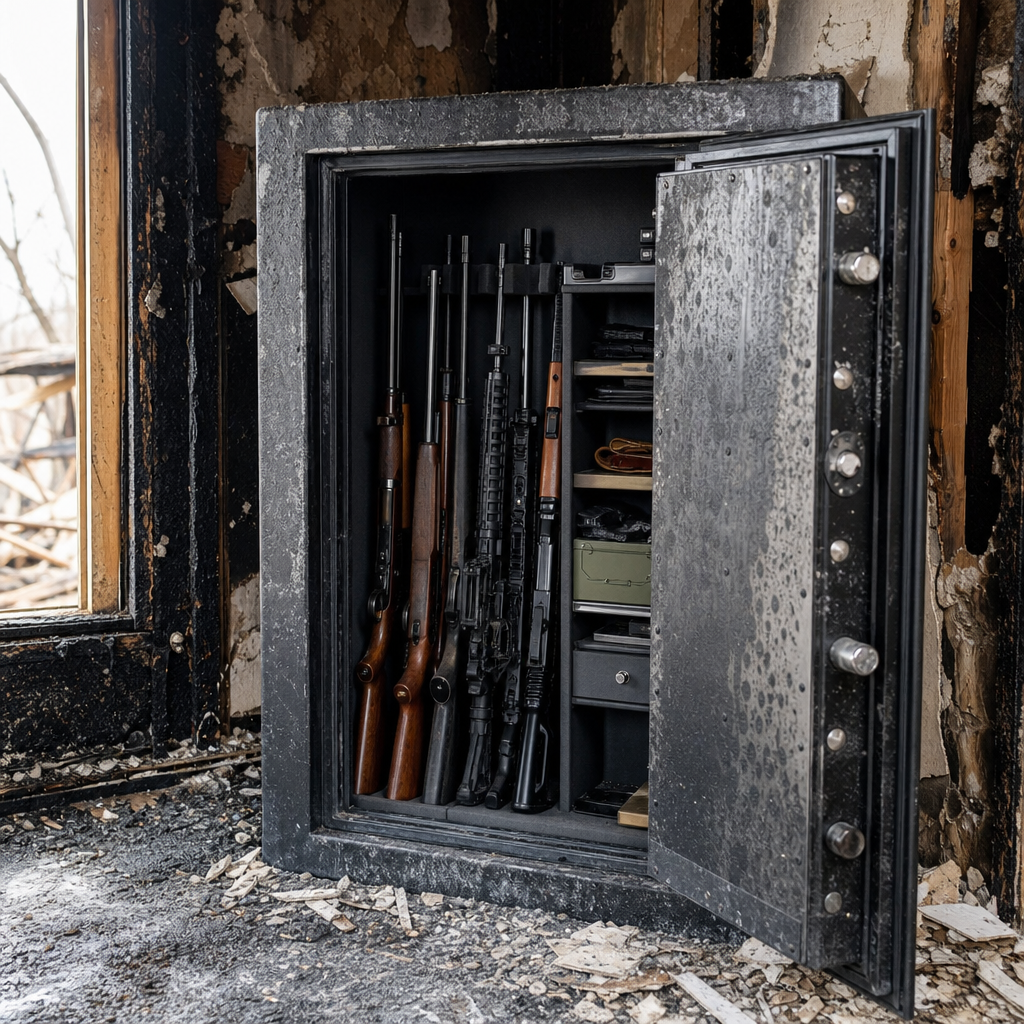
Many buyers ask whether gun safes are fireproof, but the accurate answer is more nuanced: most gun safes are fire-resistant, not fireproof, and that distinction matters when you are protecting firearms, documents, optics, and heirlooms from a house fire. In the gun safes and safety category, fire ratings are one of the most misunderstood features I see people rely on, often because marketing language sounds absolute while real-world performance is conditional. A fireproof gun safe would imply complete protection under all fire conditions for an unlimited period, which is not how safes are designed, tested, or sold in the consumer market. Fire-resistant means the safe can keep internal temperatures below a stated threshold for a defined time under defined test conditions. That threshold matters because paper chars around 451 degrees Fahrenheit, many plastics deform much sooner, and ammunition packaging, lubricants, scopes, and electronic accessories can fail well before steel itself is threatened. This article serves as the hub for gun safe myths and misconceptions, explaining what ratings mean, where advertising overreaches, how construction affects outcomes, and what buyers should verify before trusting a label.
Fireproof vs. fire-resistant: the critical distinction
The most important correction in any discussion about gun safe myths is simple: consumer gun safes are almost never truly fireproof. Reputable manufacturers usually use terms such as fire-rated, fire-resistant, or tested for a certain duration, though less careful marketing may still say fireproof because it converts better. In practice, a safe’s fire performance depends on insulation type, steel thickness, door seals, the temperature curve of the fire, where the safe is installed, and how long firefighters take to control the blaze. If a brochure promises a “90-minute fireproof safe,” read that as shorthand for a specific test scenario, not an ironclad guarantee.
When I evaluate safes, I look for the exact language behind the claim. A meaningful rating states a duration, a peak external temperature, and an internal temperature limit. For firearms owners, that internal limit is especially important because protecting paper alone is not the same as protecting optics, polymer frames, wood stocks, photographs, cash, passports, and hard drives. Many buyers assume that if steel survives, contents survive. That is false. Contents usually fail from heat transfer and humidity long before the shell is structurally compromised.
How gun safe fire ratings actually work
Fire ratings are not standardized across the entire gun safe market in the way many people assume. Some ratings come from independent labs such as UL, Intertek, or ETL, while others are based on manufacturer-run tests or inherited test protocols. That does not automatically make a rating worthless, but it does mean you should ask who conducted the test, whether the safe was preheated, whether it was humidity-monitored, whether it endured a cool-down period, and what internal temperature was maintained. A proper cool-down matters because contents can continue heating even after the fire source is removed.
Most consumer fire tests target keeping the interior below 350 degrees Fahrenheit for paper protection. That benchmark comes from the point at which paper begins to char. However, digital media often requires far lower temperatures and stricter humidity control, which standard gun safes rarely provide. In my experience, buyers commonly overestimate what a residential gun safe can save. A safe rated for 30, 60, or 90 minutes can be valuable, but it is not equivalent to a purpose-built media safe or a commercial record safe certified to more demanding standards.
Common gun safe myths and misconceptions
The fireproof question sits inside a larger cluster of gun safe myths and misconceptions that lead people to buy the wrong product. Myth one: heavier always means better fire protection. Weight can indicate more steel or insulation, but heavy safes are sometimes heavy because of drywall-based liners and not because of superior burglary resistance. Myth two: all fire insulation works the same. Some manufacturers use multiple layers of gypsum board that release steam as they heat, while others use proprietary poured insulation. Each approach has strengths and tradeoffs in cost, weight, and uniformity. Myth three: a bigger rating number always means better real-life protection. A “120-minute” claim without credible test details may be less trustworthy than a thoroughly documented 60-minute rating.
Another misconception is that surviving the fire means surviving the aftermath. After many residential fires, the threat shifts to water, corrosive smoke, and long exposure to humidity inside a sealed box. Firefighters may soak the structure for hours. If firearms sit wet in fabric sleeves or foam-lined cases inside the safe, rust can begin quickly. That is why dehumidification, post-fire recovery, and storage method matter almost as much as the initial rating.
What safe construction tells you about fire performance
Construction details reveal more than the sales sticker does. The outer shell on many residential gun safes is made from formed sheet steel, often in the 14-gauge to 10-gauge range, with stronger models moving to 7-gauge or thicker plate components. Fire resistance usually comes from the insulating layers between the exterior and interior liner, not from steel alone. Door gaps, bolt openings, and weak corner seams can become thermal pathways. Expanding intumescent door seals are especially useful because they swell under heat and help block smoke and hot gases from entering around the door perimeter.
Interior layout also affects survival. Safes packed tightly with documents, fabric, and cases may retain heat and moisture longer than lightly loaded interiors. Shelving can shield some items and trap heat around others. I advise placing the most temperature-sensitive valuables in the lower center of the safe, not against the ceiling or door, where temperatures often rise fastest. Even within a rated safe, microclimates exist, and placement can change outcomes.
Comparing common fire rating claims
| Claim Type | What It Usually Means | Main Limitation | Best Buyer Question |
|---|---|---|---|
| 30 minutes at 1200°F | Entry-level residential fire resistance for brief fires | May be inadequate for fully involved home fires or remote locations | Was the test independently verified and did it include cool-down? |
| 60 minutes at 1400°F | Mid-range protection common in better gun safes | Usually aimed at paper, not electronics or media | What internal temperature threshold was maintained? |
| 90 minutes at 1200–1400°F | Higher claimed endurance for longer fire exposure | Methodology varies widely by brand | Who performed the test and was the unit loaded? |
| “Fireproof” with no details | Marketing language, not a complete rating | Provides no usable basis for comparison | Can you show the full test report? |
Why house fires do not match laboratory conditions
One reason gun safe misconceptions persist is that buyers imagine a fire rating as a fixed promise. Real fires are chaotic. Flashover can push room temperatures well above 1100 degrees Fahrenheit, and localized conditions near fuel loads can be higher. A safe in a garage may face a different burn profile than one on a concrete slab in a first-floor closet. A safe on an upper level may fall through compromised flooring, changing its exposure. Nearby accelerants such as paint, gasoline, ammunition, or stored solvents can intensify temperatures. Fire duration also varies widely with building size, response times, ventilation, and suppression success.
Laboratory tests, by contrast, follow a controlled temperature curve. That is useful for comparison, but it cannot replicate every field condition. I have seen safes come through moderate structure fires with contents largely intact, and I have also seen rated units lose paper, optics, and finishes because the fire burned longer than the label anticipated. The lesson is not that ratings are useless. The lesson is that ratings are conditional tools for comparing risk, not guarantees against every fire scenario.
Placement, installation, and surrounding materials matter
Where you install a gun safe has a direct effect on fire survival. Basements on concrete slabs often provide better thermal stability than second-floor rooms, though flooding risks can be higher. Interior closets can shield a safe from the most intense radiant heat better than garages, where fuel loads and ventilation may increase fire severity. Bolting the safe down is essential for security, but the base material matters too. Concrete reduces movement and can limit heat transfer from below compared with wood framing during a structural fire.
Surrounding construction influences results. A safe enclosed by multiple layers of drywall may gain precious time before direct flame impingement. Conversely, a safe sitting in open space beside combustible shelving can be hit hard early. If your home has a monitored alarm, smoke detection, and a residential sprinkler system, all of those reduce the odds that the safe will ever be tested at its limit. The best fire-resistant gun safe works as one layer in a broader home fire protection plan, not as a standalone solution.
What to protect inside a gun safe, and what needs extra measures
Firearms are only part of what owners store in gun safes. Tax stamps, suppressor paperwork, passports, cash, family photos, deeds, jewelry, spare magazines, thermal optics, and backup drives often end up on the shelves. These items do not share the same heat tolerance. Wood stocks can dry and crack. Scope adhesives can fail. Polymer accessories can warp. Hard drives and memory cards are far more vulnerable than paper. That is why a practical storage plan separates items by sensitivity rather than assuming the entire safe has equal protective value.
For documents, use sealed document pouches or secondary fire-resistant boxes inside the safe. For optics and electronics, choose the coolest interior locations and avoid direct contact with exterior walls. For corrosion control, use a dehumidifier rod or rechargeable desiccants and inspect them on schedule. After any nearby fire or heavy smoke event, open the safe as soon as conditions allow, remove contents, and start drying and cleaning immediately. Fire resistance buys time; it does not eliminate recovery work.
How to shop smart and avoid misleading marketing
If you are comparing products in the gun safe myths and misconceptions category, ask for evidence instead of slogans. Request the full fire rating details, the testing agency, the internal temperature target, and whether the safe passed an impact test after heating. Look at steel thickness separately from fire protection so you do not confuse burglary resistance with thermal performance. Brands such as AMSEC, Liberty, Fort Knox, Browning, and Rhino have offered models with varying fire strategies, but model-level specifications matter more than brand reputation alone.
Also read the warranty carefully. A strong fire warranty may cover replacement of the safe after a verified fire, but that does not mean your contents are insured. Inventory your firearms with serial numbers, photos, and appraisals, and keep copies off-site or in encrypted cloud storage. In the end, the right answer to “Are gun safes fireproof, or just fire-resistant?” is clear: they are fire-resistant systems with measurable but limited performance. Buy based on tested details, install for the lowest practical risk, and treat the safe as one layer of a complete protection strategy. Review your current setup, verify your safe’s rating, and upgrade weak points before the next emergency tests your assumptions.
Frequently Asked Questions
Are gun safes actually fireproof, or are they only fire-resistant?
In most cases, gun safes are fire-resistant, not truly fireproof. That difference is important. The word “fireproof” suggests complete protection under any fire conditions, for any length of time, with no internal damage. That is not how most residential gun safes are designed or tested. Instead, they are built to resist heat for a limited period under specific conditions, which is why the more accurate term is fire-resistant.
Most manufacturers assign a fire rating based on a temperature-and-time claim, such as 30 minutes at 1,200°F or 60 minutes at 1,400°F. Those numbers do not mean the safe can survive every house fire untouched. They mean the safe is intended to slow heat transfer long enough to improve the odds that the contents remain below a critical internal temperature for a defined period. Real fires vary widely in intensity, duration, ventilation, structural collapse, and whether firefighters arrive quickly. Because of that, a fire-resistant safe offers conditional protection, not an absolute guarantee.
For buyers, the practical takeaway is simple: if you see a gun safe described as fireproof, treat that as marketing language rather than a literal promise. The safer assumption is that you are buying time, not invincibility. A quality fire-resistant safe can still be very valuable protection for firearms, documents, optics, and family keepsakes, but it should be understood as one layer of defense within realistic limits.
What does a gun safe fire rating really mean?
A gun safe fire rating usually refers to how long the safe is claimed to withstand a certain external temperature while keeping the interior below a target threshold. For example, a rating of 60 minutes at 1,400°F generally means the manufacturer expects the safe to resist heat for one hour in that test environment. The key point is that the rating is only meaningful when you know how it was established.
Not all fire ratings are created equal. Some are based on independent testing, while others come from the manufacturer’s internal methods. The most reliable ratings are tied to recognized testing standards and third-party verification, because those provide more confidence that the safe performed under controlled, repeatable conditions. If a company lists a rating but does not explain the test protocol, internal temperature limit, or certifying body, that rating should be viewed more cautiously.
It also helps to understand what fire ratings do not tell you. They do not guarantee survival in every fire, and they do not always account for all real-world factors such as water exposure from fire suppression, impact damage from collapse, or prolonged smoldering after the main flames are out. In short, a fire rating is a useful comparison tool, but it is not a universal promise. It is best used alongside other factors like safe construction, door seal quality, wall thickness, placement in the home, and whether your most sensitive valuables need a higher level of protection than the safe can realistically provide.
Can a fire-resistant gun safe protect documents, optics, and heirlooms as well as firearms?
It can, but not always equally well. Firearms are generally more tolerant of heat than paper documents, photographs, electronic media, or delicate heirlooms. A gun safe that performs well enough to shield metal firearms from direct fire exposure may still allow internal temperatures or humidity levels that damage birth certificates, passports, cash, family photos, scopes, red dots, and sentimental items.
Paper begins to char and degrade at temperatures much lower than many people realize, and electronics or optical components can be even more sensitive to heat, smoke residue, adhesives, and moisture. That means a fire-resistant gun safe may offer a meaningful level of protection for guns while still being less than ideal for irreplaceable paperwork or valuable accessories. Even if flames never reach the contents, elevated internal heat and post-fire condensation can still cause corrosion, warping, delamination, and optical damage.
If you plan to store mixed valuables, a smart approach is to think in layers. Use the gun safe for firearms and general protection, but place critical documents or highly sensitive items inside dedicated fire-rated document chests, media containers, or sealed protective pouches within the safe if those products are appropriately rated. That extra barrier can buy additional time and reduce heat and moisture exposure. It is also wise to digitize records, back up important files off-site, and avoid assuming that one large gun safe automatically provides the same level of protection to every item inside it.
What factors affect how well a gun safe performs in a real house fire?
Real-world fire performance depends on much more than the number printed on the sales tag. Construction materials matter, including the thickness of the steel body, the type and amount of fire insulation, the design of the door and frame, and the quality of expanding heat seals that help block smoke and hot gases. A safe with stronger build quality and better seals generally has a better chance of limiting internal temperature rise during a fire.
Where the safe is installed also plays a major role. A safe placed on a concrete slab in a lower-risk area of the home may fare better than one installed in a garage full of accelerants or on an upper floor that could collapse into the hottest part of the fire. Surrounding fuel load matters too. Nearby ammunition, solvents, wood shelving, and other combustible materials can intensify conditions around the safe. Even the direction of heat exposure can influence performance, since some safe designs are more vulnerable at seams, corners, or door gaps.
Another overlooked factor is fire duration. Some house fires are knocked down quickly, while others burn much longer due to delayed detection, remote location, weather, or structural complications. Water from hoses and sprinklers can also create secondary risks such as rust, swelling of stored materials, and damage to finishes or optics. This is why experienced buyers look beyond a simple fire rating and consider the whole protection strategy: safe quality, home layout, smoke detection, response time, humidity control, and proper anchoring. A fire-resistant safe works best when it is part of a broader plan, not treated as a magical box that defeats every fire scenario.
How can I choose a gun safe with the best realistic fire protection?
Start by looking for honesty and specificity rather than dramatic marketing claims. A good manufacturer should clearly state the fire rating, the temperature, the test duration, and ideally whether the rating was verified by an independent third party. Vague phrases like “factory tested” or “fireproof design” are less reassuring than detailed information about how the safe was evaluated. If the company cannot explain its rating clearly, that is a sign to dig deeper.
Next, match the safe to what you are actually protecting. If your main concern is preserving firearms from moderate residential fire exposure, a solid fire-resistant gun safe with a credible rating may be enough. If you also plan to store legal documents, old photographs, suppressor paperwork, expensive optics, or family heirlooms, you may need additional internal protection or even a separate purpose-built fire container for the most vulnerable items. The best choice is not always the highest advertised number; it is the safe that fits your risk profile and storage needs in a realistic way.
Finally, pay attention to installation and overall preparedness. Anchor the safe properly, place it in a lower-risk area when possible, keep combustibles away from it, and use dehumidification or moisture control products to protect contents before and after any emergency. Combine the safe with smoke alarms, home fire extinguishers, and a home security plan. In other words, choose a safe that buys time, understand the limits of its fire resistance, and build your storage strategy around the fact that no residential gun safe should be treated as absolutely fireproof.