
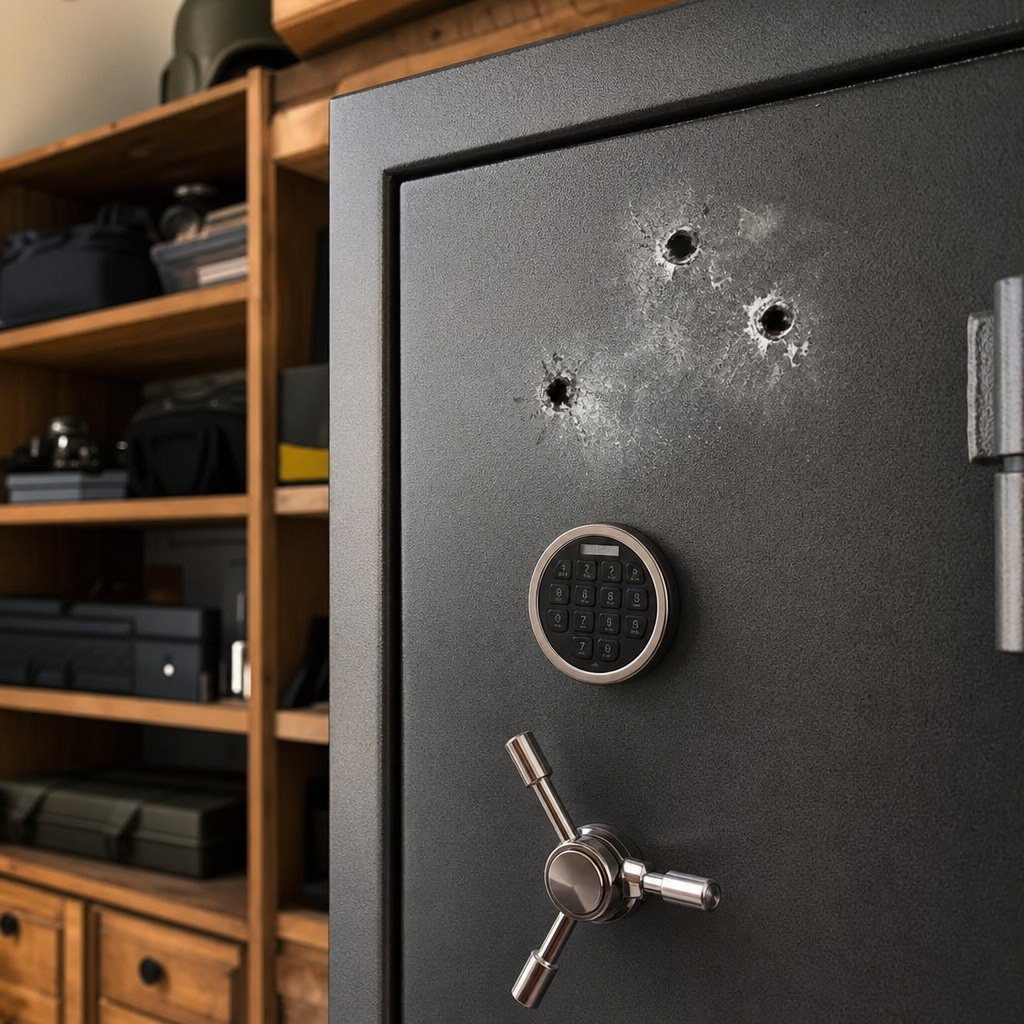
Walk into any gun store or scroll through online listings and you will quickly see the same claim implied again and again: a heavy steel gun safe must surely stop bullets. That assumption sounds reasonable, but it is usually wrong. Most residential gun safes are built to deter theft, organize firearms, and provide some fire protection, not to function as ballistic shields. Understanding that distinction matters because many buyers make decisions based on myths about gun safe construction, ratings, and real-world performance.
When people ask, “Are gun safes bulletproof?” they are usually mixing together several different ideas: burglary resistance, fire endurance, steel thickness, door strength, and ballistic resistance. Those are related but separate engineering problems. A safe that resists pry attacks for several minutes may still be penetrated by common handgun or rifle rounds. A cabinet that keeps children away from firearms may offer almost no meaningful defense against either a thief with tools or a bullet. In my own work reviewing safes, talking with locksmiths, and comparing manufacturer specifications, I have found that confusion about labels and construction is the rule, not the exception.
This article serves as a hub for gun safe myths and misconceptions within the broader gun safes and safety category. The goal is simple: separate fact from fiction so buyers know what a gun safe can do, what it cannot do, and which specifications deserve attention. We will cover the biggest myths, explain how ballistic protection differs from security ratings, and show where terms like “fireproof,” “tamper proof,” and “bulletproof” break down under scrutiny. If you are choosing a safe for home defense, long-term storage, child access prevention, or theft deterrence, the details below will help you avoid expensive assumptions.
What “Bulletproof” Actually Means in the Safe World
In plain terms, bulletproof means a material or assembly can stop specified projectiles under defined test conditions. No serious engineer uses the term loosely because ballistic resistance depends on caliber, velocity, distance, angle, shot spacing, and the materials behind the outer shell. In commercial testing, relevant standards often come from UL 752, which classifies bullet-resisting equipment such as barriers, transaction windows, and panels. A product tested to UL 752 Level 3, for example, is evaluated against .44 Magnum rounds, while higher levels address rifle threats such as 7.62 mm rounds. Most consumer gun safes are not tested or listed under UL 752 at all.
That distinction is critical. A typical residential gun safe may use 14-gauge, 12-gauge, or 10-gauge steel for the body. Those thicknesses can help against prying and slow down smash-and-grab attempts, but they are not equivalent to purpose-built ballistic armor. Even many “heavy” safe doors rely on composite construction that adds bulk without delivering rifle-rated stopping power. The door may look massive because of drywall-based fire lining, paneling, and interior trim, while the actual steel shell remains relatively thin. Buyers often interpret weight and size as evidence of bullet resistance when the mass is coming from insulation and interior materials instead of hardened ballistic plate.
The better question is not whether a gun safe is bulletproof in the abstract, but whether a specific model has verified ballistic testing against a defined threat. If the manufacturer does not publish a recognized ballistic standard, assume it is not rated for bullet resistance. That assumption is safer, more accurate, and more useful than relying on marketing language or showroom impressions.
Myth 1: Thick, Heavy Gun Safes Stop Bullets
This is the most common misconception. Weight alone tells you very little about ballistic performance. Many residential safes weigh hundreds of pounds because they contain layers of gypsum board for fire protection, reinforced door frames, shelving, and decorative finishes. Gypsum can help absorb heat during a fire, but it is not armor. I have seen buyers knock on a door, feel the mass, and conclude the safe must stop handgun rounds. In practice, common pistol calibers may penetrate steel thicknesses used on budget and midrange safes, especially on sidewalls, top panels, or thinner rear sections.
Steel gauge is a better starting point than total weight, though it still does not tell the whole story. Lower gauge numbers indicate thicker steel: 14-gauge is thinner than 10-gauge, and 7-gauge is significantly thicker than both. Many entry-level gun safes use 14-gauge or 12-gauge bodies. Better residential security containers may move to 10-gauge or 7-gauge bodies with thicker plate doors. Those upgrades improve burglary resistance, but rifle rounds can still defeat plain steel that is not engineered as a ballistic system. Handgun threats and shotgun pellets are one issue; centerfire rifle rounds are another entirely.
Real ballistic products use carefully designed combinations of steel hardness, thickness, spacing, and backing materials. Some rely on AR plate, some on fiberglass composites, and some on layered systems that reduce spall and energy transfer. A consumer gun safe almost never includes that level of design unless the manufacturer explicitly says so and backs the claim with test data. So yes, some safes may stop some rounds under some conditions, but that is far from the same thing as being bulletproof.
Myth 2: Security Ratings and Fire Ratings Mean Ballistic Protection
Another source of confusion is the alphabet soup of ratings. Buyers see UL, fire minutes, or a burglary classification and assume the product has been comprehensively tested for every hazard. That is not how safe standards work. A fire rating addresses how long a safe’s interior stays below a target temperature under a test protocol. A burglary rating measures resistance to forced entry techniques using defined tools and time limits. Neither rating automatically means the safe has any tested ability to stop bullets.
For residential gun safes, one common label is a Residential Security Container, or RSC, under UL 1037. An RSC is designed to resist a limited attack by one person using simple hand tools for a short test period. That is useful information, but it does not place the safe in the same category as a true TL-rated burglary safe, and it says nothing about ballistic resistance. By contrast, commercial safes with TL-15 or TL-30 ratings are tested against more serious attacks with specialized tools, yet even those burglary ratings still do not equal bullet resistance unless separate ballistic testing is performed.
Fire claims also deserve scrutiny. Some manufacturers run proprietary tests with favorable conditions, while others use independent labs and publish clearer methods. A “60-minute fire rating” may be meaningful for heat exposure, but it does not imply the steel body is thick enough to stop a handgun. Keeping these categories separate helps buyers compare products honestly and prevents one type of protection from being mistaken for another.
Myth 3: All Gun Safes Offer the Same Level of Protection
The phrase gun safe covers a huge range of products, from thin locking cabinets sold at big-box stores to serious steel-bodied safes with reinforced boltwork, relockers, and substantial hard plates. Treating them as interchangeable is one of the costliest mistakes a buyer can make. Construction quality varies dramatically in steel gauge, weld integrity, door gap design, hinge protection, anchor points, lock quality, and fire liner layout. Two safes that look similar in photos may perform very differently under attack.
Manufacturers also optimize for different priorities. Some maximize interior capacity and cosmetic features to hit a price point. Others sacrifice capacity for thicker steel, tighter tolerances, and stronger door structures. In side-by-side inspections, I have seen “36-gun” safes with optimistic capacity estimates, thin interiors, and flexible sidewalls positioned next to smaller units built with heavier bodies and stronger frames. The larger model often appears more impressive until you examine the actual metal.
| Feature | Entry-Level Cabinet | Typical Residential Gun Safe | Higher-Security Safe |
|---|---|---|---|
| Body steel | 16 to 14 gauge | 14 to 10 gauge | 10 to 7 gauge or thicker |
| Primary purpose | Basic access control | Theft deterrence and fire protection | Stronger burglary resistance |
| Common rating | Often none | May have RSC listing | May exceed RSC or approach commercial specs |
| Ballistic testing | Rare | Rare | Only if explicitly stated |
The practical lesson is straightforward: compare specifications, not labels alone. Look for body steel thickness, door plate details, independent ratings, lock type, and anchoring provisions. If protection goals include tool attacks, fire, unauthorized household access, and possible exposure to gunfire, no single generic category answer will do. You need model-specific evidence.
Myth 4: “Fireproof” and “Tamper Proof” Claims Are Literal
Marketing language in the safe industry is often broader than the engineering behind it. “Fireproof” is a classic example. No safe is absolutely proof against all fire conditions because house fires vary in temperature, duration, collapse risk, and post-fire moisture exposure. The meaningful question is what temperature profile the safe was tested under, for how long, and what internal temperature threshold was maintained. Paper chars around 350 degrees Fahrenheit, but electronic media and ammunition components can be affected under different conditions. A fire claim without test details is incomplete.
“Tamper proof” is equally slippery. Every lock can be attacked with enough time, skill, and tools. Mechanical dial locks, electronic keypad locks, biometric systems, and redundant locks each involve tradeoffs. Mechanical locks have a long service record and no battery dependency, but they are slower to open. Electronic locks are convenient and common on modern safes, but quality varies widely by brand and model. Biometric locks can be fast, yet fingerprint readers are affected by placement, sensor quality, and maintenance. The best manufacturers publish lock certifications and use recognized lock suppliers such as Sargent and Greenleaf, SecuRam, or La Gard.
Absolute language is usually a sign to slow down. Safe shopping is about probabilities and delays, not magic. A strong safe buys time, raises noise, increases effort, and narrows access. It does not become invulnerable because a brochure says “proof.”
How to Evaluate a Gun Safe for Real-World Safety
If bullet resistance is your concern, ask for a ballistic rating by standard and level. If the seller cannot provide one, assume there is no verified bullet resistance. If burglary resistance matters more, focus on body steel, door construction, lock quality, relockers, hard plates, and anchor capability. Anchoring is especially important. Even a heavy safe can be tipped, pried, or removed with dollies if it is not bolted to concrete or structural framing according to the manufacturer’s instructions. In burglary cases, poor installation often defeats otherwise decent equipment.
Placement also matters. A closet corner on a ground floor concrete slab generally offers better leverage resistance and concealment than an exposed garage location. Humidity control matters for firearms preservation, so consider dehumidifiers or desiccants. Interior layout matters if optics, long barrels, and accessories are part of your collection. Fast-access needs matter if the safe is intended for defensive firearms rather than archival storage. The right safe is the one matched to your threat model, not the one with the loudest marketing adjectives.
For this gun safe myths and misconceptions hub, the central takeaway is clear: separate the jobs a safe is meant to perform. Child access prevention, organized storage, theft delay, and fire endurance are realistic goals. Bullet resistance is a specialized feature that requires explicit testing and should never be assumed. Before you buy, read the spec sheet, verify independent ratings, inspect steel thickness, and ask hard questions about locks and installation. That approach leads to better firearm safety, more honest expectations, and fewer expensive mistakes. Start by reviewing the related guides in this topic cluster and compare any safe on evidence, not myths.
Frequently Asked Questions
Are most gun safes actually bulletproof?
No. Most gun safes sold for home use are not bulletproof, and that is one of the most common misunderstandings buyers have. Residential gun safes are typically designed for three main purposes: delaying theft, securing firearms from unauthorized access, and in some cases offering a degree of fire resistance. That is very different from being engineered to stop bullets. A true bullet-resistant enclosure must be built and tested to withstand specific calibers, velocities, and impact conditions, usually under recognized ballistic standards. Most standard gun safes are made from sheet steel that may be strong enough to resist prying, drilling, or casual forced entry for a period of time, but not thick or specialized enough to reliably stop handgun or rifle rounds.
The confusion often comes from appearance. Gun safes are heavy, rigid, and made of steel, so people naturally assume they must also offer ballistic protection. In reality, the outer steel on many residential models may be relatively thin compared with armor plate. Even if a bullet does not fully pass through every part of the safe, that does not make the entire unit bulletproof. Doors, seams, lock areas, and body panels can all perform differently under gunfire. Without a verified ballistic rating, it is inaccurate to assume a safe can serve as dependable cover or protection in a shooting situation.
What is the difference between a gun safe, a fire safe, and a bullet-resistant safe?
The difference comes down to design priorities and testing standards. A standard gun safe is mainly intended to secure firearms against theft and unauthorized access. It may include locking bolts, reinforced doors, anti-pry features, shelving, and interior organization for rifles, handguns, and accessories. A fire-rated safe, whether it is a gun safe or another type of safe, is built with materials intended to slow the transfer of heat during a fire. That often includes layers of insulation, fireboard, seals that expand in high heat, and construction tested for interior temperature limits over a specific amount of time.
A bullet-resistant safe is something else entirely. It is built with materials and thicknesses meant to defeat ballistic impacts, often using hardened steel, armor plate, composite ballistic layers, or specialized construction methods. More importantly, true bullet resistance is typically tied to a recognized rating system, not marketing language. In other words, theft resistance, fire resistance, and ballistic resistance are separate performance categories. A safe can be good at one, decent at another, and poor at a third. Buyers get into trouble when they assume that a heavy safe automatically checks all three boxes. It usually does not.
How can I tell whether a gun safe has real ballistic protection?
The best way is to look for documented ballistic testing and a clearly stated rating rather than vague wording. Terms like “solid steel,” “heavy-duty,” “reinforced,” or “tactical” may sound impressive, but they do not confirm that the safe has been tested to stop bullets. If a manufacturer claims bullet resistance, there should be supporting information about what standard was used, what part of the safe was tested, what calibers it resists, and under what conditions. A legitimate ballistic claim should be specific, not implied through imagery or broad language.
You should also pay attention to construction details. Steel gauge matters, but thickness alone is not the whole story. The type of steel, presence of composite layers, door construction, hinge design, seams, and lock protection all affect real-world performance. Many safes have thicker doors than bodies, which means one area may resist impact better than another. If there is no published ballistic rating, no independent testing data, and no technical explanation of the materials used, it is safest to assume the product was not designed as bullet-resistant protection. For most shoppers, that assumption is more accurate and far safer than relying on appearance or marketing impressions.
Can a heavy steel gun safe stop some bullets even if it is not rated as bulletproof?
Possibly, but that is not the same as being safely and reliably bullet-resistant. A thick steel surface may stop or deflect certain low-energy rounds under certain conditions, especially depending on impact angle, bullet type, distance, and exactly where the shot lands. However, that kind of occasional or partial resistance should never be confused with a tested protective standard. One panel may stop a handgun round while another area of the same safe, such as a thinner sidewall, door edge, or lock section, may not. Rifle rounds, armor-piercing ammunition, repeated shots, and close-range impacts can change the outcome dramatically.
This is why relying on anecdotal claims is risky. Someone may say a safe “took a bullet” once, but that does not prove consistent performance across multiple calibers and strike points. Real ballistic protection is about predictable results under controlled testing, not isolated luck. If your concern is personal protection during a defensive emergency, a standard residential gun safe should not be treated as dependable cover. If your concern is secure firearm storage, then the safe may still do its primary job very well. The key is understanding what it was built to do and what it was not.
What should buyers focus on instead of assuming a gun safe is bulletproof?
Buyers should focus on the safe’s actual intended functions: theft resistance, access control, storage capacity, build quality, anchoring options, fire protection, and fit for their collection. Start by evaluating steel thickness in both the door and body, the quality of the locking mechanism, the number and design of locking bolts, pry resistance, relocker features, and whether the safe can be securely bolted to the floor. A safe that is difficult to tip, pry open, or remove from the home often provides more practical value than one marketed with dramatic but unsupported claims.
You should also think about how you will use it day to day. Fast access matters for defensive firearms. Interior layout matters if you want to protect optics, documents, handguns, or ammunition alongside long guns. Fire ratings should be reviewed carefully, including duration, temperature, and whether the claims come from independent testing or the manufacturer alone. If ballistic protection truly matters to you, then shop specifically for a product with a legitimate bullet-resistant rating rather than assuming a conventional gun safe can serve that role. In short, the smartest purchase is based on verified performance categories, not myths. That is how you separate fact from fiction and choose a safe that meets your real needs.