
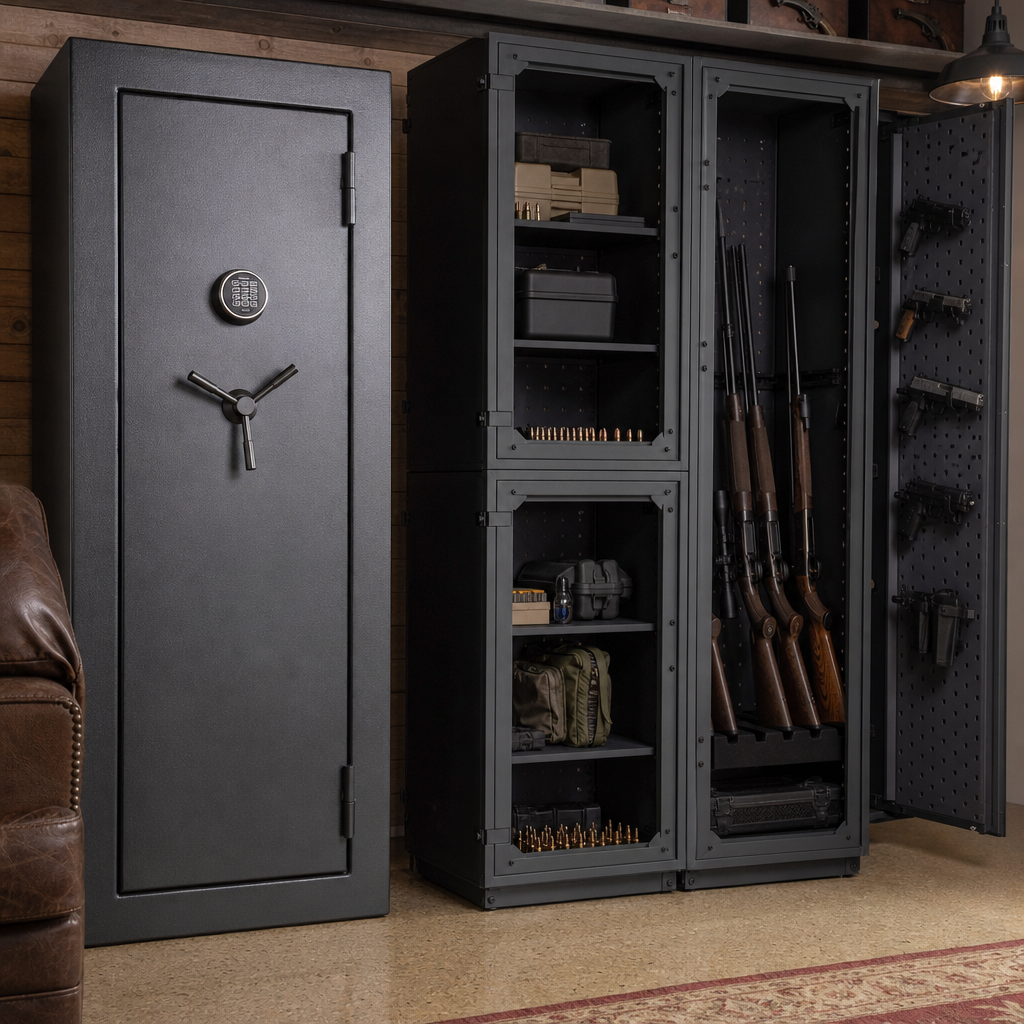
Modular gun safes are secure enough for many owners, but they are not automatically as secure as welded traditional safes; the right choice depends on construction, lock quality, anchoring, fire protection, and the actual threat you need to defeat. In the gun safes and safety category, few topics create more confusion than modular designs and the broader set of gun safe myths and misconceptions surrounding burglary resistance, fire ratings, quick access, and long-term reliability. I have installed, moved, anchored, and inspected both modular gun safes and traditional safes in real homes, upstairs rooms, garages, closets, and workshops, and the same misunderstanding appears again and again: people assume one visible feature tells the whole security story.
It does not. A safe is a system. Steel thickness, door gap, hardplate, relocker, boltwork, hinge design, frame rigidity, anchor pattern, and placement in the home all matter more than marketing language. “Traditional safe” usually means a one-piece welded body delivered intact. “Modular gun safe” means the safe arrives in panels that are assembled on site, then locked together with internal fasteners, interlocking seams, and a finished door module. This design solves a real logistical problem. Many gun owners live in apartments, older homes, or second-floor spaces where a fully welded 600 to 1,200 pound safe simply cannot be moved without risk, cost, or structural strain.
That practical benefit is why modular safes deserve serious evaluation rather than dismissal. The central question is not whether modular safes are “good” or “bad.” It is whether their design tradeoffs reduce security enough to matter for your use case. For a casual smash-and-grab burglary, a well-built modular safe that is properly anchored may perform very well. Against a determined attacker with time, privacy, and pry tools, some modular units expose more seam-related vulnerabilities than premium welded safes. Understanding those differences helps you avoid expensive mistakes and separate real protective value from myths, labels, and showroom impressions.
This article serves as a hub for gun safe myths and misconceptions by addressing the most common claims directly: heavier always means safer, fire ratings are interchangeable, modular seams are easy to defeat, any safe can stop power tools, electronic locks fail more often than mechanical locks, and a safe in a garage is “good enough” without climate control or anchoring. Those statements are incomplete at best. The goal here is to give you a plain-language framework for comparing modular gun safes and traditional safes realistically, so you can choose protection based on verified construction details instead of assumptions.
What makes a gun safe actually secure
A secure gun safe resists unauthorized entry long enough to deter or delay the most likely threat. In residential security, that usually means opportunistic burglars using pry bars, hammers, screwdrivers, wedges, or small battery-powered grinders for a short time. It rarely means cinematic attacks with cutting torches and unlimited access. When I evaluate a safe, I start with body steel gauge, door construction, lock and relocker type, hinge-side reinforcement, boltwork engagement, seam exposure, and anchor options. These details affect real performance far more than brochure language such as “military style” or “vault grade.”
Steel thickness is foundational. A safe with 12-gauge steel body walls will generally resist prying and deformation better than one built from 14- or 16-gauge steel, assuming similar frame design. Door construction matters too. Composite doors can be stronger than simple plate doors when built correctly, especially if they include internal reinforcement, hardplate over the lock, and anti-pry returns. Lock quality is equally important. UL-listed mechanical or electronic locks from recognized manufacturers such as Sargent and Greenleaf or SecuRam generally outperform anonymous lock packages found on lower-end imports.
Anchorability is often undervalued. A mediocre safe that is properly anchored to concrete can outperform a better-made safe left free-standing, because thieves prefer tipping a safe onto its back to exploit door flex and pry leverage. Placement matters as well. A closet corner or alcove that limits side access and long pry-bar movement increases the effective resistance of almost any safe. This is why the “best” safe on paper can underperform in practice, while a well-situated, well-anchored safe with modest specs can do its job extremely well in a real burglary scenario.
How modular gun safes are built and where they differ
Modular gun safes use separate wall, floor, roof, and door components that interlock during assembly. Better modular designs conceal fasteners inside the body, use tongue-and-groove or overlapping seams, and create a rigid shell once bolted together. The strongest versions are engineered specifically to reduce seam weakness, not merely to make shipping cheaper. This distinction matters. A true modular safe is not the same thing as a lightweight cabinet that happens to ship flat. Premium modular manufacturers design around transport constraints while preserving meaningful burglary resistance.
The biggest advantage is access. If a safe must pass through narrow staircases, tight turns, or upper floors, modular construction may be the only practical route to getting substantial steel into the room. I have seen buyers settle for thin steel cabinets because a welded safe could not clear a landing. In those cases, a quality modular safe was unquestionably the more secure outcome. Once assembled and anchored, it delivered thicker steel, better lock protection, and more useful storage than the cabinet they would otherwise have bought.
The main drawback is structural continuity. A welded body benefits from uninterrupted joints created at the factory. A modular body necessarily includes seams, and seams are potential attack points. Whether that matters depends on engineering quality. If seams overlap deeply, resist spreading, and are blocked by interior geometry, modular weakness may be small. If panel edges are exposed or rely on shallow connections, pry resistance can suffer. That is why modular safes cannot be judged by concept alone. Two products labeled modular can differ dramatically in real security performance.
Are modular gun safes as secure as traditional safes
The honest answer is sometimes, but not always. A high-quality modular gun safe can equal or exceed the security of a low- or mid-tier welded traditional safe. It will not usually match a premium welded safe with thicker continuous steel, advanced boltwork, and higher burglary ratings. That comparison is the one consumers need. The question is not modular versus welded in the abstract. It is modular versus a specific traditional safe at a similar price point, weight class, and construction level.
For example, a modular safe built from heavier steel with a reinforced door frame and robust anchoring can be more secure than a large welded safe using thinner body steel and weak drywall-based fire lining. I have seen budget welded models marketed aggressively on size and finish, yet they flexed badly under pry pressure around the top corner. By contrast, some well-designed modular units felt rigid after assembly and offered better interior fit, easier relocation, and enough burglary resistance for normal residential risk. In that case, modular was not the compromise many buyers assumed it would be.
Where traditional safes usually retain an advantage is cumulative resistance under sustained attack. One-piece bodies tend to manage leverage, vibration, and seam exploitation better. Their strength is not just in steel thickness but in the continuity of the shell. If your threat model includes isolated rural property, long police response times, valuable collections, or known-target theft risk, a stronger welded body is usually the safer choice. If your primary challenge is getting a capable safe into a difficult location and securing it properly, modular may be the smarter and more realistic security decision.
Common gun safe myths and misconceptions
Most gun safe buying mistakes come from repeating simplified rules that sound sensible but fail under scrutiny. Heavier does not always mean safer, because weight may come from fireboard rather than thicker steel. Bigger is not always better, because oversized interiors encourage disorganized storage and often lead people to underbuy steel quality. “Fireproof” is inaccurate for nearly every consumer gun safe; the better term is fire-resistant, and ratings vary in method, duration, and temperature. A glossy door and decorative bolts say little about actual pry resistance.
Another common myth is that any safe will stop power tools. In reality, very few residential gun safes are designed to withstand prolonged grinder or saw attacks. Their purpose is delay, deterrence, and access control, not invulnerability. There is also confusion around lock types. Electronic locks are not inherently unreliable, and mechanical dials are not inherently superior. Good electronic locks can be dependable for years if installed correctly and maintained with fresh batteries, while cheap keypads can fail early. Quality and support matter more than lock category alone.
Many owners also underestimate the role of humidity, especially in garages and basements. A burglar may never breach the safe, yet moisture can damage firearms, optics, and documents if dehumidification is ignored. Finally, people assume a safe that looks massive cannot be stolen whole. Unanchored safes are routinely removed with dollies, straps, and two or three people. Anchoring is not optional if you want the safe to perform as intended.
| Myth | Reality | What to Check |
|---|---|---|
| Heavier safes are always safer | Weight may come from fire lining, not stronger steel | Body gauge, door build, anchor points |
| Modular seams make all modular safes insecure | Seam design quality varies widely | Interlocking joints, hidden fasteners, pry resistance |
| Any fire rating means the same thing | Test standards and temperatures differ | Duration, peak heat, independent testing method |
| Electronic locks fail more than dial locks | Failure rates depend on brand, installation, and use | UL listing, warranty, battery access, service network |
| An unanchored safe is fine if it is heavy | Tip-over and removal remain realistic burglary methods | Concrete or structural anchoring plan |
How to compare modular and traditional safes the right way
Start with threat model, not brand loyalty. Ask what you are protecting, who might target it, how long an intruder could work undisturbed, and where the safe will live. Then compare measurable features: steel thickness, lock listing, hardplate presence, relocker design, seam construction, door gap, number and placement of anchor holes, internal capacity, fire protection method, and warranty support. Ignore inflated “gun count” ratings; they are almost always optimistic, especially for modern rifles with optics, lights, and slings.
Look for independent standards where available. UL Residential Security Container classification, although not the same as TL burglary ratings, still provides more meaningful baseline information than vague marketing claims. Fire claims should specify temperature and duration, and ideally reference a named test protocol rather than a generic sticker. Review the lock manufacturer, not just the safe brand. Ask whether replacement parts, locksmith service, and relocking procedures are documented. These practical service questions matter more over ten years than showroom cosmetics.
Also evaluate ownership logistics. A welded safe may be stronger in theory, but if delivery cost, stair restrictions, or floor loading force you into a poor installation, the advantage shrinks quickly. I have advised clients to buy a better modular safe rather than a cheaper welded safe they could not anchor properly in the intended room. Security is the combination of product and installation. Compare the full system, including where the safe ends up and how effectively it can be fixed in place.
Best use cases for modular safes and for traditional safes
Modular gun safes make the most sense when access is difficult, relocation is likely, or room placement is strategically important. Second-floor offices, basement rooms with narrow stair turns, urban apartments, and homes where owners want a safe in a closet rather than a garage are strong modular scenarios. A modular unit can be carried in manageable components, assembled discreetly, and anchored in a tighter, less visible location. That better placement alone may improve security more than a marginal difference in shell design.
Traditional welded safes are ideal when delivery access is straightforward and maximum rigidity is the priority. Ground-floor installations on concrete slabs, dedicated safe rooms, and collections with higher total value favor one-piece bodies. They also make sense for buyers who want larger capacities, more robust door assemblies, and greater confidence against extended pry attacks. If you expect the safe to remain in one place for decades, the transport advantage of modular construction matters less, so the structural simplicity of a welded body becomes more attractive.
In both cases, the strongest strategy is layered security. Use alarm contacts, cameras, lighting, hardened doors, and discreet placement so the safe is not your only line of defense. No gun safe should carry the full burden of home security alone. When owners understand that principle, the modular versus traditional decision becomes clearer and far less emotional.
Modular gun safes can be secure, practical, and in many homes the best realistic option, but they are not universally equal to traditional welded safes. Security depends on build quality, seam engineering, lock integrity, anchoring, placement, and the level of threat you actually face. That is the core lesson behind many gun safe myths and misconceptions: single-feature judgments lead buyers in the wrong direction. A heavy safe can still use thin steel. A modular safe can outperform a cheaper welded model. A fire label can mislead. An unanchored safe can fail fast.
If you remember one rule, make it this: compare specifics, not categories. Ask for steel gauge, test information, lock brand, seam design details, and installation requirements. Match the safe to the room, the collection, and the burglary risk, then build additional layers around it with alarms, surveillance, humidity control, and disciplined storage practices. That approach produces better outcomes than chasing slogans like “vault strength” or dismissing modular designs without examining how they are engineered.
As a hub for this subtopic, this page should guide every related decision you make about gun safe myths, fire claims, lock choices, placement, and long-term protection. If you are shopping now, create a short comparison list, verify the specifications line by line, and choose the safe you can install correctly and anchor securely. The safest purchase is the one that fits your real-world constraints and still holds up when tested against real-world threats.
Frequently Asked Questions
1. Are modular gun safes as secure as traditional welded safes?
Modular gun safes can be very secure, but they are not automatically equal to a well-built traditional welded safe in every situation. The real answer depends on how the safe is engineered, what kind of steel it uses, how the panels lock together, the quality of the door and locking system, and whether the unit is properly anchored. A good modular safe is designed so that once assembled inside the home, the connection points are protected and difficult to attack quickly. That can make it a strong and practical option for many gun owners, especially in spaces where a heavy welded safe cannot be moved into place.
That said, “modular” should not be confused with “same as all welded construction.” Traditional safes with heavier bodies, reinforced doors, robust boltwork, and fewer seams may offer an advantage against aggressive forced-entry attempts, particularly when the threat includes time, tools, and privacy. If someone is comparing a premium welded safe to a basic modular model, the welded safe may be the stronger burglary barrier. But if the comparison is a high-quality modular safe versus a light-gauge big-box welded cabinet, the modular unit may actually be the better choice. The key is to evaluate construction details rather than relying on the category name alone.
2. What matters most when judging the security of a modular gun safe?
The most important factors are steel thickness, door design, lock quality, panel interlock strength, boltwork, and anchoring. Steel thickness matters because thinner steel is easier to bend, punch, or cut. Door design matters because many attacks focus on prying the door rather than cutting through the body. A secure modular safe should have a reinforced door frame, solid locking bolts, and an internal structure that protects the assembled seams from easy access.
Lock quality is another major factor. A reliable mechanical or electronic lock from a reputable manufacturer is usually more important than flashy marketing claims. A weak lock can undermine an otherwise decent safe. Anchoring also plays a major role in real-world burglary resistance. A safe that is not bolted down can sometimes be tipped, pried, or even removed and attacked elsewhere. Fire protection is worth evaluating separately as well. Some modular safes offer good fire resistance, but buyers should look closely at how ratings are established and whether the insulation, door seals, and testing methods are clearly explained. In short, the best way to judge a modular gun safe is to look past the label and study the actual build quality and the specific risks you want it to handle.
3. Are there common myths about modular gun safes and traditional safes that buyers should ignore?
Yes, and this is where many gun safe myths and misconceptions cause confusion. One of the biggest myths is that welded automatically means highly secure and modular automatically means weak. In reality, some traditional safes sold at lower price points are made with relatively thin steel and limited pry resistance, while some modular designs are engineered with serious attention to locking seams and reinforced doors. Another myth is that a published fire rating always tells the full story. Fire ratings vary widely in testing method, duration, temperature, and whether the rating comes from independent testing or internal manufacturer standards. Buyers should treat all fire claims carefully and compare them thoughtfully.
Another common misconception is that quick access and strong security cannot coexist. For many owners, especially those balancing defensive access with child safety, the right lock setup and safe placement can provide both. Long-term reliability is also misunderstood. Some people assume modular safes loosen, weaken, or fail over time simply because they are assembled on site. A quality modular safe that is correctly installed and anchored can remain stable and dependable for years. The smarter approach is to focus on engineering, materials, testing, and the reputation of the manufacturer instead of relying on oversimplified assumptions about one design category or another.
4. Who is a modular gun safe best for, and when is a traditional safe the better option?
Modular gun safes are especially useful for owners who need to get a safe into a basement, upstairs room, tight closet, apartment, or any location that is difficult to access with a one-piece welded unit. They are also a strong option for people who want a serious safe but cannot manage the logistics, cost, or structural concerns that come with moving an extremely heavy traditional safe. In many real homes, installation challenges are not a minor issue. If a modular safe is the model that can actually be placed in the right location, anchored properly, and used consistently, it may be the more practical and secure choice.
A traditional welded safe is often the better choice when maximum resistance to forced entry is the top priority and the owner can accommodate the size, weight, and installation demands. If you are trying to defend against a higher-level burglary threat, want thicker steel and fewer body seams, or prefer a simpler one-piece build, a stronger welded safe may give added confidence. The best choice comes down to matching the safe to your environment and risk profile. For many households, the goal is not to buy the most extreme safe possible, but to buy the strongest realistic option that fits the space, budget, and threat level without compromising proper installation and daily use.
5. How can I make a modular gun safe more secure after I buy it?
The first and most important step is proper anchoring. Bolting the safe to a concrete floor or another solid structural surface greatly improves resistance to tipping, prying, and removal. Placement matters too. Installing the safe in a corner, alcove, closet, or other confined area can reduce access to the sides and make pry attacks harder. Keeping the safe out of obvious sight also adds a layer of security by reducing the chance that a casual visitor or opportunistic thief even knows it is there.
You can further improve protection by choosing a model with a high-quality lock, maintaining that lock properly, and using humidity control inside the safe to protect firearms over the long term. It is also wise to think in layers. Alarm systems, cameras, reinforced doors, exterior lighting, and discreet ownership habits all help reduce burglary risk before a thief ever reaches the safe. Finally, match the safe to the contents. If you own particularly valuable firearms, suppressors, optics, documents, or other sensitive items, it may be worth stepping up to a heavier model with stronger burglary resistance and better fire protection. A modular safe can be a very capable part of a complete security plan, but like any safe, it performs best when it is selected realistically and installed intelligently.