
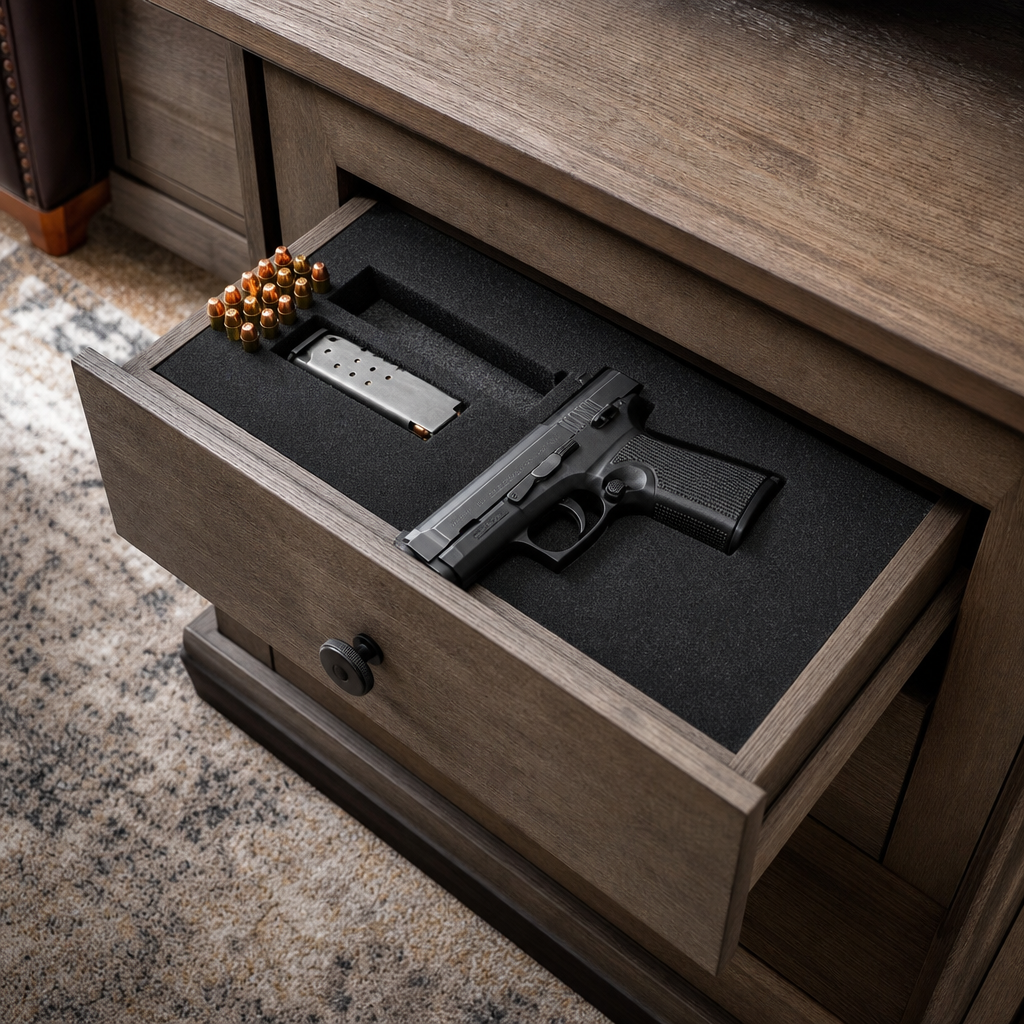
Secret gun storage gives firearm owners a way to keep weapons secure, quickly reachable, and out of plain sight inside everyday living spaces. In practical terms, hidden gun compartments are storage systems built into furniture, walls, floors, shelves, beds, staircases, picture frames, or architectural features so a firearm stays concealed from visitors, thieves, and especially children. I have worked with clients who wanted something more discreet than a large freestanding safe, and the right setup always starts with one principle: hidden storage is not the same as unsecured storage. A compartment can be invisible and still fail if it lacks a locking mechanism, responsible placement, or enough structure to prevent tampering.
For homeowners researching the best hidden gun compartments for the home, the goal is usually a balance of access, concealment, and safety. A fast-access pistol compartment near a bed solves a different problem than a long-gun hideaway in a home office or a decoy bookshelf in a den. Some people prioritize burglary resistance, while others care more about preserving the room’s appearance. Many want both. This topic matters because visible gun cases attract attention, but sloppy concealment creates risk. According to firearm safety guidance from groups such as the National Shooting Sports Foundation and recommendations echoed by law enforcement agencies, firearms should be stored unloaded when practical, locked, and inaccessible to unauthorized users. Hidden storage can complement that standard, but it should not replace it.
Hidden and discreet gun storage solutions now range from simple concealment furniture to biometric wall vaults, RFID-activated shelves, mirror safes, under-bed drawer systems, false HVAC vents, and custom millwork integrated into renovations. The market has expanded because homeowners want options that fit apartments, suburban homes, cabins, and even high-traffic family rooms without advertising what is inside. Good hidden storage also supports broader home-organization goals by reducing visual clutter and integrating firearms into normal furniture footprints.
This hub article covers the full landscape of hidden gun storage solutions so you can compare types, understand where each works best, and decide when a concealed compartment makes sense versus a traditional safe. It will also help you think about legal compliance, child access prevention, moisture control, installation quality, and realistic security limits. The best hidden gun compartment for your home is not the most clever one; it is the one that matches your firearm type, access needs, room layout, and safety responsibilities.
What Hidden Gun Storage Does Well and Where It Falls Short
A hidden gun compartment works best when you need discreet access and want to avoid advertising firearm ownership. In many burglaries, thieves move quickly and grab obvious valuables first. A compartment built into a shelf, bench, headboard, or wall cavity may be overlooked entirely, which is a real advantage over a visible cabinet. In homes where aesthetics matter, concealed storage also keeps a room from feeling tactical or industrial. I have seen homeowners use a frame-mounted pistol vault in an entryway table, and guests never noticed it because the piece looked ordinary from every angle.
Still, concealment alone is not high security. Most hidden compartments are less resistant to forced entry than a heavy, anchored gun safe with a reinforced door, hard plate, relocker, and rated lock. If a thief discovers the compartment and has time, many concealment products fail faster than a traditional safe. That is why hidden storage should be viewed as a category with different levels: simple concealment, rapid-access locking storage, and fully integrated hidden vaults. The more you understand that spectrum, the better your decisions will be.
Best Types of Hidden Gun Compartments for Different Rooms
The best hidden gun storage solutions are room-specific because furniture dimensions, daily traffic, and defensive needs vary. For bedrooms, the most effective options are under-bed sliding safes, headboard compartments, and nightstand false-bottom vaults. These allow access from a sleeping position and can conceal a handgun, spare magazine, flashlight, and medical gear. For living rooms or dens, mirror safes, coffee tables with hidden drawers, and floating shelves with magnetic or RFID latches blend into normal decor. In home offices, desk pedestal compartments and wall art vaults work well because the room already contains cabinetry and private work zones.
Long guns require different geometry. Full-length compartments behind wall panels, inside benches, within staircase risers, or in custom closet cavities can store rifles or shotguns discreetly, but they demand careful measurement around optics, slings, and overall length. A tactical rifle with an LPVO and mounted light often needs more depth than buyers expect. In tighter homes, a vertical wall stud bay compartment between standard framing members may fit a compact carbine but not a traditional shotgun with a longer barrel.
| Storage Type | Best For | Main Advantage | Main Limitation |
|---|---|---|---|
| Nightstand hidden vault | Handgun near bed | Fast defensive access | Limited capacity |
| Mirror or picture frame safe | Hallway or office | Excellent visual concealment | Moderate burglary resistance |
| Under-bed drawer safe | Bedroom long gun or pistol storage | Uses dead space efficiently | Can be exposed during cleaning |
| Bookshelf or shelf compartment | Living room discreet access | Blends into furniture | Often lighter-duty construction |
| Custom wall compartment | Rifles in private room | Tailored fit and deep concealment | Requires skilled installation |
Locking Methods: Mechanical, Electronic, Biometric, and RFID
The lock matters as much as the hiding place. Mechanical simplex-style pushbutton locks remain one of the most dependable options for rapid access because they do not require batteries and can be operated in darkness by touch. Electronic keypad locks are common and convenient, but quality varies sharply. Better units use reliable solenoids, tamper alerts, and external battery contacts or backup keys. Cheap keypad compartments often fail at the worst time because of weak wiring, inconsistent motors, or poor fitment.
Biometric locks have improved, particularly on handgun vaults from established manufacturers, but fingerprint readers are still sensitive to placement, skin condition, and enrollment quality. I advise owners to treat biometric access as a convenience layer, not the only path to entry, unless the product has an excellent record and a backup method. RFID-triggered shelves and hidden doors are popular for discreet furniture builds. They preserve the illusion better than visible keypads, but they depend on precise alignment and should be tested regularly. If a compartment protects a defensive firearm, your opening method must be repeatable under stress.
Choosing the Right Compartment for Handguns, Rifles, and Shotguns
Handgun storage is usually the easiest hidden-storage problem to solve because pistols fit into compact spaces. A shallow wall vault behind a framed print, a drawer insert with a steel lockbox, or a shelf compartment above normal eye level can all work well. The critical details are trigger protection, retention from shifting, and enough clearance to draw safely. Foam cutouts can help organization, but open-cell foam can trap moisture, so closed-cell inserts or bare steel interiors with desiccant are often better.
Rifles and shotguns introduce more variables. Barrel length, optic height, folded versus fixed stocks, suppressor use, and sling bulk all affect fit. Hidden long-gun storage should support the firearm to prevent impacts to optics or controls, and it should allow retrieval without snagging. I have seen attractive custom wall compartments fail because the homeowner could not remove the rifle quickly around a doorknob or adjacent desk. Mock up the full movement path before committing to a location.
Placement Strategy: Security, Access, and Daily Use
Where you place secret gun storage determines whether it becomes genuinely useful or just clever carpentry. Start by mapping likely use cases. A bedside pistol vault supports immediate defensive access. A main-floor compartment may support a secure staging location when you are awake and active. A deeper hidden storage zone in a closet or office may serve longer-term retention for firearms not carried daily. These are different roles and should not be forced into one compromise location.
Avoid predictable hiding places if burglary resistance is a top concern. Master bedrooms are searched first in many home break-ins because thieves expect jewelry, cash, and guns there. That does not mean bedroom storage is wrong, only that concealment and lock quality matter more in those spaces. Also avoid heat, humidity, and water exposure. Attic cavities, exterior walls with condensation risk, and basement areas prone to dampness can damage firearms over time. A discreet compartment should still provide stable environmental conditions, and it should be mounted to structural members whenever possible.
Custom Built-Ins Versus Ready-Made Hidden Gun Furniture
Homeowners generally choose between buying ready-made concealment furniture and commissioning custom hidden gun compartments. Ready-made products are faster, usually less expensive, and easier to install. Reputable brands offer mirror safes, floating shelf compartments, benches, coffee tables, and sliding wall units with hidden magnetic latches or electronic releases. These products work well when you need a known form factor and want installation completed in an afternoon.
Custom builds shine when your room has unusual dimensions, your firearm collection includes long guns with accessories, or you want the compartment completely integrated into millwork. A skilled cabinetmaker or finish carpenter can match stain, molding, trim profiles, and hardware so the compartment disappears into the room. The tradeoff is cost and project complexity. Custom work also requires tighter communication about lock type, service access, hinge load, cable routing, and emergency override. The best custom compartments are designed from the inside out, starting with firearm dimensions and access motion, not exterior appearance alone.
Child Safety, Legal Considerations, and Responsible Ownership
Any article about hidden and discreet gun storage solutions needs a clear warning: concealment is not a substitute for child-resistant security. Children are curious, observant, and far better at noticing routines than adults assume. If minors live in or visit your home, hidden storage should include a real lock and should follow your state’s child access prevention and secure storage laws. Several states impose criminal liability when a minor gains access to an unsecured firearm, and civil exposure may follow even where laws are less specific.
Responsible owners also think about who else enters the home: house cleaners, contractors, dog walkers, relatives, and guests. A hidden shelf without a lock may keep a firearm out of casual view, but it does nothing against discovery during cleaning or repair work. For defensive firearms, store them in a condition consistent with your training, local law, and risk tolerance, but make that choice deliberately. Document serial numbers, maintain insurance where appropriate, and know that no hidden compartment changes your legal obligations after a theft or negligent access event.
Installation Quality, Maintenance, and Environmental Protection
The performance of a hidden compartment depends heavily on installation. Wall units should be anchored into studs or masonry, not just drywall. Furniture-based compartments need stable base support so doors stay aligned and locks do not bind over time. If a hidden panel uses magnets, spring latches, gas struts, or slides, every moving part should be tested repeatedly under realistic conditions, including low light. A beautiful concealment piece that sticks once every twenty openings is not trustworthy enough for a defensive role.
Firearms stored in enclosed compartments also need corrosion control. Use desiccant packs, rechargeable dehumidifiers, or low-watt rod systems where space permits. Wipe firearms with a protective lubricant suitable for your climate, especially if the compartment is near an exterior wall or in a humid region. Check batteries in electronic locks on a schedule rather than waiting for a low-power alert. Maintenance should include practice: open the compartment regularly, verify the firearm’s condition, inspect fasteners, and confirm that children or guests have not observed your access routine.
How This Hub Connects to the Rest of Gun Safes and Safety
Hidden gun compartments sit inside a larger gun safes and safety strategy, not outside it. For many households, the right answer is layered storage: a true gun safe for the main collection, plus one or two discreet rapid-access compartments for specific defensive firearms. That approach combines stronger burglary resistance with practical accessibility. It also supports sensible organization by separating carry guns, home-defense firearms, ammunition, documents, and training gear according to purpose.
As a hub for hidden and discreet gun storage solutions, this page should lead your next research steps. Compare bedside handgun vaults, in-wall safes, concealment furniture, long-gun wall compartments, child-resistant quick-access options, and custom built-in storage before you buy. Measure your firearms, define who needs access, evaluate room humidity, and decide how much true security you require beyond concealment. The best hidden gun compartment for your home is the one that stays unnoticed by others, opens reliably for you, and supports safe firearm ownership every day. Review your current setup, identify its weak points, and upgrade with a concealed system that matches your home and responsibilities.
Frequently Asked Questions
What is secret gun storage, and how is it different from a traditional gun safe?
Secret gun storage refers to concealed firearm storage built into everyday features of a home, such as furniture, wall cavities, bookshelves, beds, stair risers, picture frames, cabinets, or other architectural elements. The main difference between a hidden gun compartment and a traditional gun safe is visibility and integration. A freestanding safe is designed to be obvious, heavy, and physically resistant to attack, while a hidden compartment is designed to stay out of sight and blend naturally into the room. For many homeowners, that discretion is the biggest advantage. It helps reduce unwanted attention from guests, service workers, or burglars who typically look for valuables in predictable places.
That said, hidden storage should not be viewed as a one-size-fits-all replacement for a high-quality safe. The best approach depends on what you are storing, how quickly you need access, and who lives in the home. A secret compartment can be ideal for a defensive firearm that needs to remain close at hand while still being concealed, while a true safe may be better for long-term storage, multiple firearms, important documents, or high-value collections. In many homes, the most practical setup is layered storage: a concealed compartment for rapid access and a larger safe for primary storage. When chosen and installed correctly, secret gun storage offers a strong balance of concealment, accessibility, and day-to-day practicality.
Are hidden gun compartments safe for homes with children?
They can be, but only if they are designed and used responsibly. In a home with children, concealment alone is never enough. Kids are naturally curious, and many are more observant than adults realize. A compartment that is simply “hard to notice” does not automatically qualify as secure. The safest hidden gun compartments include a dedicated locking mechanism, such as an RFID lock, keypad, biometric access, magnetic release, or another tamper-resistant system that prevents unauthorized entry. A well-designed compartment should also keep the firearm stable, protected from accidental movement, and inaccessible even if a child discovers the outer panel or piece of furniture.
Beyond the hardware itself, safe use matters just as much. Firearms should be stored according to your household’s needs, local laws, and accepted firearm safety practices. Many owners choose to keep defensive firearms in a condition that supports quick access, but that decision should be made carefully and in alignment with proper training. If children are present, education is also essential. Kids should be taught never to touch a firearm and to alert an adult immediately if they ever encounter one. The strongest setup combines concealment, a quality lock, responsible firearm handling, and family safety planning. Hidden storage can absolutely be part of a child-conscious home, but only when it is treated as a serious security solution rather than a novelty feature.
Where are the best places in a home to install hidden gun compartments?
The best location depends on your goals: fast access, deep concealment, room layout, and who uses the space. Common and effective locations include behind mirrors or framed art, inside nightstands and bed frames, beneath stair treads, within built-in shelving, behind false cabinet panels, under desks, inside benches, and in wall-mounted furniture. For quick defensive access, bedrooms, home offices, and main living areas are often the most practical because they place the firearm near where people spend the most time. For example, a discreet bedside compartment may make sense for nighttime access, while a hidden compartment in a living room console or office cabinet may fit daytime routines better.
The best installation is not just hidden; it is logical, stable, and repeatable under stress. A compartment should be reachable without complicated movement, yet not so obvious that a casual observer would notice it. You also want to think through foot traffic, visibility, and environmental factors. Areas exposed to moisture, temperature swings, or frequent household chaos may not be ideal. It is also smart to avoid cliché hiding spots that experienced burglars already know to check. Good hidden storage works because it is integrated thoughtfully into the home’s design rather than treated like a gimmick. When possible, homeowners benefit from choosing locations that support both concealment and a natural access pattern, especially if the firearm is intended for defensive use.
How quickly can you access a firearm from a hidden compartment in an emergency?
Access speed varies widely based on the compartment design, locking method, and placement. A well-built hidden gun compartment can provide very fast access, sometimes in just a few seconds, especially if it uses a reliable RFID reader, biometric scanner, keypad, or mechanical quick-release system. However, speed should never come at the expense of security. The goal is not merely to hide the firearm, but to make it available to the authorized user while keeping it secured from everyone else. That balance is what separates a professionally planned compartment from a simple concealment spot.
In real-world use, placement and familiarity are just as important as the opening mechanism. If the compartment is located where you naturally are during the times you may need it, access will feel far more efficient. On the other hand, if it requires crossing the room, kneeling awkwardly, moving objects, or remembering a complex release sequence, those extra seconds can matter. That is why practice is essential. Owners should rehearse access safely and regularly, just as they would practice any other home-defense procedure. Test the system in normal lighting, low lighting, and from realistic positions. Also consider power reliability if the compartment uses electronics. The best hidden storage solutions are discreet, dependable, intuitive to open, and consistent enough that you can operate them under stress without hesitation.
What should you look for when choosing the best hidden gun compartment for your home?
Start with security, access, and build quality. A good hidden gun compartment should be sturdy, well-fitted, and designed to prevent easy discovery or forced opening. Look closely at the locking system and ask whether it fits your household. Biometric access can be convenient, but only if the scanner is dependable. RFID and keypad systems are popular because they offer a strong mix of speed and control. Mechanical systems may appeal to owners who want simplicity and fewer electronic failure points. The compartment should also hold the firearm securely in place, protect it from unnecessary wear, and match the dimensions of your specific handgun, long gun, or accessory setup.
Just as important is how naturally the unit blends into your home. The best secret gun storage does not call attention to itself. It should look like a normal piece of furniture or a standard architectural detail, with clean construction and no obvious seams, weak hardware, or gimmicky design cues. Consider who has access to the room, how often the area is used, and whether the compartment supports your daily routine. If speed matters, prioritize intuitive placement. If deep concealment matters most, focus on integration and low visibility. Finally, think in terms of a full security plan. Hidden storage works best when paired with responsible firearm ownership, secure installation, quality materials, and a realistic understanding of your home environment. The right setup is the one that fits your layout, your access needs, and your safety priorities without compromising discretion.