
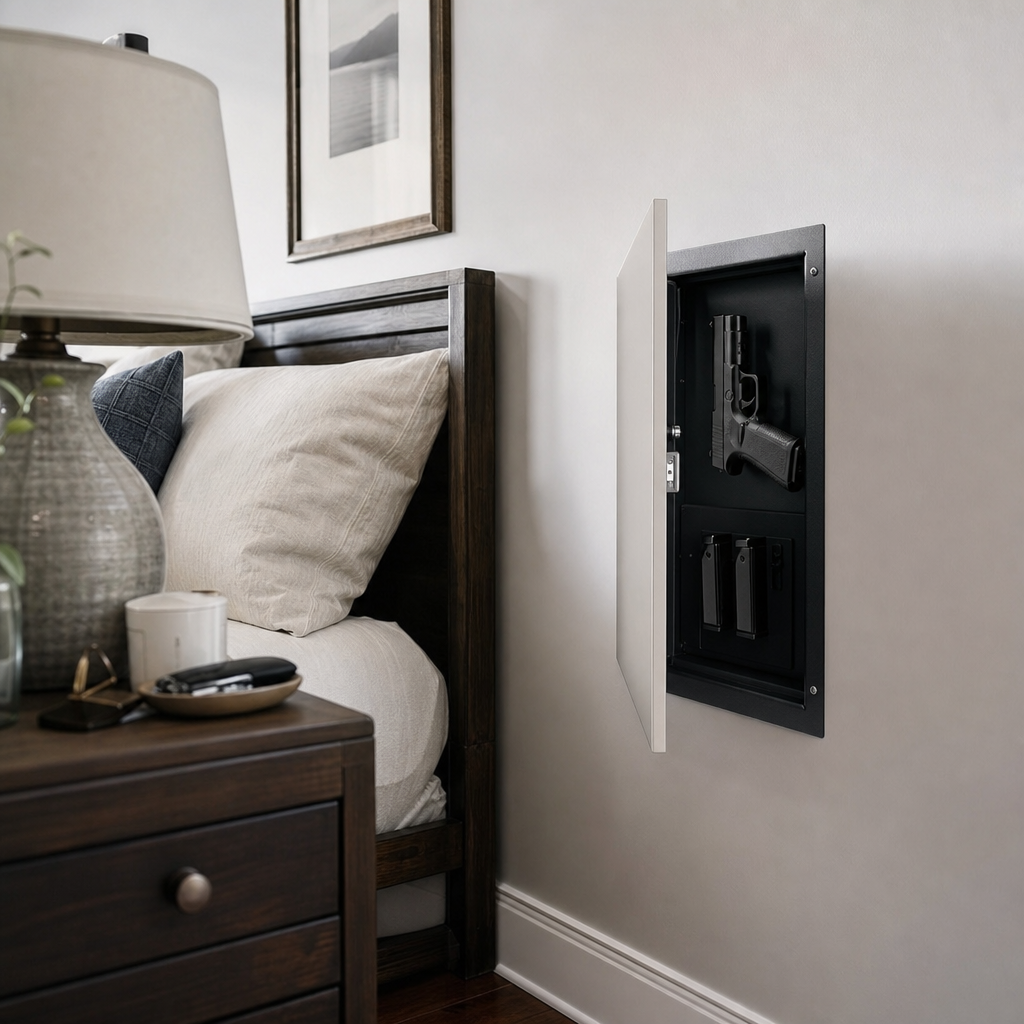
Wall-mounted hidden gun safes solve a specific problem: how to keep firearms secure, quickly accessible, and discreetly stored when floor space is limited. In apartments, smaller bedrooms, home offices, RVs, and compact suburban homes, a traditional full-size gun safe may be impractical or too visually obvious. A wall-mounted hidden gun safe fits between studs, behind furniture, inside a closet, or behind a framed mirror or artwork, giving owners a way to balance concealment with retention security.
In practical terms, hidden gun storage means a safe or lockable compartment designed to blend into a room rather than announce itself. Wall-mounted means the unit anchors directly into framing members instead of sitting on the floor. Small spaces refers to any room where every square foot matters, including condos, nursery-adjacent primary bedrooms, hallways, tight mudrooms, and converted office corners. The appeal is clear: a properly installed in-wall safe can preserve usable floor area, reduce casual visibility to guests or contractors, and keep a defensive handgun or compact long gun accessible under controlled conditions.
This category matters because firearm storage decisions affect safety, theft resistance, child access prevention, and response time. The best wall-mounted hidden gun safes for small spaces are not simply the most secretive products. They are the models and designs that combine solid steel construction, reliable locking systems, sound mounting hardware, sensible dimensions, and concealment features that match the room. I have evaluated hidden storage setups in real homes, and the difference between a smart installation and a gimmick is dramatic. A shallow box behind a picture can look clever, but if it uses weak hinges, thin sheet metal, or poor stud attachment, it fails when security is actually needed.
As a hub for hidden and discreet gun storage solutions, this guide explains what wall-mounted hidden safes do well, where they fall short, what features matter most, and how they compare with other discreet storage formats. It also points readers toward adjacent storage concepts they should explore within a broader gun safes and safety plan, including furniture safes, diversion safes, bedside quick-access units, and long-gun concealment cabinets. If your goal is to secure a firearm in a small space without sacrificing discretion, this is the foundation.
What makes a wall-mounted hidden gun safe the best choice in a small space
A wall-mounted hidden gun safe is usually the best choice when the room cannot support a floor safe, when visible gun storage would attract attention, or when fast access is needed near a bed, desk, or entry route. The in-wall format uses the dead space between studs, typically 14.5 inches wide in standard 16-inch-on-center framing. That footprint works especially well for handguns, spare magazines, passports, cash, medication, and compact valuables. Some larger models also support breakdown rifles or short-barreled defensive firearms, depending on local law and internal dimensions.
The best units share a few traits. First, they are built from steel thick enough to resist prying better than decorative concealment boxes. Second, they use dependable locks: mechanical simplex-style pushbutton locks, UL-listed electronic keypads, or biometric readers with backup keys and low-battery warning systems. Third, they mount with multiple lag bolts directly into studs, not only drywall anchors. Fourth, they open in a way that fits the room. A bedroom closet may allow a swing-out door, while a hallway installation may need a flush profile hidden behind a framed panel.
For small-space living, concealed wall safes also improve room layout. A narrow in-wall handgun safe can sit behind hanging clothes in a closet, preserving nightstand and dresser surfaces. In a home office, a mirror-front safe can disappear into existing decor while keeping a pistol secured near the workstation. In a mudroom, a shallow compartment can remain accessible without creating a visible security target near exterior doors. These use cases are why hidden and discreet gun storage solutions have become such a strong subcategory within gun safes and safety.
Key features to look for before you buy
When comparing the best wall-mounted hidden gun safes for small spaces, focus first on construction and mounting depth. Most interior residential walls use 2×4 framing, leaving about 3.5 inches of stud depth before drywall. After accounting for back panels and door thickness, usable interior depth is often tighter than buyers expect. That matters because some full-size pistols with mounted optics or weapon lights need more clearance than a basic revolver. Always compare exact interior dimensions against your firearm setup, not just the product’s exterior measurements.
Lock type matters just as much. Biometric access is attractive because it can be fast, but lower-end fingerprint readers often struggle with dry skin, partial finger placement, or multiple users. Better biometric safes store several prints, open consistently from different angles, and include keypad or key overrides. Electronic keypad safes are often more predictable if the brand uses quality components. Mechanical pushbutton locks remain excellent for reliability because they need no batteries and can be opened by touch in darkness, though they are less common in ultra-slim in-wall designs.
Concealment design is another decision point. Some safes are plain steel boxes intended to hide behind your own artwork, mirror, shelving face, or closet panel. Others ship with integrated picture frames, mirrors, or whiteboard fronts. Integrated concealment can save time, but custom concealment usually looks more natural because it matches the room. Fire protection is less common in this category due to space and venting constraints, so if document fire resistance is a priority, a hidden wall unit should complement rather than replace a fire-rated safe.
| Feature | Why it matters | Best fit in small spaces |
|---|---|---|
| Stud-mounted steel body | Improves pry resistance and prevents pullout | Essential for any in-wall installation |
| Low-profile door swing | Allows opening in closets and narrow rooms | Ideal near hanging clothes or hall corners |
| Biometric plus keypad backup | Balances speed with redundancy | Useful for primary-access defensive storage |
| Adjustable interior shelving | Fits handguns, documents, and magazines cleanly | Best for multi-purpose storage |
| Custom concealment panel compatibility | Reduces obvious safe appearance | Best where guests or service workers visit |
Best wall-mounted hidden gun safe formats and where each works best
Not every hidden wall safe is shaped for the same job. The first major format is the vertical in-wall handgun safe. This is the most common option and usually the strongest all-around choice for small spaces. It fits between studs, stores one to four handguns depending on shelf layout, and works behind mirrors, framed art, or closet garments. For most apartment dwellers, this is the practical sweet spot because it provides real locking security without requiring custom carpentry beyond drywall cutting and stud mounting.
The second format is the full-length concealment cabinet. These taller units may hold a tactical shotgun, folding carbine, or compact rifle, often behind a mirror or decorative panel. They can work in bedrooms, offices, and walk-in closets, but they require more uninterrupted wall height and more attention to local firearm storage laws. In small homes, they are effective only if the room can support the visual scale of the concealment piece without making it obvious that something substantial is hidden behind it.
The third format is the recessed quick-access compartment, often with a drop-down or swing-open door optimized for one defensive handgun. These are commonly installed beside a bed, near a desk, or inside a closet wall. They prioritize access speed over storage capacity. I have seen these perform well in primary bedrooms where owners want a pistol accessible but fully locked away from children. They are less useful as all-purpose safes because internal space is limited and organization options are minimal.
Another format worth considering is the hybrid concealment product: a wall safe integrated into furniture-adjacent decor, such as a mirror with a hidden locking cavity. These products can look polished, but quality varies widely. Some are true safes with steel bodies and framed mounting points; others are simply hidden compartments. That distinction matters. A hidden compartment without meaningful lock strength is concealment, not secure storage.
Installation, placement, and room-by-room strategy
Installation quality determines whether a hidden wall gun safe performs as intended. Before buying, identify stud spacing, electrical lines, plumbing runs, HVAC obstructions, and door swing limitations. A stud finder with live-wire detection is a starting tool, but in older homes I always recommend a careful inspection cut or borescope check before opening the wall fully. Exterior walls may have insulation that complicates recessed depth, while interior walls often provide cleaner installation paths.
Placement should support both concealment and access. In a primary bedroom, the best location is usually inside a closet at torso height or behind wall art near the side of the bed that offers natural reach without standing fully upright. In a home office, a safe hidden behind a framed certificate display or mirror can keep a defensive handgun nearby while avoiding obvious exposure on video calls or during client visits. In narrow hallways, avoid locations where the door cannot open fully or where a person would have to kneel awkwardly under stress.
Small-space owners should also think about routine behavior. The best hidden safe is the one you will actually use every day. If the safe is too high, too awkward to open, or blocked by furniture, compliance drops. If it is too obvious or too close to an entry point, theft risk increases. For households with children, wall safes should still be treated as locked firearm storage, not as a substitute for broader education and layered safety practices. Ammunition storage policy depends on your intended defensive use, local law, and household risk profile, but any chosen setup should be deliberate and consistent.
How wall safes compare with other hidden and discreet gun storage solutions
As the hub page for hidden and discreet gun storage solutions, it helps to place wall-mounted safes in the larger category. Furniture safes, such as concealed nightstands, coffee tables, and benches, are often easier to install because they require no wall cutting. They can work well for renters, but they consume floor area and may be easier for thieves to remove unless they are anchored. Under-bed safes maximize dead space and can hold larger firearms, yet they are usually less discreet during cleaning, moving, or guest visits.
Diversion safes and hidden compartments built into books, vents, shelves, or clocks offer strong concealment but usually weaker security. They may be acceptable for temporary staging in controlled environments, but they are not substitutes for a real locking safe when child access prevention or theft resistance is the goal. Vehicle lockboxes solve a different problem altogether and should not be treated as primary home storage. Likewise, full-size traditional gun safes remain the best solution for large collections, higher burglary resistance, and substantial fire protection, even though they are rarely ideal for small-space concealment.
The advantage of the wall-mounted hidden gun safe is its balance. It preserves floor space, supports concealment, and can provide legitimate lockable security when properly built and mounted. Its disadvantages are equally clear: limited capacity, dependence on wall structure, and generally lower burglary resistance than heavy freestanding safes. Understanding those tradeoffs helps buyers choose the right tool instead of expecting one product to solve every firearm storage need.
Common mistakes, product quality warnings, and buying advice
The most common mistake is confusing concealment with security. A magnetic picture frame over a cavity may hide a handgun from casual view, but if it lacks reinforced steel, a real lock, and stud anchoring, it does little against unauthorized access. Another frequent error is buying based on exterior appearance alone. Stylish mirror safes and flag-art concealment cabinets can be useful, but the steel gauge, hinge design, lock certification, and mounting hardware matter more than the decor front.
Watch for red flags in product listings: vague steel thickness claims, no interior dimension drawings, no mention of stud anchoring, and marketing that promises “childproof” performance without explaining lock standards. Reputable brands typically publish exact dimensions, lock details, battery type, override method, and hardware specifications. Reviews are useful only when they describe long-term use, installation experience, and lock consistency. Five-star comments that mention only fast shipping or attractive finish tell you almost nothing.
If you are building a complete safety plan, think of this article as the central guide within the broader gun safes and safety topic. From here, the next logical areas to explore are hidden long-gun storage, disguised furniture safes, bedside quick-access handgun safes, child-resistant storage practices, and installation planning for renters versus homeowners. Start with your room, your access needs, and your legal obligations, then choose a wall-mounted hidden gun safe that fits your actual firearm setup and daily routine. Done correctly, discreet storage protects space, privacy, and safety at the same time.
The best wall-mounted hidden gun safes for small spaces are defined by fit, mounting strength, lock reliability, and believable concealment. They work because they use unused wall cavities, reduce visual exposure, and preserve valuable square footage in bedrooms, offices, closets, and compact homes. They are especially effective for handgun storage and selected defensive setups where quick access must coexist with child access prevention and theft deterrence.
The most important lesson is that hidden storage is only as good as the safe behind the disguise. Strong stud mounting, solid steel construction, dependable access hardware, and thoughtful placement matter more than decorative styling. Buyers should measure carefully, verify interior depth, plan around wall obstructions, and choose concealment that looks natural in the room. They should also recognize the limits of this category: wall safes do not replace heavy collection safes for large arsenals, high fire ratings, or maximum burglary resistance.
As the hub for hidden and discreet gun storage solutions, this page should help you narrow the right direction quickly. If you need a compact, space-saving, lockable option that does not advertise itself, a wall-mounted hidden gun safe is often the best answer. Use this guide to compare formats, avoid weak products, and build a storage plan that matches your home and habits. Then move to the next related storage solution and complete your firearm safety setup with the same level of care.
Frequently Asked Questions
What are the main advantages of a wall-mounted hidden gun safe in a small space?
A wall-mounted hidden gun safe is designed for people who need secure firearm storage without giving up valuable floor space. In a small apartment, condo, bedroom, home office, or RV, a traditional freestanding safe can be bulky, difficult to place, and immediately visible to anyone entering the room. A recessed or wall-mounted concealed safe solves that problem by using otherwise underused wall cavity space, often fitting neatly between standard studs. That makes it especially practical when every square foot matters.
Another major benefit is discretion. Many of the best hidden wall safes are designed to sit behind a mirror, framed artwork, shelving feature, or closet contents, making them less obvious than a large steel box in the corner. This can reduce casual discovery by visitors, service workers, or opportunistic thieves. It also creates a cleaner visual appearance, which matters in rooms where a visible gun safe would feel intrusive or draw unwanted attention.
Quick access is also part of the appeal. Unlike deep storage solutions that may be secure but slow to reach, many wall-mounted hidden gun safes are built for rapid retrieval with RFID, keypad, biometric, or mechanical lock options. For owners prioritizing defensive access, a properly installed hidden wall safe can strike a practical balance between concealment, accessibility, and retention security. The key is choosing a model with solid steel construction, reliable locking hardware, and a layout that suits your firearm and the room where it will be installed.
Are wall-mounted hidden gun safes actually secure enough for firearm storage?
They can be, but security depends heavily on the safe’s build quality, lock type, and installation method. A well-made wall-mounted hidden gun safe should have a reinforced steel body, a pry-resistant door, strong internal hinges or tamper-resistant external hinge design, and a locking mechanism that engages the frame securely. Cheaper products may look discreet but offer limited resistance to forced entry, especially if they use thin sheet metal or weak latch systems. For firearm storage, that distinction matters a great deal.
Installation is just as important as construction. A hidden wall safe must be anchored correctly to wall studs or another structurally sound surface. If it is poorly mounted, even a strong safe can be compromised. In small spaces, owners sometimes focus on concealment alone, but concealment is not the same thing as security. A safe hidden behind a picture frame may avoid detection, but if the unit itself is flimsy or loosely attached, it may not provide meaningful protection against theft or unauthorized access.
It is also important to be realistic about use case. Wall-mounted hidden gun safes are excellent for controlled access, child deterrence, and reducing visibility, but they are not always equivalent to heavy, fire-rated, high-capacity vaults. If your main goal is discreet defensive storage in a compact home, they can be an excellent solution. If you need maximum burglary resistance for a larger firearm collection, a dedicated full-size safe may still be the stronger option. In many homes, the best approach is to use a hidden wall safe for one or two readily accessible firearms and a larger primary safe for long-term storage.
What should I look for when choosing the best wall-mounted hidden gun safe for a compact room?
Start with dimensions and stud spacing. Many recessed wall safes are designed to fit between standard 16-inch-on-center wall studs, but actual available depth, height, and placement can vary depending on construction, wiring, plumbing, and insulation. Before you compare models, measure the intended installation area carefully. In a small room, the best safe is not just the one with the most features, but the one that fits cleanly into the space without interfering with furniture, doors, or everyday movement.
Next, evaluate access method and reliability. Biometric locks can be convenient, but they should be backed up by a keypad or manual key override in case of battery failure or fingerprint-read issues. RFID access is fast and discreet, while electronic keypads are familiar and widely available. Some owners prefer simplex mechanical push-button locks because they do not rely on electronics at all. The right choice depends on whether you prioritize speed, redundancy, low maintenance, or silent access in a defensive scenario.
You should also compare capacity and interior layout. Some hidden wall safes are intended for a single handgun, while others can hold multiple pistols, documents, valuables, spare magazines, or even a compact long gun depending on dimensions. Interior lighting, foam lining, adjustable shelving, and magazine holsters can improve usability significantly. Finally, look at concealment options. A model that works behind a mirror, picture, cabinet door, or closet organizer may blend far better into your room than a visible locking panel. The best wall-mounted hidden gun safe is one that matches your firearm, your room, your access needs, and your security expectations without wasting precious space.
Where is the best place to install a hidden wall gun safe in an apartment, bedroom, or home office?
The best installation spot is one that balances concealment, convenience, and structural practicality. In a bedroom, common locations include behind a full-length mirror, inside a closet, behind framed artwork, or on a wall partially obscured by furniture. In a home office, a safe can work well behind a decorative panel, cabinet feature, or wall art near a desk, giving fast access while remaining out of plain sight. In apartments and other compact living environments, people often choose areas that do not attract attention but still allow a natural reach path during daily use.
However, not every wall is a good candidate. Before installation, you need to identify studs and avoid electrical wiring, plumbing, HVAC runs, and load-sensitive areas. Exterior walls may introduce insulation and moisture considerations, while certain shared or thin partition walls may not offer the best combination of discretion and structural stability. In rental properties, you also need to consider lease terms and whether recessed installation is allowed. Some owners opt for surface-mounted concealment solutions when cutting into the wall is not practical or permitted.
Accessibility matters just as much as hiding the safe. A location that is too obvious defeats the purpose, but one that is too difficult to reach may slow access when seconds count. Ideally, the safe should be reachable without moving heavy furniture or navigating obstacles, while still staying outside the direct line of sight from the doorway. The most effective placements feel natural within the room, remain discreet during normal use, and support safe, consistent firearm handling habits.
Can a wall-mounted hidden gun safe be used for more than just firearms?
Yes, and that versatility is one reason these safes are so appealing in small-space homes. In addition to storing a handgun or compact defensive firearm, many owners use them for passports, cash, legal documents, jewelry, backup drives, medications, emergency contact information, and other valuables they want secured but accessible. In compact homes where storage options are limited, a hidden wall safe can serve as a discreet multi-purpose security hub rather than a single-use product.
That said, mixed-use storage should be handled thoughtfully. If the safe contains both a firearm and personal items you access regularly, you do not want to create unnecessary handling or repeated exposure of the weapon. It is often better to organize the interior so the firearm remains in a dedicated section, separate from paperwork or valuables. Some models with shelves, pouches, and customizable inserts make this easier. A well-organized safe improves both safety and speed, especially under stress.
You should also consider humidity control, interior padding, and local legal requirements. Important documents may need waterproof sleeves, while firearms benefit from basic moisture management and proper orientation. If you are using the safe as part of a broader home security plan, think in layers: discreet placement, strong mounting, quality lock access, organized interior storage, and responsible access control. Used that way, a wall-mounted hidden gun safe becomes more than a concealment product—it becomes an efficient, space-saving solution for secure storage in modern small living environments.