
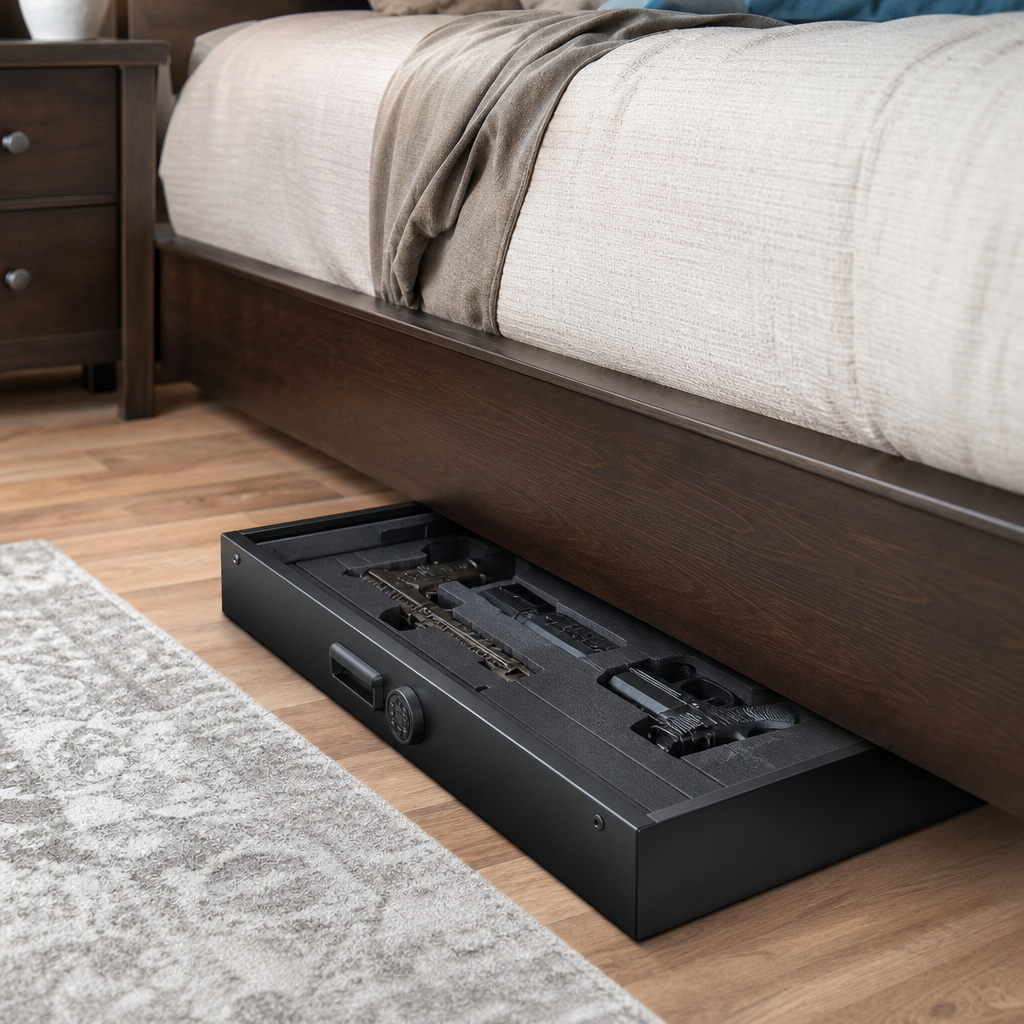
Under-bed gun safes solve a specific problem: they keep firearms secure, hidden from casual view, and reachable in seconds when access matters. In the broader category of hidden and discreet gun storage solutions, this format has become one of the most practical choices for homeowners who want better security than a nightstand drawer and faster access than a traditional closet safe. I have evaluated enough home-defense storage setups to know that convenience always shapes behavior. If a safe is awkward, too visible, or too slow, many owners stop using it consistently. That is exactly where the best under-bed gun safes stand out.
An under-bed gun safe is a low-profile security container designed to slide beneath a bed frame while storing handguns, spare magazines, documents, or even compact long guns, depending on its dimensions. Most use a pull-out drawer design, reinforced steel construction, and either electronic, biometric, or mechanical locking systems. The goal is discreet access without advertising where valuables or defensive firearms are kept. For many households, that matters just as much as burglary resistance. Hidden storage reduces opportunistic theft, limits attention from guests or service workers, and helps maintain a cleaner room layout than more obvious freestanding safes.
This topic matters because firearm storage involves two responsibilities at once: preventing unauthorized access and preserving lawful, rapid access for the owner. Those goals can conflict if the product is poorly chosen. A lockbox that opens quickly but can be pried open with hand tools is not enough. A massive safe with excellent burglary protection but no realistic access path from the bedroom may not fit the need either. The best under-bed gun safes bridge that gap. They support safe storage practices, work within the realities of modern bedrooms, and fit naturally into a larger hidden gun storage plan that may also include closet safes, furniture safes, and vehicle lockboxes.
As a hub for hidden and discreet gun storage solutions, this guide explains what makes an under-bed model worth buying, how to compare lock types, which construction details affect security, and where this style fits among other concealed storage options. If you are researching the best under-bed gun safe for quick access, compact pistol storage, or discreet long-gun storage, the answer is not one universal model. It is the product that matches your firearm size, room layout, bed clearance, speed requirements, and local legal obligations. Getting those details right is what turns hidden storage from a clever idea into a dependable part of your safety plan.
Why under-bed safes work for hidden and discreet gun storage
Under-bed safes are effective because they use space that is already present, visually quiet, and difficult to inspect casually. A burglar moving quickly through a home often targets nightstands, dresser drawers, closets, and obvious office furniture first. The underside of a bed is less conspicuous, especially when the safe sits deep enough to avoid being seen from the doorway. That concealment is not a substitute for steel thickness, locking strength, or anchoring, but it does add a meaningful layer of security by reducing discovery. In practical home defense planning, hidden placement and physical resistance work best together.
They also improve daily usability. Many owners keep a firearm in the bedroom because they want it nearby at night, yet they do not want it exposed to children, visitors, or cleaners during the day. A good under-bed safe preserves that balance. You can reach down, extend a drawer, and retrieve a firearm while staying near your normal sleeping position. Compared with a wall safe inside a closet or a larger safe in another room, the access path is shorter and usually more intuitive under stress. That matters because emergency access depends on simple motion, low light familiarity, and repeatable muscle memory, not ideal conditions.
Another advantage is versatility. Some under-bed safes store a single defensive handgun and flashlight. Others hold multiple pistols, passports, cash, suppressor-ready handguns, optics-equipped firearms, or broken-down AR-platform carbines. For apartment dwellers, they are often the only realistic way to add meaningful security without devoting visible floor space to a large cabinet. For homeowners, they can complement a primary gun safe by keeping one ready firearm accessible while everything else remains locked in a heavier unit elsewhere. In that sense, the under-bed format is rarely the whole storage strategy. It is the quick-access component within a layered system.
What features define the best under-bed gun safes
The best under-bed gun safes combine four essentials: strong construction, reliable locking, dimensions that match the intended firearm, and a drawer system that works smoothly under pressure. Start with steel. Many quality models use 14-gauge, 12-gauge, or thicker steel bodies, with reinforced doors and internal anti-pry lips. Heavier steel generally improves resistance to bending and prying, though overall design matters as much as raw thickness. A poorly supported drawer front can become a weak point even on an otherwise solid safe. Look for continuous welds, strong drawer rails, and lock engagement that secures more than one side where possible.
Locking systems deserve close scrutiny. Electronic keypad locks are common because they balance speed and affordability, but quality varies widely. Better units use dependable solenoids, tamper-resistant keypads, and backup keyed entry. Biometric locks can be fast when implemented well, though I have seen fingerprint readers become less reliable with dry skin, sweat, poor finger placement, or low batteries. Mechanical simplex-style locks remain excellent for users who value consistency and no-battery operation, though they appear more often on upright quick-access safes than under-bed drawer models. Whatever the lock type, testing repeatability in darkness is more important than showroom appeal.
Interior dimensions matter more than advertised capacity numbers. A safe described as holding two rifles may not fit a carbine with a mounted optic, light, or folded brace. A pistol safe that claims space for four handguns may become cramped once you add magazines, a tourniquet, and documents. Measure the firearm in its actual ready configuration. Include optic height, magazine length, and suppressor-height sights. Then compare those measurements with the safe’s usable interior, not just its exterior shell. Also verify bed clearance. Low-profile safes can still fail if carpet, drawer handles, or frame supports reduce the room needed for smooth extension.
| Feature | Why It Matters | What to Look For |
|---|---|---|
| Steel construction | Resists prying and bending during theft attempts | 12- to 14-gauge steel, reinforced drawer front, anti-pry design |
| Lock type | Determines speed, reliability, and failure points | Proven keypad, quality biometric reader, or mechanical access with backup |
| Interior size | Ensures firearms fit with optics, lights, and accessories | Usable interior measurements, foam layout, accessory clearance |
| Anchoring | Prevents removal of the entire safe | Pre-drilled mounting holes, strong hardware, floor or bed-frame attachment |
| Drawer action | Affects access speed in low light and stress | Smooth rails, full extension, stable travel, minimal binding |
Best use cases: pistols, long guns, and bedside readiness
For handgun owners, under-bed safes are often the strongest blend of concealment and speed. A compact or full-size pistol with a weapon light fits easily in many drawer-style models, leaving room for a spare magazine, handheld flashlight, and small trauma kit. This setup works especially well for users who do not want a visible pistol safe on top of furniture. It also helps households with children because the firearm stays secured even when the owner is asleep or briefly out of the room. If your primary need is bedside access to one or two handguns, a shallow under-bed safe is usually more practical than a large multi-gun cabinet.
For long guns, the category becomes more specialized. Some under-bed safes are built specifically for shotguns or tactical carbines, with wider drawers and foam support to stabilize the firearm during movement. These can be excellent for a short-barreled shotgun or compact rifle used for home defense, but buyers need to confirm total length, optic clearance, and whether the safe supports storage in a ready condition consistent with local law and household safety rules. If the bed frame includes center supports or low side rails, the maximum usable width may shrink fast. In real installations, room geometry often limits long-gun storage more than the manufacturer’s brochure suggests.
Bedside readiness is not just about opening speed. It also includes orientation, retrieval angle, and whether the drawer can be reached from both sides of the bed. I often recommend rehearsing access with an unloaded firearm to see if the safe location causes awkward twisting or snagging on bedding. A well-made safe placed in a poor location can still fail the test. Some couples prefer a center-mounted unit accessible from either side; others use one side of the bed to avoid foot traffic. The best choice depends on bedroom layout, sleeping arrangements, and whether one or both adults need authorized access.
Comparing lock options for quick and discreet access
If your priority is the fastest under-bed gun safe, start by understanding the tradeoffs in lock technology. Electronic keypads are the most common because they allow quick code entry and usually keep the safe’s outer profile clean. When the keypad is responsive and the drawer pops free immediately, access is very good. The weakness is electronics quality. Cheap membrane buttons, weak battery monitoring, or inconsistent actuators can turn a fast concept into an unreliable tool. Choose brands with established records in quick-access storage rather than generic imported units with little support or warranty clarity.
Biometric locks appeal to buyers who want one-touch access, but performance is highly dependent on sensor quality and enrollment setup. Good readers can work well when you program multiple angles of the same fingerprint and keep the sensor clean. Poor readers fail exactly when you need them most. I generally view biometric access as a convenience layer, not the sole reason to buy a safe. If you choose it, insist on a secondary keypad or key override and test the reader regularly in the same conditions you expect at night. That means dry hands, low light, and realistic body position next to the bed.
Mechanical locks are slower on paper but often stronger in real consistency. Because they do not rely on batteries or circuit boards, they remove several failure points. Their main limitation in under-bed safes is market availability and physical packaging, since many drawer-style units prioritize low profile over larger mechanical lock housings. For many owners, the best answer is not chasing the latest lock style but buying the most reliable implementation of the style they can use confidently. A simple keypad you can open every time beats a faster system that works only in ideal conditions. Reliability is part of speed, not separate from it.
How under-bed safes compare with other hidden gun storage solutions
Under-bed safes sit in the middle of the hidden storage spectrum. They are more secure than concealment furniture with simple hidden compartments, and usually faster to access than closet safes or wall safes placed behind hanging clothes. Compared with bedside biometric pistol boxes, they are often less visible and can hold more gear. Compared with full-size fire-rated gun safes, they are easier to conceal and faster to open, but they rarely match the same level of burglary protection, fire resistance, or total capacity. That is why they work best as part of a layered home storage plan rather than as the only secure container in a firearm-owning household.
Other discreet options each have strengths. Closet vaults can provide better concealment behind existing doors and shelving. In-wall safes preserve floor space and can disappear behind mirrors or artwork, though installation is more permanent and size is limited by stud spacing. Furniture safes hide in plain sight but sometimes sacrifice steel thickness for aesthetics. Vehicle lockboxes are essential for lawful transport but do not replace home storage. When readers ask me which hidden gun storage solution is best, the honest answer is that it depends on the access moment you are solving. Under-bed safes win specifically for low-visibility bedside access with moderate capacity.
As the hub page for hidden and discreet gun storage solutions, this article points naturally toward deeper comparisons: under-bed safes versus nightstand safes, best hidden pistol safes for apartments, discreet long-gun storage, child-resistant quick-access options, and how to anchor safes without damaging finished interiors. Those related topics matter because selecting the right hidden storage solution is always situational. Your ideal setup may include an under-bed safe in the primary bedroom, a larger fire-rated safe in a closet, and a separate lockbox for temporary vehicle storage. The point is not to hide firearms creatively. The point is to secure them intelligently while keeping access lawful and practical.
Installation, placement, and mistakes to avoid
Proper installation is what separates a discreet gun safe from an expensive drawer-shaped object. If the safe is not anchored, a thief may simply remove the whole unit and defeat it later. Most under-bed safes include pre-drilled mounting holes for floor anchoring, bed-frame attachment, or both. The best method depends on your room and housing situation. Concrete anchors offer the strongest hold on slab floors. In wood subfloors, use appropriate lag hardware into structural material, not just finish flooring. If renting restricts floor drilling, a robust attachment to a heavy steel bed frame can add resistance, though it usually provides less security than direct anchoring.
Placement mistakes are common. Buyers sometimes choose the largest safe that physically fits under the bed, then discover the drawer cannot extend fully because of a rug, bench, nightstand, or nearby wall. Others overlook power and battery maintenance for electronic locks. Another frequent error is storing firearms with optics or lights without checking interior clearance, causing the drawer to bind or compress equipment. Humidity is also worth addressing. Bedrooms can still experience moisture swings, especially in coastal climates or older homes. A small desiccant pack or rechargeable dehumidifier helps protect metal surfaces and optics inside enclosed storage.
Finally, remember that discreet storage does not cancel legal responsibility. State and local rules on secure firearm storage, child access prevention, and transport-ready conditions vary. So do best practices for loaded storage in a home with minors or prohibited persons. Review the manufacturer’s instructions, test the lock monthly, replace batteries on schedule, and rehearse access safely with an unloaded firearm. If you are building a better hidden storage plan, start by measuring your space, defining what firearm you need to secure, and choosing an under-bed gun safe built for that exact role.
The best under-bed gun safes deliver what hidden and discreet gun storage should deliver: security that people actually use. They keep firearms out of sight, reduce the chance of casual discovery, and provide faster bedside access than many larger or more visible alternatives. The strongest models pair sturdy steel construction with a dependable lock, smooth drawer action, realistic interior dimensions, and solid anchoring. Those basics matter more than marketing claims. If a safe does not fit your firearm as configured, cannot open reliably in low light, or is easy to remove, it is not the right answer no matter how sleek it looks.
For most buyers, the right choice starts with use case. A handgun owner may need a shallow, fast-opening unit for one pistol and essentials. A homeowner wanting discreet long-gun storage needs deeper measurement checks, stronger placement planning, and extra attention to drawer clearance. In both cases, under-bed safes work best as one layer in a broader gun storage strategy that may include a full-size safe, closet storage, and dedicated transport lockboxes. Hidden storage is most effective when it supports consistent habits, lawful access, and straightforward daily use for every authorized adult in the home.
If you are comparing hidden gun storage solutions, use this hub as your starting point. Measure your bed clearance, confirm your firearm dimensions, decide which lock type you trust most, and prioritize anchoring from the beginning. Then explore the related topics in Gun Safes & Safety to narrow the best discreet option for your room, routine, and risk level. The right under-bed gun safe is not just discreet. It is dependable when it counts.
Frequently Asked Questions
Why choose an under-bed gun safe instead of a nightstand drawer or a traditional safe?
An under-bed gun safe fills the gap between speed and security better than most other home-defense storage options. A nightstand drawer may feel convenient, but it offers very little real protection against unauthorized access, especially in homes with children, guests, cleaners, or anyone else who may come into the bedroom. At the other end of the spectrum, a large traditional safe in a closet usually provides excellent security, but it can be slower to reach in a high-stress situation and may not fit naturally into a nightly routine. Under-bed models are designed specifically to stay out of sight while remaining accessible within seconds.
That combination matters more than many buyers realize. In real-world use, people tend to rely on storage solutions that are simple and fast enough to use consistently. If a safe is inconvenient, awkward to open, or located too far from where the firearm is actually needed, owners are more likely to cut corners. An under-bed safe reduces that temptation by placing secure storage right where many homeowners already spend the night. It also adds a level of discretion that visible safes do not. From both a practical and behavioral standpoint, that makes under-bed gun safes one of the strongest choices for discreet home-defense storage.
What features matter most when buying the best under-bed gun safe?
The most important features are size, access speed, lock type, build quality, and how well the unit fits your specific room and firearm setup. Start with dimensions first, because under-bed safes vary widely in height, depth, and drawer extension. You need enough clearance to slide the safe under the bed without scraping the frame or floor, and you also need enough room for the drawer or door to open fully. Many buyers focus only on exterior fit and forget to consider whether the safe can be accessed comfortably from the side or foot of the bed.
Next, pay close attention to the locking system. Electronic keypads, RFID readers, biometric scanners, and simplex-style mechanical locks all offer different tradeoffs. For a defensive firearm, quick and reliable access is critical, so the best choice is usually a lock that you can operate confidently in the dark and under stress. Construction quality matters too. Look for solid steel construction, reinforced locking points, anti-pry design elements, and pre-drilled mounting holes. Interior layout is another factor that often gets overlooked. Some under-bed safes are excellent for a rifle, shotgun, or PCC, while others are better suited for handguns, spare magazines, documents, or a combination of valuables. The best model is not just the strongest one on paper; it is the one that matches your bed height, your floor plan, your firearm type, and your need for dependable, repeatable access.
Are under-bed gun safes secure enough for homes with children or frequent visitors?
Yes, a quality under-bed gun safe can be a very strong option for households where unauthorized access is a serious concern, provided it is installed and used correctly. These safes are far more secure than leaving a firearm in a drawer, on a shelf, or tucked loosely under the bed. The hidden placement alone reduces casual discovery, but the real security comes from the locking mechanism, steel construction, and the ability to anchor the safe to the floor or bed frame structure. When properly secured, an under-bed safe can make it much harder for a child, teen, guest, or burglar to access the firearm quickly.
That said, no safe should be evaluated on concealment alone. If the safe is lightweight, left unbolted, or uses a weak lock, it may still be vulnerable to tampering or removal. For family homes, the best approach is to choose a model with sturdy construction and a lock you can trust, then install it so it cannot simply be pulled out and carried away. It is also smart to practice disciplined access habits: keep codes private, store backup keys securely, and test the locking system regularly. In homes with children, the purpose of the safe is not only to hide the firearm but to create a meaningful barrier against unauthorized handling. A well-made under-bed safe does that effectively while still allowing the owner fast access when needed.
Can an under-bed gun safe hold rifles and shotguns, or are they mainly for handguns?
Many under-bed gun safes are designed to do both, but capacity depends entirely on the model. Compact units are often intended for one or two handguns plus spare magazines and small valuables. Larger drawer-style safes, however, can often store an AR-style rifle, a folding carbine, a home-defense shotgun, or multiple handguns laid out side by side. Because under-bed storage uses horizontal space rather than vertical height, it can be especially useful for long guns in rooms where a full-size upright safe is impractical.
The key is to verify interior dimensions rather than relying on marketing labels. A safe advertised for long guns may technically fit a rifle, but accessories such as optics, lights, slings, muzzle devices, or extended magazines can change the real storage picture. Foam layout and internal organization also matter. Some safes offer flexible interiors that let you configure space for both firearms and accessories, while others have simpler open compartments. If your goal is bedside access to a defensive long gun, measure your exact firearm setup and compare it to the usable interior length, width, and depth. Done correctly, an under-bed safe can be one of the most practical ways to store a ready-access rifle or shotgun discreetly inside the bedroom.
How should an under-bed gun safe be installed for the best mix of security, discretion, and quick access?
Proper installation makes a major difference in how well an under-bed gun safe performs. First, place the safe where you can reach it naturally from your normal sleeping position, usually from the side or foot of the bed depending on room layout. Test the approach path at night, in low light, and with furniture in place. You do not want to discover that a rug, bedframe support, bench, or nightstand blocks the drawer when you actually need access. Fast access is only meaningful if the safe opens cleanly and consistently in the real space where it will be used.
Second, anchor the safe whenever possible. Most quality under-bed safes include pre-drilled mounting holes for bolting into the floor or another solid structure. This improves theft resistance and keeps the safe from shifting during use. Make sure the chosen location still allows full extension of the drawer or full swing of the access door. Finally, spend time learning the lock and building muscle memory. Practice opening the safe in darkness, from different positions, and without relying on perfect conditions. The safest setup is one you can operate reliably while still keeping the firearm secured from unauthorized hands. In other words, the best installation is not just hidden and strong; it is also intuitive, repeatable, and realistic for daily use.