
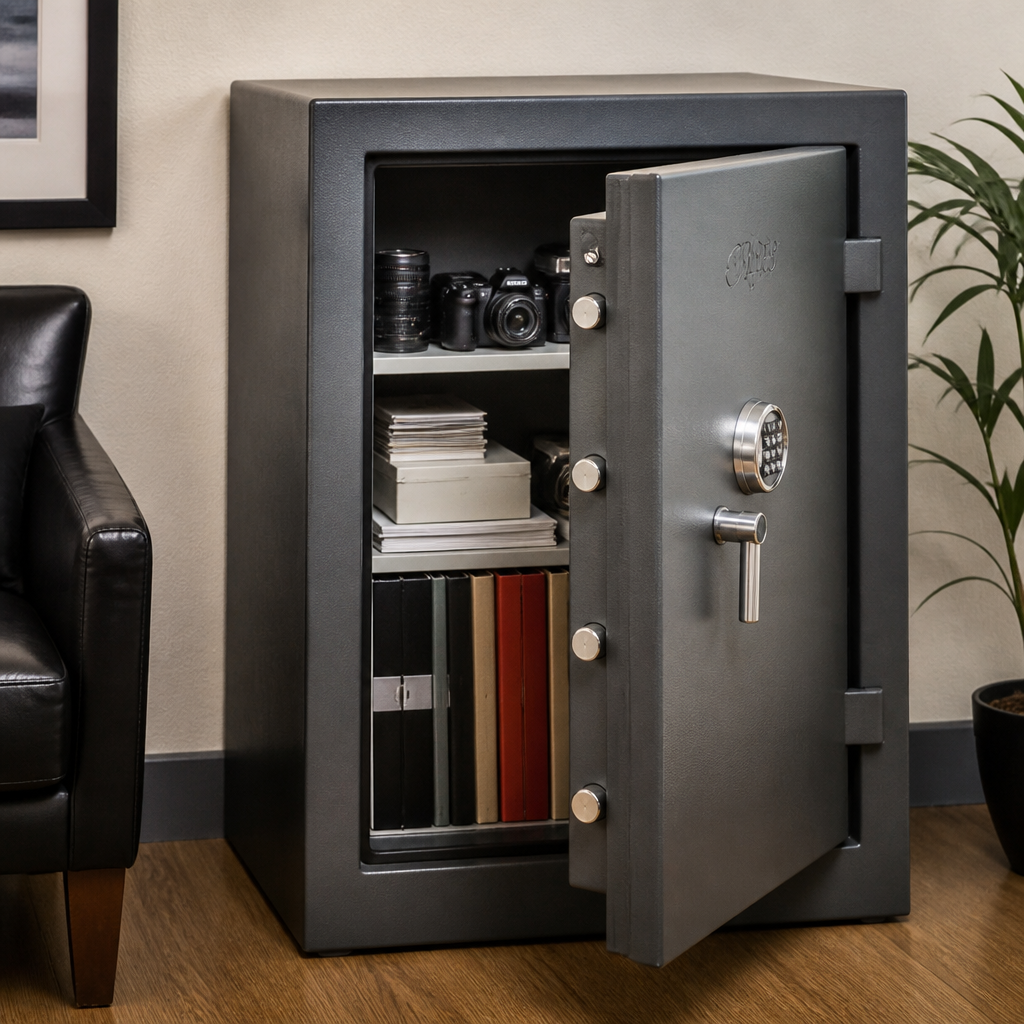
The AMSEC RF6528 stands out because it combines serious fireproofing with burglary protection in a format that fits the needs of gun owners, homeowners, and small business users who want one safe to handle multiple risks well. In practical terms, that means protection against two very different threats: heat that can destroy documents, electronics, and firearm accessories, and forced entry that targets valuables when a home or office is unattended. I have worked with buyers comparing safes in showrooms and during delivery planning, and this is exactly where confusion usually starts. Many people assume a thick-looking cabinet is secure enough, or that a fire label alone guarantees broad protection. It does not. A review of the AMSEC RF6528 matters because this model sits in an important middle ground: more robust than entry-level residential security containers, yet more attainable and installation-friendly than many commercial burglary safes. For a sub-pillar article in gun safes and safety, it also serves as a hub example for how to evaluate product reviews correctly. You should look beyond marketing terms and focus on construction details, lock options, capacity realities, placement requirements, and the tradeoffs that come with any dual-purpose safe. Understanding those factors helps buyers make better decisions across the broader product review category, not just with this one model.
Before getting into specifics, it helps to define the key terms that determine whether a safe is actually suitable. Fireproofing, in the safe industry, usually refers to a tested fire resistance rating measured by time and temperature exposure, along with limits on internal heat rise that help preserve paper records. Burglary protection refers to how long and how effectively the body, door, boltwork, hardplate, relockers, and overall design resist attack with common tools. Gun safe reviews often blur these categories, but they should not be blended carelessly because good performance in one area does not automatically mean good performance in the other. The AMSEC RF6528 matters precisely because it was designed to address both. For readers exploring product reviews as a hub topic, this safe is useful as a benchmark model: it shows what happens when a manufacturer known for commercial and residential security products builds a unit that prioritizes layered protection rather than a single headline feature. That is the right lens for comparing other safes later, whether the focus is long-gun storage, document protection, jewelry security, or mixed-use household storage.
What the AMSEC RF6528 is and where it fits in the market
The AMSEC RF6528 is part of American Security’s line of higher-security residential safes intended for users who need more than a basic gun cabinet or thin-bodied fire safe. AMSEC has long been a recognized name in the safe industry, and that matters because established manufacturers tend to publish more meaningful construction details, support lock servicing better, and maintain clearer standards across product lines. In my experience, buyers reviewing safes often start with dimensions and finish, but the more important question is category placement. The RF6528 is not simply a decorative home safe. It is built as a composite-style safe with substantial body construction, reinforced door design, and a serious fire liner strategy, making it relevant for users storing firearms, documents, cash, family records, watches, and hard drives in one location.
The “RF” designation is associated with AMSEC’s fire-resistant burglary safe approach, and the 6528 format generally points to a size profile that offers meaningful interior volume without crossing into the logistical challenges of very large commercial units. That balance is important. A safe that is too small gets underused because owners cannot organize contents properly. A safe that is too large may overload flooring, complicate delivery, and discourage ideal placement. For many households, the sweet spot is a model that can handle documents on shelves, handguns in organizers, and selected long guns or valuables without wasting space. This is one reason the RF6528 is often discussed in broader product reviews: it represents a practical crossover safe rather than a niche specialty unit.
Fire protection: what the rating means in real use
Fire protection is one of the strongest reasons buyers consider the AMSEC RF6528. A safe’s fire rating matters because house fires do not damage property only through flames. Internal temperatures rise, insulation degrades over time, and water from suppression efforts can ruin paper, photographs, and electronic media even when the exterior of the safe remains intact. AMSEC’s fire-protective construction on this class of safe is designed to delay heat transfer, and that is the critical point. Fire ratings are not magic shields; they are time-based resistance measurements under test conditions. In real-world use, the benefit is buying survivable time for the contents most likely to be destroyed early in a fire event.
For gun owners, fire protection is often misunderstood. Firearms themselves may survive temperatures that would devastate paper, but optics, polymer parts, slings, lubricants, ammunition packaging, and serial-number records may not. The same applies to estate documents, passports, tax files, and backup drives stored alongside firearms. I routinely advise buyers to think in layers: if a safe offers fire resistance for paper, use additional media-rated containers inside it for highly sensitive digital storage. The RF6528 makes sense because it gives a strong baseline for mixed contents, not because it eliminates all risk. Placement still matters. A garage corner near fuel storage is very different from an interior first-floor location with better structural support and potentially less extreme heat exposure.
Burglary protection: construction details that matter
The burglary side of the AMSEC RF6528 is what separates it from many consumer safes marketed mainly on cosmetic size and fire labels. Burglary resistance is created by layers: a thick composite body, a reinforced door, substantial boltwork, anti-pry features, lock protection, and relocking mechanisms that activate if the lock is attacked. Those details matter more than glossy paint or a high gun-count claim. In forced-entry attempts, thieves usually exploit weak doors, body flex, exposed gaps, and lock areas. A well-built safe resists those attacks by distributing force and slowing access enough to make the effort noisy, time-consuming, and often unsuccessful.
AMSEC’s reputation in burglary safes comes from emphasizing engineering rather than just storage volume. When I evaluate safes in this class, I pay close attention to door edge design, hinge-side protection, and the relationship between the locking bolts and the frame. A large number of bolts sounds impressive, but bolt count is less important than how the system engages and whether the safe’s body can resist peeling or spreading attacks. Hardplate shielding over the lock and relockers are also meaningful because attacks commonly target the lock body or drilling points. For homeowners, the practical takeaway is direct: the RF6528 offers real delay against the common tool attacks that defeat lighter residential units much faster.
How the AMSEC RF6528 compares with common safe categories
The easiest way to understand the RF6528 is to compare it with the most common alternatives buyers see in product reviews.
| Safe category | Typical strengths | Typical limitations | How RF6528 differs |
|---|---|---|---|
| Big-box gun safe | Large capacity, lower upfront price, decorative interiors | Thinner steel, modest anti-pry protection, variable fire testing quality | Offers stronger burglary construction and more credible dual-purpose design |
| Fire file or document safe | Good paper protection, office-friendly organization | Limited burglary resistance, not ideal for firearms or bulky valuables | Combines fire protection with stronger door and body security |
| TL-rated commercial safe | High burglary resistance against tool attacks, insurance appeal | Very heavy, expensive, less flexible for mixed household storage | More manageable for residential use while still offering robust protection |
| Lightweight cabinet | Affordable, easy placement, basic access control | Minimal true security, little or no fire resistance | Provides meaningful delay and fire performance instead of basic containment |
This comparison shows why the RF6528 works so well as a hub example in product reviews. It is not the cheapest option, and it is not the highest-rated commercial burglary safe. Instead, it occupies the category many serious homeowners actually need: a safe that protects against realistic residential threats without becoming impractical to own. That middle position is where many of the best-value reviews live.
Who should buy this safe and who should not
The AMSEC RF6528 is a strong fit for buyers who want one safe for firearms, legal papers, family records, and valuables rather than separate specialized units. It suits gun owners with a modest but meaningful collection, especially those prioritizing secure storage over maximizing long-gun count. It also suits homeowners who keep cash, jewelry, passports, and irreplaceable documents on site, and small business users who need overnight protection for records and selected assets. If you care about both fire and burglary resistance and do not want to compromise too sharply in either direction, this model deserves attention.
It may be the wrong fit for a few buyers. If your primary need is storing dozens of long guns with optics and gear, a dedicated larger gun safe may organize that inventory better. If your primary need is insurance-driven burglary ratings for high-value commercial holdings, a TL-rated safe is the more appropriate path. And if your budget only supports an entry-level cabinet, the RF6528 may simply be beyond reach. That said, cost should be considered against replacement difficulty, not just purchase price. For many families, losing title documents, heirloom jewelry, serialized firearms records, and backup media would be far more expensive than buying a better safe once.
Installation, lock choice, and day-to-day ownership
Installation is where good safe decisions become effective security decisions. Even a strong safe performs better when it is anchored properly, placed on a structurally appropriate surface, and located where thieves have less privacy to work. I strongly prefer ground-floor concrete installation when possible. If the safe is going on a framed floor, load distribution and exact placement should be reviewed carefully, especially in older homes. Concealment also helps. A safe in a visible garage may face more attack opportunity than one installed in an interior closet or secured room.
Lock choice matters as well. AMSEC commonly offers electronic and mechanical options across its lines, and each has tradeoffs. Electronic locks are faster for frequent access and allow simple code changes. Mechanical dial locks have a long service history and no batteries, but they are slower to open and less convenient for households that access the safe regularly. There is no universal winner. In my experience, users who need routine defensive firearm access usually prefer quality electronic locks from established makers, while users focused on documents and infrequent access often accept the slower pace of a dial. Whatever you choose, maintenance discipline matters: change batteries proactively, test the lock with the door open, and keep the safe dry and organized so access remains reliable under stress.
What this review teaches about evaluating all safe product reviews
The biggest lesson from the AMSEC RF6528 is that a good safe review should explain construction, intended use, and limitations in plain terms. It should not rely on dramatic phrases like “ultimate protection” without discussing body design, fire rating context, lock security, anchor strategy, and realistic capacity. Product reviews in the gun safes and safety category are most useful when they help readers match a model to a threat profile. That is why this article works as a hub page. The RF6528 illustrates the core questions every related review should answer: What risks does this safe address? What standards or construction features support those claims? What tradeoffs come with the design? And what type of owner will actually benefit most?
If you are building a shortlist, use the RF6528 as a benchmark. Compare other safes against it on steel and composite construction, verified fire resistance, lock options, door design, anchoring practicality, and usable interior layout. Ignore inflated capacity marketing and focus on how the safe will function in your home. The best product review is the one that helps you avoid a mismatch. The AMSEC RF6528 earns attention because it combines fireproofing with burglary protection in a way that is credible, balanced, and useful for real owners. If that is your priority, put it on your comparison list, review the specifications with a qualified dealer, and plan installation as carefully as the purchase itself.
Frequently Asked Questions
What makes the AMSEC RF6528 different from a standard gun safe or basic fire safe?
The AMSEC RF6528 is designed to address two major threats at the same time: fire and burglary. Many entry-level safes lean heavily in one direction. A basic fire safe may do a reasonable job protecting paper records from heat, but it often lacks the steel thickness, door construction, and locking strength needed to resist determined break-in attempts. On the other hand, some gun safes emphasize storage capacity and appearance but do not deliver the same level of serious fire insulation or composite body construction that buyers want for sensitive documents, electronics, jewelry, cash, and firearm-related valuables.
What sets the RF6528 apart is that it is built for people who need one safe to do multiple jobs well. That includes homeowners protecting legal papers and family valuables, gun owners storing firearms and accessories, and small business users who may need to secure records, backup drives, cash trays, or compact inventory. Instead of forcing the buyer to choose between fire performance and burglary resistance, this model combines both in a more balanced way. That makes it especially attractive for anyone who understands that theft and fire are very different risks, but both can cause permanent loss if a safe is not built to handle them properly.
In practical buying terms, the RF6528 is often considered by people who want to move beyond a simple cabinet or lightweight safe and invest in something with more substantial real-world protection. It is not just about storing items behind a lock. It is about creating a more serious barrier against heat, smoke, and forced entry in a single unit that can serve several roles inside a home or business environment.
How does the AMSEC RF6528 protect against both fire and burglary in real-world use?
The fire side of the equation comes down to insulation, door fit, body construction, and the ability of the safe to maintain survivable internal temperatures during a high-heat event. A quality fire-rated safe is intended to slow heat transfer long enough to preserve contents such as paper documents, passports, insurance files, media, and certain valuables that can be damaged even before actual flames reach them. In a house fire, the biggest issue is often not direct flame contact at first, but extreme ambient heat building inside the structure. A safe like the RF6528 is meant to buy critical time during that exposure.
Burglary protection is a different engineering challenge entirely. That involves stronger steel, reinforced locking areas, robust boltwork, hardplate or relocking features depending on the design, and a door and body structure that are much harder to pry, punch, or attack quickly with common tools. In the real world, most residential and small commercial burglaries are crimes of speed. Thieves want fast access and minimal noise. A safe that forces more time, more effort, and more specialized tools often changes the equation dramatically. The RF6528 is appealing because it is built with that reality in mind, not just cosmetic security.
What buyers appreciate most is the combined protection profile. If someone stores firearms, important paperwork, family heirlooms, and digital backups in one location, they need more than one-dimensional protection. The RF6528 is positioned as a safe that can handle layered risk better than products built primarily for only one purpose. That combination is exactly why it stands out among people trying to make a smart long-term purchase rather than simply buying the largest box with a lock on it.
Who is the AMSEC RF6528 best suited for?
The RF6528 is well suited for buyers who want one safe that can realistically support several protection priorities at once. Gun owners are a natural fit because they often need room not only for firearms, but also for optics, documents, suppressor paperwork where legally applicable, magazines, ammunition-related accessories, and other gear that should be secured from theft and environmental damage. A safe that combines fire protection with stronger burglary resistance makes more sense than separating those needs across multiple lower-grade products.
Homeowners are another ideal audience. Many families are not looking for a dedicated commercial burglary safe or a tiny records box. They want a central place to protect birth certificates, wills, deeds, insurance files, external hard drives, jewelry, emergency cash, and sentimental valuables. In that setting, the RF6528 offers a practical middle ground: substantial protection without requiring the buyer to maintain separate safes for every category of item. It also helps simplify emergency planning because critical belongings are consolidated into one more secure location.
For small business users, the appeal is just as strong. A compact office, retail operation, or professional practice may need to protect records, deposits, electronics, licenses, and sensitive information after hours. Those users face both theft risk and fire risk, especially when a property may sit unattended overnight or through weekends. The RF6528 can fit that need well because it is not limited to one type of user. Its value comes from versatility backed by more serious protection, which is exactly what many mixed-use buyers are searching for.
Can the AMSEC RF6528 be used to store documents, valuables, and firearms together safely?
Yes, that is one of the main reasons people consider this model. The RF6528 is appealing because it supports mixed-use storage better than many safes that are narrowly designed around only one category. A buyer may want to secure firearms, tax records, passports, estate documents, jewelry, family photos, collectible items, and digital media all in the same safe. That kind of storage plan only makes sense if the safe offers meaningful defense against both fire and unauthorized access, which is where the RF6528 stands out.
That said, proper organization inside the safe matters. Firearms should be arranged so they do not interfere with access to document shelves or interior compartments. Important papers should be placed in a way that keeps them flat, protected, and easy to retrieve. Small valuables should be stored in interior containers or organized sections so they do not get buried or overlooked. If the safe will hold electronics or backup media, owners should also think carefully about the heat sensitivity of those items, since different types of contents tolerate temperature and humidity differently. Good safe use is not only about what the safe can do, but also how efficiently it is set up.
For many owners, the greatest benefit is consolidation. Instead of scattering valuables throughout the home or relying on several low-security storage methods, they can centralize protection in one higher-quality safe. That is more convenient, easier to manage, and often more secure overall. The RF6528 is especially attractive to buyers who understand that modern safe ownership is rarely about one item type. It is about protecting an entire category of important possessions in a single controlled environment.
What should buyers consider before purchasing the AMSEC RF6528?
The first thing to consider is whether the safe’s protection profile matches the actual risks you are trying to solve. If you only need minimal storage for a few papers, the RF6528 may be more safe than you require. But if your concern includes theft of firearms, loss of family records in a fire, or protection of business valuables after hours, then a model that balances fireproofing and burglary resistance becomes far more appropriate. Buyers should think in terms of consequences: what would be hardest to replace, and what threats are most realistic in their location?
Capacity and layout are also important. A safe can look large on paper but still feel crowded if the user plans to store long guns, handguns, paperwork, boxed valuables, and accessories all at once. It is smart to buy with future growth in mind. Most safe owners end up storing more than they originally expected. Interior flexibility, shelf arrangement, and ease of access can make a major difference over time, especially when a safe is serving more than one function.
Finally, installation planning matters just as much as the safe itself. Placement, floor support, concealment, anchoring, and humidity control all affect long-term performance and security. A quality safe should be positioned where it is convenient enough to use regularly but not obvious to outsiders. Bolting it down is often essential for maximizing burglary resistance in real-world conditions. Buyers should also think about environmental factors such as garage placement, damp basements, or spaces with temperature swings. In short, purchasing the RF6528 is not just about choosing a model name. It is about building a complete protection strategy around a safe that is intended to perform well against both fire and forced entry.