
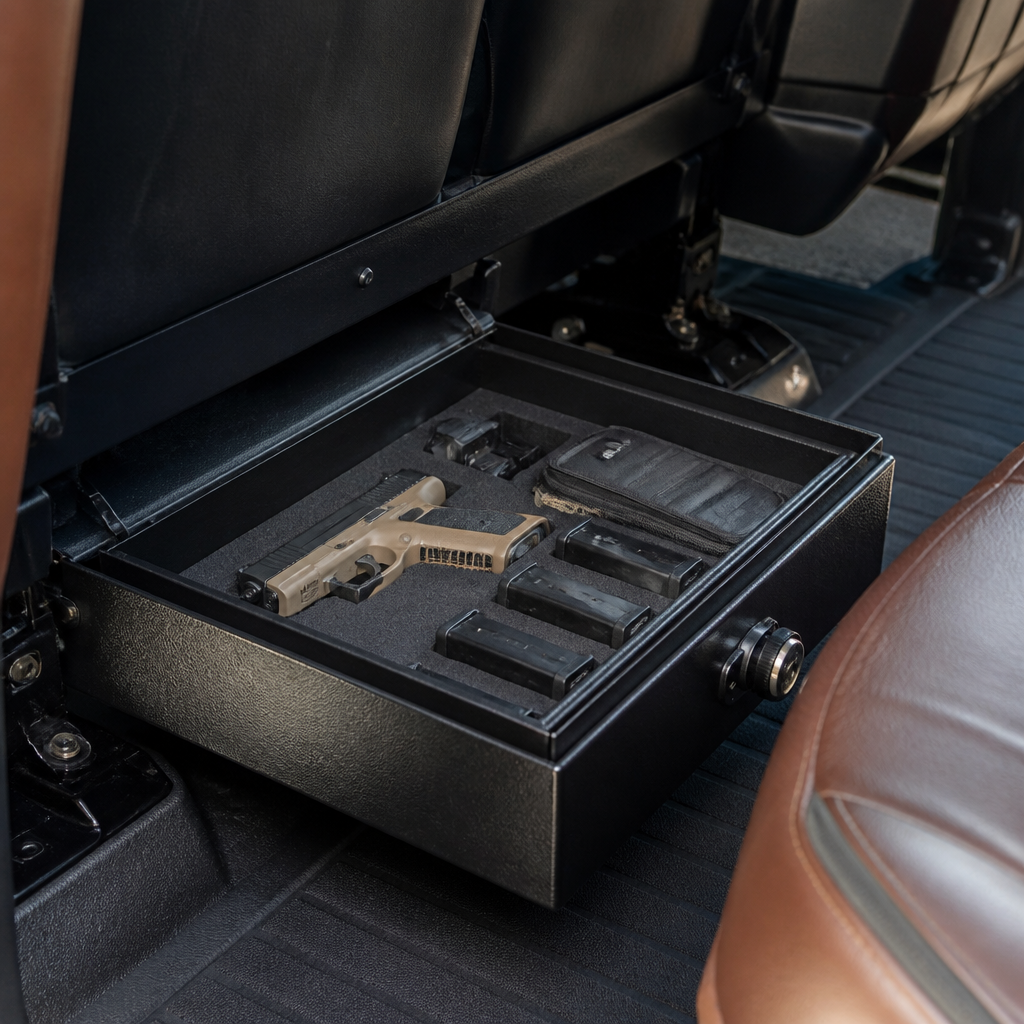
The TruckVault Command Center is a vehicle safe designed for tactical firearms storage, organized deployment, and controlled access inside trucks, SUVs, and fleet vehicles. In practical terms, it combines a lockable drawer vault, a configurable equipment management surface, and a vehicle-specific installation system intended to secure rifles, optics, armor, documents, and duty gear during transport. For buyers researching gun safes and safety products, this model sits in a distinct category: it is not a home safe, not a simple lockbox, and not a universal cargo organizer. It is a purpose-built mobile security platform for users who need fast access, discreet storage, and hardened construction while operating from a vehicle.
That distinction matters because tactical firearms storage has different risks than residential storage. A firearm left in a vehicle faces smash-and-grab theft, prying attacks, vibration, weather shifts, and constant movement. In my experience evaluating vehicle storage systems, the biggest mistake buyers make is assuming any metal box with a lock counts as secure storage. It does not. Real vehicle gun security depends on lock strength, drawer design, anchor points, internal organization, concealment, and how well the system integrates with the vehicle’s layout. The TruckVault Command Center earns attention in product reviews because it addresses all of those variables at once.
As a sub-pillar hub within Gun Safes & Safety, this article covers how the Command Center works, who it fits, what features matter most, and how to judge competing vehicle firearm safes. It also serves as a roadmap for deeper product reviews, installation guides, lock comparisons, and articles on long-gun transport, law-enforcement fleet outfitting, and secure overland storage. If you are asking whether this is the right vehicle safe for tactical firearms storage, the short answer is clear: it is one of the strongest premium options for users who prioritize build quality, modular organization, and a factory-integrated look over bargain pricing.
To review it properly, you need a few key terms. A vehicle safe is a lockable storage enclosure mounted inside a vehicle and designed to resist unauthorized access. Tactical firearms storage refers to securing rifles, carbines, shotguns, pistols, magazines, and mission-essential accessories so they remain protected yet accessible. Command center describes a layout that does more than hide gear; it organizes equipment for immediate deployment. Product reviews in this category should examine steel construction, lock options, drawer capacity, fitment, mounting hardware, weather resistance, and daily usability, because those factors determine whether a storage unit performs in the field or becomes dead weight in the cargo area.
What Makes the TruckVault Command Center Different
The Command Center differs from standard vehicle gun safes because it blends storage security with workspace organization. Instead of a bare drawer under a flat platform, the top surface can be configured to hold mission-critical gear in a structured layout. That means a patrol supervisor, security contractor, wildlife officer, or prepared civilian can stage medical kits, ammunition, restraints, breaching tools, and electronics above the secured drawer while storing firearms below. In field use, that top-down organization saves time and reduces the sloppy equipment sprawl common in cargo areas.
TruckVault as a brand is well known for vehicle-specific drawer vault systems used by law enforcement, federal agencies, hunters, and commercial fleets. The company’s products are commonly associated with heavy-duty drawer bodies, carpeted exteriors that blend with OEM interiors, and fitments tailored to specific makes and models. The Command Center builds on that formula with an operational layout aimed at users who run gear from the vehicle itself. That matters in product reviews because a safe can be technically secure and still fail the user if access is awkward, interior dimensions waste space, or external organization encourages clutter.
Another point of separation is concealment. A tactical firearm safe in a vehicle should not advertise itself. The best systems disappear into the cargo area and resemble factory storage. TruckVault products have long benefited from that low-profile approach. From outside the vehicle, an installed unit generally looks like a trimmed cargo deck rather than a conspicuous weapons case. Concealment is not a substitute for security, but it is a real theft deterrent because most vehicle break-ins are fast, opportunistic crimes. If a thief does not immediately see a firearm container, the odds of a prolonged attack often decrease.
Core Construction, Materials, and Security Design
When reviewing any vehicle safe for tactical firearms storage, start with the physical shell and drawer mechanics. The Command Center is built around a reinforced drawer-vault structure rather than a thin sheet-metal lid box. In practice, that means the attack surface is reduced, pry points are better controlled, and the unit gains rigidity under load. TruckVault systems are known for substantial materials, fitted installation, and locking drawers engineered to hold weight without excessive flex. For users transporting patrol rifles with mounted optics, plate carriers, and ammunition, structural rigidity matters because constant road vibration will expose weaknesses quickly.
Lock options are central to security and convenience. Depending on the configuration, buyers may find keyed locks, electronic locks, or upgraded locking systems offered within the broader TruckVault lineup. The right choice depends on operational needs. A keyed lock is mechanically simple and can be dependable in harsh environments, but key control becomes a serious issue in multi-user fleets. Electronic access can improve speed and accountability, especially where supervisors need managed access, though it introduces battery and component considerations. A good product review does not treat one lock style as universally best; it measures lock type against use case, climate, staffing, and response time.
Mounting is another security layer many buyers underestimate. A safe is only as secure as its attachment to the vehicle. Properly installed vehicle-specific systems distribute load and resist easy removal. Universal cargo safes often fail here because they rely on limited anchor points or awkward brackets that compromise both strength and space. The Command Center’s fitment-driven design is one reason it is taken seriously in professional circles. A well-fitted vault that uses the vehicle footprint efficiently is harder to attack, harder to remove, and easier to live with every day.
How the Command Center Performs for Tactical Firearms Storage
For tactical firearms storage, the Command Center’s value is not just that it locks; it supports organized readiness. Long guns are difficult to secure in vehicles because they are shaped irregularly, often carry lights and optics, and cannot be tossed loosely into a metal compartment without risking damage. A serious vehicle safe must account for length, height, accessory clearance, and movement during travel. TruckVault’s approach generally supports customizable interiors and practical cargo management, which makes more sense than a generic steel cavity when storing AR-platform rifles, precision carbines, or duty shotguns.
In real use, organized storage protects both the firearm and the mission. A rifle with a zeroed optic should not be bouncing against a medical bag, tire tools, and loose magazines. Separating firearms from support gear also improves accountability. Agencies and disciplined private users alike benefit when every item has a designated place. During reviews, I look closely at whether a system supports repeatable organization, because that is what turns storage into a command center rather than a trunk full of expensive equipment. The best setups reduce retrieval time, minimize gear damage, and make pre-shift inspections easier.
There is also a safety dimension beyond theft prevention. Vehicle firearm storage should limit unnecessary handling. If a user can secure weapons unloaded or in assigned configurations, then retrieve them without digging through unrelated cargo, the chances of unsafe manipulation drop. That is especially important in low light, bad weather, or high-stress roadside conditions. A professionally configured vault contributes to safer handling simply by controlling where firearms and accessories are stored.
| Evaluation Area | What to Check | Why It Matters |
|---|---|---|
| Drawer dimensions | Interior length, depth, and optic clearance | Determines whether rifles fit without removing accessories |
| Lock system | Keyed or electronic access, redundancy, reliability | Affects response speed, key control, and maintenance |
| Vehicle fitment | Model-specific installation and anchor method | Improves security, space efficiency, and appearance |
| Topside layout | Command surface, dividers, and equipment staging | Supports organized deployment from the vehicle |
| Concealment | Low-profile finish and integrated look | Reduces visual cues during opportunistic theft |
Who Should Buy It and Who Should Skip It
The ideal buyer is someone who treats the vehicle as an operational platform, not just transportation. Law enforcement personnel, wildlife and game officers, executive protection teams, ranch managers, emergency responders, firearms instructors, and overland users with high-value equipment are strong candidates. These users benefit from secure storage, repeatable organization, and a professional installation that preserves cargo usability. For them, the premium cost can be justified because failure has real consequences: stolen weapons, damaged optics, delayed response, or poor equipment accountability.
Prepared civilians can also be good candidates, particularly those who travel frequently with rifles for training, hunting, competitions, or remote property work. If a buyer routinely leaves a vehicle unattended with expensive gear inside, moving from a soft case or portable lockbox to a fitted drawer vault is a meaningful upgrade. The Command Center is especially compelling for people who want discretion. A hard rifle case in the cargo area signals value. A low-profile integrated vault does not.
Not every buyer needs this system. If your primary need is simple handgun storage during short stops, a console safe or compact cable-secured lockbox may be more appropriate and far less expensive. If you rarely transport firearms or you change vehicles often, a permanent fitted system may be hard to justify. Product reviews should be honest here: the Command Center is a premium, application-specific solution. Its strengths are real, but they only pay off when your use case matches the design.
How It Compares With Other Vehicle Firearm Safe Options
Compared with universal metal lockboxes, the Command Center offers better space efficiency, cleaner installation, and stronger integration with the vehicle. Universal boxes are attractive because they cost less and can move between vehicles, but they often waste cargo space, shift under load, and create visible clutter. They also tend to offer limited firearm organization. A dedicated drawer vault usually costs more up front, yet it works better over the long term because it becomes part of the vehicle rather than an awkward accessory.
Compared with vertical rifle racks or exposed locking mounts used in some fleet applications, the Command Center prioritizes concealment. Vertical mounts can provide very fast access, but they make firearms visible and can create policy, privacy, and theft concerns. For agencies in plainclothes environments or civilians who value discretion, concealed drawer storage is usually the smarter balance. The tradeoff is access speed: opening a drawer and retrieving a cased or staged rifle is slower than grabbing one from an exposed rack. That tradeoff should be evaluated honestly based on mission profile.
Against other premium drawer-vault brands, the Command Center’s appeal comes from its polished fitment, configurable topside utility, and reputation in professional vehicle outfitting. Buyers comparing options should look beyond marketing phrases and confirm vehicle compatibility, lead times, lock options, service support, and payload impact. The best product review questions are simple: Does it fit the firearms you actually carry? Will it stay secure in your exact vehicle? Can you access gear efficiently under stress? If those answers are yes, premium pricing becomes easier to defend.
Buying Considerations, Installation, and Review Criteria for This Hub
As the hub for product reviews in this subtopic, this page should guide readers toward the criteria that matter across all vehicle firearm safes. First, match the safe to the firearm loadout you truly transport, not the one shown in catalog photos. Measure rifle length with muzzle device installed, optic height, and the footprint of support gear. Second, verify vehicle-specific compatibility. A safe that fits a short-bed truck or full-size SUV may not suit a midsize platform. Third, assess installation quality. Professional installation often makes the difference between a vault that feels factory-integrated and one that rattles, binds, or compromises access.
Also consider environmental and operational realities. Vehicles experience heat cycles, dust, humidity, and vibration that home safes never face. Review lock reliability, drawer glide quality, and finish durability accordingly. Think about daily workflow: where will armor, ammunition, med kits, and electronics sit? How often will multiple users access the unit? Is discreet access more important than instant access? These practical questions usually matter more than headline claims about toughness.
For readers exploring the broader Gun Safes & Safety category, the TruckVault Command Center is a benchmark product review because it illustrates how mobile firearms security should be judged: by construction, concealment, organization, and fit for mission. From here, the most useful next steps are comparing lock types, reviewing model-specific installations, and evaluating alternatives for handguns, long guns, and mixed-duty gear. Start with your vehicle, your firearm dimensions, and your access needs, then shortlist systems built for that reality. If secure mobile storage matters to your work or travel, the Command Center is a strong place to begin your research.
Frequently Asked Questions
What is the TruckVault Command Center, and how is it different from a traditional gun safe?
The TruckVault Command Center is a purpose-built vehicle safe designed specifically for tactical firearms storage, organized gear management, and controlled access inside trucks, SUVs, and fleet vehicles. Unlike a traditional residential gun safe that is meant to stay in one place, this system is engineered for transport, daily deployment, and in-vehicle use. It combines three core functions: a lockable drawer vault for secure storage, a configurable top-side equipment management surface for staging and organizing mission-critical gear, and a vehicle-specific installation platform designed to integrate with the cargo area of the vehicle.
That difference matters because firearms and duty equipment stored in a vehicle face a very different set of demands than firearms stored at home. In a mobile environment, owners need protection against unauthorized access, shifting loads, rough travel, limited cargo space, and the need to retrieve equipment quickly when the situation requires it. The Command Center is built around those realities. It is not simply a metal box bolted into the back of a truck; it is a system intended to secure rifles, optics, body armor, documents, and support equipment while keeping them organized and accessible.
For law enforcement, private security, emergency response, and civilian owners who transport tactical gear, the Command Center fills a niche that standard gun safes do not. It is especially useful when buyers need a solution that supports both security and readiness. In short, a traditional safe prioritizes stationary long-term storage, while the TruckVault Command Center prioritizes secure mobile storage and efficient deployment inside the vehicle.
What types of firearms and equipment can the TruckVault Command Center store?
The TruckVault Command Center is designed to support much more than just a single firearm. Depending on the specific configuration, vehicle platform, and interior layout, it can be used to store tactical rifles, carbines, optics, magazines, ammunition, suppressor-related accessories where legally applicable, armor carriers, helmets, breaching tools, medical kits, radios, laptops, hard-copy documents, and other duty gear that needs to remain secure during transport. Its value comes from combining firearm security with broader equipment organization.
One of the key advantages of this kind of system is that storage is not limited to a generic open compartment. The layout is intended to support structured gear placement, which can help prevent damage to sensitive equipment such as optics, lights, lasers, and communications gear. This is especially important for users who need to maintain equipment condition and accountability over time. Instead of allowing rifles, plate carriers, and accessories to move around loosely in the cargo area, the system helps keep those items in designated positions for safer transport and faster retrieval.
For agencies and professionals, that level of organization can improve operational consistency because the same critical gear can be staged the same way from vehicle to vehicle. For civilian owners, it can make a major difference in keeping valuable equipment protected and reducing clutter in the rear of a truck or SUV. Buyers should still confirm fitment and internal capacity based on their specific loadout, especially if they are transporting longer rifles, specialized attachments, or large amounts of supporting gear, but overall the Command Center is built for comprehensive tactical storage rather than simple firearm containment alone.
How secure is the TruckVault Command Center for storing tactical firearms in a vehicle?
The TruckVault Command Center is designed to provide a meaningful layer of security for firearms and related gear stored in a vehicle, particularly when compared with leaving equipment exposed in the cabin, unsecured in the cargo area, or stored in lightweight cases. Its security approach centers on controlled access through a lockable drawer vault combined with a fixed installation system that is integrated into the vehicle. This helps reduce the risk of quick unauthorized removal, casual theft, and immediate access by unapproved users.
That said, vehicle safes should always be evaluated in the right context. No mobile storage solution should be viewed exactly the same way as a full-size, high-mass residential safe installed in a hardened structure. A vehicle is inherently a more exposed environment, so the goal is to significantly improve security, delay unauthorized entry, conceal valuable contents, and maintain accountability during transport. In that role, the Command Center stands out because it is built specifically for in-vehicle security rather than adapted from a general-purpose storage box.
Its real-world strength is in combining secure containment with discreet integration and organized storage. A properly installed Command Center can help keep firearms out of sight, restrict casual access, and create a more controlled chain of custody for tactical gear. This is especially important for users who may carry rifles, optics, or sensitive duty equipment between locations throughout the day. As with any vehicle firearm storage solution, best practices still apply: lock the vehicle, park in secure areas when possible, follow all applicable firearm transport laws, and avoid leaving firearms in any vehicle longer than necessary. Used appropriately, the Command Center offers a strong practical security upgrade for mobile firearms storage.
Is the TruckVault Command Center a good choice for law enforcement, fleet vehicles, and professional duty use?
Yes, the TruckVault Command Center is particularly well suited for law enforcement, agency fleets, private security teams, and other professional users who need secure, repeatable, and organized vehicle-based equipment storage. Its design aligns with the realities of duty use: firearms and critical gear must remain secured during transport, equipment must be organized in a way that supports rapid deployment, and the storage system must fit the operational layout of trucks and SUVs that are used daily in the field.
For professional environments, consistency matters almost as much as security. A system that allows gear to be staged in a predictable way can help reduce confusion, protect equipment from damage, and support better readiness at the point of deployment. The Command Center’s integrated work surface and secure drawer concept make it attractive for users who need more than hidden storage. It can function as part of a broader mobile equipment management setup, allowing officers or operators to store rifles, armor, electronics, documents, and support tools in a more deliberate and controlled manner.
It can also be a strong fit for fleet applications because vehicle-specific installation is often a major concern for agencies and organizations. Rather than relying on improvised mounting solutions, a system designed around vehicle fitment is generally better for long-term durability, safer cargo-area integration, and cleaner use of available space. For departments or companies researching gun safes and safety products, the Command Center belongs in a different category from ordinary lockboxes because it is engineered for operational workflow as well as security. Buyers considering professional deployment should still review vehicle compatibility, locking options, loadout needs, and internal policy requirements, but overall it is a serious solution for duty-oriented mobile firearms storage.
What should buyers consider before choosing the TruckVault Command Center for a truck or SUV?
Before choosing the TruckVault Command Center, buyers should think carefully about how they actually use their vehicle, what firearms and gear they need to transport, and how important access speed, organization, and cargo-area efficiency are to their day-to-day routine. This is not a one-size-fits-all safe. It is a specialized vehicle storage platform, so the best purchase decision comes from matching the system to the mission. Vehicle make and model compatibility is one of the first factors to confirm, since fitment affects installation quality, usable storage space, and how well the system integrates with the interior.
Buyers should also evaluate their loadout in practical terms. Consider the number and size of rifles, whether optics or other accessories remain mounted, what non-firearm gear must be secured, and whether the setup needs to support documents, electronics, body armor, or medical equipment in addition to weapons. Access requirements are equally important. Some users prioritize maximum concealment and secure transport, while others need a layout that supports fast, orderly deployment during field operations. The Command Center is most valuable when those needs overlap.
Another important consideration is the difference between simple theft deterrence and full equipment management. Some buyers may only need a compact lockbox for occasional firearm transport, but others need a more complete solution that turns the rear of a truck or SUV into a secure, organized mobile staging area. That is where the Command Center makes the strongest case for itself. It is best suited to owners who want a professional-grade vehicle safe that supports tactical firearms storage, gear accountability, and a cleaner, more controlled transport setup. As always, buyers should verify applicable firearm laws, agency rules, and manufacturer specifications before purchase, but for the right user, this system offers a highly practical blend of security, organization, and vehicle integration.