
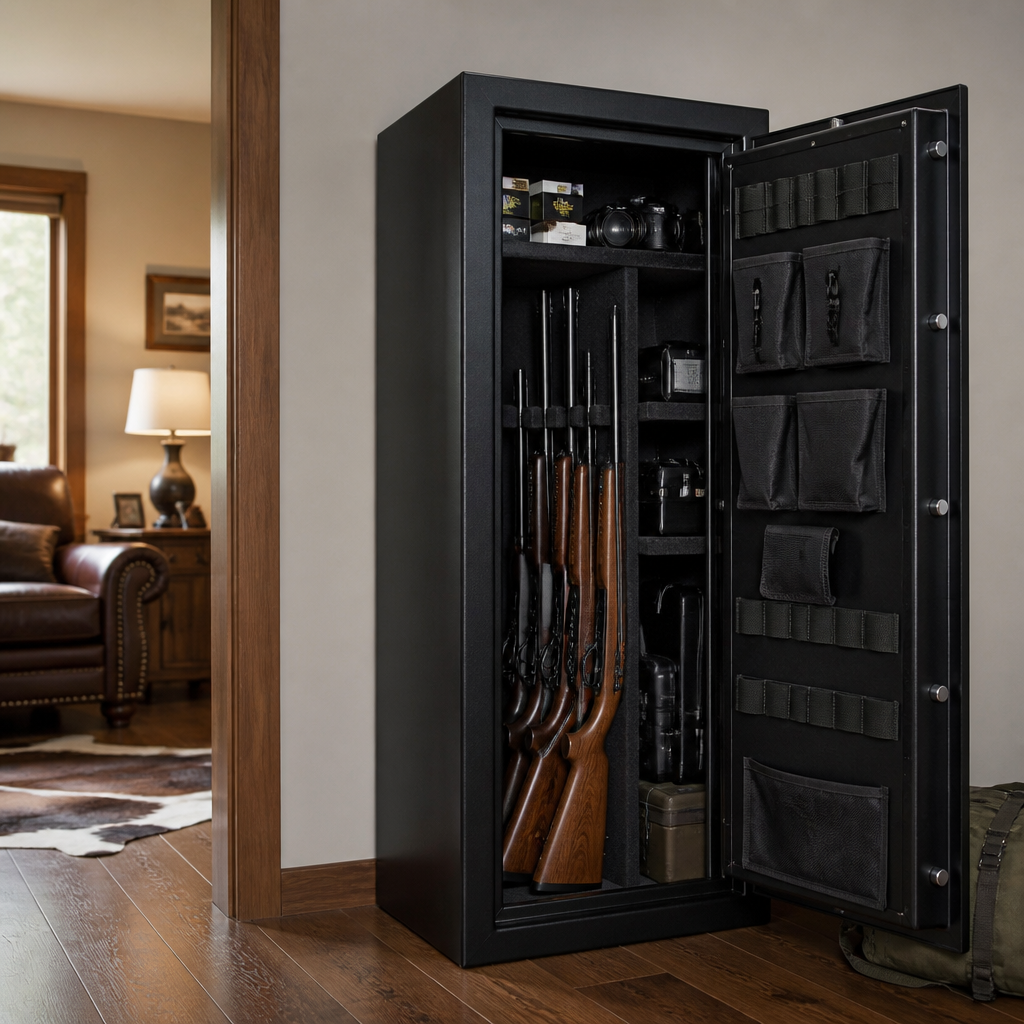
The Winchester Bandit 31 sits in a part of the gun safe market that many buyers care about most: large enough for a growing collection, affordable enough for a real household budget, and simple enough to evaluate without decoding marketing language. In practical terms, this safe is positioned as a budget-friendly large capacity safe for owners who want organized long-gun storage, basic fire protection, and a recognized brand name without paying premium vault prices. I have worked through enough safe comparisons, showroom inspections, and installation planning sessions to know that this middle tier is where expectations need the most careful management. Capacity claims, steel thickness, lock choices, and interior flexibility all matter more than the badge on the door.
Before reviewing the Winchester Bandit 31 specifically, it helps to define a few terms. Large capacity safe usually refers to a long-gun model advertised to hold roughly 24 to 36 firearms, though actual usable capacity is almost always lower once optics, slings, bipods, and modern chassis rifles enter the equation. Budget-friendly does not mean cheap in the disposable sense. In the gun safe category, it means prioritizing practical security and storage over luxury fit, heavier plate steel, and custom interiors. Product review, in the context of gun safes and safety, should also mean more than listing features. A useful review explains how a safe performs in a real home, what compromises the buyer is accepting, and which kinds of owners will benefit most.
This matters because the wrong safe creates problems immediately. A safe that is too small becomes cluttered within months. A safe with weak interior layout wastes space and increases the chance of scuffed stocks, tangled slings, and awkward access in low light. A model that appears strong on paper but uses thin steel, minimal locking coverage, or poor anchoring strategy can give owners a false sense of security. At the same time, overspending on features that do not match your risk profile is unnecessary. The Winchester Bandit 31 deserves attention because it aims directly at that balancing point. For many households, it offers enough storage and baseline protection to serve as the first serious safe or the secondary overflow safe in a larger security plan.
What the Winchester Bandit 31 is designed to do
The core purpose of the Winchester Bandit 31 is straightforward: provide entry-level to mid-entry secure storage for a moderately sized firearm collection, along with ammunition, documents, and selected valuables. The model name signals the headline capacity, but buyers should read that number as a layout maximum under ideal conditions, not a guaranteed real-world count. In my experience, a nominal 31-gun safe often becomes a 16- to 22-gun safe when the collection includes scoped hunting rifles, AR-platform rifles with pistol grips, shotguns with side saddles, and soft cases or accessory bins on shelves. That adjustment is normal across the category, not unique to Winchester.
As a hub review under product reviews, the most useful way to frame this safe is by function. It is meant for owners graduating from a locking cabinet, from closet storage, or from an undersized safe purchased years earlier. It is also a sensible option for people who want to separate home-defense firearms from collector pieces by adding a second safe. Winchester has long recognition in sporting goods retail, and the Bandit line targets buyers who shop at farm stores, outdoor chains, and regional dealers where value, immediate availability, and familiar operation matter. That retail context is important because safes are often purchased after a trigger event: a move into a new home, the first child in the house, an insurance requirement, or a collection that has simply outgrown unsecured storage.
The Bandit 31 is not designed to compete with premium American-made vaults using thicker bodies, heavier doors, higher fire ratings, and more advanced bolt systems. It competes with other mass-market long-gun safes from brands such as Cannon, Liberty’s lower-priced lines, Sports Afield, Stack-On’s upgraded models, and Big Horn. In that field, the value question is not whether it is the strongest safe available. The better question is whether the Winchester Bandit 31 delivers acceptable security, usable organization, and practical ownership cost for the money. For many buyers, that is exactly the right question to ask.
Security construction, lock options, and realistic protection
When shoppers ask whether the Winchester Bandit 31 is a good safe, they usually mean one thing: how secure is it really? The honest answer is that it offers meaningful deterrence and access control, but it remains a residential gun safe rather than a commercial high-security container. That distinction matters. Most safes in this class rely on formed steel bodies, multiple live locking bolts, concealed or semi-concealed hinges, and a relocking feature tied to the lock system. Those elements can stop casual intrusion, child access, smash-and-grab theft, and opportunistic tampering. They are not engineered to withstand prolonged attack with power tools the way heavier, higher-cost safes can.
Lock choice affects daily ownership more than many first-time buyers expect. Depending on trim and retailer, the Bandit 31 may be offered with an electronic lock or a mechanical dial. Electronic locks are faster, easier for frequent access, and generally preferred by owners who open the safe often. Mechanical dials are slower but have a long service record and avoid battery dependency. After seeing lock complaints across many brands, my advice is consistent: choose the lock type that matches your habits, replace batteries proactively if electronic, and learn the manufacturer’s override and service procedures before you need them. Lock quality is not only about resisting attack; it is about reliability on an ordinary Tuesday morning.
Anchoring is the non-negotiable step that turns a safe like this from useful to credible. A budget-friendly large capacity safe can often be tipped, pried, or removed if it is left unsecured on a garage slab or closet floor. Bolting it to concrete, or to an approved structural surface following manufacturer guidance, closes off the easiest attack path. If the Bandit 31 is installed in a corner, with limited pry access on the sides and top, practical security improves immediately. That is a real-world truth often missed in spec-sheet comparisons. Placement and anchoring can matter as much as one small difference in steel gauge.
Storage capacity, interior layout, and day-to-day usability
Capacity is where the Winchester Bandit 31 can either satisfy buyers for years or disappoint them within a season, depending on expectations. The width and interior volume typically support the broad use case of mixed long guns plus shelf storage, but every safe rated around 31 guns suffers from the same math problem. Firearms are no longer slim, iron-sighted wood-stock rifles lined up shoulder to shoulder. They wear scopes with tall turrets, red dots on risers, oversized bolt handles, weapon lights, and magazine-fed stocks that eat space. If you own modern sporting rifles, the practical count drops fast.
The good news is that a safe in this category usually works best when treated as a storage system, not a strict gun rack. Adjustable shelving lets owners reserve one side for documents, handguns, optics boxes, suppressor accessories where legal, cleaning gear, and emergency items. That flexibility is one reason the Bandit 31 is attractive as a sub-pillar product review topic. It does not just store firearms; it becomes the central cabinet for household security equipment. I have seen owners use door organizers for pistols and passports, upper shelves for hard drives and wills, and lower corners for dehumidifiers and medical kits. Thoughtful arrangement creates far more value than chasing the highest advertised gun count.
| Feature area | What buyers expect | Real-world outcome |
|---|---|---|
| 31-gun capacity | Space for 31 modern long guns | Usually fewer once scopes, slings, and AR-style rifles are included |
| Adjustable shelving | Easy customization | Useful for mixing firearms, documents, ammo, and accessories |
| Door storage | Extra room without reducing rack space | Excellent for handguns, papers, and small gear if included |
| Wide access | Fast retrieval | Better than compact safes, especially for taller scoped rifles |
| Large footprint | One-time storage solution | Works well if measured carefully before delivery and anchoring |
Usability also depends on dimensions, door swing, and interior lighting. A safe can look spacious in a showroom and feel cramped in a dim closet. If the Bandit 31 will live in a bedroom, office, or conditioned basement, add battery or motion-activated lighting early. It is one of the cheapest upgrades with the highest daily benefit. Plan for clearance in front of the door, not just the footprint on the floor. I have watched more than one buyer realize too late that a nearby wall, bed frame, or shelving unit prevented comfortable access to the lower rack. Large capacity is only valuable when the opening angle and interior visibility support it.
Fire protection, installation, and value compared with competitors
Fire protection in the budget-safe category requires especially careful reading. Manufacturers commonly publish a fire rating measured in minutes at a stated external temperature, but shoppers should understand what that number does and does not mean. It usually reflects a controlled test protocol chosen by the brand or testing partner, not a universal guarantee that contents will survive a house fire unchanged. The Winchester Bandit 31 generally appeals to buyers seeking baseline document and firearm protection during limited-duration residential fires, not archival-grade preservation. Heat, humidity, smoke infiltration, and steam can all damage contents even when the safe shell remains intact.
That limitation does not make the feature meaningless. It simply means fire rating should be weighed alongside home conditions and insurance planning. If the safe is installed on a ground floor over a basement fire risk, near flammable storage in a garage, or in a wildfire-prone region, placement strategy matters. Avoid locating any gun safe where surrounding fuel load is high if a better interior room exists. Use desiccants or an electric dehumidifier rod, because insulated safes can trap moisture. I recommend owners store critical paper documents in sealed pouches or dedicated document containers inside the safe rather than assuming the safe interior alone solves every hazard.
Installation is where value is won or lost. Delivery charges, stair carries, and professional anchoring can change the true purchase price significantly. A budget-friendly large capacity safe that costs less upfront but requires difficult handling through narrow hallways may not be the bargain it first appears to be. Measure doors, turns, floor load considerations, and final placement before ordering. In some homes, a 31-gun class safe is best placed in a first-floor closet on a slab-adjacent area; in others, a basement with low visibility and controlled humidity is better. Professional installers do more than move weight. They reduce injury risk, floor damage, and poor anchoring mistakes.
Against competitors, the Winchester Bandit 31 makes the strongest case for buyers who prioritize interior volume and recognizable branding over top-tier steel or premium fit and finish. A Liberty entry model may offer stronger dealer support in some regions. A Cannon or Sports Afield model may match features closely at promotional pricing. Some warehouse-club safes undercut the Bandit on sticker price, but often with less refined interiors or less consistent availability of service parts. Winchester’s advantage is familiarity and broad appeal. If the sale price is strong and the feature set includes the lock type and shelving layout you want, it is often a sensible purchase. If your threat model includes targeted theft, long unoccupied periods, or irreplaceable heirlooms, stepping up to heavier construction is the wiser move.
Who should buy the Winchester Bandit 31 and who should look elsewhere
The Winchester Bandit 31 is best for the practical firearm owner who wants one safe to solve several problems at once: child access prevention, organized long-gun storage, moderate fire protection, and room for a collection that is still growing. It is a particularly good fit for hunters, recreational shooters, and households upgrading from a cabinet or small 12- to 18-gun unit. It also works well as a second safe for enthusiasts who already own a heavier main safe and need overflow capacity for less sensitive items. Buyers who value straightforward ownership more than prestige will likely appreciate it most.
It is not the ideal choice for everyone. Collectors with high-value custom rifles, owners in high-theft environments, and anyone storing a large number of optics-equipped tactical rifles should consider moving up in security class or at least up in size. If you think you need a 31-gun safe today, you may need a 40-gun safe in two years. That is one of the oldest lessons in gun safe buying, and it remains true. Buy for future volume when possible. Still, within its lane, the Winchester Bandit 31 delivers the main benefit many buyers need: practical, affordable consolidation of firearms and valuables into one controlled, lockable space. Compare sale pricing, confirm the exact lock and interior configuration, measure your installation path, and choose the largest secure model your space and budget can reasonably support.
Frequently Asked Questions
Is the Winchester Bandit 31 a good choice for buyers who want a large safe without spending premium-level money?
Yes, that is exactly where the Winchester Bandit 31 makes the most sense. It is aimed at buyers who need meaningful storage capacity for a growing firearm collection but do not want to jump into the much higher price brackets associated with heavier, more feature-rich safes. In practical terms, this safe appeals to homeowners who want enough room for multiple long guns, shelf space for accessories, and the reassurance of a recognized brand name, all while staying within a more realistic household budget.
What makes it attractive is not that it competes head-to-head with premium vaults, but that it delivers the core features many people actually use. Most buyers in this category are looking for organized firearm storage, basic theft deterrence, and a level of fire protection that is better than a cabinet or unsecured closet. The Bandit 31 is designed to cover those essentials without burying the buyer in luxury upgrades that dramatically increase cost. If your goal is practical value rather than top-tier commercial-grade protection, it can be a very sensible option.
That said, buyers should keep expectations grounded. A budget-friendly large capacity safe is still a compromise product by definition. You are typically trading away some steel thickness, some internal refinement, and some of the advanced security enhancements found on more expensive models. For many households, that tradeoff is perfectly acceptable. If you want solid basic protection, cleaner organization, and room to grow, the Bandit 31 is often the kind of purchase that feels balanced rather than excessive.
How much can the Winchester Bandit 31 realistically hold, and is the stated gun capacity accurate?
Like most gun safes, the listed capacity should be treated as a best-case estimate rather than a guarantee of real-world storage. The “31” in the Bandit 31 suggests a maximum long-gun count under ideal conditions, usually assuming slim rifles or shotguns placed closely together, often without optics, oversized stocks, slings, bipods, or other attachments. In real use, most owners find that true capacity is lower once they begin storing modern sporting rifles, scoped hunting rifles, pistol cases, ammunition, documents, and other gear inside the safe.
A more practical way to think about the interior is that it should comfortably handle a moderate-to-large long-gun collection for the average owner, especially if the collection includes a mix of firearms and not every slot is occupied by a large scoped rifle. Buyers who value organization will often get better results by using some of the interior volume for accessories rather than trying to force the safe to meet the full advertised long-gun number. That usually leads to easier access, less crowding, and less chance of firearms knocking into one another.
If you are shopping because your collection is actively growing, the Bandit 31 offers useful breathing room compared with smaller safes in the same budget class. It is best suited for someone who wants meaningful capacity today and some flexibility for tomorrow, but who also understands that manufacturer ratings are usually optimistic. In short, expect usable large-capacity storage, but not literal full-capacity performance once optics and accessory storage enter the picture.
What level of security and fire protection should buyers expect from the Winchester Bandit 31?
Buyers should view the Winchester Bandit 31 as a residential gun safe built to provide basic-to-moderate protection rather than extreme-duty vault performance. From a security standpoint, it is intended to deter opportunistic theft, prevent unauthorized household access, and create a substantial barrier compared with unsecured storage. That alone is a major upgrade over closets, cabinets, or furniture-based storage. For many homeowners, the most important benefit is keeping firearms locked, organized, and inaccessible to children, guests, or casual intruders.
In terms of burglary resistance, it helps to remember that entry-level and mid-budget safes are designed around delay and deterrence. They are not impenetrable, and they are not built to perform like ultra-heavy plate-steel safes that cost several times more. Their effectiveness improves significantly when they are installed properly, especially when bolted down in a discreet location. A safe that is anchored, positioned in a corner, and placed where access to pry points is limited will generally perform better in a real burglary attempt than the exact same safe left freestanding in an open garage.
Fire protection in this category should also be understood in practical rather than exaggerated terms. The Bandit 31 is intended to provide a meaningful measure of fire resistance for household scenarios, helping shield contents from heat and smoke for a rated period under test conditions. That can be valuable for firearms, important papers, and some personal items, but no fire rating should be interpreted as a promise of total survival under every real-world fire event. Fire intensity, placement in the home, duration, structural collapse, and water exposure all affect outcomes. The safest mindset is to treat the fire protection as an important layer of defense, not absolute immunity.
Who is the Winchester Bandit 31 best suited for, and who should consider stepping up to a higher-end safe?
The Winchester Bandit 31 is best suited for budget-conscious gun owners who want a recognizable brand, a larger footprint than entry-level compact safes, and enough interior room to support a growing collection. It is a strong fit for first-time safe buyers, families wanting more secure firearm storage, and owners who have outgrown smaller cabinets or undersized safes. It also works well for buyers who prioritize straightforward value and do not want to overpay for premium cosmetic details or specialized features they may never fully use.
It is especially appealing if your needs are centered on common residential use: storing long guns, keeping handguns and accessories organized, adding a layer of fire protection, and meeting the basic security expectations most households have. For many people, that covers the most important buying criteria. The Bandit 31 occupies the practical middle ground where size, price, and usability intersect in a way that feels manageable rather than aspirational.
On the other hand, some buyers should probably move upmarket. If you own very high-value firearms, rare collectibles, or a particularly large number of optics-equipped rifles, you may want thicker steel, more advanced locking systems, stronger anti-pry construction, and a more adaptable interior. The same is true if you live in a higher-risk area, want stronger burglary resistance, or simply prefer to buy once and grow into a heavier-duty safe over the long term. In those cases, the Bandit 31 may still look appealing on paper, but a premium model could be the smarter investment.
What should buyers look at besides price before deciding on the Winchester Bandit 31?
Price matters, but it should never be the only factor. Before buying the Winchester Bandit 31, it is worth evaluating how the safe will actually function in your home. Start with exterior dimensions and placement. Make sure it fits not just in the intended room, but also through doorways, hallways, stair turns, and flooring transitions during delivery. Large-capacity safes can be more complicated to install than buyers expect, and the convenience of ownership improves significantly when placement is planned in advance.
You should also think carefully about interior layout. Capacity claims are useful as a rough guide, but storage flexibility matters more. Consider whether the shelving arrangement supports the way you store firearms and gear, whether scoped rifles will fit without crowding, and whether there is enough room left for documents, magazines, ammunition, and accessories. A safe that looks spacious in a product listing may feel much smaller once your real equipment is inside.
Lock type, ease of access, and long-term usability are also important. Buyers should consider whether they prefer the feel and operation of the lock system offered, how often they expect to open the safe, and whether quick routine access matters more than simplicity. Beyond that, look at warranty support, delivery options, bolt-down capability, and where the safe will be installed relative to humidity, temperature swings, and visibility in the home. When evaluated as a whole package instead of just a low price point, the Bandit 31 tends to stand out most for buyers who want practical storage and dependable everyday value rather than premium-spec bragging rights.