
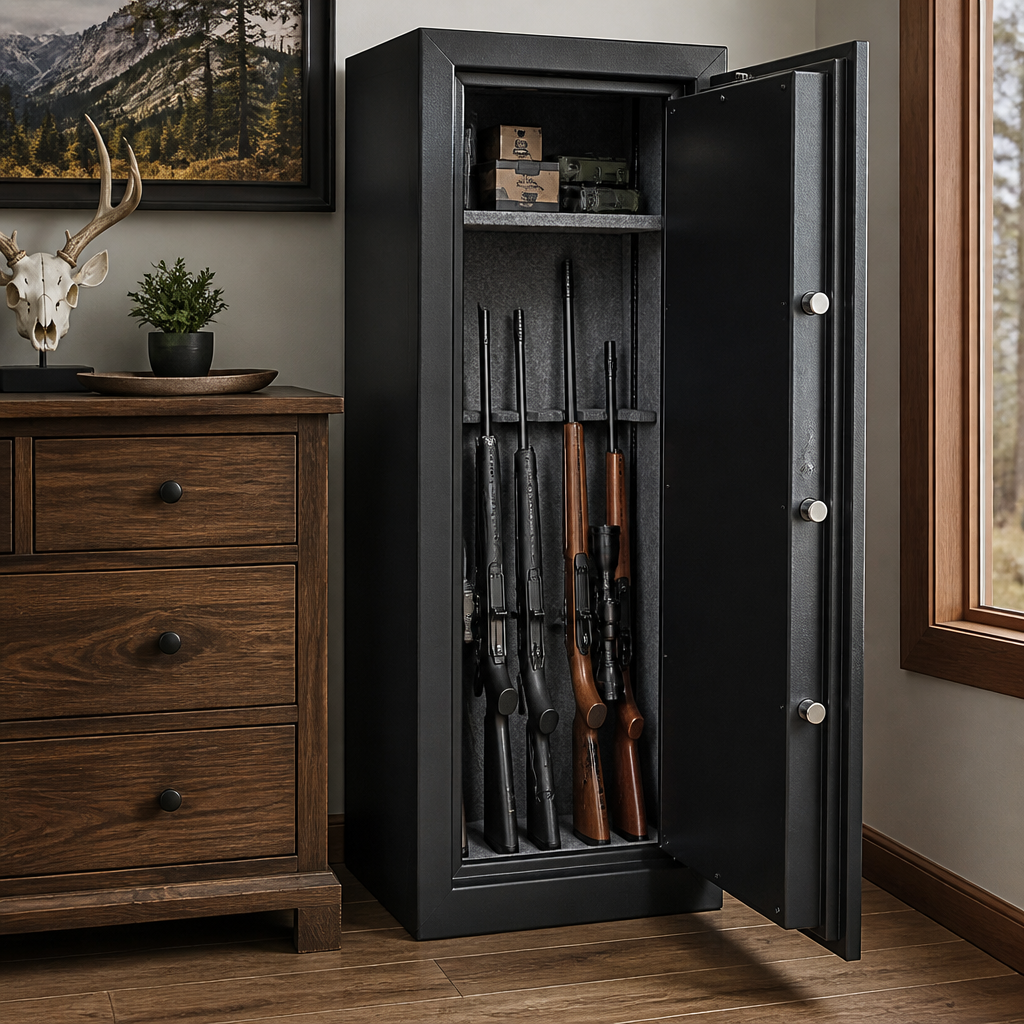
The Liberty Safe Centurion 24 sits in a part of the market that many first-time buyers struggle to judge: affordable gun safes that promise meaningful theft protection, usable fire resistance, and enough capacity for a practical home collection. In my experience reviewing residential security products, this category is where marketing language often outruns reality. Buyers see large capacity numbers, patriotic branding, and a long feature list, yet still end up with a cabinet that feels too light, too cramped, or too easy to compromise. The Centurion 24 matters because it is positioned as an entry-level gun safe rather than a bare steel locker, and that distinction is important for anyone comparing true safes with simple storage cabinets.
At its core, the Liberty Safe Centurion 24 is designed for secure firearm storage in a household setting. “Entry-level” does not mean disposable or ineffective; it means the product is built to hit a lower price point while preserving the most important safeguards. In practical terms, that usually includes a formed steel body, multiple locking bolts, a fire rating, and a lock system that meets recognized industry expectations. It also means accepting tradeoffs. You should not expect the plate steel thickness, composite construction, or extended fire endurance found in premium safes, but you should expect a clear step up from stack-on style cabinets and unreinforced closets.
This article serves as a hub for gun safe product reviews by using the Centurion 24 as the anchor example for how to evaluate this segment. If you are shopping for your first safe, upgrading from a locking cabinet, or comparing Liberty against Winchester, Cannon, Sports Afield, or SecureIt, the questions are usually the same. How much protection does the safe really provide? How many long guns does it realistically hold? Is the fire rating meaningful? What type of lock should you choose? Does it make sense for apartments, garages, or families with children? Those are the questions that matter more than brochure copy, and they are the questions this review answers directly.
Why does this matter beyond simple storage? Because responsible firearm ownership depends on controlled access, environmental protection, and theft deterrence. The U.S. Department of Justice and firearm safety organizations consistently recommend secure storage to reduce unauthorized access and theft. A reliable gun safe helps keep firearms away from children, limits liability, and buys time against smash-and-grab burglary. It can also protect documents, optics, magazines, and valuables that would otherwise be vulnerable to heat, moisture, or quick removal. For many households, an entry-level gun safe is not a luxury purchase; it is the baseline infrastructure for safe ownership.
What the Liberty Safe Centurion 24 Is Built to Do
The Centurion line is Liberty’s accessible series, built for buyers who want the credibility of a major safe manufacturer without stepping into the cost of heavier mid-tier models such as the Colonial or Franklin. The Centurion 24 generally aims to balance three priorities: burglary deterrence, organized storage, and modest fire protection. In real-world use, that means it is best suited for bedrooms, interior closets, offices, and other locations where a safe can be anchored properly and where a burglar has limited time and privacy to attack it.
Its job is not to defeat professional safecrackers with power tools and unlimited time. No residential safe in this price class should be judged by that standard. Its job is to resist common residential attacks, slow down pry attempts, secure the contents from unauthorized household access, and survive lower-intensity fire events long enough to improve the odds of content protection. That may sound restrained, but it is exactly the right lens. A good entry-level gun safe is a delay device, and delay is what prevents many crimes from succeeding.
Liberty’s brand reputation is part of the value proposition here. In the gun safe market, brand consistency matters because specifications alone rarely tell the whole story. Hinge fit, door alignment, lock installation, relocker integration, interior finish quality, and warranty responsiveness all affect ownership. Liberty has built a strong position in the U.S. market partly because buyers and dealers understand what the company’s lines represent. That does not make every model perfect, but it makes product comparisons easier and support expectations clearer.
Key Specifications Buyers Should Understand First
When buyers look at the Centurion 24, they usually focus on the “24 gun” label first, but capacity figures are the least reliable part of gun safe marketing. Like most manufacturers, Liberty counts space under ideal conditions: slim rifles, few optics, no slings, no bipods, and careful arrangement. In actual use, the Centurion 24 will hold fewer firearms comfortably, especially if you store scoped hunting rifles, AR-pattern rifles, pistol-caliber carbines, or shotguns with side saddles. A realistic capacity for many owners is closer to half to two-thirds of the advertised number if you want quick access and minimal stock-to-stock contact.
Other core specifications matter more. Buyers should pay attention to exterior dimensions, weight, lock type, bolt count, steel thickness, interior configuration, and stated fire rating. Weight in particular is a useful proxy. Heavier safes are not automatically better, but additional mass usually reflects more steel, more insulation, or both. An entry-level safe that can still be moved easily by two people without equipment should always be anchored to concrete or structural flooring. The Centurion 24 falls into the category where bolting down is not optional if theft resistance is a priority.
Lock options typically include a mechanical dial or an electronic keypad, depending on configuration and dealer inventory. Mechanical locks are time-tested and require no battery, while electronic locks offer faster access and simpler daily use. Over years of reviewing safes in occupied homes, I have found that many owners use electronic locks more consistently because they do not delay retrieval or storage. That said, reliability depends on using a quality lock from recognized manufacturers and replacing batteries on schedule. The best choice is the one your household will use correctly every time.
Security Performance in Real Home Conditions
The biggest reason to choose the Liberty Safe Centurion 24 over a basic gun cabinet is the difference in attack resistance. A cabinet mainly keeps honest people honest. A true safe adds a reinforced door, multiple locking bolts, a more robust lockwork system, and a body that requires more time, noise, and effort to breach. In suburban burglary scenarios, that time difference matters. Most residential burglars are opportunistic, working fast and trying to avoid attention. If a safe is anchored, positioned well, and not visible from outside the home, many thieves will move on rather than escalate to a prolonged forced entry attempt.
Placement and installation strongly affect the Centurion 24’s security performance. The safest location is usually a climate-controlled interior corner where two walls limit pry angles and where the door can still open fully. In garages, temperature swings and humidity are higher, and the safe may be more visible during open-door periods. If a garage install is necessary, use a dehumidifier, avoid direct contact with standing moisture, and pay extra attention to anchor quality. I have seen decent safes undermined by poor installation far more often than by weak specifications alone.
Here is a practical framework for evaluating this model against common entry-level alternatives:
| Feature | Centurion 24 Strength | What Buyers Should Watch |
|---|---|---|
| Burglary deterrence | Better door structure and lockwork than a cabinet | Must be bolted down to realize that advantage |
| Capacity | Works for a starter collection plus documents | Advertised gun count is optimistic with optics |
| Fire protection | Meaningful basic rating for entry-level use | Not equivalent to high-end long-duration protection |
| Access | Electronic lock option improves daily usability | Battery maintenance and code discipline still matter |
| Value | Recognized brand with broad dealer support | Price can rise quickly with delivery and setup |
The key takeaway is simple: the Centurion 24 is reliable when used as part of a system. That system includes concealed placement, anchoring, code management, moisture control, and realistic expectations. On its own, no safe solves every security problem. Combined with alarms, reinforced entry points, and discreet ownership habits, it becomes substantially more effective.
Fire Protection, Interior Layout, and Day-to-Day Use
Fire ratings in the gun safe world cause understandable confusion because manufacturers use different test methods, time intervals, and temperature thresholds. The Centurion 24 offers entry-level fire protection intended for common residential incidents, not extreme commercial standards. Buyers should interpret that as a layer of mitigation, not an absolute guarantee. Fire outcome depends on burn duration, room location, collapse risk, water exposure during suppression, and the thermal vulnerability of the items inside. Paper documents, wood stocks, optics, ammunition packaging, and electronics all tolerate heat differently.
Even so, a fire-rated safe is materially better than a non-rated cabinet if your goal is broad household protection. In homes I have evaluated after minor fire events, insulated safes often preserved documents and firearms that would have been severely damaged in unprotected storage. The lesson is not that all ratings are equal; it is that basic passive protection can make a meaningful difference. If fire exposure is a top concern because you live in a wildfire zone or a rural area with longer fire response times, you may want to move beyond entry level. For many urban and suburban owners, the Centurion 24 offers a reasonable baseline.
Interior layout is another area where real use diverges from the catalog image. The Centurion 24 works best when you think of it as flexible storage rather than a strict long-gun box. Shelving can be used for handguns in racks, suppressor accessories where legal, magazines, passports, hard drives, and estate documents. A door organizer, if compatible, can improve efficiency dramatically by moving pistols and paperwork off the main floor. I usually recommend planning your layout before delivery so you know whether you need rifle rods, moisture control, lighting, or added shelves on day one.
Daily use should also be part of the buying decision. If the safe is frustrating to open, too crowded to navigate, or placed in a room where access feels awkward, owners often cut corners. They leave a frequently used handgun elsewhere, skip locking the safe during short trips, or overstack rifles until retrieving one disturbs several others. The Centurion 24 performs best for households that want a straightforward, repeatable storage routine: open, retrieve, return, relock, and verify.
Who Should Buy the Centurion 24 and How It Compares
The ideal buyer for the Liberty Safe Centurion 24 is a first-time safe owner, a household with a modest firearm collection, or anyone moving up from a cabinet and wanting a recognized brand without entering premium pricing. It is particularly well suited to owners with six to twelve long guns, several handguns, and a need to store key documents in one place. It also fits families that prioritize child access prevention and want a product that feels substantial without demanding the space and budget of a much larger safe.
It is less ideal for collectors with many optics-heavy rifles, competitive shooters with extensive gear, or buyers seeking top-tier burglary resistance. Those users typically outgrow the interior faster and may be better served by buying larger and heavier at the outset. The common mistake in this category is buying to your current count rather than your likely three-year count. Most owners underestimate how quickly accessories consume space. Cases, chargers, suppressor paperwork, spare bolts, and ammunition-related gear all compete for room unless you separate storage across systems.
Compared with many big-box competitors, the Centurion 24’s main advantage is balanced credibility. Some rivals may advertise larger capacity or longer fire numbers at similar prices, but construction details, dealer setup quality, and after-sale service vary widely. Liberty’s footprint in the market gives buyers more predictable support and resale confidence. That matters in a category where the product is heavy, long-lived, and expensive to replace. If you are building out a complete gun room strategy, this article should be your starting point for related reviews covering larger safes, quick-access pistol safes, dehumidification, safe placement, and lock comparisons.
The Liberty Safe Centurion 24 earns its reputation as a reliable entry-level gun safe because it does the essentials well. It gives first-time buyers a practical level of theft deterrence, meaningful basic fire protection, and a usable interior from a manufacturer with strong recognition and broad support. It is not a premium fortress, and it should not be bought with premium expectations. But judged honestly, within its class and price band, it is one of the more sensible options for responsible firearm storage at home.
The most important lesson is to evaluate the whole ownership equation, not just the sticker price or the advertised gun count. Capacity claims are optimistic, installation matters as much as steel thickness, and lock choice should match the way your household actually lives. When anchored correctly, placed intelligently, and organized around realistic storage needs, the Centurion 24 can serve as the foundation of a safer home setup. That is exactly what an entry-level safe should do: create dependable control without unnecessary complexity.
If you are comparing models in the gun safes and safety category, use the Centurion 24 as your benchmark for what a solid starter safe should include, then branch into related product reviews based on your space, budget, and collection size. Measure your room, count your firearms realistically, plan for growth, and price delivery before you buy. Then choose the safe that you will install properly and use every day.
Frequently Asked Questions
Is the Liberty Safe Centurion 24 a good choice for first-time gun safe buyers?
Yes, for many first-time buyers, the Liberty Safe Centurion 24 is a sensible place to start because it targets the exact concerns that matter most at the entry level: basic burglary resistance, practical interior space, and a fire rating that is more reassuring than what you typically see on bargain-bin cabinets. The key is understanding what it is and what it is not. This is not a true high-security safe built to resist prolonged, aggressive attack with heavy tools, and it should not be judged by that standard. What it does offer is a meaningful step up from lightweight sheet-metal storage cabinets that can be pried open quickly or simply feel insubstantial once installed.
For a new buyer, that distinction is important. The Centurion 24 generally appeals to people who want real locking bolts, a more robust door and body than ultra-cheap alternatives, and a recognized brand with a long presence in the residential safe market. It is especially well suited for households that need secure firearm storage for a modest collection, along with some deterrence against smash-and-grab theft. If it is properly anchored, placed in a smart location, and used within its design limits, it can provide solid value. In other words, it is a reliable entry-level gun safe, not a luxury model and not a commercial vault, and buyers who approach it with realistic expectations are usually the ones most satisfied with it.
How much can the Centurion 24 actually hold, and should buyers trust the stated capacity?
Buyers should treat the published “24 gun” number as an optimistic manufacturer capacity figure rather than a realistic everyday loading plan. That is common across the gun safe industry. Capacity ratings are often based on tightly spacing long guns without optics, slings, oversized stocks, bipods, magazines, or the kind of accessories most owners actually use. In real-world conditions, the usable long-gun capacity is usually lower, sometimes significantly lower, depending on your firearm mix.
If your collection includes scoped rifles, modern sporting rifles, shotguns with wider forends, or firearms stored in sleeves, the practical capacity can shrink fast. For many owners, a more honest expectation is that a “24 gun” safe works best for a smaller number of long guns plus handguns, documents, ammunition, and other valuables arranged with some breathing room. That is not a flaw unique to the Centurion 24; it is simply how most safe capacity claims work in this price class and above. The smart buying approach is to choose more space than you think you currently need, especially if your collection may grow. If you are already near the posted maximum on day one, the interior may feel cramped sooner than expected. As an entry-level model, the Centurion 24 offers practical storage, but buyers should view its capacity as flexible and accessory-dependent rather than literal.
How secure is the Liberty Safe Centurion 24 against theft and forced entry?
The Centurion 24 offers credible residential security for its class, particularly when compared with low-end locking cabinets or imported safes that rely more on appearance than structure. Its value is in creating delay, resistance, and deterrence. Most residential gun safe thefts are not sophisticated vault attacks; they are fast attempts by burglars using pry bars, leverage, and limited time. In that context, a well-built entry-level safe from an established manufacturer can make a substantial difference, especially if the thief is trying to get in quickly and quietly.
That said, buyers should be realistic. An entry-level gun safe is designed to resist opportunistic and moderate attack, not unlimited abuse. If a safe is left unanchored, placed in an exposed area, or installed where burglars have room to work tools around the door, its security advantage drops sharply. Proper anchoring is essential because even a decent safe becomes far more vulnerable if criminals can tip it, move it, or attack it from better angles. Placement matters too. A corner installation, ideally with limited side access, can reduce pry opportunities. The best way to think about the Centurion 24 is as one layer in a broader home security plan. Pair it with good locks, alarm coverage, cameras, and discreet placement, and it becomes much more effective. On its own, it is a worthwhile deterrent in the entry-level category, but its performance depends heavily on how intelligently it is installed and used.
Is the fire protection on the Centurion 24 meaningful, or is it mostly a marketing feature?
The fire protection is meaningful, but it should be understood in the context of entry-level safe construction and fire testing standards. In this market segment, fire ratings are often one of the most misunderstood parts of the sales pitch. Some buyers assume a listed fire time means complete protection under all house-fire conditions, which is not how residential fire ratings work. The Centurion 24’s fire resistance is best viewed as a reasonable buffer against many common residential fire scenarios, not as a guarantee that contents will emerge unharmed from every severe event.
For most homeowners, having some tested fire resistance is far better than relying on a steel cabinet with essentially no insulation at all. Fireboard, door seals, and construction details can buy valuable time by slowing heat transfer into the interior. That can protect firearms, paper documents, and some valuables during shorter or less intense fire exposures. However, there are limits. Firearms may survive conditions that would damage documents, electronics, photos, or heat-sensitive items. Moisture, smoke, and post-fire conditions can also affect contents even if the safe itself remains intact. If your primary concern is safeguarding irreplaceable paperwork, digital media, cash, or jewelry during a serious fire, you may still want specialized interior containers or a higher-tier safe with stronger fire credentials. So yes, the Centurion 24’s fire rating has real value, but buyers should treat it as practical entry-level protection rather than invincibility.
What should buyers consider before purchasing and installing the Liberty Safe Centurion 24?
Before buying, focus on three things: realistic sizing, installation logistics, and how the safe fits your actual risk profile. First, make sure the interior will suit your collection as it exists in real life, not as it appears in marketing diagrams. Count scoped rifles, tactical-style long guns, handguns, and non-firearm valuables separately. Think about whether you want space for shelves, documents, or family valuables in addition to firearms. Buying slightly larger than your current needs is usually wise if space and budget allow.
Second, plan the installation before delivery. Confirm doorways, hallways, floor strength, stair access, and the exact room where the safe will sit. Measure everything twice. A safe that looks compact on paper can still be awkward to move through a finished home. Once in place, anchoring is one of the most important steps you can take. A bolted safe is dramatically harder to steal and often harder to attack effectively. Choose a location with limited visibility, low humidity if possible, and enough structural support for the safe’s loaded weight. Many owners also add a dehumidifier or desiccant inside to protect firearms over time.
Third, match the safe to your goals. If you need affordable, recognizable-brand protection for a typical household firearm collection, the Centurion 24 makes sense. If you need premium burglary resistance, expansive interior flexibility, or elite fire performance, you may outgrow this class quickly. That does not make it a poor buy; it simply means buyers should be honest about whether they need an entry-level safe, a mid-tier upgrade, or something more specialized. In practical terms, the Centurion 24 performs best for buyers who want a dependable first safe, understand the limitations of capacity claims and entry-level construction, and are willing to maximize its strengths through smart placement and proper anchoring.