
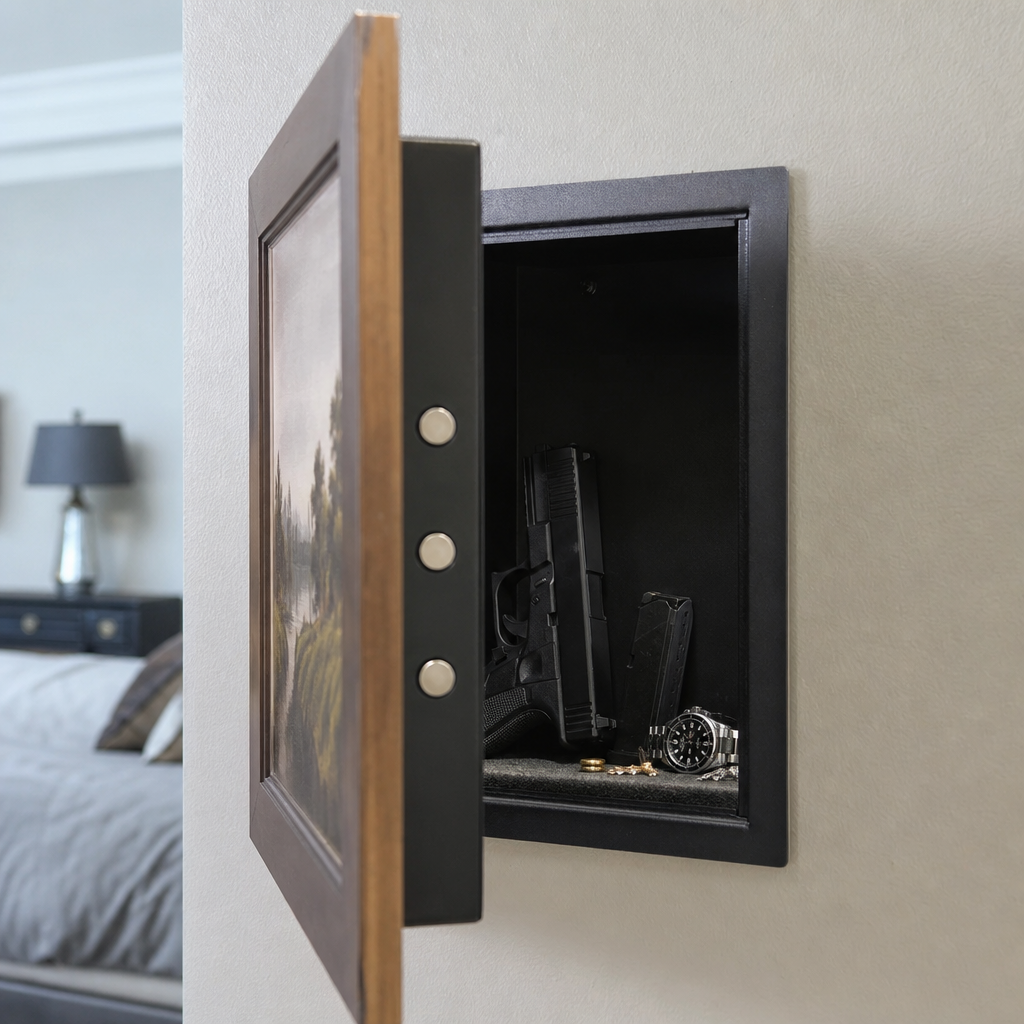
Wall safes can protect firearms in specific situations, but they are rarely strong enough to serve as the primary security solution for most gun owners. The core issue is not whether a wall safe can hide a handgun or store documents; it is whether a recessed safe built between studs can resist burglary, prevent unauthorized access, and meet the practical demands of responsible firearm storage. After evaluating residential security products, installation methods, and burglary patterns, the answer is clear: a wall safe is usually a concealment device first and a true gun safe second.
To judge wall safes fairly, it helps to define the terms. A wall safe is a recessed container installed inside a wall cavity, usually between 16-inch-on-center studs. A gun safe is a broader category that includes cabinets, residential security containers, modular safes, and true safes built with heavier steel, reinforced doors, and robust locking mechanisms. Firearm protection also involves more than theft resistance. It includes child access prevention, moisture control, fire exposure, quick access under stress, and compliance with state storage laws or insurance expectations. Many buyers confuse these goals, which is why myths about gun safes persist.
This matters because the wrong storage choice creates a false sense of security. I have seen homeowners assume that a hidden wall safe was automatically safer than a freestanding safe simply because a burglar could not see it immediately. In practice, concealment buys time, but structural strength stops attacks. If a thief finds a typical wall safe, the surrounding drywall, the limited mounting surface, and the smaller locking bolts often become the weak points. For firearms, especially anything beyond a compact handgun, those limits matter fast. As the hub for gun safe myths and misconceptions, this guide explains what wall safes do well, where they fail, and how to evaluate better options.
What wall safes are actually designed to do
Most wall safes are engineered around available space, not maximum steel mass. A standard interior wall cavity restricts width and depth, so manufacturers prioritize fit, ease of installation, and concealment behind mirrors, framed art, or closet panels. That makes wall safes useful for passports, cash, jewelry, and in some cases a single defensive handgun. It does not automatically make them ideal firearm safes. The steel body is often thinner than buyers expect, commonly in the 14- to 18-gauge range on entry models, with stronger materials reserved for the door rather than the recessed box.
That distinction drives one of the biggest myths in gun safes and safety: “If it locks, it is a safe.” In the industry, many products sold as safes are closer to lockboxes or residential security containers. They may deter smash-and-grab theft, but they are not intended to withstand determined pry attacks, sidewall cutting, or removal from framing. Some wall safes use decent electronic or mechanical locks from brands such as SecuRam, Sargent and Greenleaf, or La Gard, yet the lock quality alone cannot compensate for a lightly built body anchored to wood studs and surrounded by drywall.
Wall safes also solve a real-world problem that larger gun safes sometimes cannot: discreet placement in tight homes. Apartment dwellers, condo owners, or owners who want immediate access in a bedroom may not have space for a 500-pound safe. In that niche, a properly installed wall safe can be part of a layered plan. For example, storing one carry pistol in a hidden wall unit while keeping long guns in a heavier safe elsewhere can make sense. The mistake is treating the wall safe as equivalent to a dedicated burglary-rated firearm safe.
How strong are wall safes against burglary?
For burglary resistance, wall safes are generally weaker than floor safes, heavy freestanding gun safes, and well-anchored security containers. The reason is simple physics. A recessed safe must fit inside a wall cavity, so its steel shell cannot be very thick without sacrificing interior space. It also relies on the surrounding wall framing for support. A burglar attacking the perimeter may pry against studs, break drywall to expose the body, or cut around the unit. Once the thief can access the sides, the advantage of the front door construction diminishes quickly.
In residential break-ins, thieves often work fast and target obvious valuables first, but they also search bedrooms, closets, home offices, and garages. If they discover a wall safe during that window, they may attack the wall itself rather than the lock. I have seen installations where a decent door was mounted into a cavity with only lag screws into dry, old studs. The safe survived, but the wall did not. By contrast, a heavier gun safe anchored through concrete or a reinforced subfloor forces the attacker to deal with significantly more steel and mass.
That does not mean every wall safe is flimsy. Higher-end models may use thicker plate doors, anti-pry lips, relockers, and better internal hinges. These features improve delay time. Delay time, however, is not the same as high security. True burglary safes are evaluated under recognized standards such as UL 687, while many consumer wall safes are not. A residential gun safe with a UL-listed lock and 10-gauge or thicker steel body is still not equivalent to a commercial TL-rated safe, but it usually outperforms a typical in-wall unit when tools come out.
Can a wall safe protect firearms from children, guests, and unauthorized users?
For access control, wall safes can be effective if they are installed correctly and used consistently. This is where a more nuanced answer matters. Responsible firearm storage is not only about defeating burglars; it is also about preventing unauthorized handling by children, teens, houseguests, contractors, or family members who should not have access. A wall safe with a reliable lock can absolutely reduce that risk compared with leaving a gun in a drawer, nightstand, or closet shelf. In that sense, even a modest wall safe is a major safety upgrade over unsecured storage.
The weakness is behavioral, not just structural. Quick-access wall safes are often placed in bedrooms for defensive use, which increases the temptation to leave them open, use short PINs, or rely on biometric scanners without backup access. Biometric readers vary widely. Good fingerprint units can be fast, but low-cost sensors may reject a legitimate user when fingers are wet, dirty, or angled poorly. Mechanical Simplex-style pushbutton locks remain popular because they avoid batteries and are highly reliable, though they are more common on handgun lockboxes than recessed wall safes.
If your main concern is keeping one handgun away from children while retaining relatively quick access, a wall safe can work. If your concern includes multiple firearms, magazines, suppressors where lawful, or preventing theft by a determined intruder, then a larger anchored gun safe is the safer choice. Storage laws in states such as California and Massachusetts also push owners toward secure locking devices or containers that meet defined standards. The right question is not “Will a wall safe lock?” but “Will this specific unit prevent the specific unauthorized access risk I actually face?”
Common gun safe myths and what buyers get wrong
Most myths in the gun safe market come from marketing language, not malicious intent. Terms like fireproof, tamper-proof, or heavy-duty are used loosely, and buyers often compare products that are not in the same class. Wall safes sit at the center of several misconceptions because they look substantial in photos yet operate within strict dimensional limits. The table below summarizes the most common myths I encounter when discussing gun safes and safety with homeowners.
| Myth | Reality | Why it matters for firearms |
|---|---|---|
| Hidden means secure | Concealment delays discovery but does not replace steel strength or solid anchoring | A found wall safe may fail faster than a heavier floor-mounted unit |
| All safes sold for guns offer similar protection | Lockboxes, cabinets, RSCs, and true safes differ sharply in steel thickness and testing | Misclassification leads buyers to under-protect valuable firearms |
| Biometric access is always best | Some readers are excellent, others are unreliable under stress or poor finger conditions | Defensive access requires consistent performance and backup entry |
| Fire ratings are standardized | Many ratings are manufacturer-generated, not independently verified | Paper, optics, ammunition, and firearm finishes react differently to heat and moisture |
| A bigger lock means a stronger safe | The lock is only one component; body steel, door fit, boltwork, and anchors matter too | A good lock on a weak box still leaves an easy attack path |
| Wall safes are ideal for all guns | They are usually best for one handgun and small valuables, not long guns or full collections | Capacity, depth, and mounting limits restrict real firearm use |
Another common mistake is overestimating fire protection. Many wall safes have little or no meaningful fire insulation because cavity depth is limited. Even units with fire liners may not protect contents for long in a structure fire, especially if the surrounding wall collapses. Firearm owners should also remember that surviving heat is not the same as emerging functional. Optics, polymer components, lubricants, and ammunition can all be affected by extreme temperature and steam. If fire resistance is a top priority, a tested fire-rated gun safe or dedicated document safe stored separately is usually smarter.
When a wall safe makes sense for gun owners
A wall safe makes sense when the use case is narrow and realistic. The best example is a homeowner who wants discreet storage for one defensive handgun in a master bedroom, office, or hallway and already owns a larger safe for long-term storage. In that setup, the wall safe acts as a secondary access point, not the only line of defense. It can also work in homes where floor loading, rental restrictions, or layout make a full-size safe difficult. Concealment behind artwork or inside a closet can reduce casual discovery by visitors and service workers.
Installation quality determines whether this approach is responsible or reckless. The unit should be mounted to sound framing, ideally with reinforcement added during installation. Location matters too. Exterior walls can create moisture and temperature issues, especially in humid or cold climates. Bathrooms and laundry-adjacent walls are poor choices because corrosion risk rises. Bedrooms are common, but avoid walls that are easy to see during a quick search. I typically recommend pairing the safe with a dehumidification plan, serialized firearm records stored separately, and an alarm system covering the room.
Product selection should reflect actual needs. If the handgun is only for staged home defense, prioritize reliable access, secure retention, and discreet placement. If theft risk is high, consider a small heavy-gauge quick-access safe bolted into furniture or masonry instead of a wall cavity. Brands vary widely, and specs matter more than logos. Look for thicker steel, recessed doors, anti-pry features, manual override policies, and lock pedigree. Skip vague claims and read warranty language carefully. A strong return policy often tells you more about manufacturer confidence than ad copy does.
Better alternatives to wall safes for serious firearm protection
If your goal is serious firearm protection, a wall safe is usually not the best primary option. A dedicated gun safe or robust residential security container anchored to concrete offers better resistance to pry attacks, better storage organization, and better compatibility with long guns, optics, and accessories. Even compact upright safes outperform many wall units because they can use thicker steel and larger locking systems without the dimensional limits of stud spacing. Modular safes from companies serving upstairs installations are another practical option when weight and access are concerns.
For single-handgun access, purpose-built bedside or closet-mounted quick-access safes often beat wall safes on both speed and strength. Many use thicker steel, reinforced lids, and direct anchoring to floor joists or heavy furniture. Models with mechanical pushbutton locks avoid battery dependence, while premium electronic units offer audit trails or tamper alerts. If theft is a major concern, a small safe hidden but also bolted down usually provides a better security equation than a recessed box with exposed drywall all around it.
Layered security remains the best practice. That means a hardened safe, monitored alarm, quality exterior doors, longer hinge and strike plate screws, camera coverage, and restrained disclosure about gun ownership. No residential container is invincible. The goal is to increase attack time, noise, visibility, and uncertainty for the intruder while reducing unauthorized access inside the home. For most households, the ideal setup is simple: primary firearms in a larger anchored safe, one authorized defensive firearm in a fast-access container if needed, and wall safes reserved for niche concealment roles rather than core protection.
So, are wall safes strong enough to protect firearms? Sometimes, but only within a limited role. They are usually adequate for hiding and locking a single handgun away from children, casual visitors, or opportunistic thieves. They are usually inadequate as the main protective container for multiple guns or valuable firearms that could attract a determined burglar. The difference comes down to construction, anchoring, and realistic threat assessment. A wall cavity is a convenient place to conceal a firearm, but it is not an ideal structure for building the strongest possible safe.
The biggest lesson from gun safe myths and misconceptions is that labels do not protect firearms; design and use do. Hidden is not the same as secure. Fire-rated is not always independently tested. Biometric does not always mean reliable. A good lock does not make thin steel strong. Once you separate marketing claims from physical realities, wall safes become easier to evaluate. They are specialized tools, not universal answers. Used correctly, they can improve home firearm safety. Used as a substitute for a proper safe, they often create overconfidence.
If you are choosing storage now, start with your actual risks: unauthorized access, burglary, fire, humidity, and the number of firearms you own. Then match the container to that threat profile instead of the other way around. For most gun owners, that means making a heavier anchored gun safe the foundation of the plan and treating a wall safe as a secondary option only when concealment and quick access justify the tradeoffs. Review your current setup, inspect how it is mounted, and upgrade the weak points before you trust it with firearms that must stay secure.
Frequently Asked Questions
Are wall safes strong enough to protect firearms from theft?
Wall safes can offer limited protection, but in most cases they are not strong enough to be the primary theft-resistant storage solution for firearms. The main reason is structural: a wall safe is designed to fit between standard wall studs, which usually means it must be relatively narrow and shallow. That size limitation often results in lighter steel construction, smaller locking bolts, and less resistance to prying or forced entry than a full-size gun safe or a heavy-duty burglary-rated safe. A thief who discovers the safe may have an easier time attacking the surrounding wall, exposing the unit, or removing it from the framing altogether if the installation is weak.
That does not mean wall safes have no value. They can work well for discreet storage of a single handgun, important documents, or emergency access items when concealment is part of the security strategy. In a quick smash-and-grab burglary, a hidden wall safe may go unnoticed, and that alone can be useful. However, concealment is not the same as true burglary resistance. If the safe is found, many residential wall safes simply do not have the steel thickness, door strength, or anchoring capacity needed to stop determined tools and repeated attack. For most gun owners, especially those storing multiple firearms or higher-value weapons, a wall safe is best viewed as a secondary layer of security rather than the main protective barrier.
Why are recessed wall safes usually less secure than traditional gun safes?
Recessed wall safes are constrained by the dimensions of the wall cavity, and that limitation affects nearly every security feature. Traditional gun safes can use thick steel bodies, reinforced doors, extensive locking bolt systems, and heavy overall weight to resist tampering and removal. A wall safe does not have that luxury. It has to slide into a relatively thin space between studs, so manufacturers often prioritize compactness and convenience over heavy-duty construction. Even when the door appears solid, the body of the safe may be made from thinner steel than many buyers expect.
Installation also plays a major role. A freestanding gun safe can be anchored into concrete or substantial flooring and may weigh hundreds of pounds before it is even bolted down. A wall safe, by contrast, depends on the integrity of the framing and drywall around it. If the surrounding wall can be cut, broken, or pulled apart, the safe may become much more vulnerable. In practical terms, that means a burglar may not need to defeat the lock directly. They may target the area around the safe, attack the mounting points, or exploit the fact that the safe is secured inside a structure that is easier to damage than the safe door itself. This is one of the biggest reasons wall safes generally fall short as serious firearm security for most households.
Can a wall safe prevent unauthorized access by children or other people in the home?
A properly locked wall safe can absolutely be better than leaving a firearm unsecured in a drawer, closet, or nightstand. If the safe has a reliable lock, is installed correctly, and is used consistently, it can reduce the chance of casual or accidental access by children, guests, or other unauthorized people in the home. For many households, that alone makes a wall safe a meaningful improvement over no safe at all. It creates a locked barrier and supports more responsible storage habits, especially for a single defensive handgun.
Still, the level of protection depends heavily on the quality of the safe and how it is used. Some lower-end wall safes have weaker locking systems, electronic keypads of inconsistent quality, or backup key access that can become a vulnerability if the keys are not controlled carefully. Placement matters too. If the safe is easy to find and readily accessible, a determined teenager or another person in the home may attempt to tamper with it over time. Responsible firearm storage also requires more than just locking the gun behind a steel door. Owners should think about who knows the safe exists, who might know the code, how quickly the safe can be reached in an emergency, and whether additional safeguards such as a trigger lock, separate ammunition storage where appropriate, or a more robust handgun safe would better match the household’s risk profile. So yes, a wall safe can help prevent unauthorized access, but its effectiveness depends on product quality, installation, secrecy, and disciplined use.
Are wall safes a good option for storing handguns for quick access?
Wall safes can be a reasonable option for handgun storage when the goal is discreet placement and relatively fast access, but they involve tradeoffs. Their biggest advantage is concealment. A handgun stored in a wall safe behind a picture, mirror, or cabinet may be less obvious than one kept in a bedside lockbox or closet safe. For owners who want a firearm accessible in a specific room without advertising its presence, that can be appealing. In some cases, a quality wall safe with a dependable electronic or mechanical lock can provide access that is fast enough for practical defensive use.
However, wall safes are not automatically the best quick-access choice. Access speed depends on the lock type, the height and location of the safe, and whether the concealment method slows retrieval. In a high-stress situation, reaching behind décor, opening a panel, entering a code, and positioning the door correctly may not be as simple as it seems during installation. Some wall safes are also too small or awkwardly shaped for a handgun, spare magazine, and accessories to be stored in a way that allows clean, immediate retrieval. For many users, a purpose-built quick-access handgun safe mounted to furniture or secured in a closet may be a better combination of speed, safety, and reliability. A wall safe can still work well for certain setups, but it should be chosen based on realistic use rather than the assumption that hidden always means practical.
What is the best role for a wall safe in a responsible firearm storage plan?
The best role for a wall safe is usually as a supplemental security layer, not the foundation of the entire firearm storage plan. It can be useful for storing a single handgun, backup defensive firearm, important paperwork related to firearm ownership, or other compact valuables where concealment adds meaningful protection. In that role, a wall safe can help keep a firearm out of casual sight, reduce opportunistic access, and add one more obstacle for anyone who should not be handling the weapon. It can also be a practical solution in homes where space is limited and a large gun safe is not feasible in every room.
For primary storage, though, most gun owners are better served by a dedicated gun safe or security container designed specifically for firearms. That is especially true for long guns, multiple handguns, valuable collections, or homes with elevated theft risk. A stronger primary safe should offer better steel construction, stronger locking mechanisms, more secure anchoring, and greater resistance to pry attacks and removal. In a well-rounded setup, the wall safe becomes part of a layered approach: a main gun safe for serious storage, a smaller quick-access safe where defensive access is needed, and sensible operational habits such as limiting who knows where firearms are kept, maintaining lock discipline, and choosing products from reputable manufacturers. In short, a wall safe can play a useful role, but it is rarely sufficient by itself for the full demands of responsible firearm security.