
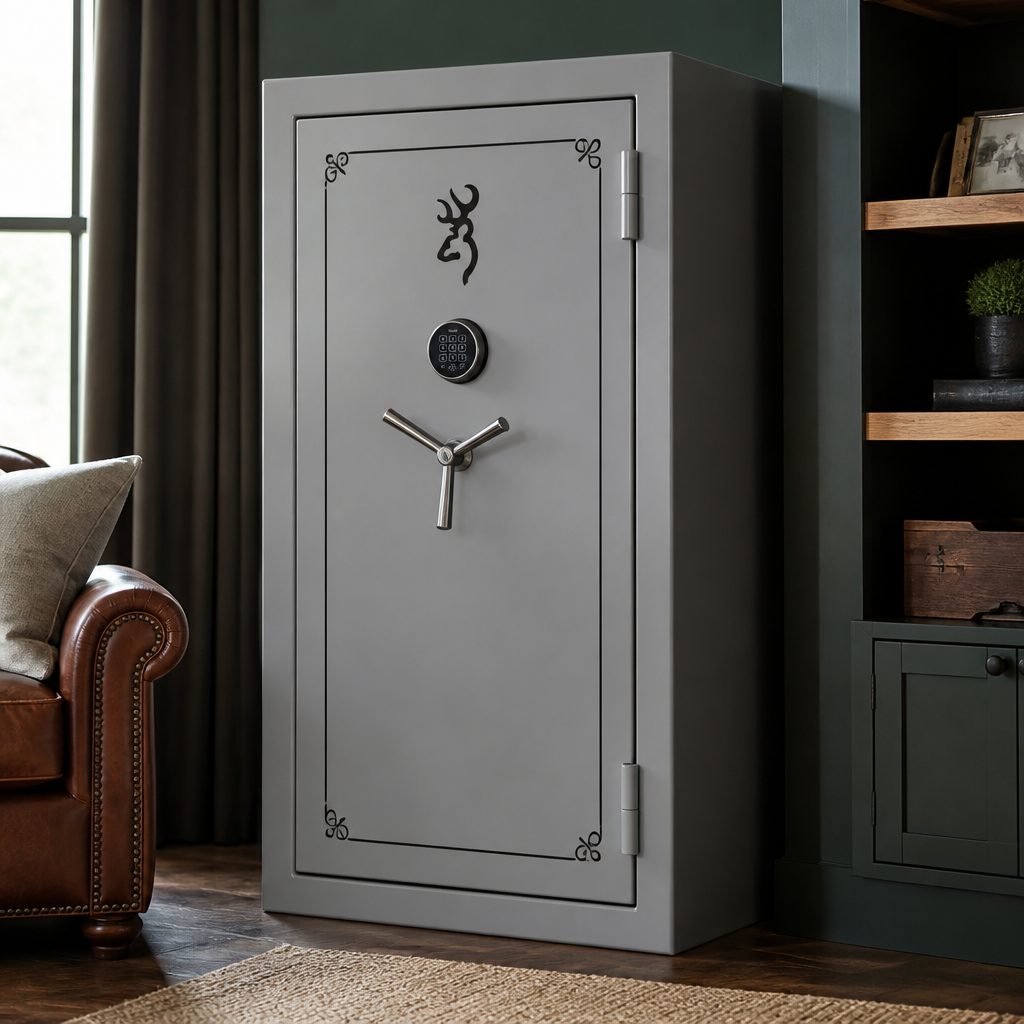
The Browning ProSteel Silver Series sits at an important intersection in the gun safes and safety market: it is a product line built to protect firearms from theft, heat, and unauthorized access while still looking refined enough for a home office, den, or master closet. For buyers researching a fireproof safe, that combination matters. A safe that feels too industrial often gets pushed into a garage where humidity, temperature swings, and poor anchoring conditions can undermine long-term protection. A safe that looks attractive but compromises on steel, locking strength, or fire resistance is even worse. The Silver Series is relevant because it aims to balance security engineering, fire protection, and presentation in one cabinet.
Within Browning’s broader ProSteel lineup, the Silver Series is generally positioned as a mid-tier to upper-mid-tier option, above entry-level offerings but below the brand’s most heavily fortified flagship safes. In practical terms, that means shoppers can expect meaningful anti-theft construction, organized interior storage, and a published fire rating without paying for every premium feature Browning makes. I have evaluated safes in this category for years, and this is exactly where many households land: they need more than a basic metal locker, but they do not need a commercial vault door in the spare bedroom. That makes the Silver Series a useful hub topic for anyone comparing product reviews across the gun safes and safety category.
Before going deeper, it helps to define key terms. A fireproof safe is not literally proof against all fire conditions. In the gun safe industry, fire protection usually refers to a tested or manufacturer-rated duration at a stated temperature, such as thirty, sixty, or ninety minutes. Security also has layers. Steel gauge, door thickness, locking bolts, relockers, hard plates, pry resistance, hinge design, and anchoring all affect burglary resistance. Interior capacity is another term buyers often misunderstand. A “33-gun safe” rarely stores thirty-three scoped rifles in a realistic layout. Capacity claims are marketing estimates based on slim, unscoped long guns packed tightly together. Understanding those definitions helps shoppers read Browning ProSteel Silver Series product reviews with realistic expectations.
This article matters because a safe purchase is not a casual accessory buy. It influences legal compliance, household safety, insurance outcomes, and firearm longevity. The right safe limits access by children and smash-and-grab thieves, reduces exposure to fire loss, and supports better organization for rifles, shotguns, handguns, documents, and valuables. The wrong safe creates frustration every time the owner tries to store a scoped rifle or retrieve a defensive handgun quickly. As a product review hub, this guide explains what the Browning ProSteel Silver Series is, where it fits, what features deserve attention, and which related review angles buyers should use when comparing safes under the broader Gun Safes and Safety topic.
What the Browning ProSteel Silver Series Is Designed to Do
The Silver Series is designed for residential firearm storage with three priorities: deter theft, resist fire long enough for typical house-fire response windows, and keep firearms organized in a practical, accessible layout. Browning has built its reputation on the interior experience as much as on exterior security, and that is a major reason the line stands out in product reviews. Many safes advertise body steel and bolt count, but owners live with shelving, door storage, rifle spacing, and lighting every day. Browning understood early that a safe is both a security appliance and a storage system.
In use, that means the Silver Series usually appeals to gun owners with mixed collections. A buyer may own hunting rifles with large optics, shotguns, AR-pattern rifles, pistols, tax documents, jewelry, and suppressor accessories. A simplistic interior turns that collection into a pile. Browning’s configurable layout approach tends to handle it better. The company’s practical innovation has often centered on maximizing usable space rather than inflated brochure capacity. That design philosophy matters more than it first appears, because a crowded safe leads owners to leave firearms unsecured elsewhere.
The series also serves households that care about aesthetics. The “stylish” part of the title is not cosmetic fluff. Finish quality, hardware appearance, trim, and interior presentation matter when a safe goes inside conditioned living space. A safe installed in a bedroom closet or study becomes part of the room. In my experience, buyers who appreciate the look of a safe are more likely to place it indoors, where moisture control, convenience, and anchoring to structural flooring are often better managed.
Security Construction: Steel, Locks, Bolts, and Real Burglary Resistance
A secure gun safe starts with the shell. On the Browning ProSteel Silver Series, buyers should evaluate steel thickness, door edge design, reinforced lock areas, and boltwork rather than focusing on brochure language alone. In the residential security container market, body steel often ranges from thinner 14-gauge entry-level walls to heavier 12-gauge, 11-gauge, or thicker on stronger models. The difference is significant. Thicker steel resists bending, cutting, and prying better, and it gives hardware and bolt systems a stronger foundation. If a given Silver Series model uses heavier steel than a low-end competitor, that is a meaningful upgrade, not a trivial spec-sheet detail.
Lock choice also matters. Most buyers choose an electronic lock for speed and convenience, while some still prefer mechanical dial locks for long-term simplicity. High-quality electronic locks from recognized names such as Sargent and Greenleaf or SecuRam have improved substantially. When properly installed and maintained, they are reliable. That said, no lock compensates for poor anchoring. A safe that is not bolted down can be tipped, pried, or removed entirely for later attack. I have seen lighter safes defeated not because the lock failed, but because the entire unit was carted away.
Bolt count gets outsized marketing attention, but total number is less important than bolt diameter, engagement depth, door fit, and whether inactive sides use dead bars or active bolts. A well-designed door with robust locking lugs, pry-resistant corners, and relocker protection is what you want. A hard plate over the lock area helps resist drill attacks. An internal relocker can keep the safe secured if the primary lock is punched or tampered with. These are the hidden features that separate a serious gun safe from a decorative cabinet.
| Feature | Why It Matters | What to Check on a Silver Series Model |
|---|---|---|
| Body steel thickness | Thicker steel improves pry and cut resistance | Compare gauge directly against competing models in the same price range |
| Door construction | Most attacks target the door and frame interface | Look for reinforced edges, solid fit, and protected lock area |
| Lock type | Affects speed, reliability, and user preference | Verify brand, warranty, and available mechanical or electronic options |
| Boltwork | Determines how the door resists prying | Evaluate engagement depth, not just total bolt count |
| Anchoring points | Prevents thieves from removing the safe | Confirm floor bolt holes and installation requirements |
For most homeowners, the Silver Series should be viewed as strong residential protection, not a substitute for a true commercial burglary-rated vault. That distinction is important and honest. Against opportunistic theft, common hand tools, and short attack windows, a well-installed safe in this class can perform very well. Against a prepared crew with time, power tools, and privacy, no consumer gun safe is invincible. That is why placement, concealment, alarms, cameras, and layered home security should accompany the safe.
Fire Protection: What “Fireproof” Means in Practice
Fire ratings sell safes, but they are often misunderstood. When reviewers call the Browning ProSteel Silver Series a fireproof safe, the useful question is: fireproof under what conditions? Fire testing can vary by protocol, manufacturer method, furnace profile, and whether there was an independent laboratory standard involved. UL 72 is the best-known standard for record protection, but many gun safes rely on proprietary or factory testing rather than a UL-classified fire label. That does not automatically invalidate the rating, but it does mean buyers should read carefully.
In practical terms, fire protection depends on insulation type, door seals, body construction, and duration of heat exposure. Many gun safes use layered drywall-based insulation with expanding door seals that help block smoke and heat. Better designs also manage heat transfer at door gaps and vulnerable seams. For firearm owners, the goal is not only preventing ignition of adjacent contents; it is also reducing heat damage to optics, polymer components, wood stocks, ammunition packaging, documents, and heirloom items. A safe interior can remain closed and intact while still reaching temperatures high enough to ruin sensitive contents.
Real-world house fires are complex. Room flashover, fuel load, ventilation, and collapse risk all matter. A sixty-minute rating can be enough in some suburban neighborhoods with quick fire response and not enough in remote rural settings. I advise buyers to match the safe to their risk profile. If you live fifteen minutes from the nearest station and store irreplaceable records with your firearms, prioritize higher fire endurance and consider a secondary document container inside the safe. If your main risk is unauthorized access rather than wildfire or delayed response, a balanced security-first model may make more sense.
Interior Layout, Capacity Claims, and Everyday Usability
This is where Browning usually distinguishes itself. The company’s interior systems often make better use of cubic space than generic shelves. Adjustable shelving, barrel supports, door organizers, and segmented storage help accommodate modern firearm collections, which rarely consist of identical wood-stock hunting rifles. Scoped precision rifles, tactical carbines with lights, short-barreled firearms stored lawfully, and bulky pistol cases all challenge old capacity formulas. A flexible interior is not a luxury; it directly affects whether the safe functions well over time.
Capacity claims deserve skepticism. If a Silver Series model is listed for a certain number of long guns, assume your real number will be lower once optics, slings, bipods, and wider fore-ends enter the picture. This is not unique to Browning. It is an industry-wide issue. A better approach is to map your current collection, then add realistic growth. If you own twelve long guns today, buy for at least eighteen to twenty in practical capacity. Otherwise, the safe will be overcrowded within a year or two, especially if you also store handguns and paperwork.
Door storage is especially valuable. Handgun pouches, choke tubes, magazines, passports, and jewelry fit well on an organized door panel and free shelf space for bulkier items. Interior lighting is another underappreciated feature. Battery or outlet-powered lights reduce the temptation to leave firearms half stored because the back corner is hard to see. Dehumidifier compatibility also matters. In humid climates, a goldenrod-style heater or desiccant system can prevent rust and mildew, preserving both blued steel and wood furniture.
Style, Finish, and Placement Inside the Home
The Silver Series earns attention partly because it does not look like an afterthought. Exterior finish quality, color options, handle design, and trim all contribute to whether the safe can live comfortably in visible indoor spaces. That matters for more than taste. A safe kept in conditioned interior space is usually exposed to less humidity than one placed in a detached garage or damp basement. Better environmental conditions translate into less corrosion risk and more stable lock performance over time.
Placement still requires planning. Even an attractive safe should not be installed where delivery access is unsafe or where floor load limits are uncertain. Large safes can weigh hundreds of pounds before contents are added. Ground-floor placement on a concrete slab is ideal, while upper floors may require confirmation of structural support. Closet installations can improve concealment, but buyers need to leave enough clearance for door swing, shelving access, and power cords for lights or dehumidifiers. I have seen beautiful safes effectively ruined by poor placement that prevented the door from opening fully.
Style also has a psychological benefit: it reduces friction. Owners are more likely to use a safe consistently when it feels integrated into the home rather than exiled to a corner. Consistent use is the entire point of secure storage. A firearm on a shelf because the safe is inconvenient is not protected by steel, fireboard, or locking bolts.
How the Silver Series Fits Within Product Reviews and Hub Coverage
As a sub-pillar hub for product reviews under Gun Safes and Safety, the Browning ProSteel Silver Series is best understood through comparisons. Buyers typically ask five questions. Is it better than entry-level big-box safes? Usually yes, if steel, interior design, and fire rating are meaningfully stronger. Is it enough for a serious collector? Often, for many households, though very high-value collections may justify heavier construction. Is it worth the premium over imported budget cabinets? In most cases, yes, because usability and protection tend to be more credible. Is it the best-looking option? It is among the stronger choices for combining residential décor with functional security. Is it perfect? No safe in this class is.
That is why this page works as a hub. From here, related review articles should branch into model-by-model breakdowns, electronic versus dial lock comparisons, Browning versus Liberty or Fort Knox style comparisons, fire rating methodology explainers, installation guides, humidity control articles, and realistic capacity calculators. The Silver Series is not only a single review topic; it is an anchor for the questions shoppers ask across the entire category.
The key takeaway is simple: the Browning ProSteel Silver Series offers a compelling mix of style, organization, fire protection, and residential security for gun owners who want more than an entry-level safe. Its strongest selling points are balanced engineering and day-to-day usability, not marketing gimmicks. Buyers should still verify the exact model specifications, compare steel and fire ratings against competitors, and plan for proper anchoring and moisture control.
For households storing firearms, documents, and valuables in lived-in spaces, that balance is the real benefit. A safe you trust, can organize, and are willing to place inside the home is far more useful than a cheaper box that creates compromises from day one. Use this hub as your starting point, then move into detailed product reviews and comparison guides to choose the Browning ProSteel Silver Series configuration that matches your collection, budget, and security needs.
Frequently Asked Questions
What makes the Browning ProSteel Silver Series different from a basic gun safe?
The Browning ProSteel Silver Series stands out because it is designed to do more than simply lock firearms behind a steel door. It brings together burglary protection, fire resistance, organized firearm storage, and a more furniture-friendly appearance that works well in finished interior spaces. For many buyers, that balance is the real advantage. A basic gun safe may offer security, but it can look overly industrial and end up in a garage or utility area where moisture, temperature swings, and weak floor anchoring can create long-term problems. The Silver Series is better suited to placement in a home office, den, or master closet, which can improve both accessibility and environmental stability.
Another important difference is the emphasis on livability and presentation. Homeowners often want a safe that protects valuable firearms while still fitting into the visual style of the room. The Silver Series answers that need with a more refined exterior while still focusing on core protective features such as reinforced construction, a secure locking system, and fire protection. In practical terms, it is a safe built for people who want serious security without making their home feel like a warehouse or commercial storage space.
Is the Browning ProSteel Silver Series truly fireproof, and what does that mean in real-world use?
No residential gun safe should be thought of as absolutely fireproof in the literal sense, and that is an important distinction for buyers to understand. The better way to evaluate the Browning ProSteel Silver Series is to look at its fire rating, insulation design, door seal system, and overall construction. A safe in this category is engineered to slow heat transfer and help protect contents during a house fire for a stated period under specified testing conditions. That can be highly valuable protection for firearms, paper records, heirlooms, and other sensitive contents, but it is not the same as a guarantee that every item inside will emerge unaffected under every fire scenario.
In real-world use, the Silver Series can be a strong choice for homeowners who want meaningful fire resistance as part of their safe purchase. The most important takeaway is that fire protection works best when combined with smart installation decisions. Placing the safe inside the conditioned envelope of the home rather than in a detached garage or damp outbuilding generally helps with long-term preservation. Interior placement can also reduce exposure to humidity and temperature extremes that may affect firearms over time. Buyers should also remember that paper documents, optics, wood stocks, and electronics may all react differently to heat, so interior organization and storage methods still matter even inside a fire-rated safe.
Why does placing a safe inside the home matter so much for security and firearm protection?
Placement matters because the environment around the safe can directly affect both the safe itself and the firearms stored inside it. A garage may seem convenient, but it often exposes a safe to fluctuating temperatures, higher humidity, concrete-floor moisture, and less discreet visibility. Those conditions can contribute to rust risk, stock swelling, finish wear, and long-term maintenance issues for guns. In addition, garages and utility spaces sometimes offer poorer anchoring options or make it easier for burglars to work unnoticed with tools.
The Browning ProSteel Silver Series is especially appealing because its more polished appearance makes in-home placement more realistic. Putting a safe in a home office, den, spare room, or master closet can improve climate consistency, concealment, and day-to-day usability. A safe located indoors is often easier to monitor, less vulnerable to environmental abuse, and more likely to be integrated into a thoughtful security plan. That combination of stable conditions and practical placement helps owners protect not just against theft and fire, but also against the slow, preventable damage that can come from storing firearms in the wrong part of the house.
Is the Browning ProSteel Silver Series a good choice for homeowners who care about appearance as much as security?
Yes, that is one of the strongest reasons this series attracts attention. Many safe buyers do not want a large steel box that dominates the room or clashes with the rest of the home. The Browning ProSteel Silver Series is aimed at people who want credible protection while maintaining a more refined, residential look. That matters because a safe that fits comfortably into a finished space is more likely to be installed where conditions are better for both security and firearm preservation. Instead of hiding the safe in a harsh environment simply because it looks too industrial, owners can place it in a location that supports better humidity control, stronger daily oversight, and easier access.
Appearance should never replace substance, of course, but the best safe purchases often come from finding the right balance. A stylish exterior can support better real-world outcomes when it encourages proper placement inside the home. For households that care about décor, room flow, and a less utilitarian feel, the Silver Series offers a practical middle ground. It allows buyers to maintain the visual standard of the home without giving up the key protections expected from a dedicated gun safe and fire-resistant storage solution.
What should buyers consider before choosing a Browning ProSteel Silver Series safe?
Buyers should start by thinking beyond the headline features and focus on how the safe will actually be used. Capacity is a major consideration, especially because firearm counts listed by manufacturers can be optimistic depending on stock size, optics, slings, and accessory layout. It is wise to choose a model with more room than you think you currently need, particularly if your collection may grow or if you also plan to store documents, jewelry, cash, or other valuables. Interior organization, shelf flexibility, and door storage can make a meaningful difference in daily convenience and long-term satisfaction.
It is also important to evaluate where the safe will go, how it will be anchored, and what level of fire resistance makes sense for your household. A safe performs best when installed on a solid surface, properly secured, and located in a part of the home that offers environmental stability and discretion. Buyers should also think about lock preference, ease of access, and whether the safe’s dimensions will work with doorways, stairwells, and room layout during delivery. In short, the Browning ProSteel Silver Series is a compelling option for people who want a secure, fire-resistant, and more attractive safe, but the best results come from matching the model to your space, collection, and long-term storage priorities.