
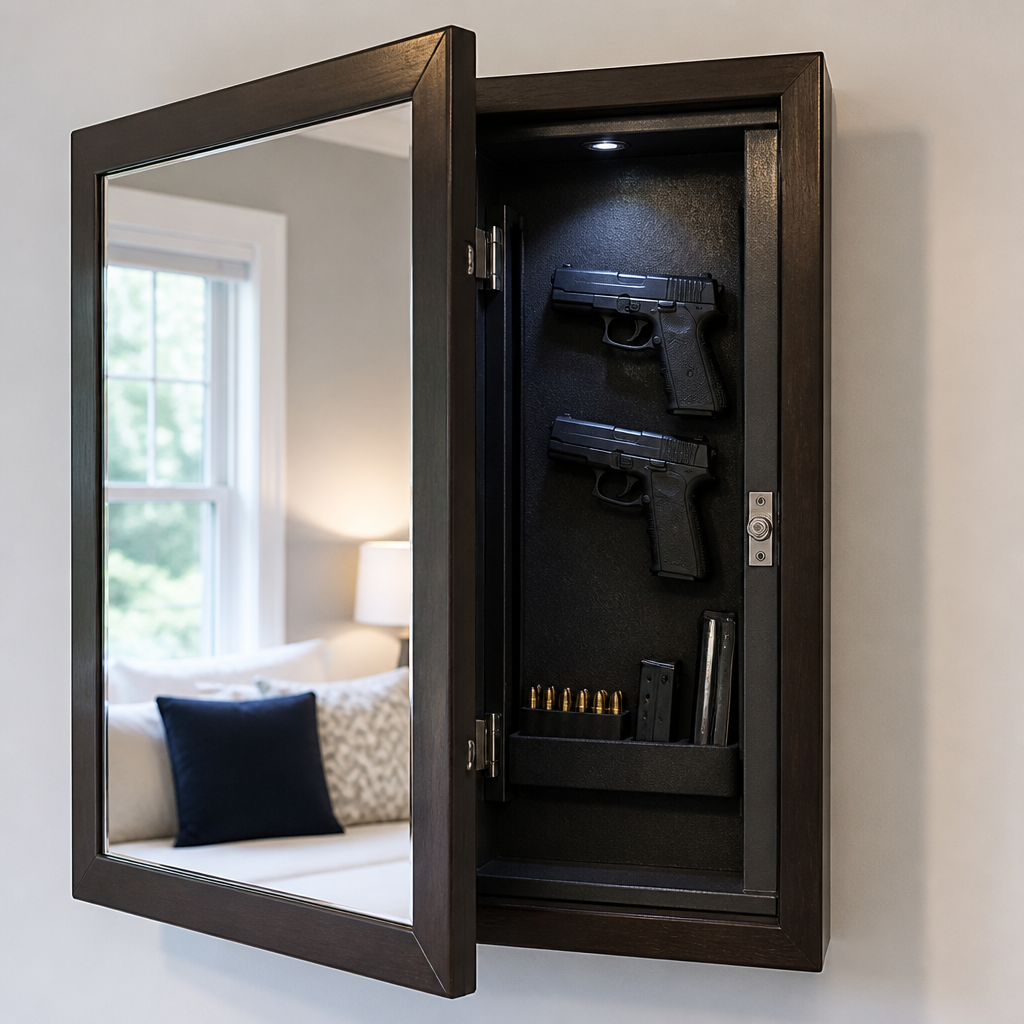
A hidden gun safe behind a mirror combines secure firearm storage with visual concealment, giving homeowners a practical way to protect weapons while keeping them out of casual sight. In the gun safes and safety category, this approach sits within a broader group of hidden and discreet gun storage solutions that includes furniture safes, wall safes, under-bed drawers, biometric nightstand vaults, and custom millwork compartments. The core idea is simple: the safe is real security, while the mirror is camouflage. When both parts are installed correctly, the result can reduce opportunistic theft, maintain fast access for authorized users, and preserve the appearance of a normal room.
I have worked with wall safes, between-stud storage cavities, and concealment furniture in homes where owners wanted a balance between access, safety, and privacy. The same lesson comes up every time: concealment is not a substitute for secure construction. A mirror that swings open to reveal a flimsy steel box is still only as strong as the box, its locking mechanism, and the way it is anchored to framing. That is why a proper hidden gun safe installation starts with planning for structure, code considerations, child safety, and realistic access needs before a single cut is made in drywall.
For most homeowners, the hidden safe behind a mirror matters for three reasons. First, it reduces visual exposure. Visitors, contractors, and delivery workers may never know firearms are present. Second, it can improve use of tight floor plans where a large freestanding safe is impractical. Third, it can support layered home security by pairing a physical safe with a concealed opening, monitored alarms, and access controls such as electronic keypad or biometric locks. The goal is not invisibility in a movie sense. The goal is delayed discovery and controlled access in an ordinary residential setting.
Key terms are worth defining clearly. A wall gun safe is a safe body recessed into a stud bay or mounted on the wall surface. A concealment mirror is a framed mirror or mirror cabinet that hides the safe from view, often on hinges, sliders, or magnetic catches. Fire rating refers to a tested level of heat resistance, though many in-wall safes have limited ratings compared with heavy standalone safes. Quick access means the owner can open the safe rapidly under stress, usually by keypad, RFID, or fingerprint reader. Retention means preventing unauthorized handling, especially by children or untrained adults.
This hidden and discreet gun storage solutions hub covers the installation process and also helps readers understand when a mirror safe is the right choice, what its limitations are, and how it compares with other discreet firearm storage methods. If you are planning a bedroom, closet, hallway, office, or den installation, the details below will help you choose a location, select hardware, and avoid common errors that make concealment systems unsafe or unreliable.
What a hidden mirror gun safe does well, and where it falls short
A hidden gun safe behind a mirror works best as part of a layered security plan. Its main strength is concealment. Most residential burglaries are quick, and thieves commonly search master bedrooms, closets, and obvious desk drawers first. A mirror on a wall does not usually signal firearm storage, so the safe may escape notice entirely during a short smash-and-grab event. That concealment benefit is meaningful, especially for homeowners who do not want a large, visible safe advertising that valuables or firearms are present.
Its second strength is accessibility. In a bedroom or dressing area, a mirror safe can place a handgun or compact long gun at ergonomic height, unlike under-bed storage that requires bending or floor-level access. With a quality electronic lock, the opening sequence can be faster than retrieving keys from another room. In homes where defensive firearms are stored but must remain inaccessible to children, this balance of speed and control is often the main reason people choose the format.
Limitations are equally important. Wall depth usually constrains storage. Standard interior framing with nominal 2×4 studs leaves limited cavity depth after drywall, so larger optics, long gun magazines, or bulky accessories may not fit. Security is also constrained by wall construction. Even a solid in-wall safe cannot match the steel mass, pry resistance, and fire endurance of a large freestanding safe anchored to concrete. Finally, concealment features can introduce maintenance issues. Hinges sag, mirrors drift out of alignment, magnetic catches weaken, and low-cost electronic locks fail. The correct mindset is to treat a hidden wall unit as a specialized access solution, not as a universal replacement for a primary safe.
Choosing the right location and safe type
The best location for a hidden gun safe behind a mirror is structurally sound, easy for the owner to reach, hard for others to observe, and appropriate for the firearm type being stored. Bedrooms are common because owners already use mirrors there and because nighttime defensive access is a frequent use case. Walk-in closets can be even better because they reduce guest traffic and provide visual privacy during opening. Hallways and home offices can work, but they require more attention to sightlines and traffic patterns.
Stud layout drives many decisions. In most homes, wall studs are spaced 16 inches on center, though 24-inch spacing exists in some construction. Before selecting a safe, confirm stud spacing with a stud finder and by exploratory verification. Check for electrical wiring, plumbing vents, HVAC runs, and load-bearing constraints. Exterior walls may introduce insulation, vapor barriers, or temperature swings that are less than ideal for firearm storage. Interior walls are generally simpler and more stable.
Safe selection should follow the firearm profile. A handgun safe hidden behind a mirror is the easiest configuration because compact dimensions fit standard stud bays. A long gun wall safe requires greater height and careful measurement for barrel length, optics, and door swing. Look for steel thickness, continuous hinge quality, anchor points, lock type, tamper alerts, and interior organization. Brands vary widely, but the best units provide reinforced locking bolts, reliable electronics, and mounting points aligned with framing. If local law requires locked storage, verify that the safe meets the relevant state definition for secure containment.
| Storage option | Best use | Main advantage | Main limitation |
|---|---|---|---|
| Mirror wall safe | Quick-access handgun or compact carbine storage | Strong concealment in plain sight | Limited depth and capacity |
| Furniture concealment safe | Living room or office discreet storage | No wall cutting required | Often easier to steal as a whole unit |
| Under-bed gun drawer | Low-profile bedroom storage | Uses dead space efficiently | Requires bending and can collect dust |
| Nightstand biometric vault | Immediate bedside handgun access | Very fast opening | Minimal capacity and lower concealment |
| Full-size freestanding safe | Primary collection storage | Highest security and fire protection | Visible, heavy, and space intensive |
Tools, materials, and preparation before installation
Installing a hidden gun safe behind a mirror typically requires a stud finder, level, tape measure, oscillating multi-tool or drywall saw, drill and bits, lag screws or structural fasteners, shims, painter’s tape, safety glasses, and a vacuum for dust control. The concealment assembly may use a hinged mirror frame, piano hinge, French cleat, rare-earth magnetic latches, or a prebuilt concealment cabinet. If the mirror is large, plan for two-person handling. Tempered or safety-backed glass is the safer choice because ordinary mirror glass can crack dangerously during installation.
Before opening the wall, map the cavity carefully. I mark stud edges, scan repeatedly for wiring, and confirm with a small inspection hole in an inconspicuous area. If a receptacle, switch leg, plumbing line, or fire block appears in the bay, I relocate the project rather than forcing a workaround. This is especially important in older homes, where renovations often leave surprises behind finished surfaces. A clean cavity is what makes an in-wall safe straightforward.
Preparation also includes environmental planning. Firearms stored in wall cavities can face humidity shifts, particularly on exterior walls or in bathrooms and laundry-adjacent spaces. Use a dehumidifier packet, rust inhibitor, or rechargeable desiccant inside the safe, and inspect it routinely. If the safe uses batteries, document the battery type and replacement interval. A hidden lockout at the wrong time defeats the purpose of quick-access storage.
Step-by-step installation process
Start by laying out the safe opening using the manufacturer’s rough-in dimensions, not the outer trim dimensions. Mark level lines and verify that the opening lands fully between studs or on a framing plan that you are prepared to modify correctly. Cut drywall slowly and preserve edges for a cleaner trim fit. Once the cavity is open, inspect for obstructions and verify depth. If the wall includes horizontal fire blocking, remove only what is necessary and restore structural and code-appropriate integrity as needed.
Test-fit the safe before fastening it. The flange should sit square and flush without forcing the body into a twisted position. Use shims where needed so the door operates true. Fasten the safe to framing using the manufacturer’s specified hardware, typically lag screws or structural screws into studs. Tighten evenly and check the door after each stage. A misaligned safe can bind locking bolts, create uneven gaps, and make the concealment mirror difficult to close cleanly.
Next, mount the mirror concealment system. For a swing-open mirror, I prefer robust hinges secured into framing or a dedicated backer, not just drywall anchors. The mirror should move smoothly, stop at a controlled angle, and close without rattling. Magnetic catches or touch latches can keep the frame seated, but they must not interfere with rapid access. Some owners use hidden cabinet locks or RFID catches on the mirror itself for an added barrier; that can make sense in homes with children, though it adds one more opening step under stress.
Finish by checking reveal lines, lock function, and reach ergonomics. Practice opening the mirror, accessing the safe, entering the code or using the biometric reader, and retrieving the unloaded firearm. If the sequence feels awkward, correct it now by adjusting swing direction, shelf layout, or mounting height. A hidden storage system is successful only if it is secure, repeatable, and intuitive in low light and under pressure.
Safety, legal considerations, and common mistakes
Safe firearm storage is not just about theft prevention. It is primarily about unauthorized access prevention. If children, teens, guests, caregivers, or service workers enter the home, the firearm must remain locked whenever not under direct control. A concealed mirror does not satisfy that requirement by itself. The locking safe does. Store firearms unloaded when appropriate for your use case, keep magazines or ammunition according to your risk model and local law, and verify the chamber status every time you place a firearm into storage.
State and local laws vary. Some jurisdictions impose child access prevention standards, negligent storage penalties, or explicit locked-storage rules. Lease agreements, condominium rules, and insurance policies may also affect what is prudent. If you are cutting into a wall in a newer home or multifamily property, understand whether fire-rated assemblies, wiring rules, or association approvals apply. When in doubt, a licensed contractor or qualified carpenter can handle framing and finish work, while the homeowner manages safe setup and firearm procedures.
The most common mistakes are predictable. People choose a location before checking for utilities, buy a mirror that is too heavy for the mounting method, rely on drywall anchors instead of framing, ignore door swing clearance, and overestimate how much a shallow wall safe can hold. Another frequent error is placing the unit where daily habits make secrecy impossible, such as a hallway used by visitors. The best hidden and discreet gun storage solutions are integrated into normal room design, supported by real hardware, and tested regularly. If you are building a broader gun safes and safety plan, use the mirror safe as one layer: pair it with a primary safe for bulk storage, maintain access discipline, inspect the hardware, and upgrade weak points before they fail.
A hidden gun safe behind a mirror is one of the most effective discreet firearm storage options for homeowners who need concealment, controlled access, and efficient use of wall space. It works because it combines two separate functions: a real locking safe for retention and a normal-looking mirror for visual disguise. When those functions are planned around framing, room layout, and lawful storage practices, the system can serve as a dependable part of a home defense or responsible ownership setup.
The key takeaways are straightforward. Choose an interior wall with clean structure and low visibility. Buy the safe first, then size the mirror and framing around it. Anchor everything to studs or solid backing, not drywall alone. Prioritize lock reliability, corrosion control, and ergonomic access. Treat concealment as a delay tactic, not as your only security measure. And remember that hidden and discreet gun storage solutions each solve different problems: mirror safes improve concealment and access, while larger traditional safes still lead on fire protection, capacity, and brute-force resistance.
If you are creating a complete gun safes and safety plan, use this page as your hub for evaluating discreet storage types room by room. Compare mirror safes with furniture safes, under-bed drawers, and bedside vaults based on who lives in the home, how fast access must be, and what level of theft resistance you need. Then measure your wall, verify local requirements, and install the safest option you can support properly.
Frequently Asked Questions
Is a hidden gun safe behind a mirror actually secure, or is it mainly for concealment?
A hidden gun safe behind a mirror should be viewed as a two-part system: concealment plus true security. The mirror helps reduce casual discovery by guests, service workers, or burglars who are quickly scanning a room, but the safe itself is what provides real protection. A well-built unit should have a solid steel body, a reinforced door, dependable locking mechanism, and strong anchoring to wall framing or structural supports. If the mirror simply covers a weak lockbox or an unsecured cavity between studs, it may look discreet, but it will not offer meaningful resistance against theft or unauthorized access.
In practical terms, hidden placement improves security by making the safe less obvious than a freestanding cabinet or visible long-gun safe. Many smash-and-grab burglars do not spend enough time searching behind decor, especially if the mirror appears permanent and naturally placed. That said, concealment should never replace responsible firearm storage standards. The ideal installation uses a safe specifically designed for in-wall or recessed mounting, paired with a mirror assembly that does not interfere with access, locking, or structural stability. For homeowners, the best mindset is this: the mirror delays discovery, and the safe delays or prevents forced entry. You want both working together.
What type of wall works best for installing a hidden gun safe behind a mirror?
The best wall for this kind of installation is typically an interior framed wall with enough cavity depth to accommodate the safe body and enough stud spacing to fit the model you choose. Standard residential walls often use 16-inch-on-center stud spacing, so many recessed safes are designed to fit between two studs. Before installation, you need to verify wall construction, stud location, cavity depth, and whether the space contains plumbing, electrical wiring, ductwork, or other obstructions. A stud finder can help, but for a project involving firearm storage and structural cutting, careful inspection is important.
Interior walls are often preferred because they are easier to modify than exterior walls and usually do not involve insulation, vapor barriers, masonry, or weatherproofing concerns. Exterior walls can sometimes work, but they may present problems such as limited usable depth, interference from insulation, or increased exposure to humidity and temperature swings. If you are installing the safe in a basement, garage-adjacent room, or older home, wall composition may vary significantly, so assumptions can be risky.
Load-bearing walls also require extra caution. In many cases, a between-studs installation can be done without compromising structure, but any cutting, reframing, or widening of the opening should be evaluated carefully. If the wall includes mechanical systems or if you need to alter framing, it is smart to involve a qualified contractor. The goal is to choose a location that supports both security and clean concealment: structurally sound, easy to anchor, simple to access, and natural for mounting a mirror that does not draw attention.
How do you install a hidden gun safe behind a mirror without making the mirror look suspicious?
The key is to make the mirror appear intentional, proportionate, and consistent with the room’s design. Start by selecting a mirror size and style that would look normal in that location even if no safe were behind it. A full-length mirror in a bedroom, hallway, dressing area, or closet can feel natural. A framed decorative mirror in an office or den can work well too. Problems usually arise when homeowners choose a mirror solely to cover the safe opening, resulting in awkward placement, unusual height, or a frame style that clashes with the room.
From an installation standpoint, the safe should be mounted first, securely anchored to studs or framing according to manufacturer instructions. Once the safe is fixed in place, the mirror concealment system can be built around it. Some setups use a hinged mirror door, while others use a sliding panel or lift-off frame. Whichever method you choose, movement should be smooth and quiet, and the mirror should sit flush enough to look permanent. Hardware selection matters. Soft-close hinges, hidden pivots, magnetic catches, and quality slides can help the concealment feature operate cleanly without rattling or sagging over time.
You also want to avoid visual clues. Uneven gaps, scuffed drywall, exposed screws, obvious finger pulls, or a frame that sits oddly away from the wall can attract attention. Keeping nearby furniture and decor natural helps as well. In short, a convincing installation is not just about hiding the safe opening. It is about integrating the mirror into the room so it feels like ordinary decor while still allowing reliable access when needed.
What are the most important safety and legal considerations when installing a hidden gun safe behind a mirror?
Safety comes first, especially in homes with children, teenagers, visitors, or anyone who should not have unsupervised access to firearms. A hidden safe is helpful, but concealment alone is never sufficient. Firearms should be secured in a locked safe, and many owners choose to store guns unloaded, with ammunition stored separately depending on household needs, local law, and intended readiness. The locking method should match your priorities. Biometric entry can be fast, keypad locks can be dependable, and mechanical locks can offer simplicity, but whatever you choose must be reliable under stress and used consistently.
Local and state firearm storage laws vary widely, so it is important to verify the requirements that apply where you live. Some jurisdictions have child-access prevention laws, mandatory secure storage rules, or specific standards for keeping firearms inaccessible to minors or prohibited persons. If the firearm is intended for defensive access, you should balance speed with compliance and safety. That means understanding not just how quickly you can reach the gun, but whether the setup still meets legal expectations and best practices for unauthorized access prevention.
Another major consideration is emergency access versus overcomplication. A concealment feature should never make the safe so cumbersome that you are tempted to leave it unlocked. Likewise, the mirror should not create hazards such as sharp edges, unstable mounting, or difficult operation in low light. Finally, think beyond the install day. Practice safe access, maintain the lock, check mounting hardware periodically, and review your storage plan whenever household circumstances change. A hidden gun safe is only a good solution if it remains secure, lawful, and consistently used as intended.
Can you install a hidden gun safe behind a mirror yourself, or should you hire a professional?
That depends on your skill level, the wall structure, and the complexity of the concealment design. A straightforward installation into a standard interior stud wall using a purpose-built recessed safe can be manageable for an experienced DIY homeowner who is comfortable locating studs, cutting drywall accurately, checking for utilities, anchoring hardware properly, and mounting a mirror assembly securely. If the safe is small, the wall cavity is clear, and the mirror is a simple hinged or hanging cover, the project may be within reach.
However, many installations become more complicated than they first appear. You may discover electrical wiring, plumbing lines, fire blocking, uneven studs, nonstandard framing, or a wall that is not deep enough for the safe you selected. The concealment side can also be trickier than expected. A large mirror is heavy, and if it is hinged incorrectly or mounted on weak hardware, it may sag, bind, crack, or become unsafe. In addition, a poorly anchored safe can fail at the exact point where security matters most.
Hiring a professional is often the better choice if you want a polished result, if the wall needs reframing, or if you are aiming for a high-end concealed look with custom trim or millwork. A contractor, carpenter, or safe installation specialist can help ensure that the wall opening is clean, the unit is anchored correctly, and the mirror cover operates naturally. For many homeowners, the right approach is a hybrid one: choose the location and safe carefully, then bring in a professional for the structural and finish work. Because this project combines security, concealment, and household safety, precision matters more than saving a little time upfront.