
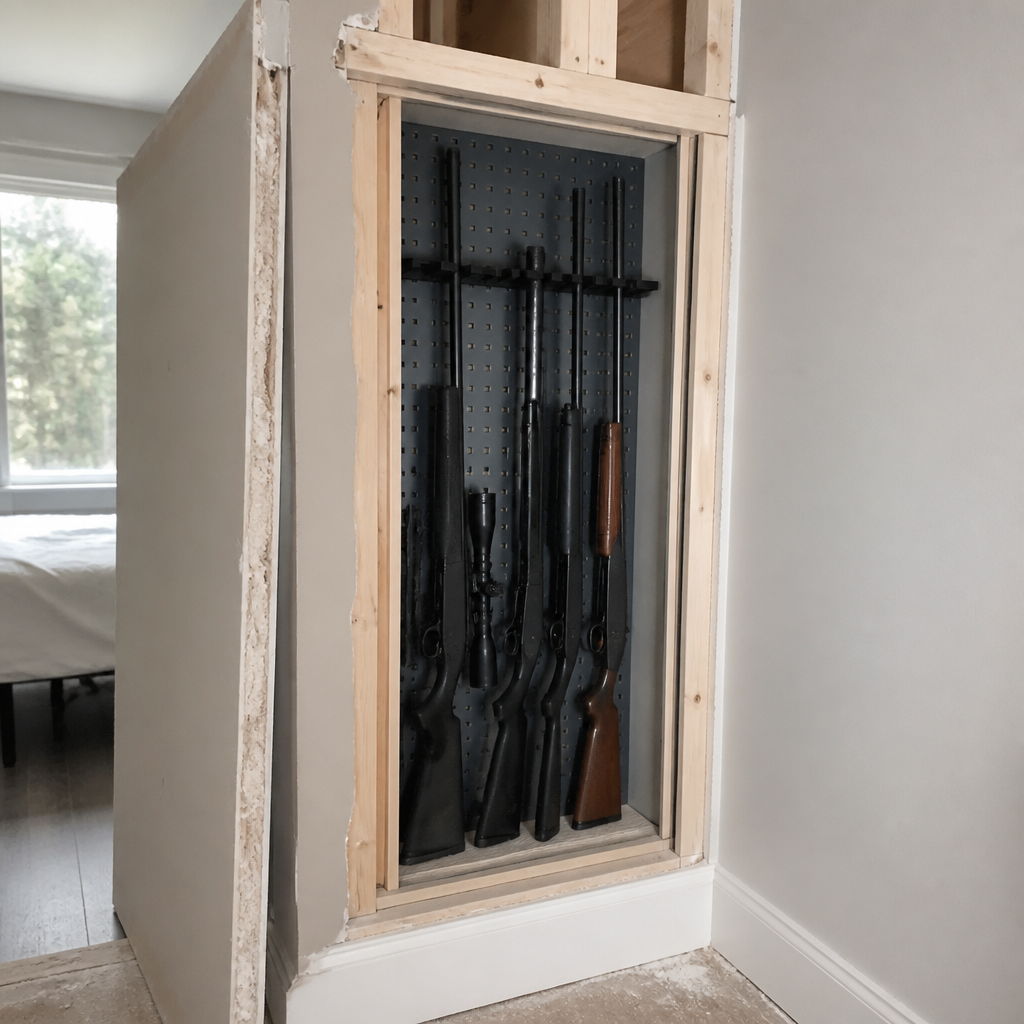
Gun storage inside false walls offers a discreet way to secure firearms while preserving fast access, but it only works when concealment, structural planning, and safe handling are treated as one system. In this context, a false wall is any intentionally built cavity, chase, recessed compartment, or secondary surface that hides a storage space behind normal-looking finishes such as drywall, paneling, shelving, millwork, or trim. Hidden and discreet gun storage solutions include everything from magnetic picture-frame compartments to full-depth stud-bay vaults, yet false-wall storage sits at the center of the category because it can balance invisibility, capacity, and daily usability better than many off-the-shelf products. I have worked with homeowners, carpenters, and safe installers on these projects, and the same lesson repeats every time: the hidden compartment matters far less than the way it is integrated into the room, anchored to structure, protected from unauthorized access, and planned around the realities of humidity, fire risk, and local law. For owners who want firearms undetectable to casual visitors, service workers, or opportunistic burglars, hidden wall storage can be effective. For owners who need maximum burglary resistance or code-rated fire protection, a conventional safe may still be the better primary layer.
That distinction matters because “undetectable” has practical limits. A false wall can disappear visually, avoid obvious safe signatures, and defeat the quick sweep that drives many residential thefts. It cannot guarantee secrecy against a determined intruder using time, demolition tools, or detailed prior knowledge of the home. It also does not remove the core responsibilities of safe gun ownership. Firearms must remain inaccessible to children and prohibited persons, protected against corrosion, documented for insurance purposes, and stored in a way that aligns with state and local requirements. As the hub for hidden and discreet gun storage solutions, this guide explains where false-wall systems work, where they fail, which build methods are most credible, and how to think about layered security instead of gimmicks.
What false-wall gun storage does well, and what it does not
The main advantage of gun storage inside false walls is concealment through normalcy. A burglar often has minutes, not hours. In many break-ins, thieves target jewelry boxes, dresser drawers, closets, bedside tables, garages, and obvious safe locations first. A wall cavity concealed behind a bookshelf face, removable slat panel, mirrored medicine cabinet, acoustic treatment, or built-in headboard does not advertise value. In projects I have seen work well, the best designs avoid theatrical “secret room” cues and instead mimic standard architectural details already present in the house. A section of wainscoting that matches adjacent trim, or a recessed cabinet masked by a utility panel in a workshop, draws less attention than a novelty moving painting.
Capacity is the second advantage. A stud bay between 16-inch-on-center framing can hold handguns, documents, magazines, and some takedown long guns. A deeper false wall built in a basement, closet, office, or media room can accommodate full-length rifles, suppressor-ready configurations, spare optics, and maintenance gear. That flexibility makes false walls useful as a hub strategy within discreet storage: one primary hidden compartment for ready access, plus secondary hidden caches for overflow, paperwork, or emergency equipment.
The weaknesses are just as important. Standard drywall and trim provide almost no burglary resistance by themselves. A hidden compartment without steel reinforcement, solid lock hardware, and proper anchoring is concealment, not a safe. Fire protection is also limited unless the build incorporates tested materials, insulation choices, and internal barriers, and even then it will not equal a true fire-rated safe unless specifically engineered. Moisture control can become a hidden problem, especially on exterior walls, basement walls, and areas near HVAC chases. Finally, emergency access can suffer if the mechanism is too clever. A storage system that looks invisible but jams during a power outage, or requires a phone app that fails, is poorly designed.
Best locations for hidden wall firearm storage
Location determines whether false-wall storage remains unnoticed and functional over time. The best placements are low-traffic private spaces that already support built-ins, utility access panels, or visual complexity. Primary bedroom closets are common because they provide privacy and allow concealed storage behind wardrobe panels, shoe shelving, or a full-height mirror. Home offices work well because bookshelves, framed art, acoustic panels, and cabinetry create natural cover. Basements offer more framing freedom and depth, especially for long-gun storage behind utility partitions or workshop walls, but they demand stricter moisture management.
Avoid exterior walls when possible. They are harder to insulate correctly after modification, more vulnerable to condensation, and often interrupted by wiring, plumbing, vapor barriers, or fire blocking. Avoid walls shared with garages unless you understand code separation issues and temperature swings. Avoid obvious “male hobby room” tells such as a single large flag panel in a sparsely decorated room; concealment works best when it disappears into an ordinary design language.
| Location | Why it works | Main risk | Best use |
|---|---|---|---|
| Bedroom closet | Private, easy to disguise with shelving or mirrors | Limited depth | Handguns, documents, compact long guns |
| Home office wall | Bookshelves and cabinetry hide seams naturally | Frequent guests or cleaners | Mixed-access storage with fast retrieval |
| Basement partition | Can create larger cavity with custom framing | Humidity and water intrusion | Rifles, gear, bulk storage |
| Workshop utility wall | Panels and service access look normal | Tool exposure, dust, vibration | Ruggedized secondary cache |
Within any room, choose a position that allows a natural stance and clear draw path. If the storage is meant for defensive use, test whether doors, furniture, or bed placement obstruct access. If it is meant for low-frequency retrieval, prioritize concealment over speed. These use cases should not be mixed casually. A family with children may choose a hidden wall vault with a mechanical push-button lock in a closet for one defensive handgun, while keeping the rest of the collection in a heavier safe elsewhere.
How to build concealment that stays believable
Believability comes from matching the room, not from adding theatrical hardware. The compartment face should align with existing trim reveals, shadow lines, baseboards, and paint sheen. Drywall access panels can work in utility spaces, but living areas usually benefit from millwork: beadboard, shiplap, cabinet fronts, slat walls, book spines on a pivoting shelf, or framed mirror assemblies. The reveal gap is where many amateur builds fail. If one panel has different spacing, nail patterns, or paint texture than surrounding surfaces, observant visitors notice.
Concealment mechanisms generally fall into four categories: lift-off panels, push-latch doors, hinged disguises, and motorized openings. Lift-off panels are simple and silent, with few failure points, but they are slower and usually require two hands. Push-latch doors can disappear nicely within cabinetry but must be tuned to avoid accidental opening. Hinged disguises, such as mirrors or shallow bookcases, offer good access yet add weight and require stronger mounting. Motorized systems look polished but introduce the highest failure risk and should always include a manual override.
The best hidden wall firearm storage also minimizes evidence of repeated use. Finger-smudged frames, worn carpet tracks, or polished touch points around a hidden latch create patterns. I recommend designing an opening method that can be operated consistently without visible wear, then practicing it enough that access is calm and repeatable. Fast access comes from familiarity, not novelty.
Security features that matter more than secrecy
A false wall should hide a lockable container or lockable inner compartment, not just a firearm resting in a cavity. At minimum, use a welded steel insert, commercial in-wall gun vault, or reinforced cabinet body secured to studs or masonry anchors. Thin-gauge sheet-metal boxes provide little pry resistance; thicker steel, continuous hinge protection, and anti-pry door returns are worth the added cost. Simple Residential Security Container designs can be suitable for hidden use, even if they are not equivalent to high-end burglary safes.
Lock choice should reflect your threat model. Mechanical simplex-style push-button locks are durable, battery-free, and strong for quick-access compartments. Electronic keypad locks are faster for some users and support audit features on premium units, but batteries and solenoids add maintenance. Biometric locks can be useful as a secondary convenience layer, yet fingerprint readers vary widely in reliability depending on skin condition, angle, and sensor quality. For a hidden wall system, I prefer a strong mechanical or keypad primary lock and treat biometrics as optional.
Anchoring is nonnegotiable. If the compartment can be ripped out of the wall, concealment has failed at the first pry bar. Reinforce framing around the opening, distribute load across multiple studs, and use lag bolts or structural screws appropriate to the substrate. In masonry basements, use rated anchors and account for uneven walls. If the compartment stores more than one long gun, calculate total load including ammunition and accessories. Many improvised shelves sag over time, telegraphing the secret through cracked caulk or misaligned trim.
Environmental protection, legal issues, and practical upkeep
Inside-wall storage creates a microenvironment. Firearms placed in enclosed cavities can trap moisture, especially near concrete, plumbing, or poorly insulated exterior sheathing. Use a hygrometer, rechargeable desiccants or rod-style dehumidification where power is available, and closed-cell insulation strategies that do not hold water against steel. Protect contact points with silicone-treated socks or inert foam cutouts, not cheap open-cell foam that can retain moisture and solvents. If the compartment is in a basement, inspect seasonally for mildew smell, rust bloom on screws, or cold-surface condensation.
Legal compliance is local and specific. Some jurisdictions impose safe-storage duties when minors could access firearms. Others define locking requirements after transport or during temporary absence. Landlords, military housing, and homeowners insurance policies may add separate rules. Hidden storage does not exempt an owner from any of these obligations. Documentation also matters: keep serial numbers, photographs, and purchase records in a separate secure location, ideally encrypted digitally and backed up offsite.
Maintenance should be scheduled, not improvised. Quarterly, test the opening mechanism, lock, anchors, humidity control, and lighting. Replace batteries before they fail. Verify that optics have not shifted if rifles are stored vertically in contact with racks. Clean dust from vents or moving panels. Most hidden storage failures are mundane: dead batteries, warped trim, swollen wood from seasonal humidity, or a latch blocked by household clutter. The owners who get this right treat the compartment like any other security device and inspect it accordingly.
How false walls fit into a complete discreet storage plan
False walls work best as one layer in a broader storage strategy. A robust approach often includes a conventional safe for the bulk of the collection, a hidden quick-access compartment for one defensive firearm, and separate discreet storage for documents, ammunition, and backup valuables. This division reduces concentration risk. If one layer is discovered or damaged, not everything is lost. It also lets each storage type do the job it is best at: a rated safe for burglary delay and some fire protection, a hidden wall compartment for concealment, and portable lockboxes for travel or temporary staging.
As a hub for hidden and discreet gun storage solutions, this topic connects naturally to in-wall safes, concealed furniture vaults, under-bed drawers, mirror safes, bookshelf compartments, and decoy-room design. The same principles apply across all of them: avoid obvious patterns, favor simple mechanisms, protect against unauthorized access, control humidity, and plan for real human use under stress. If you are deciding where to start, begin by defining the firearm’s purpose, the likely threat, and the room that can support believable concealment without compromising safety.
Gun storage inside false walls can be highly effective when the goal is to keep firearms out of sight, reduce discovery during quick burglaries, and preserve practical access in a private part of the home. It succeeds because concealment buys time and avoids the visual cue of a traditional safe. It fails when owners confuse hidden with secure, skip structural reinforcement, ignore moisture, or rely on gimmicky access methods. The strongest projects combine discreet design, a real locking steel compartment, careful anchoring, and routine maintenance.
The key takeaway is simple: make the wall believable, make the container strong, and make the storage plan layered. Choose interior locations when possible, match surrounding finishes precisely, use a lock you trust under stress, and manage the environment inside the cavity as carefully as you manage the appearance outside it. If your collection is large or your burglary and fire concerns are high, pair false-wall storage with a conventional safe rather than treating one solution as universal.
For most responsible owners, hidden and discreet gun storage solutions are not about novelty. They are about reducing attention, controlling access, and fitting firearm security into the actual architecture of daily life. Review your rooms, threat model, local storage rules, and access needs, then map where a false-wall system belongs in your overall gun safety plan. If the design cannot stay hidden, locked, dry, and usable, revise it before a single tool touches the wall.
Frequently Asked Questions
Is storing guns inside a false wall actually secure, or does it only provide concealment?
Storing firearms inside a false wall can be highly effective, but only when concealment and security are treated as two separate goals. A false wall is excellent at reducing visibility and avoiding obvious detection during everyday life, but concealment alone does not automatically prevent unauthorized access. If a hidden compartment can be opened with light pressure, a magnetic latch, or a decorative panel that anyone can move, it is discreet, but not truly secure. For a false-wall system to function responsibly, the hidden cavity should include a locking mechanism, child-resistant access control, and a structure strong enough to resist casual tampering.
Good hidden storage also depends on context. A compartment behind built-ins, trim work, shelving, or a recessed chase can blend naturally into a room and avoid drawing attention, which is often the first layer of defense. However, the firearms inside should still be protected from children, guests, workers, and burglars who may discover the space by accident or during a search. That is why many well-designed false-wall installations combine discreet exterior finishes with a hardened interior insert, such as a lockbox, steel enclosure, or purpose-built gun vault fitted inside the cavity.
In practical terms, the best approach is to think of a false wall as a concealment shell around a secure storage core. That combination preserves fast access while maintaining safer control over the firearms. If the installation only hides the guns but does not physically secure them, it may create a false sense of safety. A strong design uses concealment, restricted access, structural stability, and safe firearm handling as one integrated system.
What should be considered when planning a false wall for hidden firearm storage?
Planning is the most important part of a false-wall gun storage project because the success of the installation depends on far more than just finding an empty space. The location should allow discreet access without interfering with normal room use, and it should not compromise the integrity of existing framing, wiring, plumbing, insulation, HVAC chases, or fire-blocking elements. Before any wall is opened or modified, it is important to understand what is inside the cavity and whether the area can safely support a concealed storage system.
The dimensions of the firearms and accessories matter as well. Long guns require enough height or diagonal clearance for retrieval without snagging optics, slings, or mounted lights. Handgun storage may allow a shallower cavity, but owners still need room for secure mounts, lockable inserts, and a smooth presentation angle. Access speed also influences design. A panel that blends perfectly into surrounding millwork may still fail if it cannot be opened quickly and quietly when needed. In other words, the storage compartment must balance invisibility with practical usability.
Environmental factors are another key consideration. Interior walls can experience temperature swings, humidity variation, and dust infiltration, especially near exterior boundaries, basements, garages, and attics. Firearms stored in hidden cavities should be protected against moisture and corrosion with proper finishing, air management, and routine inspection. Finally, the visual design should look natural. The best false walls do not advertise themselves through uneven trim, awkward room proportions, mismatched panel lines, or hardware that seems out of place. If the concealment feature stands out, it undermines the entire purpose of the storage system.
How can a false-wall gun storage compartment remain accessible while still staying undetectable?
The key is to design access around normal room behavior. A hidden compartment should be concealed behind a surface that already makes sense in the space, such as paneling, built-in shelving, wainscoting, a recessed feature wall, trim details, or millwork that appears purely decorative. When the compartment is integrated into something visually expected, it is much less likely to attract attention than a standalone hidden panel or an obviously modified section of drywall.
Fast access usually comes from minimizing unnecessary steps while avoiding visible cues. That means the user should be able to reach the compartment without moving large furniture, clearing clutter, or performing an awkward sequence that would be difficult under stress. At the same time, there should be no exposed handles, obvious seams, or repeated wear patterns that reveal how the panel opens. Well-designed hidden storage often uses concealed hinges, touch-latch systems, disguised release points, or electronically controlled locks hidden within otherwise ordinary architectural elements.
That said, “undetectable” should never mean unsafe. Accessibility must be limited to authorized users, especially in homes with children or frequent visitors. If the design favors instant entry over secure entry, it may improve speed at the cost of responsible control. The best systems achieve both by combining discreet access methods with locks, retention mounts, and thoughtful placement. The result is a compartment that does not invite discovery during ordinary use of the room, but still allows the owner to reach the firearm efficiently when necessary.
Are there safety, legal, or code issues to think about before building hidden gun storage into a wall?
Yes, and these issues should be taken seriously from the start. Firearm storage laws vary by state, locality, and household circumstances, especially when minors are present. In some areas, owners may be required to use locking devices or store firearms in a manner that prevents unauthorized access. A hidden wall compartment may satisfy the concealment goal, but if it is not locked or child-resistant, it may still fall short of legal or best-practice expectations. Owners should confirm how safe storage rules apply where they live and make sure the hidden system supports compliance rather than merely secrecy.
Building and safety considerations matter too. Modifying a wall without understanding structure can create problems ranging from damaged utilities to weakened framing. Hidden compartments should not interfere with load-bearing members, electrical runs, plumbing lines, ventilation systems, insulation performance, or fire-stopping features. In some homes, especially multifamily buildings or newer construction, careless modifications can violate code requirements or create hazards that are expensive to correct. If there is any uncertainty, consulting a qualified contractor or building professional is the responsible move.
There is also the issue of safe handling inside the storage space itself. Firearms should be stored in a condition consistent with the owner’s training, local law, and risk profile, and the compartment should support secure orientation, retention, and trigger protection. Ammunition, magazines, and accessories should be organized so they do not interfere with retrieval or create unnecessary handling complexity. In short, hidden storage should never bypass the same legal awareness and safety discipline expected of any other firearm storage method.
What are the most common mistakes people make with false-wall gun storage?
One of the biggest mistakes is focusing entirely on the hidden panel while ignoring the storage system behind it. A compartment can look brilliantly concealed from the outside and still perform poorly if the firearm is hard to grip, improperly supported, exposed to moisture, or accessible to unauthorized users. Another common error is choosing a location based only on convenience rather than structure, room layout, and natural sight lines. If a panel is placed where people constantly lean, clean, rearrange furniture, or inspect shelving, the chance of accidental discovery goes up significantly.
Poor visual integration is another frequent problem. Many concealed compartments fail because they look slightly “off.” Uneven trim, unusual spacing, fresh paint differences, repeated scuff marks, or hardware that does not match the surrounding finish can all signal that something is hidden. In concealed storage, subtlety matters. The compartment should disappear into the architecture of the room rather than calling attention to itself through novelty or gimmicks.
People also underestimate maintenance. Hidden gun storage is not a set-it-and-forget-it solution. Firearms should be checked regularly for corrosion, dust, function, and retention. Locks, latches, hinges, and electronic access components should also be inspected to ensure they work reliably every time. Finally, many owners make the mistake of relying on concealment as their only layer of protection. The best false-wall setups use layered security: discreet placement, natural-looking finishes, restricted access, strong internal retention, and consistent safe-storage habits. When any one of those elements is missing, the system becomes weaker than it appears.