
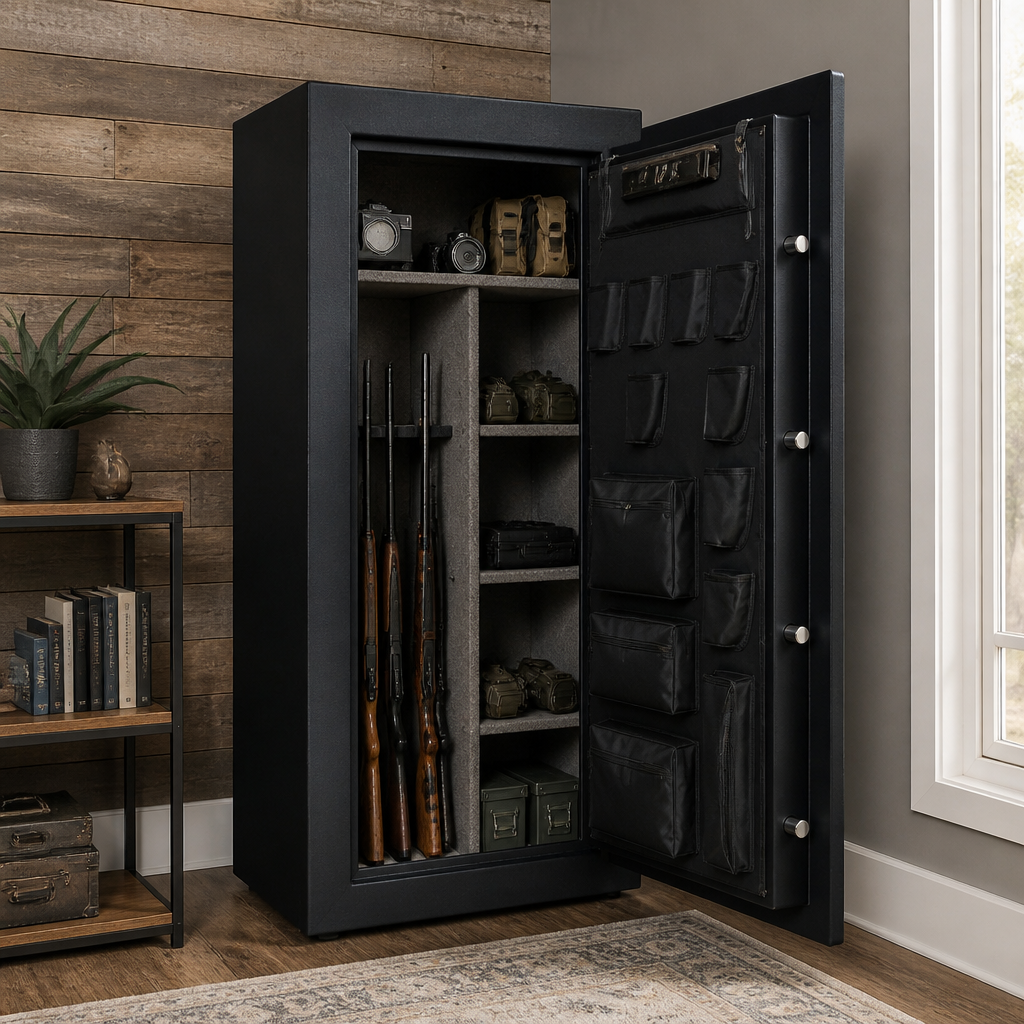
The Liberty Safe Freedom 30 sits in a practical middle ground that many gun owners actively search for: more capacity and stronger construction than entry-level cabinets, without the price, weight, or complexity of premium vault-class safes. In the gun safes and safety category, this makes it an important model to evaluate because it reflects what most households actually buy. A mid-tier safe must balance theft resistance, fire protection, interior flexibility, delivery constraints, and long-term value. If it misses on any one of those factors, ownership becomes frustrating fast.
When I review safes in this class, I look beyond brochure claims and focus on how they perform in normal use. Key terms matter here. Capacity refers to the manufacturer’s stated long-gun count, though real usable capacity is usually lower once optics, slings, and wider stocks are involved. Fire rating describes how long the safe is designed to maintain survivable interior temperatures during a standardized heat exposure. Gauge measures steel thickness, and lower gauge numbers indicate thicker steel. Locking bolts, relockers, hard plates, door organization, anchor points, and dehumidification options all affect whether a safe works well over years, not just on delivery day.
The Freedom 30 matters because it addresses a common buying problem. Many gun owners outgrow small safes quickly, yet they do not need a flagship model with heavy plate construction and luxury interiors. They need a credible residential security container for rifles, pistols, documents, and accessories in a footprint that still fits a garage, closet, utility room, or spare room. As a product review hub, this article also sets the standard for how to compare gun safes intelligently: not by headline capacity alone, but by construction details, lock quality, internal layout, serviceability, warranty support, and the way a safe fits real ownership patterns.
What the Liberty Safe Freedom 30 Is Designed to Do
The Freedom 30 is best understood as a general-purpose home gun safe aimed at the broad center of the market. Liberty positions it for owners who want recognizable brand support, baseline fire protection, and enough internal room for a meaningful collection. In practical terms, that means a safe that can store a mix of bolt-action rifles, scoped AR-pattern carbines, handguns, ammunition kept within reasonable moisture limits, passports, and estate documents. It is not intended to stop a prolonged attack with power tools by a determined crew, but it is designed to delay smash-and-grab theft and protect contents during many residential fire scenarios.
That design goal is exactly why the Freedom 30 belongs in a product reviews hub. It is a reference point. Once buyers understand where this safe fits, they can compare upward to heavier lines such as Liberty Colonial, Franklin, or Lincoln, and downward to stack-on style cabinets or bare-bones imported boxes sold primarily on price. In my experience, the mid-tier category is where the smartest purchasing decisions happen, because buyers have enough budget to obtain meaningful protection, yet not so much that they can ignore tradeoffs.
Security Construction: Where Mid-Tier Value Is Won or Lost
The first question most buyers ask is simple: how secure is the Liberty Safe Freedom 30? The honest answer is that it is meaningfully better than a cabinet and meaningfully less robust than a high-end composite or plate safe. That may sound obvious, but it is the correct framework. Mid-tier safes derive their value from layered delay features rather than one massive defensive element. Those layers typically include formed steel body construction, a reinforced door, active locking bolts, drill-resistant hard plate protecting the lock area, internal hinges or protected external hinge designs, and anchor holes that let the owner bolt the unit to concrete.
In use, anchoring is nonnegotiable. A safe in this class can often be tipped, pried, or removed entirely if left free-standing. Anchoring to a concrete slab with quality wedge anchors dramatically changes the attack profile by preventing thieves from gaining leverage or moving the safe to a less visible work area. I have seen average safes perform well when properly installed and surprisingly expensive safes perform poorly when left unsecured in a garage corner.
The lock matters just as much. Liberty commonly offers electronic and mechanical options across many models and trim levels. An electronic lock gives faster access and easier code changes, which many families prefer for defensive firearms. A mechanical dial has no battery dependency and remains attractive to owners who prioritize long service intervals and straightforward reliability. Neither is automatically better. What matters is choosing a proven lock from a recognized maker and testing it regularly. For a review hub, that point matters because lock quality is often more important than cosmetic upgrades buyers notice first.
Fire Protection and What the Rating Really Means
Fire ratings are among the most misunderstood parts of any gun safe review. Buyers often compare one printed number against another as if those figures were universally standardized. They are not. Different manufacturers use different testing protocols, temperatures, and measurement methods, which makes direct comparisons imperfect. The Liberty Safe Freedom 30 offers fire protection that is competitive for a mid-tier safe, and that is useful, but the correct reading is practical rather than absolute. It gives you a margin of safety in common house-fire conditions; it does not make contents indestructible.
For gun owners, that matters in three ways. First, paper documents char at lower temperatures than many people expect, so anything truly irreplaceable should still be stored in dedicated document protection inside the safe. Second, optics, adhesives, polymers, and ammunition packaging can all be affected by heat and smoke even if the firearms themselves survive. Third, placement within the home influences survival odds. A safe installed against an exterior wall on a concrete slab often faces a different heat profile than one on an upper floor surrounded by combustibles. Good product reviews always connect the lab claim to the installation reality.
Capacity, Interior Layout, and Real-World Storage
Stated capacity is where expectations most often collide with reality. A “30 gun” safe rarely stores thirty modern long guns comfortably unless many are slim, unscoped, and arranged with unusual discipline. Add large objective lenses, bipods, adjustable stocks, suppressor-ready barrel lengths, or soft cases, and practical capacity drops fast. For most owners, the Freedom 30 should be evaluated as a roomy safe for perhaps half to two-thirds of its advertised long-gun number if rifles wear optics and accessories. That is not a flaw unique to Liberty; it is how the entire category works.
The more important question is whether the interior is adaptable. Adjustable shelving, door panel storage, pistol pockets, and modular racks often matter more than one extra row of nominal long-gun slots. A buyer with ten rifles, six handguns, passports, tax records, and magazine bins may need a different interior than a hunter storing twenty similarly configured long guns. In practice, owners who organize by use case rather than by maximum count get more from a mid-tier safe. Keep defensive firearms easiest to access, put seasonal hunting rifles deeper in the array, and use upper shelves for documents and serialized accessories.
| Evaluation Area | What to Check on the Freedom 30 | Why It Matters |
|---|---|---|
| Usable gun capacity | Count rifles with optics, slings, and wider stocks | Advertised capacity is usually optimistic |
| Door storage | Pistol pockets, document sleeves, accessory pouches | Frees shelf space and improves access |
| Shelf flexibility | Adjustable or removable interior sections | Supports mixed firearm and document storage |
| Anchoring options | Factory anchor holes and floor type at installation site | Prevents removal and reduces pry leverage |
| Moisture control | Space for desiccants or an electric dehumidifier rod | Protects bluing, optics, and paperwork |
How the Freedom 30 Compares With Entry-Level and Premium Safes
Compared with entry-level gun cabinets, the Freedom 30 is in a different class. Cabinets are mainly access-control devices. They keep children, casual visitors, and opportunistic thieves away from firearms, but their thin sheet metal and simple locking arrangements are not designed for serious attack resistance. The Freedom 30 offers heavier construction, a real locking system, fire protection, and a more substantial door structure. That difference becomes especially important for owners storing multiple long guns, pistols, tax stamps, or family documents in one place.
Compared with premium safes, however, the Freedom 30 gives up steel thickness, aggregate mass, decorative fit and finish, interior luxury, and often more sophisticated locking-bar geometry. Higher tiers may include thicker bodies, upgraded fire insulation packages, finer interior customization, and stronger anti-pry designs. Those advantages are real, but so are the costs. Premium safes can be dramatically heavier and more difficult to install, especially on upper floors or through narrow residential entries. For many households, the Freedom 30 lands in the best-value zone because it delivers credible protection without creating a logistical project that delays the purchase for another year.
Installation, Placement, and Long-Term Ownership Costs
A safe review is incomplete if it ends at the showroom floor. Installation determines whether the safe performs as intended. The best placement is usually a low-visibility area with a stable floor, limited humidity swings, and enough clearance for the door to open fully. Concrete slabs are ideal because they support weight well and simplify anchoring. In garages, moisture management becomes more important; in finished interiors, concealment often improves but floor-loading should be verified for very heavy units. The Freedom 30 is substantial, yet still manageable enough for professional movers to place in many standard residential locations without the extraordinary equipment some heavier safes require.
Ownership costs continue after delivery. Electronic locks need periodic battery changes. Any safe storing blued steel should have humidity control, whether through rechargeable desiccants or a powered dehumidifier rod. Interior layouts evolve as collections change, so buyers should consider shelf replacement and accessory compatibility. Liberty’s broad dealer network and brand familiarity help here because service, accessories, and support tend to be easier to source than for obscure imports. That support infrastructure is part of value, even if it is not listed on a spec sheet.
Who Should Buy the Liberty Safe Freedom 30
The Liberty Safe Freedom 30 is a strong fit for three buyer types. First, it suits the growing gun owner moving up from a starter cabinet or undersized safe after adding optics-equipped rifles and handguns. Second, it works well for the family that wants one centralized location for firearms, important papers, and a few valuables without stepping into luxury-safe pricing. Third, it fits the practical enthusiast who values a known brand, dealer support, and a balanced feature set more than prestige trim.
It is less ideal for collectors with large, high-value inventories, for owners wanting true commercial burglary protection, or for anyone who knows they will exceed the interior within a year. In those cases, buying one tier larger or one tier heavier is usually cheaper than replacing the safe later. The safest buying rule I give clients is simple: buy for your collection three to five years from now, not for what you own today.
The Liberty Safe Freedom 30 earns its place as a great mid-tier option because it solves the real problem most gun owners face: securing a meaningful collection with credible fire protection and manageable cost. Its strengths are balance, brand support, practical capacity, and everyday usability. Its limitations are the same ones found across the category: optimistic gun counts, security that depends heavily on proper anchoring, and protection levels that should be understood realistically rather than romantically.
As the hub for product reviews within gun safes and safety, this model is an excellent benchmark. It shows how to judge a safe by construction, lock quality, fire claims, usable interior space, installation demands, and long-term ownership factors instead of marketing gloss. If you are comparing safes in this class, use the Freedom 30 as the middle reference point: better than budget storage, not a substitute for premium plate-heavy protection, and often the smartest value for normal households.
Before you buy, measure your space, count your firearms with accessories attached, choose the lock style you trust, and budget for professional delivery plus anchoring. Then compare the Freedom 30 against the next size up and the next tier up. That simple step prevents most buyer’s remorse and helps you choose a safe that will still serve you well years from now.
Frequently Asked Questions
Is the Liberty Safe Freedom 30 a good choice for someone who wants more than a basic gun cabinet but is not ready for a premium safe?
Yes, that is exactly where the Liberty Safe Freedom 30 tends to make the most sense. It is built for gun owners who have moved beyond the limitations of lightweight sheet-metal cabinets and want a more serious level of security, fire protection, and storage organization without stepping into the much higher costs associated with heavy-duty premium safes. For many households, that middle-ground positioning is what makes it appealing. You get a product that feels meaningfully more substantial than entry-level storage, but it is still realistic in terms of budget, placement, and day-to-day use.
From a practical standpoint, this type of safe usually appeals to owners with a growing firearm collection, families that want a more responsible storage solution, and buyers who understand that “good enough” security often means balancing several factors instead of chasing the most extreme specifications. A premium vault-class safe can offer thicker steel, more advanced locking options, and higher-end fire ratings, but those upgrades also bring major increases in weight, price, and installation complexity. The Freedom 30 is attractive because it gives many buyers the core features they actually need: solid theft deterrence, better structure than bargain options, room for long guns and accessories, and a format that is still manageable in a garage, closet, or spare room.
In other words, the Freedom 30 is often a strong fit for buyers who value practical security. It is not designed to be the last word in high-security residential storage, but it does represent a meaningful step up from entry-level choices. If your goal is to secure firearms responsibly, organize them well, and invest in a safe that reflects real-world needs rather than luxury-level specifications, this model sits in a very sensible part of the market.
How much can the Liberty Safe Freedom 30 really hold, and is the stated gun capacity realistic?
Like most gun safes, the stated capacity should be treated as a best-case estimate rather than a guarantee of how many firearms you will comfortably store in normal use. Manufacturers typically base long-gun counts on slim rifles or shotguns placed closely together, often without optics, oversized stocks, slings, bipods, or other accessories that take up extra space. In the real world, many gun owners have scoped rifles, modern sporting rifles, pistol grips, wider fore-ends, and soft cases or gear that all reduce usable capacity. That means the Liberty Safe Freedom 30 may not practically store 30 long guns in the way many buyers imagine.
For most owners, the better question is not the advertised maximum, but whether the interior layout matches their actual collection. If you have a mix of hunting rifles, shotguns, a few handguns, ammunition kept separately, and some documents or valuables, a safe in this size class can work very well. If you have several optic-equipped rifles or a growing AR-style collection, the effective capacity may be noticeably lower. In many cases, buyers find that a safe marketed for 30 guns is more comfortably used for a smaller number of long guns plus shelves, bins, handguns, and accessories.
That does not make the safe misleading so much as it reflects how all safe capacities are marketed across the industry. The smart approach is to buy with future growth in mind. If you already think your collection will expand, or if your current firearms have bulkier configurations, choosing a safe with more room than you think you need is usually the better long-term decision. The Freedom 30 can be a strong option because it often provides enough interior flexibility to support a mixed-use setup, which is far more realistic for most gun owners than simply lining up the maximum number of rifles side by side.
How does the Liberty Safe Freedom 30 compare to entry-level and high-end gun safes in terms of security and fire protection?
The Liberty Safe Freedom 30 generally occupies the middle of the market in a very useful way. Compared with entry-level cabinets or bargain safes, it usually offers stronger overall construction, a more serious locking system, better door fit, and improved fire protection. Those upgrades matter because they increase both security and peace of mind. A basic gun cabinet may keep children or casual visitors away from firearms, but it often offers limited resistance to forced entry. A mid-tier safe like the Freedom 30 is intended to create a more credible barrier against smash-and-grab theft attempts while also adding some level of insulation against heat and smoke exposure in a house fire.
That said, it is still important to stay realistic about what “mid-tier” means. The Freedom 30 is not the same as a premium safe with much thicker steel, advanced anti-pry features, more aggressive bolt coverage, and top-shelf fire ratings. Higher-end safes are built for buyers who want longer resistance times, more robust materials, and more refined security engineering. Those are meaningful benefits, but they come at a significantly higher cost and often require more planning for floor support, moving logistics, and installation. For many homeowners, the jump from an entry-level product to a capable mid-tier safe is where the biggest practical value is found.
Fire protection should be viewed the same way. A fire rating is useful, but it should never be interpreted as absolute protection under every possible fire condition. Real house fires vary dramatically depending on room location, burn duration, structural collapse, and firefighting response time. A safe like the Freedom 30 can offer important protection for firearms and some valuables, but it is wise to store irreplaceable documents in specialized document containers if they are especially sensitive. Overall, the Freedom 30’s strength is that it offers a balanced level of theft resistance and fire protection that is appropriate for many households without demanding a premium-safe budget.
What should buyers consider about installation, delivery, and placement before choosing the Liberty Safe Freedom 30?
Installation is one of the most overlooked parts of buying a gun safe, and it matters just as much as the feature list. A safe in the Freedom 30 category is often chosen in part because it offers meaningful storage and protection without the extreme weight and logistical complications of larger premium models, but that does not mean it is easy to move. Buyers should measure everything in advance: doorways, stairwells, hallway turns, closet openings, garage clearances, and the final footprint of the installation space. A safe can be the right size on paper and still become a delivery problem if the path into the home is too tight or includes difficult elevation changes.
Placement also affects long-term satisfaction. Many owners prefer locations that offer some concealment, such as a closet, office corner, or interior room, while others use a garage for convenience and space. Each location has tradeoffs. A garage may simplify delivery and allow more room, but it can expose the safe to temperature swings and humidity depending on the climate. Interior placement may be better for environmental control and discretion, but it can complicate movement and floor loading considerations. Buyers should also think about door swing, lighting, access to power if interior accessories are planned, and whether the location allows comfortable use of shelves and long-gun storage.
One of the most important security considerations is anchoring. Even a well-built safe benefits greatly from being properly bolted down, because anchoring helps prevent thieves from tipping or removing it for later forced entry. Floor type matters here, especially if the safe will be installed over concrete versus wood framing. In addition, consider moisture control from the start. A dehumidifier, desiccant, or interior moisture management plan can help preserve firearms and valuables over time. In short, the Freedom 30 is attractive partly because it is more manageable than a massive high-end safe, but buyers should still treat delivery and installation as a serious part of the purchase decision.
Is the Liberty Safe Freedom 30 a good long-term value for gun owners, or is it better to save up for a more expensive safe?
For many buyers, the Liberty Safe Freedom 30 represents very good long-term value because it aligns closely with how most households actually shop and store firearms. The best safe is not always the most expensive one; it is the one that meaningfully improves security, fits the collection, works in the home, and gets used consistently over many years. In that sense, a mid-tier safe often offers the strongest value proposition. It gives owners a substantial improvement over basic storage while avoiding the steep cost increases that can come with premium construction and specialized features.
Value should be judged in practical terms. If a safe is too expensive, too heavy to place properly, or too large for the available space, then its higher specifications may never translate into better real-world ownership. The Freedom 30 tends to make sense for buyers who want a dependable, recognizable safe from an established brand and who need enough capacity and protection to support a household firearm collection responsibly. It can also be a smart purchase for owners who want some room to grow without immediately outspending their actual needs.
That said, there are cases where saving for a higher-end safe is justified. If you have a very large or high-value collection, if your risk profile is elevated, or if you specifically want heavier steel and more advanced burglary resistance, then stepping up may be worthwhile. The key is being honest about your priorities. For a large segment of gun owners, the Freedom 30 sits in the sweet spot: more capable than entry