
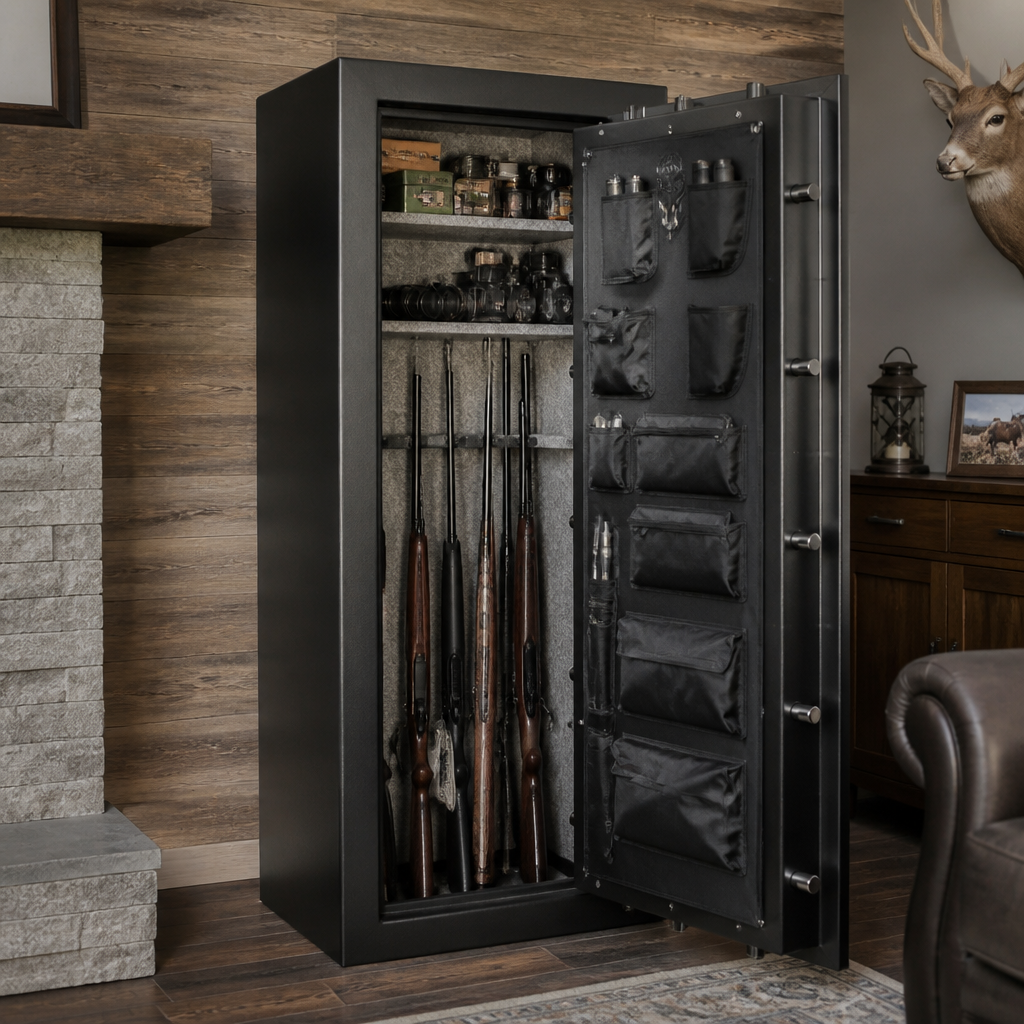
The Rhino A-Series Gun Safe stands out because it treats firearm security as both a protection problem and a furniture-grade design decision. In the gun safes and safety category, many buyers arrive looking for a simple product review, but what they actually need is a framework for comparing construction, fire resistance, lock options, storage flexibility, and day-to-day usability. This article serves as that hub for product reviews, using the Rhino A-Series as the anchor example while connecting the broader issues that matter across the category. If you are evaluating safes for home defense firearms, hunting rifles, collectible long guns, or mixed-use storage for documents and valuables, understanding why the A-Series gets attention will help you judge competing models more accurately.
At its core, a gun safe is a reinforced security container designed to resist unauthorized access, delay forced entry, and protect contents from fire and environmental damage. Those goals sound straightforward, but performance varies widely. Steel thickness, door design, boltwork, relockers, hinges, interior layout, lock type, and anchoring all influence real-world protection. The Rhino A-Series enters the conversation as a premium, visually distinctive line known for antiqued finishes, external strap hinges, and a classic look that fits homes where an industrial black box would be unwelcome. That aesthetic appeal matters more than many reviewers admit, because safes that integrate well into living spaces are more likely to be installed in climate-controlled, observable areas rather than neglected in vulnerable outbuildings.
Practical security still comes first. In my experience evaluating residential safes, shoppers often fixate on one advertised metric such as “gun count” or a headline fire rating and miss the full ownership picture. A safe can claim room for dozens of guns yet become cramped once optics, slings, and shelves are included. A polished finish can look impressive online but scratch easily if the steelwork and coating process are not executed well. Electronic locks can be fast and convenient but should be assessed alongside mechanical reliability, battery access, and serviceability. The Rhino A-Series is worth reviewing in depth because it sits at the intersection of these concerns: luxury appearance, substantial storage, and defensive construction aimed at serious home owners rather than impulse buyers.
As a sub-pillar hub for product reviews, this guide does more than describe one model line. It explains how to read specifications, how to compare marketing claims, and where the Rhino A-Series fits among other residential gun safes. You will see what the line does well, where tradeoffs exist, and which buyer profiles are best served by its features. That makes this article useful whether the A-Series is already on your shortlist or you are still narrowing the field among brands such as Liberty, Fort Knox, Browning, Winchester, and American Security. Product reviews are most valuable when they turn specs into buying decisions, and that is the goal here.
What the Rhino A-Series Is and Why It Draws Attention
The Rhino A-Series is a line of full-size gun safes designed for buyers who want more visual character than the standard matte-finish safe provides. The most recognizable versions use an antiqued finish, decorative metalwork, and old-world styling cues that make the safe resemble heirloom furniture more than commercial security equipment. That design language is not superficial. It targets a common barrier in safe ownership: placement. A large safe that clashes with a room often ends up hidden in a garage or basement, where humidity, temperature swings, and reduced oversight can undermine its long-term value. By contrast, the A-Series is intentionally built to look acceptable in a study, den, or main-floor room.
From a construction standpoint, the A-Series generally competes in the premium residential safe segment. Buyers expect a formed steel body, reinforced door, multiple locking bolts, fire lining, and a branded lock system from manufacturers commonly used across the safe industry, such as SecuRam or Sargent and Greenleaf depending on configuration. Exact specifications vary by model and production year, so any serious review should verify current gauge, composite door details, bolt count, and tested fire rating from the seller or manufacturer. That is a critical product review principle: model names matter less than actual build sheets. Safe lines evolve, and a five-year-old forum post may not describe the safe being sold today.
The attention around the A-Series also comes from its balance of ornament and utility. Some decorative safes are lightly built and rely too heavily on appearance. Rhino’s appeal is that the styling typically sits on top of a true gun-safe platform with adjustable shelving, door organizers, long-gun capacity, and substantial locking hardware. The result is a product line that attracts not only collectors and design-conscious homeowners, but also practical buyers who want one large secure container for firearms, passports, jewelry, optics, suppressor paperwork, and family documents. In product review terms, the A-Series is notable because it solves a problem many buyers do not articulate at first: they need a safe they will be willing to live with every day.
Security Construction: What Actually Protects the Contents
When evaluating any gun safe, including the Rhino A-Series, the first question is simple: what delays forced entry? Real burglary resistance in residential safes comes from layers rather than a single feature. Steel thickness in the body and door matters because thinner metal is easier to pry, peel, or cut. Door fit and frame reinforcement matter because attacks usually focus on the door perimeter. Locking bolts matter, but only in combination with a rigid door structure and secure bolt receptacles. Internal relockers matter because they can keep the safe locked if the main lock is punched or tampered with. Anchoring matters because a heavy safe that is not bolted down can sometimes be tipped, pried, or removed for later attack.
The Rhino A-Series typically earns positive attention here because it is positioned above entry-level big-box safes. Buyers should still read the details carefully. A longer list of bolts is not automatically better if the steel or door structure is modest. Conversely, a well-built door with effective active and passive bolt coverage can outperform flashier marketing. In side-by-side reviews, I pay close attention to body thickness, hardplate protecting the lock, continuous weld quality, door edge profile, and whether the safe includes pre-drilled anchor holes sized for concrete installation. These details reveal more than brochure adjectives ever will.
For practical home use, the A-Series is best understood as a burglary-delay product, not an impenetrable vault. That distinction is important and responsible. Residential gun safes are designed to buy time against smash-and-grab attempts and common pry attacks, especially when anchored and paired with alarms, cameras, and sensible placement. They are not substitutes for commercial TL-rated safes tested to rigorous tool-attack standards. If a buyer needs high-value jewelry storage or faces elevated burglary risk, a true burglary-rated safe may be the better recommendation. For most firearm owners, however, the Rhino A-Series offers the level of layered security that aligns with serious residential use when installed correctly.
Fire Protection, Seal Design, and the Limits of Marketing Claims
Fire resistance is one of the most misunderstood parts of any gun safe review. Many buyers assume a printed time-and-temperature claim can be compared across brands as if it were a universal standard. It cannot, unless the safes were tested under the same protocol by the same independent laboratory. Some manufacturers publish internal test results, some use third-party certifications, and some provide very limited context. The Rhino A-Series should therefore be judged not only by the advertised fire rating, but by the overall fire-protection system: insulation type, door seal design, body construction, and whether the safe will be installed in a conditioned space or an outbuilding.
In practical terms, a gun safe’s fire performance depends on heat transfer, moisture release from insulation materials, and seal expansion around the door gap. Intumescent seals are common because they swell when heated and help block smoke and hot gases. Multi-layer drywall-style insulation is widely used in residential safes, though thickness and placement vary. Some safes emphasize composite construction or poured materials in premium tiers. The A-Series is usually positioned as offering meaningful fire protection for residential scenarios, especially for paper documents and firearms stored in a home rather than a detached structure. That said, no fire safe performs identically in every blaze. Duration, peak temperature, floor collapse, hose stream exposure, and the room’s location all change the outcome.
For review purposes, the smarter question is not “Is the fire rating good?” but “Is the fire package credible for my risk profile?” A suburban homeowner with monitored smoke alarms, a sprinklered newer home, and main-floor installation faces a different risk than someone placing a safe in a workshop full of fuel and tools. The Rhino A-Series makes sense when buyers want a substantial fire feature set without stepping into specialty document-safe territory. To protect irreplaceable paperwork, I still recommend secondary measures inside the safe, such as UL-classified document chests, desiccants, and digital backups of records. Fire protection in gun safes is valuable, but it should be viewed as one layer in a broader protection plan.
Storage, Interior Layout, and Everyday Usability
A gun safe succeeds or fails in daily life based on organization. The Rhino A-Series generally appeals to buyers who want flexible interiors rather than a fixed rack that wastes space. Adjustable shelving supports mixed storage: scoped rifles on one side, handguns and optics above, documents and valuables elsewhere. Door panel organizers can dramatically increase usable capacity by relocating pistols, magazines, and small gear to the door, freeing shelf space for larger items. This is where real-world reviews become more useful than spec sheets. “Thirty-gun capacity” may translate into eighteen practical slots if most long guns wear scopes, bipods, or slings.
| Review Factor | What to Check on the Rhino A-Series | Why It Matters |
|---|---|---|
| Long-gun capacity | Actual spacing with scoped rifles installed | Published counts are usually optimistic |
| Adjustable shelving | Whether shelves can be reconfigured for mixed storage | Supports documents, ammo, and valuables |
| Door organizer | Pistol pockets, zip compartments, and magazine storage | Improves capacity without crowding the floor |
| Interior lighting | Factory lighting or aftermarket compatibility | Makes access faster and safer in low light |
| Dehumidification | Power pass-through and room for rods or desiccants | Helps prevent rust and moisture damage |
The A-Series often earns strong marks for usability because its premium positioning encourages attention to fit and finish inside as well as out. Buyers should still inspect shelf rigidity, carpet quality, door swing clearance, and handle projection. A beautiful safe that is awkward to open in a tight room will become frustrating quickly. I also advise measuring your tallest scoped rifle, not just the safe’s external height. Internal dimensions, shelf placement, and door organizer thickness can reduce usable clearance more than expected.
Another often-overlooked point is growth. Firearm collections rarely shrink. If a buyer currently owns ten long guns, two handguns, and a box of documents, a safe marketed for twenty-four guns may feel full in a year once accessories are added. The Rhino A-Series is usually best for buyers willing to size up. Extra room improves organization, reduces stock dings, and keeps important items visible. In product review terms, usability is not a soft feature; it directly affects security because owners are more likely to lock, maintain, and consistently use a safe that is easy to live with.
Lock Options, Installation, and How the A-Series Compares
Lock choice is one of the most personal decisions in safe buying. Mechanical dial locks are slower but time-tested, require no batteries, and appeal to owners who prioritize simplicity and long service life. Electronic keypad locks offer speed and convenience, especially for buyers who access firearms or documents frequently. Modern electronic locks from established makers can be reliable, but quality varies, and emergency planning matters. On any Rhino A-Series review, confirm the exact lock model, battery location, warranty support, and whether a redundant entry option exists. Fast access is meaningful only if the lock remains dependable over years of use.
Installation is equally important. A premium safe performs poorly if dropped into place without planning. The A-Series is heavy enough that delivery path, floor load, stair access, and final room dimensions should be confirmed before purchase. Once positioned, anchoring into concrete is the standard recommendation for burglary resistance. In wood-floor installations, anchoring should follow manufacturer guidance and local structural realities. I also recommend locating the safe where pry space is limited, humidity is controlled, and the door can open fully. Good placement can make an average safe better and a strong safe significantly harder to attack.
Compared with other product review staples, the Rhino A-Series competes most directly with premium residential safes that blend stronger construction with upgraded interiors and finishes. Liberty’s upper lines often appeal to buyers focused on dealer availability and broad brand recognition. Fort Knox is frequently considered by shoppers seeking extensive customization and heavier build options. Browning emphasizes interior organization innovations, while American Security is often praised for robust steel and security-focused engineering. The Rhino A-Series differentiates itself through appearance without abandoning substance. That makes it especially attractive to homeowners who want one safe to satisfy security requirements and design expectations at the same time.
The main tradeoff is value concentration. Buyers who care nothing about appearance may find more steel-per-dollar elsewhere, depending on model and dealer pricing. Buyers who do care about appearance may find the A-Series uniquely compelling because it reduces the hidden cost of compromise: installing an ugly safe in a bad location. The right conclusion for most reviews is balanced. The Rhino A-Series is not the universal best gun safe, but it is one of the more distinctive premium residential options for buyers who want practical security in a visually refined package.
The Rhino A-Series Gun Safe earns its reputation by addressing the two realities of firearm storage that matter most in homes: a safe must protect contents, and it must fit the way people actually live. Its strengths are clear. It offers a decorative, furniture-friendly exterior that improves placement options, a serious residential security platform with reinforced door construction and modern lock choices, credible fire-protection features, and an interior flexible enough for firearms, accessories, documents, and valuables. Those qualities make it a strong focal point for product reviews within the broader gun safes and safety category.
The most useful takeaway is that buying a gun safe should never be reduced to one spec. Body steel, door design, lock quality, fire package, shelving, anchoring, and room placement work together. The Rhino A-Series performs well because it balances those factors while solving a common homeowner concern that plain reviews miss: visual acceptance. A safe you are willing to place inside the home, bolt down correctly, organize properly, and access consistently is usually a better security decision than a bulkier model hidden in a poor environment. That is the practical advantage behind the A-Series design.
Use this hub as your starting point for product reviews under Gun Safes and Safety, then compare the Rhino A-Series against your actual needs, not just marketing claims. Measure your space, estimate future collection growth, verify current specifications with a dealer, and plan for professional delivery and anchoring. If the goal is aesthetic and practical security in one purchase, the Rhino A-Series deserves a close look.
Frequently Asked Questions
What makes the Rhino A-Series Gun Safe different from a standard gun safe?
The Rhino A-Series Gun Safe is notable because it approaches firearm storage as more than a basic security purchase. Many standard gun safes focus almost entirely on keeping unauthorized users out, which is obviously important, but the A-Series also emphasizes appearance, interior flexibility, and how the safe fits into everyday living spaces. That matters for buyers who do not want a large steel box to feel purely industrial or out of place in a home office, den, or bedroom. The furniture-style exterior and more refined finish give it a different role in the home: it is designed to provide protection while also complementing the room around it.
From a practical standpoint, the Rhino A-Series also encourages buyers to evaluate the full ownership experience, not just a single headline feature. That means looking closely at steel construction, door strength, fire protection ratings, lock choices, shelving arrangements, and accessibility. In that sense, it works well as an anchor example for comparing safes across the broader gun safes and safety category. Rather than asking only, “Is this a good safe?” a more useful question is, “Does this safe balance burglary resistance, fire resistance, organization, and visual design in a way that matches my needs?” The Rhino A-Series stands out because it pushes that broader conversation.
How should I evaluate the security features of the Rhino A-Series before buying?
The best way to evaluate the Rhino A-Series is to treat security as a combination of materials, design, and installation, rather than relying on marketing language alone. Start with the body and door construction. Look at steel thickness, how the door is reinforced, and whether the safe uses substantial locking bolts that engage securely when locked. A safe’s resistance to attack is shaped not only by the steel itself, but also by how well the door frame, hinges, and locking mechanism work together. Buyers should pay particular attention to pry resistance, because many real-world break-in attempts are less sophisticated than people imagine and often involve attacking the door edge or weak structural points.
Next, consider the lock system. The Rhino A-Series may be available with electronic or mechanical options depending on the model and configuration. Electronic locks offer speed and convenience, which can be useful for owners who need quicker access, while mechanical dial locks are often valued for simplicity and long-term reliability. Neither is automatically “better” in every situation. The right choice depends on your priorities, comfort level with electronics, and maintenance expectations. Also remember that even a strong lock can be undermined by poor placement. A safe installed in a hidden location and securely bolted down is significantly harder to remove or attack. In other words, buying the safe is only part of the security equation; proper installation is what allows the safe’s construction features to do their job effectively.
Is the Rhino A-Series a good option for buyers who care about both fire protection and daily usability?
Yes, and that is one of the most useful ways to think about the A-Series. Many buyers shop for fire protection by focusing on a single number, such as a stated fire rating or a temperature claim, but daily usability matters just as much over the life of the safe. A gun safe that offers fire resistance but is frustrating to organize, difficult to access, or poorly suited to your collection may not serve you well in practice. The Rhino A-Series appeals to buyers who want a safe that is protective without becoming inconvenient. That includes features like organized interiors, adaptable shelving, and a layout that supports firearms as well as documents, valuables, and accessories.
When reviewing fire protection, it is wise to look beyond the marketing summary and understand what the fire rating actually represents. Ask how long the safe is rated to withstand heat, under what testing conditions, and whether that rating aligns with the risks in your area and your storage priorities. Then balance that information against real-life use. If you open the safe regularly, store more than long guns, or expect your collection to evolve over time, interior flexibility becomes extremely important. The Rhino A-Series is especially appealing to buyers who do not want to choose between protection and convenience. Instead, it is positioned as a model that can deliver both, provided its specific size, layout, and ratings match your actual needs.
What should I compare between the Rhino A-Series and other gun safes in the same category?
If you are comparing the Rhino A-Series to competing safes, focus on five core areas: construction quality, fire resistance, lock options, storage design, and overall fit for your home. Construction quality includes steel gauge, door thickness, boltwork, hinge design, and whether the unit can resist common forms of forced entry. Fire resistance includes not just the published rating but the credibility and clarity of that rating. Lock options should be assessed in terms of reliability, speed, maintenance, and your own comfort with mechanical versus electronic operation. Storage design includes long-gun capacity, shelf adjustability, door-panel organization, and whether the interior can handle optics, documents, handguns, and accessories without becoming cluttered.
The Rhino A-Series deserves extra attention in the final category: overall fit. Some safes may offer strong technical specifications but feel overly utilitarian for buyers who want a product that integrates into a well-designed room. This is where the A-Series often separates itself. Its appeal is not just that it stores firearms securely, but that it treats the safe as a permanent piece of the home rather than a purely hidden utility item. For some buyers, that is a major advantage; for others, appearance may matter less than maximum capacity or the most aggressive security specs in a price bracket. A strong comparison process should therefore include not only numbers on a spec sheet, but also how the safe will function in your space and whether you will actually be satisfied using it for years.
Who is the Rhino A-Series best suited for?
The Rhino A-Series is best suited for buyers who want a balanced safe rather than a one-dimensional solution. It is a strong fit for homeowners who value secure firearm storage but also care about aesthetics, organization, and how the safe contributes to the room it occupies. That can include collectors, hunting households, firearm owners with mixed storage needs, and buyers who are furnishing a study, office, or living space where visual design matters. It may also appeal to people who began their search expecting a basic product review but then realized they needed a more complete framework for evaluating what really matters in a gun safe.
It is particularly well matched to people who see a gun safe as part of a long-term household security strategy. That means they are thinking beyond simple firearm storage and considering documents, heirlooms, personal valuables, and responsible access management. However, suitability still depends on individual priorities. If a buyer needs maximum capacity at the lowest possible price, or wants a highly specialized high-security safe with different performance priorities, another option may be a better fit. The Rhino A-Series is most compelling for those who want practical protection, fire resistance, flexible organization, and furniture-grade presentation in one package. For that audience, it offers a thoughtful middle ground between utility and design without ignoring the serious security role a gun safe must perform.