
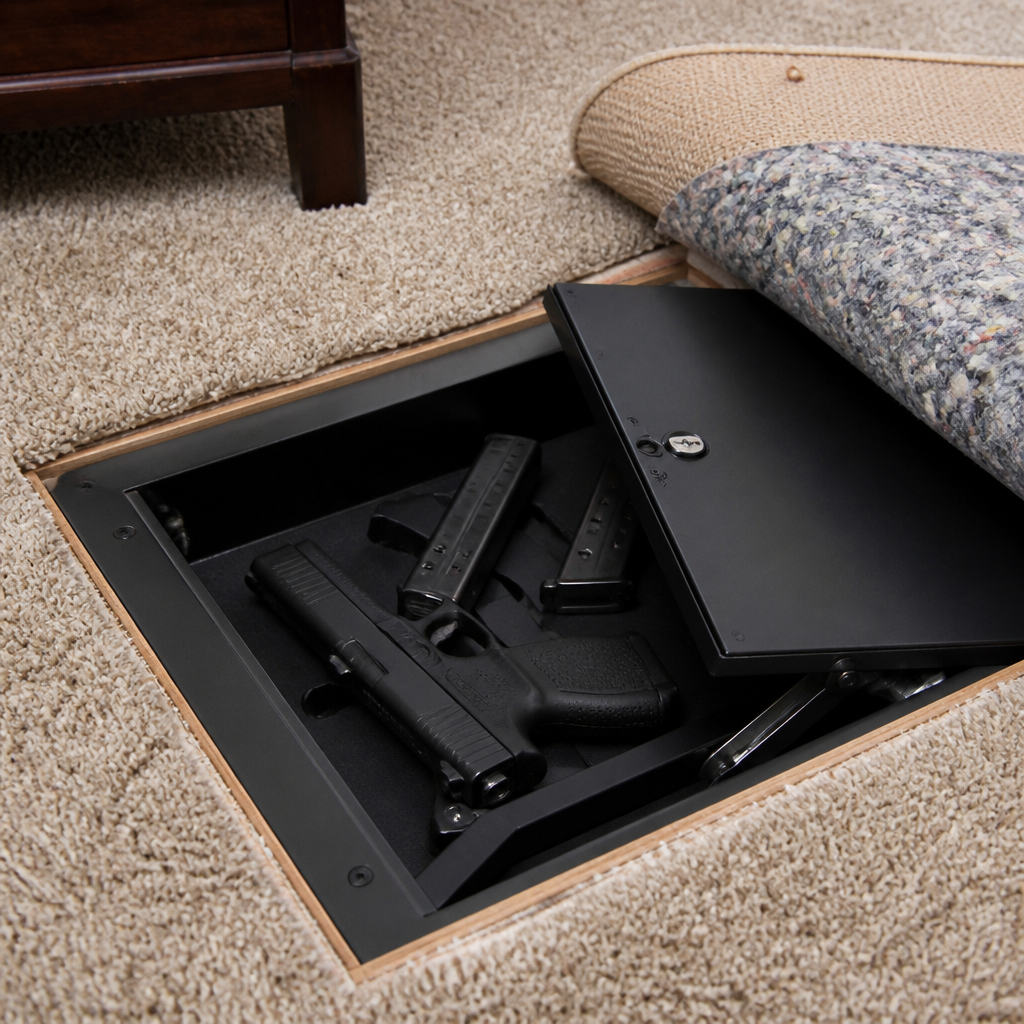
The best floor safes for concealing firearms under carpets combine deep concealment, fast access, and meaningful burglary resistance in a form factor that disappears beneath everyday flooring. For gun owners who want hidden and discreet gun storage solutions, a floor safe installed below a rug or wall-to-wall carpet can solve two problems at once: it keeps firearms out of casual view, and it places them in a hardened enclosure that is far more secure than a nightstand drawer or a hollow furniture compartment. In my experience evaluating residential safe setups, floor safes work best when buyers understand exactly what they are buying: not every in-floor unit is appropriate for firearms, not every locking system is practical under carpet, and not every room in a home provides equal security.
A floor safe is a built-in safe recessed into a concrete slab or framed into a wood subfloor between joists. Once installed, the lid sits flush or nearly flush with the surrounding floor, allowing a carpet, rug, or low-profile cover to conceal the opening. For firearm storage, the term usually refers to a compact safe large enough for one or more handguns, spare magazines, documents, and sometimes valuables such as cash or passports. Some larger models can hold a short-barreled firearm or a takedown platform, but most floor safes are better suited to pistols than long guns.
This category matters because hidden gun storage occupies a middle ground between full-size gun safes and quick-access lock boxes. A traditional upright safe offers the highest capacity and often the best fire rating, but it is visible, heavy, and not always convenient on the floor plan where a defensive handgun is needed. A small bedside box gives speed but rarely provides meaningful concealment and can often be stolen whole if it is not anchored properly. A well-installed floor safe under carpet addresses visibility and anchoring better than either option. Since the safe is recessed below the floor and physically tied into the structure, it is difficult for a thief to spot and even harder to remove quickly.
That does not mean every floor safe is automatically ideal. Buyers need to weigh access speed, moisture control, installation complexity, interior dimensions, and local legal obligations for firearm storage. They also need to think through practical use. A safe hidden beneath a thick carpet pad may be wonderfully discreet, but if the lid catches on the carpet edge or requires two hands and a key in the dark, it may not serve its defensive purpose. Choosing correctly requires matching the safe to the firearm, the room, the subfloor type, and the user’s daily routine.
Why floor safes are effective for hidden and discreet gun storage
Floor safes are effective because concealment and structural integration reinforce each other. Most residential burglaries are fast, opportunistic events. Thieves typically look in primary bedrooms, closets, dresser drawers, and obvious office locations first. They also search for recognizable safe silhouettes, especially compact boxes in closets or under beds. A floor safe under carpet avoids these visual cues entirely. If the safe is flush with the floor and covered by a normal area rug, there is little for a casual intruder to notice without already knowing it is there.
Installation below the finished floor adds another security advantage: the safe cannot be carried away intact like many small handgun vaults. In concrete, the body is literally encased by the slab or grout fill. In wood-frame construction, the safe can be lag-bolted and blocked between joists so that pry attacks are constrained by the surrounding structure. That matters because many residential gun thefts are not sophisticated lock attacks; they are grab-and-go removals of portable containers.
From a storage-planning perspective, floor safes also support layered security. I often recommend using them for one defined role rather than trying to make them do everything. For example, a concealed floor safe in a home office may hold a carry pistol, two loaded magazines, a flashlight, and critical documents, while a larger RSC-rated gun safe elsewhere handles the broader collection. This division keeps one firearm accessible but hidden, without exposing the larger inventory.
There are limitations. A floor safe is usually less spacious than a dedicated pistol cabinet, harder to relocate, and often weaker in fire performance than a premium upright safe. Under-carpet concealment can also complicate quick access if the rug must be moved first. These tradeoffs are manageable, but they should shape the purchase decision.
What makes a floor safe suitable for firearms under carpet
The best floor safes for concealing firearms under carpets share five practical traits: usable interior geometry, a lid profile compatible with flooring, strong lockwork, adequate corrosion protection, and an installation method that resists removal. Interior geometry matters more than many buyers expect. A handgun with a mounted optic, weapon light, or extended magazine may not fit the published dimensions the way a bare pistol would. Foam-lined interiors help prevent finish wear, but removable trays or rigid shelves can interfere with a natural draw angle.
Lid design is equally important. Under carpet, a raised dial or protruding keypad can create a visible hump, telegraphing the safe’s position. Flush lids with recessed pulls are easier to disguise. Mechanical dial locks are proven and durable, but they are slow and inconvenient beneath carpeting. For most defensive handgun applications, a high-quality electronic lock or dedicated push-button mechanical lock is more practical, provided the keypad remains low profile and reliable. The best setup lets the user fold back the rug, open the cover, and unlock the safe without awkward repositioning.
Steel thickness and boltwork deserve scrutiny. Many compact floor safes use 10-gauge to 12-gauge bodies with thicker doors, while better units reinforce the lid with plate steel and anti-pry geometry. Look for hard plate protection over the lock, internal hinges where possible, and relocking features in models intended for security rather than simple concealment. A floor safe hidden under carpet should still resist chisels, pry bars, and punch attacks long enough to defeat a hurried burglary attempt.
Moisture resistance is often overlooked. In-slab floor safes, especially in garages, basements, and ground-floor rooms, are vulnerable to condensation. Firearms stored in enclosed steel boxes can rust surprisingly fast without silica gel, vapor corrosion inhibitors, or a sealed handgun sock. I have seen excellent concealed installs compromised by nothing more dramatic than seasonal humidity. Any shortlist should include a plan for desiccants, periodic inspection, and avoiding direct contact between firearms and damp concrete-adjacent surfaces.
Best floor safe types and key selection criteria
Not all floor safes serve the same user. Some are true burglary-oriented in-floor safes for concrete slabs. Others are between-joist models for wood floors, and some are hybrid hidden compartments marketed more for valuables than firearms. The correct choice depends on the home’s structure and the role the safe will fill. In slab-on-grade homes, steel in-floor safes from established manufacturers such as Hayman, AMSEC, Gardall, and Hollon are common choices because they are designed to be set in concrete and offer stronger body support once installed. In homes with crawl spaces or upper stories, purpose-built between-joist safes or custom framed floor vaults are often more realistic.
| Selection factor | What to look for | Why it matters for concealed firearms |
|---|---|---|
| Installation surface | Concrete slab or joist-compatible design | Determines whether the safe can be anchored securely without weakening the floor |
| Interior size | Depth and width that fit pistols with optics or lights | Prevents access problems and protects ready-use defensive setups |
| Lock type | Low-profile electronic or push-button mechanical lock | Improves opening speed when the safe is hidden under carpet |
| Lid profile | Flush lid with minimal external protrusions | Reduces visible bulges under rugs and improves concealment |
| Moisture control | Coatings, liners, desiccant space, sealed edges | Helps prevent rust in below-floor environments |
| Security construction | Reinforced door, hard plate, relocker, pry resistance | Concealment alone is not enough if discovered during a burglary |
As a rule, concrete floor safes offer the best resistance to removal, while wood-floor options offer easier retrofits and often better bedroom placement. If your main need is discreet storage near a sleeping area, a joist-mounted installation may outperform a concrete garage floor safe simply because it is where you can reach it quickly. If your main need is theft resistance and document storage, a slab-installed model in a low-traffic room may be the stronger answer.
Top use cases, room placement, and real-world installation issues
The most successful hidden and discreet gun storage solutions are designed around room use, not just product specs. Primary bedroom placement is common because it balances concealment and access. A floor safe under an area rug near the bed, inside a closet walkway, or beneath a bench can stay out of sight while remaining reachable. Home offices are another strong location because they naturally justify rugs, furniture, and document storage. A den or study can support a concealed handgun safe without attracting attention from guests.
I am cautious about recommending bathrooms, laundry rooms, and garages unless there is a compelling reason. These spaces tend to have higher humidity, more temperature swings, and greater water exposure. Basements can work, but only if moisture conditions are under control and the user checks the contents regularly. Carpeted basements often seem ideal for concealment, yet they are one of the easiest places to create a rust problem if the slab sweats seasonally.
Real-world installation often determines whether the product performs as promised. In concrete, the safe opening must be cut accurately, spoil removed cleanly, and the body leveled before backfilling. In wood framing, installers must identify joist direction, preserve load paths, and reinforce around the cut opening. A hidden floor safe that weakens the subfloor or squeaks noticeably underfoot defeats part of its purpose by drawing attention. Professional installation is usually worth the cost when structural work or concrete cutting is involved.
Carpet handling deserves planning too. Thick plush carpet and heavy padding can mask the safe well, but they may also impede the lid. Low-pile carpet or a rug with a thin pad often gives the best compromise. Some owners use furniture placement to create a natural reason for a rug to stay in one position, which prevents accidental exposure and makes the concealment look ordinary.
Security, legal, and maintenance considerations before you buy
A floor safe should be judged as one layer in a broader firearms security plan. It is not a substitute for responsible access control, especially in homes with children, frequent visitors, or prohibited persons. State laws differ widely, but many jurisdictions impose criminal liability when a minor gains unauthorized access to a firearm because it was not secured appropriately. A hidden location does not satisfy safe storage requirements by itself. The firearm still needs to be locked in a compliant manner.
Buyers should also be realistic about emergency access. If the firearm is intended for home defense, practice the opening sequence with the room darkened and the rug in place. Time the process safely with an unloaded firearm. If the safe requires kneeling, moving a heavy chair, or lifting a rug corner that tends to snag, adjust the setup. The right concealed safe is the one you can access consistently without fumbling.
Maintenance is straightforward but essential. Inspect the safe interior several times per year, replace desiccants as needed, and check batteries on electronic locks before they become weak. Wipe exterior steel and hinges, confirm the lid still opens freely against the carpet edge, and verify that stored magazines and ammunition remain clean and dry. For corrosion prevention, a silicone-treated gun sock or VCI emitter is inexpensive insurance.
Price varies with construction and installation more than branding alone. The safe itself may be only part of the budget; concrete cutting, finish flooring work, electrical relocation, and professional fitting can exceed the purchase price. That is not a reason to avoid floor safes. It is a reason to plan carefully and buy once. When chosen well, the best floor safes for concealing firearms under carpets provide discreet, structurally anchored storage that is difficult to detect and difficult to steal. Start by measuring your firearm setup, evaluating your floor construction, and identifying the room where hidden access truly improves safety. Then compare purpose-built models, moisture-control needs, and installation requirements before committing to a final design.
As the hub for hidden and discreet gun storage solutions, this topic connects naturally to bedside handgun vaults, furniture safes, wall safes, concealment shelves, under-bed drawers, vehicle lock boxes, and decoy storage systems. Each option solves a different problem, but floor safes stand out when the goal is maximum concealment with real anchoring. If you are building a layered storage plan under the broader gun safes and safety category, use this page as your starting point, then map each firearm to the storage type that best fits its role, access needs, and risk level.
Frequently Asked Questions
Are floor safes under carpets a good option for storing firearms discreetly?
Yes, a well-made floor safe installed beneath a carpet can be one of the most discreet ways to store firearms in a home. The main advantage is concealment: unlike a bedside safe, closet cabinet, or visible lockbox, a floor safe can disappear under a rug or wall-to-wall carpet and avoid drawing attention during everyday life. That hidden placement helps reduce the chance of casual discovery by guests, children, service workers, or opportunistic burglars who tend to search obvious storage areas first. For firearm owners who prioritize low visibility, a recessed safe below the floor surface offers a strong blend of hidden placement and secure containment.
That said, concealment alone is not enough. A good floor safe for firearms should also offer meaningful burglary resistance, a solid steel body, a reinforced door, reliable locking hardware, and an installation method that anchors it securely into the structure below. The best models are not simply hidden boxes; they are designed to resist prying, tampering, and quick smash-and-grab attacks. If you are evaluating options, look for construction quality, lid thickness, lock type, interior dimensions, and whether the safe can accommodate a handgun, spare magazine, and possibly important documents without forcing an awkward fit.
Floor safes under carpets are especially appealing for owners who want quick access without leaving a firearm exposed in furniture drawers or nightstands. However, they work best when the surrounding floor structure allows a proper installation and when the homeowner is realistic about access speed. A concealed safe can be extremely effective, but only if you can reach it easily, open it reliably, and retrieve the firearm without unnecessary delay. In short, floor safes are an excellent discreet storage solution when concealment, secure installation, and practical access are all addressed together.
What features should I look for in the best floor safe for concealing firearms under carpet?
Start with size and usable interior space. Many people underestimate how much room a firearm setup actually needs, especially if the gun has a mounted optic, weapon light, extended magazine, or a holster-style insert. A safe that is too shallow or too narrow can make retrieval slow and clumsy. You want enough interior clearance to store the firearm securely while still being able to grasp it cleanly. If you plan to store more than one handgun, extra magazines, or legal paperwork, interior layout becomes even more important.
Next, pay close attention to steel thickness, door construction, and lock quality. A stronger body and more robust lid provide better resistance to prying and physical attack. For lock options, some owners prefer mechanical simplicity, while others want the speed of an electronic lock. The right choice depends on your priorities, but reliability matters more than novelty. The lock should function consistently, be protected against tampering, and allow repeatable access in low light or stressful conditions. If fast entry is a priority, practice matters just as much as hardware.
Also consider how the safe will sit beneath the carpet and how flush the lid will be with the floor. A bulky or uneven top can print through thin carpeting or create a visible bump that defeats the purpose of hidden storage. Better floor safes are designed to integrate cleanly with the flooring above them. Finally, look for moisture protection, interior lining, corrosion resistance, and secure anchoring provisions. Because floor safes live close to concrete, subfloors, and potentially humid conditions, long-term firearm protection is just as important as theft resistance. The best choice balances concealment, access, fit, and durable construction rather than focusing on just one feature.
How secure are carpet-covered floor safes compared with traditional gun safes or bedside lockboxes?
Carpet-covered floor safes generally sit in the middle of the security spectrum, and their real-world effectiveness depends heavily on build quality and installation. Compared with a basic bedside lockbox or an unsecured drawer, a properly installed floor safe is usually a major upgrade. It is harder to spot, harder to remove quickly, and often more resistant to opportunistic theft. The hidden location works in your favor because many burglars are trying to move fast and target obvious valuables first. A safe that is both concealed and structurally anchored can buy valuable time and create a meaningful barrier.
However, a floor safe is not automatically superior to a large, premium gun safe in every category. Full-size gun safes often offer more steel mass, better fire protection, larger storage capacity, and stronger locking systems designed for long-duration attack resistance. If your goal is storing a full collection, protecting against house fire, or meeting very high security expectations, a traditional gun safe may still be the better primary storage option. In many homes, a floor safe works best as a specialized solution for one or two defensive firearms, valuables, or documents that benefit from discreet placement and faster localized access.
The key point is that floor safes are highly effective when their strengths are matched to the right role. They excel at covert storage, reducing visual exposure, and improving security over casual or makeshift storage methods. Their limitations usually involve capacity, installation complexity, and sometimes access angle depending on furniture placement and carpet type. If you choose a quality model and install it correctly, a floor safe under carpet can be a very secure option for discreet firearm storage, especially when used as part of a broader home security strategy rather than as the only layer of protection.
Can you still access a firearm quickly if it is stored in a floor safe beneath a rug or carpet?
Yes, but quick access depends on planning, safe design, and practice. A concealed floor safe can absolutely be set up for reasonably fast retrieval, but it will never be as instinctive as reaching into an unsecured drawer. You need to account for lifting or moving the rug, locating the safe lid immediately, operating the lock without hesitation, and retrieving the firearm from a recessed space. Every one of those steps can be streamlined, but none should be ignored during the buying and setup process.
The best way to improve speed is to choose a safe with a reliable lock and a layout that supports a clean draw. If the firearm sits awkwardly at the bottom of a deep compartment, access may feel slower than expected. Interior organizers, holster inserts, foam cutouts, or elevated trays can make a substantial difference by keeping the handgun in a predictable orientation. The carpet itself also matters. Thick padding, heavy furniture placement, or multiple layered rugs can interfere with rapid access. Ideally, the concealment remains subtle without making the safe difficult to reach in a hurry.
Just as important, practice with the exact setup you plan to use. Dry runs help you identify friction points, such as a rug edge catching, a lid opening the wrong way for your body position, or a keypad that is harder to use than expected in dim light. Firearm storage should support both security and safe handling, so retrieval should be deliberate, controlled, and repeatable. For many owners, a floor safe under carpet can provide a strong balance of discretion and accessibility, but that balance only works if the setup is intentional and tested under realistic conditions.
What installation and legal considerations matter most before putting a firearm floor safe under carpet?
Installation is critical because even an excellent safe can underperform if it is placed poorly. Before buying, confirm the floor structure can accommodate the safe’s depth, footprint, and anchoring requirements. Some homes allow an easier install in concrete slabs, while others involve wood subfloors, joists, or finished flooring systems that limit placement options. You need to avoid compromising structural elements, interfering with utilities, or creating an uneven surface that makes the concealment obvious. Professional installation is often worthwhile, especially if you want the lid to sit cleanly beneath carpet without telegraphing its location.
Moisture control is another major issue that many buyers overlook. Floor safes can be exposed to humidity from concrete, basements, crawl spaces, or seasonal environmental changes. Firearms stored close to the floor may be more vulnerable to corrosion if the safe interior is not properly protected. Depending on the environment, desiccants, vapor barriers, interior liners, or periodic maintenance may be necessary. A concealed safe should protect the firearm, not create a hidden rust problem over time.
On the legal side, gun owners should always review applicable federal, state, and local laws regarding firearm storage, child access prevention requirements, and safe storage obligations. Laws vary widely by jurisdiction, and in some areas the standard is not just whether a gun is hidden, but whether it is secured in a way that prevents unauthorized access. If children or prohibited persons may be present in the home, storage choices carry even greater legal and safety implications. It is also wise to consider whether your insurance policy, landlord rules, or homeowners association standards impose any restrictions. The most effective floor safe setup is one that is structurally sound, moisture-conscious, legally compliant, and aligned with responsible firearm ownership.