
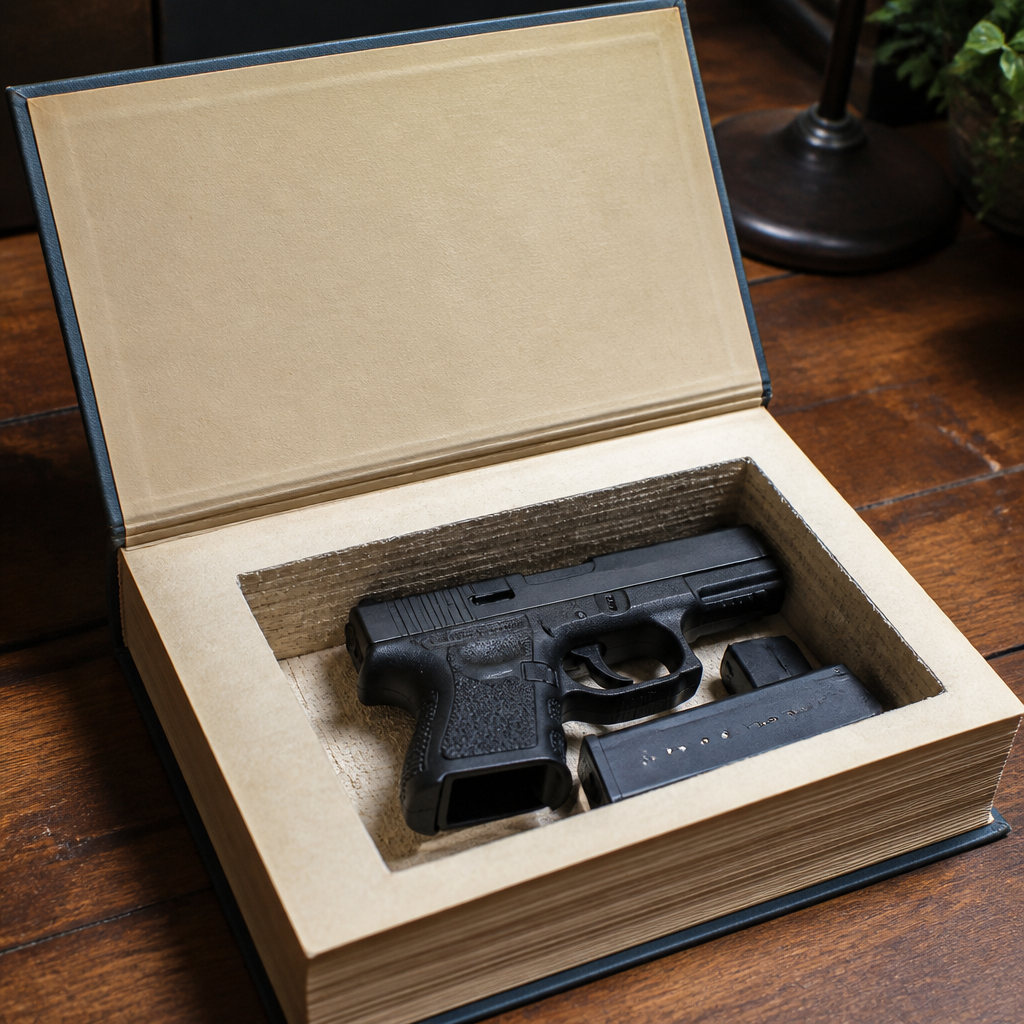
Hidden gun storage appeals to owners who want fast access, low visibility, and a way to reduce casual discovery inside the home. A hollowed-out book safe is one of the oldest concealment ideas, but building one to hold a handgun safely requires more than cutting pages and dropping a pistol inside. The project sits at the intersection of firearm safety, discreet storage, legal compliance, and practical home security. When done thoughtfully, it can support a broader hidden and discreet gun storage plan; when done poorly, it can create a false sense of security, encourage unsafe handling, or leave a firearm vulnerable to children, guests, or thieves.
A hidden gun safe inside a hollowed-out book is exactly what it sounds like: a rigid enclosure disguised as a normal hardcover volume, sized to fit a compact firearm or other valuables. The “book” may be a real hardcover shell reinforced internally, or a purpose-built box wrapped in a book jacket. In practice, the best versions are not simply secret containers. They include retention, moisture control, a locking mechanism, and enough structural strength to prevent the contents from printing through the cover. For gun owners, those details matter because safe storage means balancing concealment with unauthorized-access prevention, especially in homes with minors or frequent visitors.
This matters because concealed storage solves a different problem than a traditional full-size gun safe. A large UL-rated safe is ideal for bulk security, long guns, and theft resistance, but it is not always convenient for staged access in a bedroom, office, den, or apartment. Many owners therefore use layered storage: a primary safe for most firearms and a secondary discrete container for one defensive handgun. I have helped evaluate home setups where a visible lockbox drew attention but a well-integrated hidden container disappeared into an ordinary bookshelf. The lesson was consistent: discreet storage works best when it is part of a system, not a gimmick.
As the hub for hidden and discreet gun storage solutions, this guide explains how to build a hollowed-out book safe, when it makes sense, where it falls short, and how it compares with furniture safes, wall safes, diversion containers, under-desk mounts, and biometric bedside boxes. The goal is not to promote novelty. The goal is to help you create storage that keeps a firearm out of casual sight while respecting safe handling rules, state and local storage laws, and the realities of moisture, fit, and emergency access. If you decide a book safe is not the right answer, this article will also help you identify better hidden gun storage options for your space and risk level.
What a Hollowed-Out Book Safe Can and Cannot Do
A hollowed-out book safe offers concealment first, not high theft resistance. That distinction is essential. A heavy steel handgun safe anchored to furniture resists smash-and-grab theft better than a disguised container on a shelf. A hidden book safe, by contrast, is designed to avoid notice during routine life and quick visual scans. It can stop a child, a curious guest, or a casual worker from stumbling onto a firearm, but only if the build includes a lock and the placement is controlled. Without those safeguards, it is concealment without meaningful security.
Use cases are therefore narrow. A book safe makes the most sense for a compact handgun, a spare magazine, paper cash, documents, or a tracker. It does not suit a full-size pistol with a weapon light unless the book is oversized and the shelf depth supports it. It is also a poor choice for long-term storage of blued firearms in humid environments unless you add desiccant and corrosion protection. The pages and adhesives used in many DIY builds can trap moisture. If your home lacks climate control, a steel lockbox with a vapor corrosion inhibitor tab is usually safer for the gun.
From a safety perspective, the standard is simple: if unauthorized people can access the shelf, the book safe should include a positive locking method. Mechanical cam locks, magnetic release mechanisms, or concealed hasps can work. Friction-fit lids and elastic straps are not enough. The container should also secure the handgun in one consistent orientation, with the trigger guard fully covered or isolated from anything that could enter it. A fitted foam insert is better than a loose cavity. Good concealed storage reduces surprises during retrieval.
Materials, Tools, and Design Choices That Matter
The best builds start with the right shell. Choose a large hardcover reference book, atlas, legal volume, or encyclopedia with a sewn spine and rigid boards. Thin novels collapse under weight and look suspicious when overstuffed. For most subcompact and compact handguns, the outside dimensions should be at least 9 by 6 by 2 inches, though actual fit depends on grip height and optic profile. Many builders prefer using a thrift-store hardcover as an outer disguise and installing a separate internal box made from thin plywood, Kydex, or polymer sheet. That approach is stronger than relying on glued page edges alone.
For the cavity, I recommend 1/8-inch birch plywood or 0.080 Kydex because both materials are easy to cut, dimensionally stable, and capable of supporting foam. Closed-cell polyethylene foam is ideal for the insert because it resists moisture better than open-cell craft foam. Adhesives matter too. PVA glue works for sealing page blocks, but contact cement or epoxy is better for structural joints inside the cavity. Add a small silica gel pack, a rust inhibitor chip, and a soft fabric hinge stop so the lid opens predictably without stressing the spine.
Tool choice affects finish quality. A sharp utility knife can cut page blocks, but a scroll saw, oscillating tool, or router template produces a cleaner internal box. Use a square, calipers, and painter’s tape for precise layout. If you install a cam lock, verify throw length and clearances before gluing anything. Small rare-earth magnets are useful for alignment, but they should not be your only retention method. For any firearm with iron sights or a mounted optic, test fit with the gun unloaded and a chamber flag inserted. Tiny dimensional errors become obvious once foam compresses and the cover closes.
| Component | Recommended Option | Why It Works |
|---|---|---|
| Outer shell | Large sewn-spine hardcover | Looks natural on a shelf and supports added structure |
| Inner cavity | 1/8-inch birch plywood or 0.080 Kydex | Stronger and cleaner than glued pages alone |
| Insert | Closed-cell polyethylene foam | Protects finish and resists moisture absorption |
| Lock | Small cam lock or concealed magnetic latch with backup | Prevents casual access better than friction fit |
| Moisture control | Silica gel plus rust inhibitor tab | Reduces corrosion risk during staged storage |
How to Build the Hidden Book Safe Step by Step
Start by confirming legal and household suitability. If your state imposes specific safe storage duties when minors are present, make sure a disguised container with your chosen lock satisfies that requirement; in some homes, only a certified lockbox is prudent. Then unload the firearm in a separate area, remove all ammunition from the workspace, and measure the gun at its longest, widest, and tallest points. Add clearance for sights, optic, and draw angle. I usually allow at least 1/4 inch around the profile and 1/2 inch at the grip cutout so retrieval is clean.
Next, prepare the book. If using a real book shell, glue the outer page edges together while keeping the front cover free. Clamp lightly between wax paper sheets and let it cure fully. Mark the cavity on the first sacrificial page, centering the cut to preserve wall thickness around all sides. If using an internal box, cut fewer pages and remove the core until the box drops in flush. Dry fit repeatedly. The goal is a normal-looking closed book with no bulging and no visible hardware from the shelf-facing side.
Build the internal cavity as a separate insert whenever possible. Cut plywood or Kydex panels to form a tray, then line the tray with fitted closed-cell foam. Create a grip relief so your fingers can index the backstrap without fumbling. If the handgun is striker-fired, rigid coverage around the trigger guard is particularly important. Install the lock in the cover or sidewall, depending on your design. A side-mounted cam lock hidden by neighboring books often preserves the exterior appearance better than a front-mounted keyway.
Before final assembly, test retrieval under realistic conditions. Place the unloaded handgun in the insert, close and lock the book, then open it from its shelf position with your usual hand. If the cover flops too far, add a ribbon stop or fabric strap. If the gun shifts, revise the foam. If the muzzle or optic snags, enlarge the relief cut. Only after repeated successful access tests should you glue the insert permanently into the shell. Finish by blending the spine and jacket naturally into the shelf arrangement. The safest hidden storage is the one that functions consistently without announcing itself.
Placement, Shelf Integration, and Home Security Strategy
Where you place a hidden book safe matters as much as how you build it. A believable location is a shelf that already contains similar books, with enough depth to keep the spine aligned and enough stability to support weight. Oversized decorative shelves with only three books often look staged. Better options include a mixed home office bookcase, a den shelving unit, or a bedroom built-in where hardcovers naturally live. Avoid placing the safe at eye level in a sparse room, because visual isolation attracts attention.
Think in terms of layers. The shelf should not be in a high-traffic public area if visitors, cleaners, contractors, or children move through the space. A private room with controlled access is preferable. If the firearm is staged for defense, map the route from bed or desk to the shelf and confirm there are no obstacles in darkness. Some owners pair a hidden book safe with a room door lock, alarm contacts, or a discreet camera. That layered approach is stronger than relying on concealment alone. It also creates an audit trail if someone tampers with the area.
Theft behavior matters here. Experienced burglars often search bedroom closets, dresser drawers, mattresses, and obvious office safes. Bookshelves may receive less attention during short intrusions, but they are not invisible, especially if a shelf contains valuables or hidden-room cues. Weight can also betray the safe when handled. To reduce that risk, keep the book among other substantial volumes and avoid novelty titles that invite grabbing. In one home review I performed, the concealment improved dramatically after the owner replaced a lone fake dictionary with a row of actual law books and anchored the shelf so nothing shifted during access.
How Book Safes Compare With Other Hidden Gun Storage Solutions
A book safe is only one branch of hidden and discreet gun storage solutions. Wall safes hidden behind framed art offer better structure and can be anchored between studs, but they require installation and may be slower to access if concealed too aggressively. Furniture safes in nightstands or coffee tables can blend well and support biometric or keypad locks, though they cost more. Under-desk and under-bed safes are excellent for rapid access and steel protection, but they are less disguised. Diversion containers beyond books, such as vent covers or false electrical panels, can work, yet many look more suspicious up close than owners expect.
The best choice depends on threat model. If your main concern is casual discovery by guests, a book safe in a private office may be enough, provided it locks and the room is controlled. If your concern is unauthorized access by older children or teens who know the house well, steel construction and tamper resistance become more important. If your concern is burglary, anchored steel with hidden placement wins. For many households, the strongest approach is a primary handgun in a quick-access bedside safe and a separate concealed container elsewhere for backup or valuables. Discreet storage should fit behavior, not aesthetics alone.
Cost also varies. A DIY book safe may cost far less than a commercial RFID drawer safe, but time, fitment, and reliability testing have value. Commercial hidden safes from brands such as Vaultek, StopBox, Hornady, and ShotLock solve different access problems, though not all are disguised as décor. If you are building for daily use, compare your DIY result against those standards: consistent opening, secure retention, low unauthorized access risk, and resistance to humidity. If your build cannot meet those basics, it should not hold a defensive firearm.
Safety, Legal, and Maintenance Considerations
No hidden storage method overrides core firearm safety rules. Store the gun unloaded or loaded according to your defensive plan, but make that choice deliberately, not by habit. If it is loaded, the holster-like insert must fully protect the trigger area, and the retrieval path must keep fingers away from the trigger until the gun is on target. Keep spare ammunition organized separately unless the design securely contains a magazine without interfering with the firearm. In homes with children, the threshold for acceptable security should be high; concealment by itself is never childproof.
Legal requirements differ widely by state and municipality. Some jurisdictions impose criminal liability if a minor gains access to a negligently stored firearm. Others define safe storage more specifically when prohibited persons may be present. Because a homemade hidden safe is not usually tested to recognized burglary or child-resistance standards, owners should verify whether local law, lease terms, or household policies demand a certified lockbox. When advising clients, I tell them to document their storage method, test access, and revisit compliance whenever household composition changes.
Maintenance is straightforward but essential. Inspect the lock monthly, replace desiccant as indicated, and check the firearm for corrosion, lint, and dust. Cycle the opening method with the book on the shelf, not just in your hands. Refit foam if the gun develops play. If you change optics, lights, or base plates, remeasure the cavity. Hidden storage fails gradually: warped covers, weak magnets, sticky locks, crushed foam, and rust spots all begin small. Review your setup now, improve the weak points, and make discreet storage genuinely safe rather than merely clever.
Building a hidden gun safe inside a hollowed-out book can be a useful project when you understand its purpose. It is a concealment solution for a specific role, not a replacement for a real safe. The strongest builds use a hardcover shell, a rigid internal box, closed-cell foam, moisture control, and a true locking method. They place the firearm in a consistent orientation, protect the trigger, and blend naturally into a realistic shelf. They also fit into a larger home security plan that may include room control, cameras, anchored safes, and clear storage habits.
As a hub for hidden and discreet gun storage solutions, this guide should help you evaluate the full category with more discipline. Book safes, wall safes, furniture safes, under-desk mounts, and diversion containers each solve different problems. Your decision should be driven by household risk, legal duties, access needs, and burglary concerns. If you proceed with the hollowed-out book design, build it carefully, test it repeatedly, and maintain it like any other safety-critical equipment.
Choose one storage location in your home, assess who can reach it, and decide whether a hidden book safe truly meets that need. If it does, build to a higher standard than a novelty craft project. If it does not, move to a stronger concealed safe option and make secure, discreet storage part of a deliberate gun safety system.
Frequently Asked Questions
Is a hollowed-out book actually a safe way to store a handgun?
A hollowed-out book can work as a discreet concealment method, but it should not be treated as a true gun safe in the traditional sense. Its main advantage is low visibility. A well-made book safe can reduce casual discovery by guests, children who are not actively searching, or opportunistic intruders moving quickly through a room. However, concealment is not the same as secure storage. A book does not provide the pry resistance, lock strength, fire protection, or access control that a dedicated handgun safe offers.
If this approach is used, the handgun should still be stored in a way that supports core firearm safety principles. That means the trigger should be protected, the firearm should fit securely so it does not shift inside the cavity, and the book should be placed in a stable location where it cannot easily fall, tear, or be exposed to moisture. Many owners also choose to pair the concealment with an additional retention method, such as a fitted insert, holster shell, or lockable compartment inside the book structure. In practice, a hollowed-out book is best understood as one layer in a broader hidden and discreet gun storage plan, not a replacement for responsible secure storage.
What kind of book and materials are best for building a hidden gun safe inside a book?
The best starting point is a large, sturdy hardcover book with a thick page block and a rigid spine. Size matters because the cavity must fit the handgun without forcing it into an awkward position. A common mistake is choosing a book based only on appearance, then discovering the pages are too thin to create enough depth or the cover flexes too much under weight. A practical build usually begins by measuring the unloaded handgun and accounting for extra space around it for padding, trigger coverage, and easy retrieval.
Beyond the book itself, internal structure is important. Simply cutting a cavity into paper pages can create a weak shell that crumbles over time. Reinforcing the page block with adhesive helps bind the pages into a more solid body. A liner or insert can then be added to improve durability and firearm protection. Dense foam, a fitted insert, or a rigid tray can help hold the handgun consistently and reduce movement. The cover and spine should remain as natural-looking as possible so the finished piece still blends into a bookshelf. The most effective builds prioritize fit, structure, and durability rather than novelty, because the goal is not just concealment but safe, repeatable access.
How can you make a book safe discreet without making it difficult to access in an emergency?
The key is balancing concealment with consistency. A hidden storage method is only useful if the owner can access it quickly and predictably under stress. That means the book should live in a location that is discreet but not random. If it is buried among dozens of nearly identical books without any personal indexing system, access may be slower than expected. On the other hand, if it is placed too prominently or handled differently from the surrounding books, it may draw attention. The best setup is one where the owner can identify and retrieve it immediately while it still appears ordinary to everyone else.
Inside the book, the handgun should be oriented in a repeatable position that supports a safe grip during retrieval. If the firearm shifts, snags, or sits too tightly in the cavity, access can become clumsy and unsafe. Some builders address this by creating a fitted recess that keeps the grip exposed and the trigger area protected. The opening method matters as well. The cover should open smoothly without sticking, and the storage location should allow the book to be removed or opened without knocking over surrounding items. In short, discreet access comes from thoughtful placement, a consistent orientation, and a design that works reliably every time, not just one that looks clever on a shelf.
Are there legal or safety issues to think about before storing a gun in a hollowed-out book?
Yes, and they are significant. Firearm storage laws vary widely by state, county, and municipality, and some jurisdictions impose specific requirements related to child access prevention, locking devices, or storage when the firearm is not under the owner’s direct control. A hollowed-out book may or may not meet those legal standards depending on how it is built and whether it includes a locking or access-control feature. That is why owners should review the laws that apply where they live and, if necessary, speak with a qualified local attorney or firearms instructor for guidance.
Safety is equally important. Any hidden storage method should be evaluated based on who lives in the home, who visits regularly, and what the real access risks are. If children, teenagers, vulnerable adults, or unauthorized persons may encounter the storage area, concealment alone may be inadequate. The firearm should be stored in a condition that matches the owner’s training, defensive plan, and household risk profile, and the storage design should protect the trigger and minimize negligent handling during retrieval. The broader point is that discretion should never come at the expense of lawful and responsible storage. A hidden book compartment may support a layered home security plan, but it must still align with legal obligations and safe gun ownership practices.
Is a hollowed-out book safe better as a primary storage solution or as part of a larger hidden gun storage strategy?
For most owners, it makes more sense as part of a larger strategy. A book safe can be useful in situations where low visibility is the priority, especially for reducing casual discovery in common living areas. It can also serve as a supplemental option for a specific room or use case, such as keeping a defensive handgun discreetly staged in a space where a traditional lockbox would stand out. That said, it usually lacks the physical security, tamper resistance, and environmental protection expected from a true primary safe.
A stronger overall approach is layered storage. That means combining concealment with appropriate retention, responsible placement, and a clear plan for who can access the firearm and when. In many homes, a conventional quick-access handgun safe remains the main storage solution, while discreet options like a hidden book compartment play a secondary role. This layered mindset helps balance fast access, reduced visibility, and legal and safety considerations. When viewed this way, the hollowed-out book is not a gimmick or a complete answer. It is one practical concealment tool within a broader hidden and discreet gun storage system designed around real-world safety and security needs.