
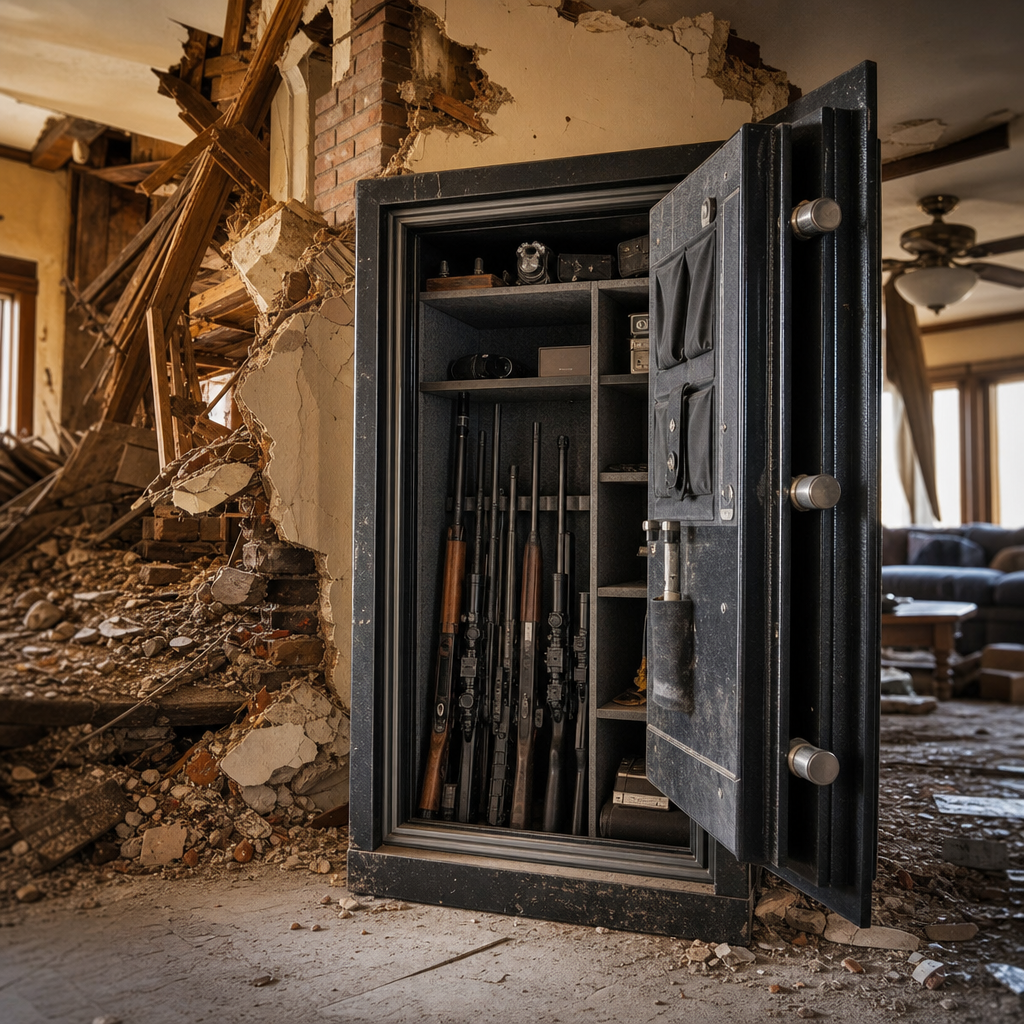
The best gun safes for surviving earthquakes and fires combine structural stability, verified fire protection, secure locking systems, and installation features that keep the safe upright and sealed when a home faces extreme stress. For gun owners in wildfire zones, seismic regions, or older homes with uneven foundations, disaster-resistant storage is not a luxury feature. It is the difference between firearms remaining protected, legally secured, and retrievable after an emergency, or becoming damaged, inaccessible, or stolen during the chaos that follows.
In practical terms, a fireproof and disaster-resistant gun safe is a heavy-gauge steel enclosure designed to resist heat transfer, forced entry, and movement. “Fireproof” is often used loosely in marketing, but the useful measure is a tested fire rating expressed as minutes or hours at a specific temperature, such as 60 minutes at 1200 degrees Fahrenheit or 90 minutes at 1400 degrees. Earthquake resistance is less standardized, so buyers need to evaluate mass, anchoring points, center of gravity, door design, hinge strength, and the safe’s behavior when bolted to concrete or reinforced flooring. After years of evaluating residential safes, I have found that many units advertised as premium fail on the basics: weak bolt-down hardware, thin bodies hidden behind plush interiors, or intumescent seals that look impressive but lack independent test credibility.
This topic matters because modern gun storage has to solve several risks at once. A house fire can ignite ammunition packaging, melt optics, char stocks, and destroy important documents kept alongside firearms. An earthquake can topple a tall safe, misalign a door, crack drywall around anchor points, or leave a safe trapped under framing members. Natural disasters also increase burglary risk because homes may sit vacant, damaged, or exposed for days. The best gun safes for surviving earthquakes and fires are built for layered protection: thick steel, robust door frames, tested insulation, redundant relockers, moisture control, and anchoring that matches the building structure. As the hub page for fireproof and disaster-resistant storage, this guide explains what features matter most, which safe types perform best, and how to choose a model that protects firearms when the entire house is under stress.
What makes a gun safe truly fire-resistant and earthquake-ready
A disaster-resistant gun safe needs more than a high published fire number. The first question is how the fire rating was established. Independent testing from laboratories such as Intertek, ETL, or UL carries more weight than an internal factory claim. Residential gun safes typically use layers of gypsum board, ceramic wool, or proprietary composite insulation to slow heat transfer. During a serious structure fire, internal temperatures can still rise enough to damage wood stocks, polymer frames, optics, passports, cash, and digital media. That is why thicker insulation, multiple door seals, and tighter body-to-door tolerances matter more than branding language.
Earthquake performance depends heavily on stability and anchoring. A wide safe with a low center of gravity will generally perform better than a narrow, top-heavy cabinet of the same weight. In California retrofit work and mountain-region installations, I have repeatedly seen safes survive shaking only because they were anchored with proper wedge anchors or epoxy-set bolts into sound concrete. Units installed with undersized lag screws into subfloor alone often loosen over time, especially when loaded with rifles on the door side. Good earthquake-ready design includes reinforced anchor plates, at least four bolt-down points, substantial internal frame rigidity, and a door that will not spring open if the body twists.
Locking systems also matter during disasters. Electronic locks are convenient, but they need proven reliability, quality keypads, and fresh batteries. Mechanical dial locks remain popular because they are less vulnerable to battery failure after prolonged displacement, though they are slower to open under stress. On better safes, relockers and hard plates help prevent forced entry if the lock area is attacked after a disaster. For homes in wildfire country, smoke and corrosive residues are another issue, so interior dehumidifiers, door seals, and post-fire serviceability should be part of the buying decision.
Key construction features that separate serious safes from marketing-heavy models
The steel body is the foundation. Many big-box gun safes use 14-gauge or 12-gauge steel bodies, which can be acceptable for basic residential storage, but 10-gauge or thicker steel offers a meaningful increase in resistance to prying, deformation, and impact after a collapse event. Door thickness can be confusing because manufacturers may quote total thickness including paneling and insulation rather than plate thickness. What matters is the steel in the door skin and frame, plus the number and engagement depth of locking bolts. A thick-looking door with thin formed steel is less impressive than a simpler door with real plate.
Door seals deserve close attention. Intumescent seals expand under heat to block smoke and reduce thermal transfer through gaps around the door. Better safes use multiple layers and place them where expansion helps preserve the seal even if the outer edge chars. Interiors should not be an afterthought either. Heat-sensitive items, scopes, suppressor paperwork, and documents benefit from interior organization that keeps valuables off the floor and away from the hottest outer walls. In a fire, the floor and corners often see severe heat accumulation.
Weight is another honest signal. All else equal, heavier safes usually contain more steel, more insulation, or both. That extra mass improves thermal inertia and reduces tipping risk, but only if the safe is installed correctly. A 900-pound safe is still vulnerable if it sits unanchored on a slick garage slab. Some of the best-performing residential models I have handled come from Liberty, Fort Knox, AMSEC, Browning, Hollon, Rhino Metals, and Superior, though performance varies by series. Within those brands, entry-level lines may be adequate for moderate risk, while premium composite lines are much better for serious fire and disaster exposure.
Best types of gun safes for earthquakes, fires, and mixed disaster risk
For many homeowners, the strongest all-around choice is a mid-size or full-size residential gun safe with a verified fire rating, 10-gauge or thicker body, internal hinges or protected external hinges, and bolt-down capability to concrete. This category balances capacity, theft resistance, and survivability. A quality 60- to 90-minute safe rated at 1200 to 1400 degrees Fahrenheit is realistic for many suburban homes where fire response times are moderate and the goal is to survive the most likely fire window rather than a total burn-to-foundation scenario.
Composite safes are the better option for buyers prioritizing fire resistance above all else. AMSEC’s BF series is a classic example because it combines substantial steel with poured or layered fire-resistant materials and a stronger body than many decorative gun safes. Composite construction tends to improve fire performance and stiffness, which can help a safe remain square after structural stress. The tradeoff is cost, and in some cases slightly reduced interior space relative to exterior dimensions.
Modular gun safes deserve mention for homes with difficult stair access or second-floor placement, but they require careful evaluation. Systems from brands like Zanotti solve delivery problems and can be robust when assembled correctly, yet a one-piece welded safe usually has an advantage in rigidity during severe shaking. For very high seismic risk, I generally prefer a welded safe anchored on a ground-floor concrete slab. If a modular safe is necessary, proper assembly torque, panel alignment, and anchoring become even more important.
| Safe type | Best use | Main advantage | Main limitation |
|---|---|---|---|
| Residential gun safe | Most homes needing balanced protection | Good mix of fire rating, capacity, and security | Quality varies sharply by model line |
| Composite safe | High fire risk and premium protection | Better insulation and stronger structure | Higher cost and heavier installation |
| Modular safe | Homes with tight access routes | Easier delivery and placement | Usually less rigid than welded units |
| Fire-lined document safe inside gun safe | Protecting papers, cash, and media | Adds layered protection for sensitive items | Takes up interior space |
How to evaluate top brands and avoid weak fire-safe claims
Brand reputation matters, but only at the model level. Liberty’s higher-tier safes, for example, typically offer better steel thickness, stronger boltwork, and more credible fire protection than entry lines. Fort Knox is known for customization and heavier steel options, which matters for seismic anchoring and pry resistance. AMSEC stands out in composite construction and commercial safe crossover design. Hollon has built a solid reputation in fire-focused safes and B-rated burglary units, while Rhino Metals and Browning offer attractive interiors and useful organizational systems in selected lines.
The mistake many buyers make is comparing only advertised fire minutes. A 120-minute rating without clear test conditions tells you less than a 75-minute rating with published temperature data and third-party validation. Ask what temperature was used, whether the safe was preheated, whether internal temperature thresholds were measured, and whether the rating reflects a full furnace test or a factory estimate. Also ask if the safe was tested with the door facing the heat source, because door gaps are a common failure point.
Finish quality and interior features should not distract from core structure. Door organizers, electrical outlets, and deluxe lighting are useful, but they do not compensate for thin steel or weak frame geometry. I also advise buyers to verify the bolt-down hardware included in the purchase. Some manufacturers ship basic anchors that are inadequate for cracked concrete, post-tension slabs, or raised wood floors. In those cases, a local installer or structural contractor should specify hardware suited to the building.
Installation strategies that determine whether the safe survives the disaster
Installation is where a strong safe either becomes a resilient system or remains just a heavy box. The best location is usually a ground-floor concrete slab in a low-visibility interior area away from windows, garages full of accelerants, and rooms likely to collect water after firefighting. Closets, utility-adjacent rooms, and corners that allow the safe to open fully while limiting pry access are strong options. In earthquake zones, avoid placing a tall safe where falling masonry, chimneys, or water heaters can strike it.
Anchoring should match the substrate. On solid concrete, wedge anchors or high-quality concrete screw anchors can work, but embedment depth, edge distance, and slab condition matter. For compromised slabs, epoxy anchors may be the better choice. On wood floors, anchoring into joists or adding steel backing plates below the subfloor can reduce pull-through risk. When a safe is extremely heavy, verify floor load capacity, especially in older homes. Concentrated loads can exceed design assumptions, and I have seen sagging floors create door misalignment months after installation.
Fire resilience also improves with placement and accessories. Installing a dehumidifier rod or desiccant system protects blued steel from post-fire humidity and suppression water. Elevating the safe slightly on a sealed base can help in minor flooding or during hose-down runoff. If documents, titles, or suppressor tax paperwork are stored inside, add a separately rated document box because paper chars at lower temperatures than many firearms components fail. These details are not glamorous, but they are what make the difference after the event.
Matching the safe to your region, firearms collection, and recovery plan
The right safe depends on where you live and what you store. In wildfire-prone states such as California, Colorado, Arizona, and parts of Texas, prioritize longer fire ratings, thicker seals, and a location away from attached garage fuel loads. In major seismic regions, anchoring and safe geometry move higher on the list than interior finish. In humid coastal areas, corrosion control is essential because disaster recovery can leave a home closed up and wet for weeks.
Collection type matters too. A safe storing heirloom wood-stock rifles, collector revolvers, NFA paperwork, and expensive optics needs better internal climate control and organization than one holding a few modern polymer pistols. If you keep ammunition inside the safe, follow manufacturer guidance and local regulations, and understand that ammunition storage raises complexity during a fire even though modern cartridges in a confined safe usually do not behave like chambered rounds. Insurance documentation, serial-number records, and photos should also exist outside the safe in secure digital form. Physical protection and recovery planning belong together.
As a hub for fireproof and disaster-resistant storage, this article points toward the core standard every buyer should apply: choose a safe with credible fire testing, substantial steel, reliable locking hardware, and professional anchoring suited to your structure. Then build a complete system around it with humidity control, document protection, and an inventory plan. The main benefit is not just preventing theft. It is knowing your firearms, records, and critical gear have the best chance of surviving the exact emergencies most likely to hit your home. Review your current safe, identify its weak points, and upgrade before the next fire season or earthquake reminder makes the decision for you.
Frequently Asked Questions
What features matter most in a gun safe designed to survive both earthquakes and fires?
The best disaster-resistant gun safes are built around four core priorities: structural strength, fire protection, anchoring capability, and reliable locking security. In earthquake-prone areas, the safe needs a heavy steel body, a stable footprint, reinforced door construction, and pre-drilled anchor holes that allow it to be bolted securely into concrete or substantial floor framing. Weight helps, but weight alone is not enough. A tall, narrow safe that is not properly anchored can still tip during severe shaking, especially in older homes with uneven floors or in garages where slab conditions vary.
For fire protection, shoppers should look beyond generic marketing claims and pay attention to tested fire ratings, insulation type, door seal design, and the duration-to-temperature standard being referenced. A safe advertised as “fireproof” without a clear time-and-temperature rating is not giving you enough information. Better models typically specify something like 60, 90, or 120 minutes at a stated external temperature, and they often include expanding heat seals around the door to limit smoke and heat intrusion. In wildfire regions, longer fire durations and stronger sealing systems are especially important because homes can be exposed to extended radiant heat and secondary interior fires.
Locking systems also matter during and after a disaster. A quality gun safe should have a dependable UL-rated lock, strong boltwork, and a door that remains aligned even if the safe is jarred or shifted. Some buyers prefer mechanical dial locks for long-term durability and minimal dependence on electronics, while others prefer high-quality electronic locks for speed and convenience. Either can be a good choice if it comes from a reputable manufacturer and is matched to the environment. In all cases, the safe should protect firearms from theft, unauthorized access, and legal liability, not just physical damage from fire or shaking.
How important is bolting down a gun safe in an earthquake zone?
Bolting down a gun safe is one of the most important steps you can take if you live in a seismic region. Even a very heavy safe can shift, rock, or tip over during strong ground movement, especially if it is top-heavy, placed on a slick surface, or loaded unevenly. When a safe falls, several things can go wrong at once: the door can become misaligned, the locking mechanism can be damaged, the frame can warp, nearby walls and flooring can be destroyed, and retrieving firearms afterward can become much more difficult. In severe cases, a fallen safe can also create a major household hazard during evacuation or emergency access.
Anchoring improves more than just stability. It also increases theft resistance because criminals cannot simply tip the safe forward to attack the door, drag it out, or move it into another location where they have more time and tools. For homeowners in older houses, homes on raised foundations, or properties with known floor irregularities, installation planning matters just as much as the safe itself. The strongest setup is usually anchoring into concrete with appropriate hardware, though some wood-framed floor installations can be effective when done correctly and when the structure can support the load.
If you are comparing safes for earthquake survivability, look for models with well-positioned anchor holes, a broad and balanced base, and clear installation guidance from the manufacturer. Professional installation is often worth the cost because a poorly anchored safe can give a false sense of security. In short, if a safe is marketed for seismic resilience but is not properly installed, it is only partway prepared for the actual risk.
Are all fire ratings on gun safes equally trustworthy?
No, and this is one of the most misunderstood parts of shopping for a gun safe. Fire ratings vary widely in how they are determined, and not every advertised rating comes from the same testing standard or level of independent verification. Some manufacturers perform internal testing, which may still be useful, but it is not equivalent to a recognized third-party certification. Others use broad language like “fire resistant” or “tested at high temperatures” without explaining how long the safe was exposed, what the peak temperature was, or what internal temperature threshold was considered acceptable for the contents.
For a more meaningful comparison, look for a specific duration and temperature, such as 60 minutes at 1,200 degrees Fahrenheit or 90 minutes at 1,400 degrees Fahrenheit, along with any mention of independent testing or recognized standards. Also remember that firearms are not the only items many owners keep inside a gun safe. Important documents, optics, ammunition records, backup drives, heirlooms, and legal paperwork may all have different heat tolerances. A safe that protects steel firearms from direct flame may still allow enough internal heat to damage paper, electronics, or adhesives used in accessories.
Fire performance should also be considered in real-world context. In a house fire or wildfire event, the safe may be exposed to heat for longer than the headline rating suggests, and surrounding conditions can intensify risk. That is why build quality matters alongside the rating itself. Thick steel, quality insulation, tight door fitment, and expanding seals all help the safe perform better under stress. The most trustworthy approach is to choose a safe from a reputable manufacturer that gives transparent fire data and combines that rating with strong construction and proper installation.
Should I choose a mechanical lock or an electronic lock for a disaster-resistant gun safe?
Both mechanical and electronic locks can work well on a gun safe intended for earthquakes and fires, but each has trade-offs. Mechanical dial locks are often favored for long-term durability, simplicity, and reduced dependence on batteries or circuit boards. Many gun owners appreciate that a high-quality mechanical lock has fewer electronic failure points and can remain serviceable for decades. In a post-disaster scenario where power is out, temperatures have fluctuated, and maintenance may have been delayed, that simplicity can be reassuring.
Electronic locks, on the other hand, offer faster access and are often easier for households to use consistently. That matters more than many people realize. A safe only improves safety if it is actually locked every time firearms are stored. A quality electronic lock from a reputable brand can be highly reliable and may include useful features such as multiple user codes, lockout modes, and easier day-to-day operation. However, buyers should avoid cheap electronic systems with poor track records, weak keypads, or limited support. In a disaster-resistant setup, lock quality matters far more than whether the lock is digital or mechanical in principle.
The best choice usually depends on your priorities. If you want maximum simplicity and long-term durability, mechanical may be the better fit. If rapid access and household usability matter most, a premium electronic lock can be an excellent option. Either way, choose a safe with a proven lock brand, strong relocking features, and good service support. The lock should be considered part of the overall protection system, not a separate convenience feature.
Where is the best place to install a gun safe for maximum protection from fire and earthquake damage?
The ideal location is a place that balances structural support, lower fire exposure, reduced visibility, and practical access. In many homes, a ground-floor interior location on a concrete slab is one of the strongest options because it offers solid anchoring potential and reduces the stress that a very heavy safe can place on elevated framing. Interior locations are often preferable to perimeter walls because they may be less exposed to direct exterior heat during a wildfire and less vulnerable to weather-related damage if the building envelope is compromised.
That said, placement should always be evaluated case by case. Garages are common gun safe locations because they are accessible and typically built on concrete, but they can also present risks such as higher temperature swings, easier visibility during open-door periods, and increased exposure to vehicle-related fire hazards or flood runoff depending on the site. Upstairs installations may be possible for smaller safes, but they require careful structural consideration. A large safe loaded with firearms and gear can weigh far more than homeowners initially expect, and in an earthquake, that concentrated weight becomes even more important from a safety standpoint.
No matter where the safe is placed, it should sit level, be firmly anchored, and have enough clearance for the door to open fully without stressing hinges or surrounding walls. Humidity control, ventilation considerations, and ease of retrieval after an emergency also matter. The best installation location is not simply the most hidden corner of the house. It is the spot where the safe can remain upright, sealed, secure, and accessible when the home is under extreme stress and when you may need to confirm the condition of your firearms and documents afterward.