
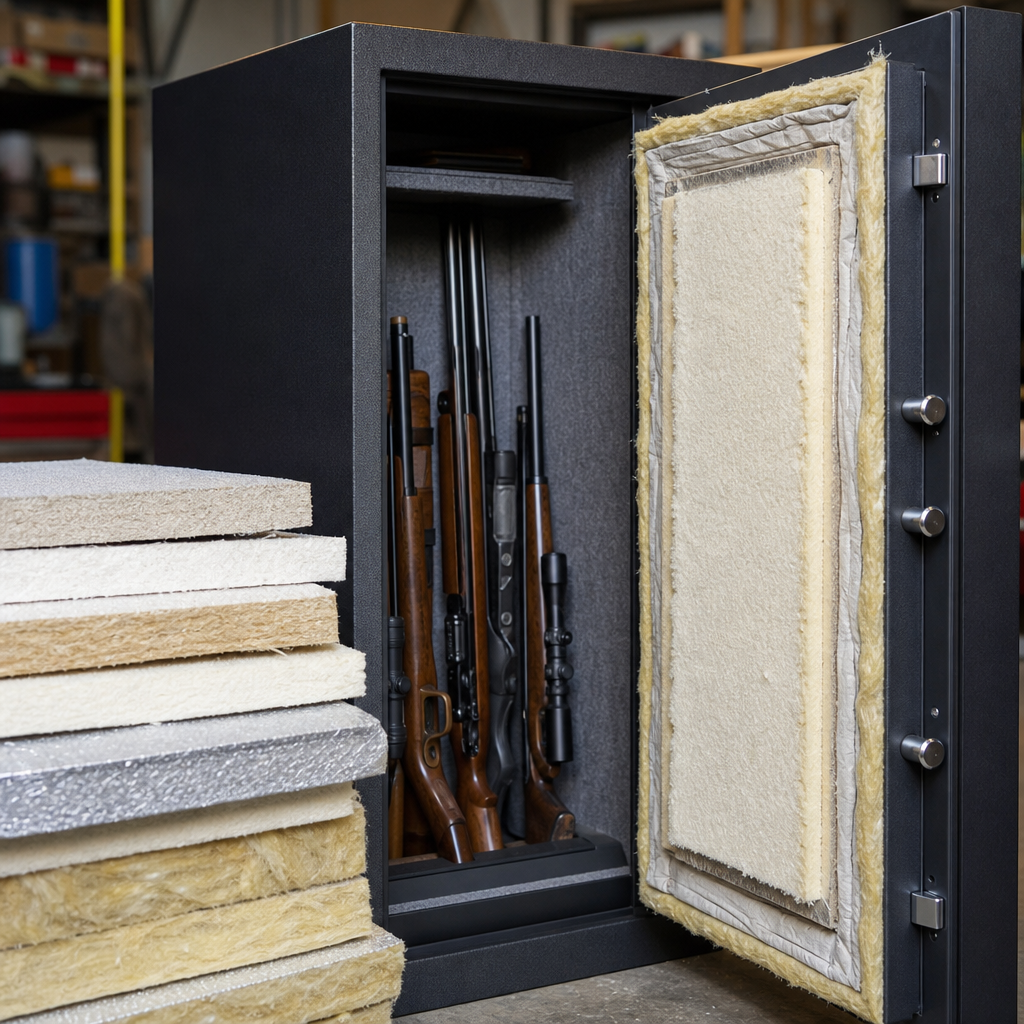
Fireproof gun safe design depends heavily on insulation materials because the steel shell alone cannot keep internal temperatures low enough to protect firearms, documents, optics, and ammunition during a structure fire. In practical terms, a “fireproof” gun safe is really a fire-resistant container engineered to delay heat transfer for a tested period, usually expressed as minutes or hours at a stated furnace temperature such as 1,200°F or 1,700°F. The insulation layer is the core of that delay. After working with safe buyers, installers, and product specifications for years, I have seen that most purchasing mistakes happen when people focus on gauge thickness, lock type, or brand prestige while treating insulation as a vague marketing feature. It is not vague at all. The material, thickness, placement, moisture behavior, and test standard determine whether a safe merely survives scorched drywall or actually preserves contents after a severe fire.
This matters because gun safes now serve multiple roles within household risk management. Owners use them to secure firearms against theft and unauthorized access, but the same safe often stores passports, suppressor paperwork, hard drives, cash, family photos, jewelry, and insurance records. Those contents do not fail at the same temperature. Paper begins to char around 350°F, many plastics deform sooner, electronics can be damaged by both heat and steam, and ammunition, while not likely to explode like movie scenes suggest, can still be ruined by excessive heat. A disaster-resistant storage strategy therefore requires matching safe construction to realistic hazards: fire duration, peak temperature, water exposure from sprinklers or hoses, humidity after the event, and impact from collapse. Insulation materials sit at the center of all of those variables, which is why this article functions as the hub for understanding fireproof and disaster-resistant storage within the broader gun safes and safety category.
How fire-resistant insulation works inside a gun safe
Heat moves into a safe through conduction, convection, and radiation. Steel is strong and useful for security, but it conducts heat rapidly. Without insulation, a steel cabinet in a house fire becomes an oven. Effective fire-resistant gun safe insulation interrupts that process by adding low-conductivity layers, creating thermal mass, releasing bound moisture in controlled ways, and limiting direct pathways for heat around seams and doors. In a well-designed safe, the body insulation, door insulation, intumescent door seal, and inner liner work together. If one element is weak, the rating becomes less meaningful in real-world conditions.
The most common mechanism in consumer fire safes is gypsum-based board, often called fireboard or drywall-type insulation. Gypsum contains chemically bound water. When heated, that water is released as steam, and the phase change absorbs energy, slowing the temperature rise inside the safe. This is why many gun safe interiors feel humid after a fire event or even after extreme summer heat. The process is useful, but it also means moisture management matters. Better manufacturers account for this with sealed liners, tighter joints, and guidance on dehumidifiers after installation. Lower-quality models may rely on a few layers of standard board with gaps around boltwork, producing a published fire rating that looks respectable on a tag but performs inconsistently.
More advanced designs add proprietary composite insulation. These formulas may combine gypsum, ceramic wool, mineral wool, concrete-like aggregate fills, vermiculite, perlite, or other refractory ingredients. The goal is to improve thermal resistance, structural stability, and endurance at higher test temperatures. Commercial record safes and data safes often use composite pours or engineered panels because they need to protect paper or digital media under stricter conditions than many residential gun safes. In the gun safe market, composite construction usually appears in premium models, where greater weight, cost, and manufacturing complexity are acceptable tradeoffs for better fire performance.
Common insulation materials and what each one does well
Gypsum board remains prevalent because it is inexpensive, available, and effective for moderate fire resistance when installed correctly. Multiple layers can raise the time rating, and the material is familiar to manufacturers. Its limitations are equally important. It is heavy for the level of protection offered, vulnerable to cracking if poorly supported, and can contribute moisture during heating. I have inspected safes after delivery where rough handling likely fractured board around corners; the exterior looked perfect, yet the insulation may already have been compromised. That does not make gypsum bad, but it does make manufacturing quality and shipping integrity critical.
Mineral wool and ceramic fiber products perform differently. They resist high temperatures well, are noncombustible, and do not depend on releasing moisture to the same extent as gypsum. Mineral wool is common in building firestopping and industrial insulation because it handles heat while maintaining dimensional stability. Ceramic fiber can withstand even higher temperatures, though cost and handling requirements are greater. In a gun safe, these materials are often part of a composite system rather than the sole insulating layer. They help reduce heat transfer and maintain protection after the initial steam-driven benefit of gypsum has been exhausted.
Poured composite insulation, including proprietary cementitious or aggregate blends, is often the strongest approach for serious fireproof and disaster-resistant storage. It can fill voids more completely than board systems, reduce thermal bridges, and add rigidity to the body. The downside is significant mass. A true composite safe may weigh hundreds of pounds more than a comparably sized board-insulated model, affecting floor loading, delivery logistics, and price. Still, when buyers ask what usually separates entry-level fire ratings from premium fire protection, insulation density and continuity are high on the list.
| Material | Main advantage | Main limitation | Typical use in gun safes |
|---|---|---|---|
| Gypsum fireboard | Affordable, proven, easy to layer | Can crack, releases moisture, performance varies with installation | Most residential fire-rated models |
| Mineral wool | High heat resistance, stable, noncombustible | Usually needs pairing with other materials | Composite doors and body panels |
| Ceramic fiber | Excellent high-temperature performance | Higher cost | Premium or specialized fire barriers |
| Poured composite fill | Continuous coverage, strong thermal mass | Very heavy, more expensive | Higher-end fire-resistant safes |
| Intumescent seal material | Expands to block smoke and heat at gaps | Supports but does not replace body insulation | Door perimeters on better safes |
Fire ratings, test methods, and why numbers can mislead buyers
A stated fire rating only means something when you know who tested it, how it was tested, and what internal temperature limit was used. This is where many shoppers get confused. Some manufacturers use independent laboratories such as UL, Intertek, or ETL. Others use in-house protocols. There is a large difference between a furnace test that raises ambient temperature to a published curve, a test that includes a cool-down period, and a test that also evaluates impact after a drop through a burning structure. UL Class 350, for example, is tied to paper document protection because the interior must stay below 350°F. Data media standards are stricter because magnetic and digital media fail at much lower temperatures and humidity thresholds.
In the gun safe category, published ratings like “60 minutes at 1,400°F” are common, but they are not directly comparable across brands unless the methodology is equivalent. I tell buyers to ask four direct questions: Was the test independent? What was the furnace temperature? What was the maximum internal temperature? Did the rating include cool-down? A safe can pass the heating phase and still allow contents to be damaged during cooling if trapped heat continues migrating inward. Better manufacturers provide detailed test sheets or at least identify the lab and protocol. Vague labels are a warning sign.
Real-world fires also vary widely from test conditions. A room-and-contents fire may peak and decline differently than a whole-house burn. Location matters: a garage with accelerants can create harsher conditions than a climate-controlled interior closet, while a basement may expose the safe to water first and heat second. That is why no fire-resistant gun safe should be sold as absolute protection. The honest approach is layered risk reduction: choose a tested safe, place it intelligently, anchor it properly, insure the contents, and avoid storing irreplaceable digital media in a unit rated only for paper-level temperatures.
Door seals, body design, and the hidden weak points around insulation
Even the best insulation materials can be undermined by poor enclosure design. The door is usually the weakest thermal point because it contains gaps, boltwork channels, lock components, and decorative panels. A quality fireproof gun safe uses stepped door construction and intumescent seals that expand under heat to reduce smoke and hot-gas intrusion. These seals are not cosmetic. During the early stages of a fire, superheated smoke can enter before the steel body itself reaches extreme temperatures. Once inside, that heat attacks contents directly. Door geometry and seal quality are therefore inseparable from insulation performance.
Thermal bridges are another overlooked issue. Any uninterrupted metal path from the exterior shell to the interior liner can conduct heat inward faster than surrounding insulated areas. Manufacturers reduce this through layered construction, internal liners, spacing, and composite fills. Hinges, relocker chambers, hard plates, and wiring ports for lights or dehumidifiers all need careful detailing. I have seen attractive safes with plush interiors, power outlets, and door organizers that unintentionally added more pathways for heat and smoke. Convenience features are worthwhile only when they do not compromise the fire envelope.
Body seams and corner joints matter as much as insulation thickness. A thick layer with voids, compression gaps, or inconsistent coverage will not perform like a continuous system. This is one reason heavier safes from reputable brands often justify their price: not just more material, but better fit-up, more controlled assembly, and fewer shortcuts at penetrations. For buyers comparing models online, interior photos, cutaway diagrams, and transparent technical specifications are more useful than lifestyle images.
Fireproof and disaster-resistant storage beyond fire alone
A hub article on fireproof and disaster-resistant storage has to address more than flames. After a residential fire, safes are commonly hit with thousands of gallons of water from sprinklers and fire hoses. Flooding, storm surge, and burst pipes can create similar conditions without any fire at all. Insulation materials respond differently to water exposure. Gypsum can absorb water and lose integrity if saturation is prolonged. Composite fills may resist movement better, but door seals, lock housings, and interior upholstery can still trap moisture. That is why water resistance features, elevated installation, and post-event drying plans deserve equal attention.
Impact resistance is the next layer. In severe fires, floors can collapse and debris can strike the safe. Some commercial standards include drop testing after heating because a hot safe that splits open on impact has failed its purpose. Residential gun safes do not always undergo that level of evaluation. If your installation is on an upper floor, ask not only whether the floor can support the weight in normal use, but what happens structurally during a fire. In many homes, a ground-floor concrete slab remains the best location for both theft resistance and disaster resilience.
Humidity control also belongs in this discussion. Fire-resistant insulation and disaster exposure can increase internal moisture, which threatens bluing, optics coatings, stocks, and documents long after the emergency ends. GoldenRod dehumidifiers, rechargeable desiccants, and monitored hygrometers are practical tools, but they work best in a safe with decent sealing and realistic occupancy. Overpacking a safe reduces airflow and creates cold spots where condensation forms. Disaster-resistant storage is not just a purchase; it is an ongoing maintenance practice.
How to choose the right insulated gun safe for your risks
The right choice starts with a risk profile, not a brand list. If your main concern is suburban house fire and basic child access prevention, a well-built residential security container with verified fireboard construction and an intumescent seal may be enough. If you store regulated items, expensive optics, heirloom firearms, legal documents, and backup drives, move toward composite insulation, better test documentation, and possibly separate media storage inside the larger safe. If you live in a wildfire zone, hurricane region, or flood-prone area, placement and water strategy become as important as the fire rating itself.
Budget should be allocated according to what you are protecting. I often advise buyers to calculate the replacement cost of contents plus the administrative burden of loss. A safe protecting $15,000 in rifles, tax records, NFA paperwork, passports, and family documents deserves different insulation quality than one holding two budget handguns. Weight, access needs, interior layout, and lock preference still matter, but insulation should be treated as a primary specification. Ask for cross sections, independent ratings, seal details, total weight, and warranty language covering fire events.
For next steps, use this page as your starting point for the wider Fireproof and Disaster-Resistant Storage topic within Gun Safes and Safety. Compare insulation systems, verify test standards, review placement guidance, and match safe design to your real hazards rather than advertising claims. When you evaluate a safe through the lens of insulation materials, you make a better decision for security, survivability, and long-term peace of mind.
Frequently Asked Questions
Why are insulation materials so important in a fireproof gun safe?
Insulation materials are the heart of a fire-resistant gun safe because steel by itself is a poor solution for protecting the contents from sustained heat. A steel shell can provide strength, security, and structural integrity, but when exposed to a house fire it will absorb and conduct heat inward. Without an effective insulating barrier, the temperature inside the safe can rise quickly enough to damage firearms, scorch documents, degrade optics, and compromise ammunition. In other words, the safe’s metal body helps resist attack and contain the insulation, but it is the insulation layer that slows heat transfer and buys critical time during a fire.
This is why the term “fireproof” is often misleading. Most gun safes are more accurately described as fire-resistant containers designed to delay internal temperature rise for a tested period, such as 30 minutes, 60 minutes, or 90 minutes at a specified external furnace temperature like 1,200°F or 1,700°F. The insulation is what makes that performance possible. It acts as a thermal buffer between the hot exterior and the protected interior, reducing the rate at which heat reaches sensitive contents. A well-designed safe depends on the insulation material, its thickness, how it is installed, and how well the door, seams, and body work together as a complete thermal system.
What types of insulation are commonly used in fire-resistant gun safes?
Several insulation approaches are used in fire-resistant gun safe design, and each comes with different strengths, costs, and performance characteristics. One of the most common materials is gypsum board, often referred to in general terms as drywall-type fireboard. Gypsum contains chemically bound water, and when exposed to high heat, that water is gradually released as steam. This process helps absorb heat energy and slows the temperature rise inside the safe. Because it is relatively affordable and widely available, gypsum-based insulation is frequently used in consumer gun safes, often in multiple layers to improve fire resistance.
Higher-end safes may use more advanced insulating materials such as ceramic fiber, proprietary composite fire barriers, poured concrete-like amalgamations, or specialized mineral-based insulation. Ceramic and mineral fiber products can perform very well at elevated temperatures because they are designed to resist thermal breakdown and reduce heat conduction. Composite systems may combine several materials to improve fire performance, structural stability, and manufacturing efficiency. In some premium designs, the insulation is selected not just for its heat resistance but also for how well it maintains integrity over time, resists moisture issues, and works with door seals and body construction.
It is also important to understand that the same material can perform differently depending on how it is engineered into the safe. The number of layers, the density of the material, the size of air gaps, and how tightly the insulation is fitted all matter. That means comparing safes based only on the name of the insulation material can be misleading. Real fire performance depends on the complete design, not just the ingredient list.
How does insulation actually protect firearms, documents, optics, and ammunition during a fire?
Insulation protects safe contents by slowing the transfer of heat from the fire-exposed exterior into the interior storage space. In a structure fire, external temperatures can climb rapidly, and if the safe walls transmit that heat too quickly, the inside will eventually reach levels that can damage the contents even if flames never enter the safe. Different items inside have different heat tolerances. Paper documents can char or ignite at relatively low temperatures compared with steel gun parts. Optics, polymer components, adhesives, lubricants, and electronic accessories may be even more vulnerable than the firearms themselves. Ammunition also presents concerns because elevated temperatures can degrade performance or create hazardous conditions.
The insulation layer works by resisting conduction, absorbing heat energy, and in some materials delaying temperature rise through chemical or physical processes. For example, gypsum-based systems release moisture as they heat up, which absorbs significant thermal energy and helps keep the interior cooler for longer. More advanced insulating materials may rely on low thermal conductivity, structural resistance to extreme temperatures, or multilayer construction that interrupts heat flow. Combined with expanding door seals that help block smoke and hot gases, insulation creates a protective time window in which interior temperatures remain below damaging thresholds.
This time window is the key concept. A fire-resistant safe does not stop heat forever; it delays the internal temperature increase long enough to improve the chances that the contents survive until the fire is controlled. That is why published fire ratings are expressed in terms of duration and test temperature. The goal is not perfect immunity to fire, but controlled thermal protection for a defined period under defined conditions.
What should buyers look for when evaluating the fire insulation performance of a gun safe?
Buyers should start by looking beyond broad marketing terms like “fireproof” and focus on specific, testable details. A meaningful fire rating should state both the duration and the furnace temperature, such as 60 minutes at 1,200°F or 90 minutes at 1,700°F. Without both pieces of information, the claim is difficult to interpret. It is also wise to check whether the rating comes from an independent testing organization or from the manufacturer’s in-house testing. Independent verification generally adds more credibility because it suggests the product was evaluated according to a defined test method rather than only internal standards.
Next, pay attention to construction details that affect how insulation performs in the real world. The thickness and type of insulation matter, but so do door fitment, seam design, and the presence of heat-activated seals that expand during a fire to block smoke and hot gases. A safe with decent wall insulation can still underperform if the door perimeter leaks heat and smoke. Likewise, the overall body design, bolt openings, and any penetrations for wiring or accessories can influence thermal resistance. In many cases, fire performance is only as strong as the weakest point in the enclosure.
It is also smart to match the safe’s fire protection level to what you plan to store and to the fire risk of the installation site. Firearms alone may tolerate more heat than paper records, photographs, cash, optics, or electronic media. If you plan to store mixed valuables, a higher-quality fire-resistant design is usually worth considering. Finally, remember that placement matters. A safe installed on a lower floor, away from concentrated fuel loads, and in a location less likely to be exposed to prolonged collapse or extreme burn conditions may perform better in an actual emergency than the exact same safe placed in a more severe fire environment.
Can better insulation make a gun safe completely fireproof?
No insulation material can make a gun safe completely immune to fire under all conditions. Even the best fire-resistant designs have limits, and those limits depend on temperature, exposure time, installation conditions, and the severity of the fire event. A safe can be engineered to delay heat penetration very effectively, but if it is exposed to high enough temperatures for long enough, the internal temperature will eventually rise. That is why reputable manufacturers describe performance in terms of ratings and resistance intervals rather than absolute guarantees of protection.
Better insulation absolutely improves survivability, but it should be understood as part of a layered fire-resistance strategy rather than a magical solution. High-quality insulating materials, multiple insulation layers, robust door seals, well-designed seams, and tested construction all work together to extend the amount of time the safe can protect its contents. However, the real-world outcome still depends on factors outside the safe itself, including how quickly the fire spreads, whether the structure collapses, how long the safe remains exposed, and how fast firefighters can respond.
The practical takeaway is that insulation is essential because it creates the delay that protects what is inside, but no safe should be viewed as invulnerable. A better way to think about the design is this: the steel shell provides the structure, the insulation provides the thermal defense, and the fire rating tells you how long that defense is intended to hold under specific test conditions. That is the most accurate and useful way to understand the role of insulation materials in fireproof gun safe design.