
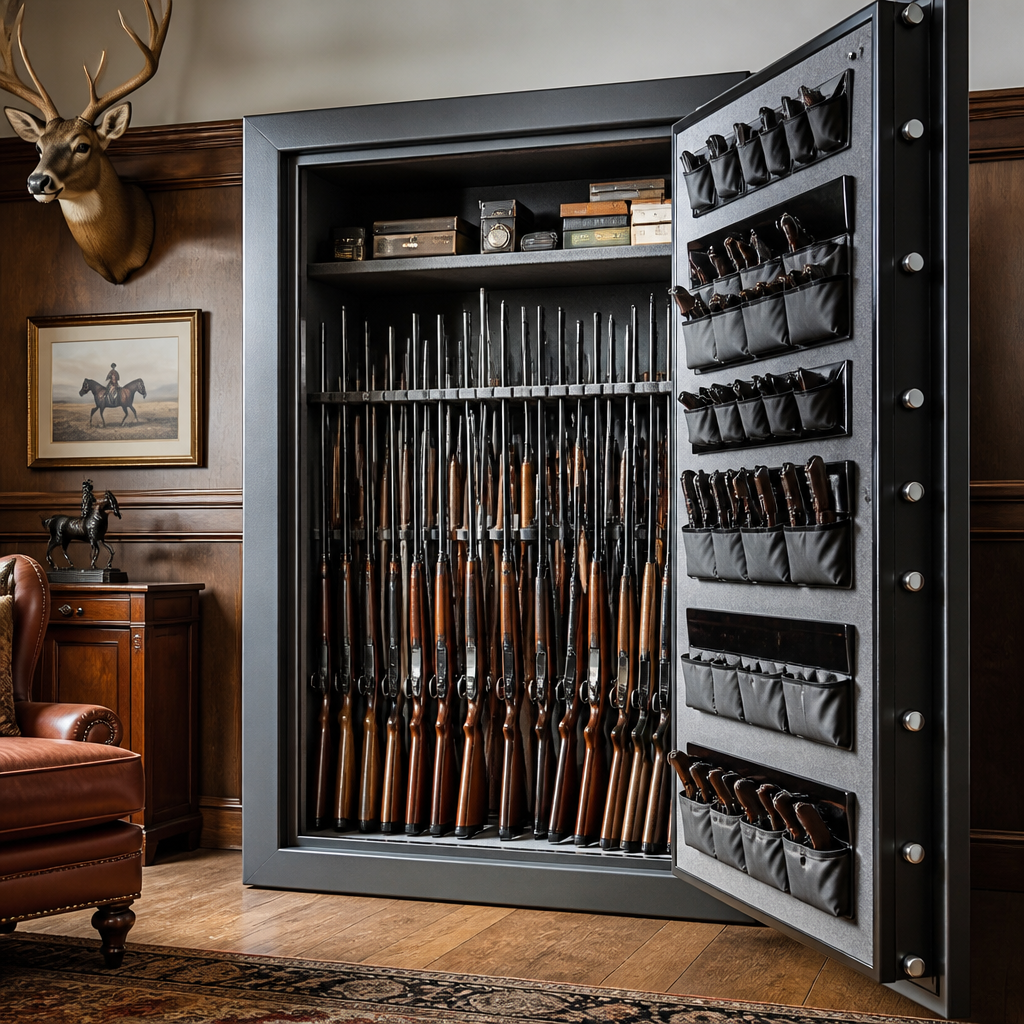
The Winchester Big Daddy 75-Gun Safe is built for owners who have outgrown standard residential security containers and need one central storage solution for long guns, handguns, optics, documents, and ammunition-related accessories. In practical terms, “75-gun capacity” refers to a manufacturer maximum based on tightly packed long guns without oversized scopes, slings, bipods, or tactical stocks, so real usable capacity is usually lower. That distinction matters because serious collectors buy safes for decades of growth, not for a single season. As a hub article for product reviews within Gun Safes & Safety, this guide explains what the Big Daddy does well, where its limits appear, and how to judge whether it fits a large collection, a mixed-use household, or a gun room expansion plan.
I have worked with large-format safes in homes where owners started with a 24-gun cabinet, graduated to a 36-gun safe, and then discovered that hunting rifles, AR-platform carbines, scoped precision builds, and family documents quickly consume every inch. The Big Daddy category exists for exactly that buyer. It promises maximum capacity, but capacity alone is not the full buying decision. Fire protection ratings, steel thickness, locking systems, interior flexibility, anchoring, delivery logistics, and local building constraints all determine whether a safe performs well in daily use. If you are researching product reviews, the right question is not simply “How many guns does it hold?” but “How effectively does it secure and organize a growing collection under real conditions?”
That broader view is important because the best large gun safe should reduce risk on several fronts at once. It should deter smash-and-grab theft, slow determined entry, protect valuables from typical house fires long enough for fire service response, and make access orderly rather than chaotic. For collectors, disorder is its own cost: scratched stocks, bent slings, damaged optics, hidden serial numbers, and firearms stacked too tightly to inspect or rotate. The Winchester Big Daddy 75-Gun Safe enters the conversation as a high-capacity option aimed at owners who want one oversized enclosure rather than multiple scattered cabinets. Understanding its design helps buyers compare it intelligently against Liberty, Cannon, Browning, Rhino, and other major safe makers.
What the Winchester Big Daddy 75-Gun Safe Is Designed to Do
The core appeal of the Winchester Big Daddy 75-Gun Safe is consolidation. Instead of splitting firearms across a main safe, a closet cabinet, and lock boxes for pistols, this model is intended to centralize storage in a single footprint. That matters more than marketing language suggests. One large safe means one lock, one fire barrier, one humidity-control plan, and one anchoring point. In households with dozens of long guns and a steady buying pattern, centralization simplifies inventory control and insurance documentation. I have seen collectors save hours during annual policy reviews because every serialized item was staged in one interior with clear shelving and dedicated pockets for handguns and paperwork.
Like many extra-large safes, the Big Daddy is designed around a compromise between gross capacity and practical accessibility. The headlining gun count attracts attention, but the real value comes from width, depth, and adjustable interior layout. A collector with lever actions and traditional hunting rifles may approach the advertised count more closely than an owner with chassis rifles, drum-fed sporting rifles, oversized suppressor-ready setups, or shotguns wearing side saddles. The Big Daddy makes sense when the buyer understands that its “75-gun” designation signals an upper boundary, while the everyday experience depends on how well the interior can be tuned to the actual collection.
Capacity, Layout, and Real-World Storage Performance
Large safe reviews often fail by repeating the catalog number without testing fit. In the real world, storage performance depends on barrel length, optic height, stock shape, and whether rifles can stand vertically without tangling. Winchester’s large-format interiors usually provide a blend of long-gun racking, door-mounted handgun storage, and adjustable shelving. That arrangement is useful because a serious collection rarely consists of seventy-five near-identical long guns. More often, the owner needs room for scoped deer rifles, AR-style rifles with lights, family shotguns, cased handguns, tax documents, heirloom jewelry, and spare magazines. Flexible shelving turns a giant safe from a warehouse into an organized system.
Buyers should assume a realistic working capacity of roughly 45 to 60 long guns if many carry optics or accessories. That estimate is consistent with what I see when owners transition from showroom expectations to home use. A row of bolt-action rifles with 50mm scopes consumes dramatically more space than the capacity sticker implies. Pistol racks, document shelves, and ammo storage reduce long-gun count further. The advantage of the Big Daddy is not that it literally stores seventy-five fully outfitted firearms with easy reach; the advantage is that it gives enough cubic volume to store a large mixed collection without immediate overflow.
| Storage Factor | Best-Case Result | Typical Collector Result | Why It Changes Capacity |
|---|---|---|---|
| Traditional wood-stock rifles | Near advertised count | Higher density storage | Slim profiles fit rack spacing efficiently |
| Scoped hunting rifles | Moderate reduction | 10% to 25% fewer long guns | Optics create overlap and snag points |
| AR-platform rifles with accessories | Noticeable reduction | 20% to 35% fewer long guns | Pistol grips, lights, and wider handguards take extra room |
| Interior shelves for documents or valuables | Improved organization | Lower firearm count, better usability | Non-firearm storage consumes rack area |
| Door organizer use | Efficient accessory storage | Better overall capacity utilization | Moves handguns and small items off shelves |
For a product review hub, that is the key lesson: capacity claims are comparative, not literal. When reading other reviews in this subtopic, use the same filter. Ask what type of firearms were counted, whether optics were installed, and whether the reviewer measured convenience or simply maximum fit. A safe that technically holds more firearms but forces constant shifting is less useful than one with a lower claimed number and superior interior management.
Security Construction, Locking System, and Theft Resistance
The Winchester Big Daddy 75-Gun Safe is generally positioned as a large residential gun safe rather than a commercial high-security vault, and that distinction should guide expectations. Most safes in this class use heavy composite doors, multi-point locking bolts, reinforced frames, and either electronic or mechanical locks. Those features provide strong resistance against opportunistic burglary, especially when the safe is anchored correctly into concrete. In my experience, anchoring is the most overlooked part of theft resistance. An unanchored large safe can still be tipped, pried, or attacked with more leverage than a securely bolted unit. Size helps, but attachment to the structure is what converts weight into real security.
Buyers should pay attention to steel gauge, door fit, hinge design, relocker features, and lock certification rather than relying on brand reputation alone. A UL-listed lock, for example, carries more meaning than vague language about “advanced security.” Likewise, the presence of multiple locking bolts sounds impressive, but bolt count matters less than overall door design and resistance to pry attack at the vulnerable edges. Winchester’s appeal in this segment usually comes from delivering a recognizable brand with substantial dimensions and mainstream residential security features at a price below boutique premium safes. That is a valid value proposition, but it remains a residential security container strategy, not a claim of invulnerability.
For collectors with especially high-value inventories, NFA items, rare Winchesters, custom 1911s, or engraved shotguns, the best practice is layered security. The safe should sit within a protected room, alarm coverage should include door contacts and motion detection, and cameras should document access points. Reviews that treat the safe as a standalone answer miss how firearm security actually works in high-value homes. The Big Daddy can be the anchor of the system, but the full system matters.
Fire Protection, Interior Environment, and Long-Term Preservation
Fire protection is often the second major reason buyers move into an oversized safe. Winchester typically markets fire resistance in terms of time and temperature, but shoppers should read those ratings carefully because testing methods vary across the industry. A stated duration at a given temperature can still leave important questions unanswered: Was the safe tested independently? Were interior temperatures monitored at multiple points? Did the rating include a cool-down period? Because manufacturers use different protocols, the fairest comparison is not the headline number alone but the reputation of the maker, the construction details, and whether the safe includes expanding door seals to block smoke and heat.
Collectors should also remember that fire ratings are only one part of preservation. Humidity control is crucial, especially in basements, garages, and humid regions. A large safe like the Big Daddy creates enough enclosed air volume that a dehumidifier rod or rechargeable desiccant becomes a standard accessory, not an optional upgrade. I have opened poorly managed safes where bluing showed early rust freckles, foam cases trapped moisture, and paper records curled despite a respectable fire label on the door. Long-term storage means managing temperature swings, airflow, and moisture inside the safe, particularly if owners store documents, optics, leather slings, or collectible wood stocks.
Interior finishes and shelving layout matter here too. Carpeted shelves reduce abrasion, while adjustable configurations allow separation between firearms and documents. If the Big Daddy is used as a true collector safe, preservation improves when owners avoid overpacking. Air needs room to circulate, and firearms need enough spacing to avoid constant contact wear. A giant safe that is stuffed beyond convenience can paradoxically shorten the life of the collection it is supposed to protect.
Who Should Buy It, Who Should Pass, and How It Compares
The Winchester Big Daddy 75-Gun Safe is best for three buyer profiles: established collectors consolidating multiple storage points, growing households that want to buy once rather than upgrade repeatedly, and owners who need a shared valuables safe with significant long-gun capacity. It is especially compelling for suburban homes where owners want one large safe in a basement, interior room, or reinforced garage corner. In those settings, the model’s major strengths are capacity, recognizable branding, and practical flexibility for mixed storage. For a review hub, it represents the high-capacity end of mainstream residential gun safes and serves as a benchmark against which smaller 36-gun and 50-gun models can be judged.
Some buyers should pass. Apartment dwellers, owners dealing with narrow stair access, and anyone who expects literal seventy-five-gun storage with optics attached may be disappointed. The safe may also be the wrong fit for buyers who prioritize thick plate steel over interior volume, or for collectors whose inventory value justifies stepping into higher-end custom or commercial-grade security. Compared with competitors, Winchester often competes on size-to-price value, while brands like Browning may stand out for interior organization, Liberty for broad dealer presence, and Rhino for stronger emphasis on steel and anti-pry features in certain lines. The correct comparison is not which brand has the loudest brochure, but which model best fits the collection, the room, and the threat profile.
Delivery and installation deserve special mention because they affect satisfaction more than most reviews admit. A safe this large needs measured doorways, planned flooring protection, and confirmed load-bearing support. Many frustrated owners do not have a product problem; they have an installation problem. Before buying, measure every turn, verify final placement, ask about inside delivery, and plan electrical access if using lighting or dehumidification accessories.
The Winchester Big Daddy 75-Gun Safe earns its place in serious product reviews because it addresses a real collector problem: standard gun safes fill up faster than expected, especially once optics, documents, and handguns enter the mix. Its strongest advantage is maximum practical capacity within the mainstream residential safe market, not a literal promise that seventy-five outfitted long guns will stand in perfect order. Buyers who understand that distinction are far more likely to be happy with the purchase.
The main takeaways are straightforward. First, judge the Big Daddy by usable storage, not by the headline count. Second, evaluate security in terms of anchoring, lock quality, steel construction, and layered home protection. Third, treat fire resistance and humidity control as connected responsibilities if you want to preserve a collection over decades. Finally, compare it with competing large-format safes based on layout, delivery realities, and your actual firearm mix, not generic marketing claims.
As the hub for product reviews under Gun Safes & Safety, this article should help you frame every related purchase decision more intelligently. If your collection is expanding and you want one oversized safe that can centralize storage with credible residential protection, the Winchester Big Daddy 75-Gun Safe deserves a close look. Next, review your inventory, measure your installation path, and compare interior layouts before you buy.
Frequently Asked Questions
Does the Winchester Big Daddy 75-Gun Safe really hold 75 guns?
The short answer is: it can, but only under ideal conditions. The stated 75-gun capacity is a manufacturer maximum, which typically assumes a very tight arrangement of standard-profile long guns placed closely together without bulky scopes, slings, bipods, wide forends, pistol grips, or adjustable tactical stocks. In real-world use, most collectors find that actual capacity is lower because modern firearms are rarely configured in the most space-efficient way. Scoped hunting rifles, AR-style platforms, shotguns with accessories, and precision rifles all take up more room than a basic long gun silhouette.
That is why the “75-gun” label should be viewed as a ceiling rather than a guarantee. For many owners, the more realistic question is not how many firearms the safe can theoretically hold, but how many it can hold while still allowing organized access and protecting optics and finishes from being crowded together. If you want room for long guns plus handguns, documents, shelves, ammunition-related accessories, and other valuables, the usable firearm count will almost always drop. For a serious collector, that tradeoff is often worth it because a less crowded safe is easier to manage, safer for the contents, and better suited to long-term ownership.
Who is the Winchester Big Daddy 75-Gun Safe best suited for?
This safe is best suited for firearm owners who have outgrown standard residential security containers and need one centralized storage solution instead of juggling multiple smaller safes or cabinets. It makes particular sense for established collectors, multi-generational households with extensive long-gun inventories, shooting enthusiasts with a mix of hunting rifles and tactical platforms, and owners who also need protected space for handguns, optics, important papers, jewelry, and other high-value items. The appeal is not simply capacity for its own sake, but the ability to consolidate storage in a way that improves organization and access.
It is also a strong fit for buyers who understand that storage needs evolve over time. Many people purchase a safe based on what they own today, then discover within a few years that they underestimated future acquisitions, accessory growth, and the space required for practical layout. A large-format safe like the Big Daddy is often attractive because it gives collectors breathing room. Instead of packing every shelf and barrel rest immediately, owners can dedicate zones for long guns, handguns, optics, paperwork, and miscellaneous gear. That flexibility is especially valuable if your collection includes firearms of different lengths and configurations, or if you prefer to store some items for quick visibility rather than maximizing every cubic inch.
How much usable space should collectors expect once optics, accessories, and shelves are factored in?
Collectors should expect usable firearm capacity to decrease noticeably once real-world storage variables are introduced. Scopes are one of the biggest factors because they add width and interfere with close side-by-side placement. Slings, bipods, muzzle devices, extended magazines, oversized bolt handles, and tactical furniture all compound the issue. Even if the interior dimensions are generous, the practical arrangement of these features can reduce efficiency and create dead space. As a result, a safe marketed for 75 long guns may function more like a lower-capacity unit when it is filled with accessorized firearms rather than bare rifles and shotguns.
Shelving configuration matters just as much. Many owners do not want every inch devoted exclusively to barrel slots because they need room for handgun racks, document storage, ammo-related accessories, suppressor paperwork, range gear, cleaning supplies, and valuables unrelated to firearms. Every shelf section added for organization generally reduces the number of long guns the safe can hold. That is not a flaw; it is the reality of using a large safe intelligently. In practice, the best approach is to plan around categories: how many scoped rifles you own, how many tactical long guns need extra width, how many handguns require dedicated storage, and how much shelf space you want reserved for non-firearm items. Thinking that way gives a much more accurate picture of usable space than relying on the printed maximum alone.
Is a larger safe like the Winchester Big Daddy better than buying multiple smaller safes?
For many collectors, one larger safe offers meaningful advantages over multiple smaller units. The biggest benefit is centralization. Keeping long guns, handguns, optics, documents, and related valuables in one secure location simplifies inventory management, daily access, and overall organization. It also avoids the inefficiency of dividing a collection across several containers with different internal layouts and capacity limits. If your goal is to create a single, structured storage system that can grow with your collection, a large-capacity safe is often the more practical solution.
That said, the better choice depends on your space, budget, and storage priorities. A very large safe demands significant floor space, proper placement, and consideration of weight and delivery logistics. Some owners prefer multiple smaller safes because they can separate firearm types, distribute weight, or place secure storage in different areas of the home. However, that approach can also create inconvenience and lead to fragmented organization. The Winchester Big Daddy appeals most to buyers who want one primary storage hub and who recognize that “extra room” is rarely wasted. In the safe world, unused space today often becomes essential space tomorrow, especially for collectors who continue acquiring firearms and accessories over time.
What should buyers consider before choosing the Winchester Big Daddy 75-Gun Safe for a growing collection?
Before choosing this safe, buyers should think beyond the headline capacity and evaluate how they actually store firearms. Start with the makeup of the collection: standard hunting rifles, scoped precision guns, AR-style platforms, shotguns, handguns, and accessory-heavy builds all consume space differently. Then consider what else belongs inside the safe. For many owners, secure storage is not limited to firearms alone. Optics, tax documents, passports, hard drives, jewelry, magazines, and ammunition-related accessories often compete for the same interior volume. A safe that appears oversized on paper can become appropriately sized very quickly once these categories are accounted for.
It is also important to think in terms of long-term ownership rather than immediate fit. Collectors frequently regret buying too small, far more often than buying too large. If your collection is already approaching the limits of a standard safe, moving to a model like the Big Daddy can be a strategic upgrade because it provides room for better organization, safer spacing between firearms, and future acquisitions. Buyers should also account for placement logistics, including the dimensions of the installation path, floor support, preferred room location, and how interior shelving will be configured for their specific needs. Approached realistically, the Winchester Big Daddy 75-Gun Safe is less about chasing a raw firearm count and more about creating a secure, adaptable storage system that matches the needs of a serious collector.