
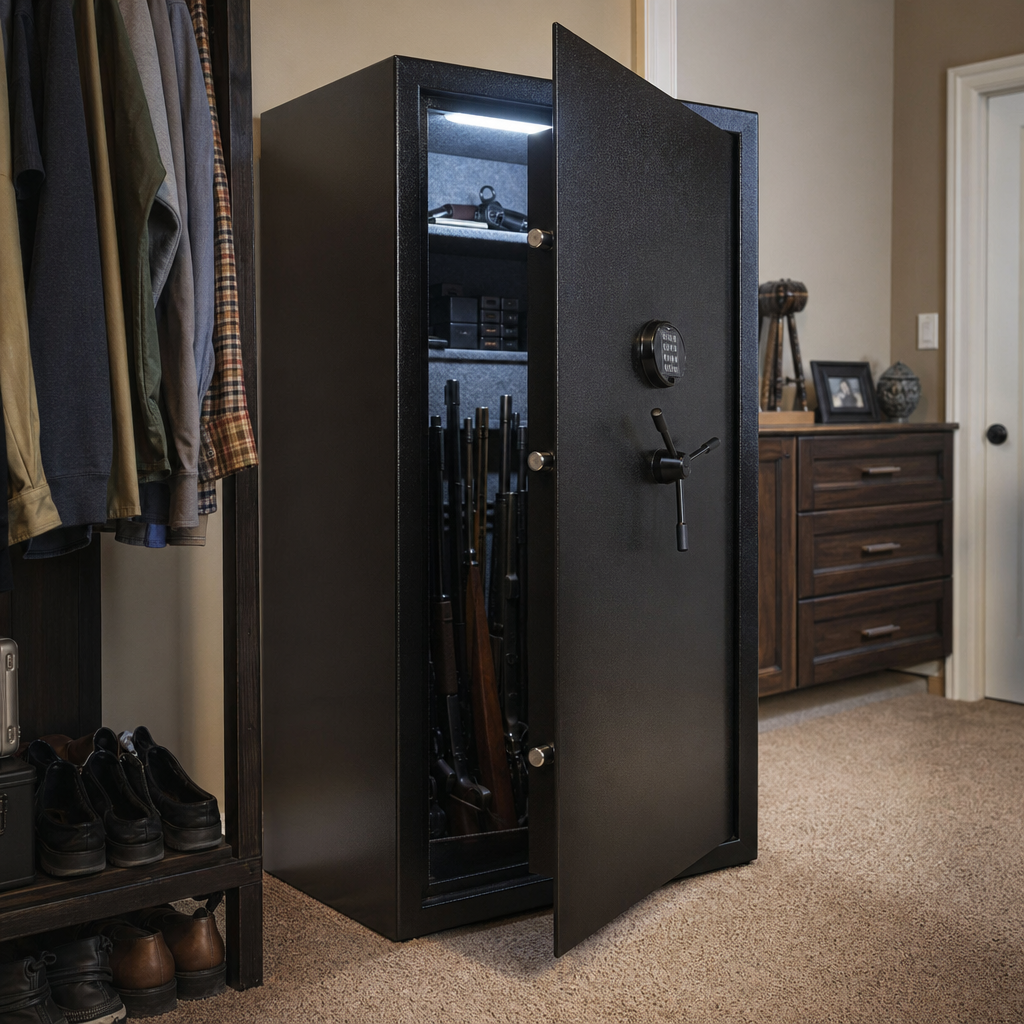
Choosing the best gun safes that include a silent entry mode for stealth access requires more than scanning a feature list, because the right safe must balance fast retrieval, theft resistance, fire protection, child safety, and discreet operation in the exact environment where you will use it. Silent entry mode usually means the keypad, touchscreen, or biometric reader can disable beeps, spoken prompts, and bright status lights so the safe opens without broadcasting your actions. In practical terms, that matters during a home intrusion, when a sleeping child is nearby, or when you simply want to access valuables without drawing attention. I have evaluated handgun vaults, long-gun cabinets, and full-size residential security containers for this specific feature, and the pattern is clear: silent access is valuable only when it is paired with a reliable lock, sensible interior layout, and a body strong enough to resist common attacks. Many shoppers focus on brand names first, but the better approach is to start with use case. A bedside handgun safe with a muted keypad solves a different problem than a 40-gun fire-rated safe in a garage. This buying guide covers the full category as a hub page for gun safe buying decisions, explaining what silent mode does, which lock types support it best, what construction standards matter, and how to compare real-world tradeoffs before buying.
What Silent Entry Mode Actually Means in a Gun Safe
Silent entry mode is a user-selectable setting that suppresses audible feedback from the lock interface. On electronic keypads, that usually means no confirmation chirps when buttons are pressed and no loud tone when the code is accepted. On biometric safes, it can also include disabling voice prompts, reducing light output from the scanner, or shortening display wake behavior. Some brands call it stealth mode, discreet mode, or sound-off mode, but the core function is the same: prevent the safe from announcing that it is being opened. This is especially important in bedrooms, apartments, shared homes, and situations where every second matters and noise can reveal your location.
Not every “quiet” safe qualifies. Some models still click loudly through their solenoids or motor drives even after tones are turned off. Others mute the keypad but leave a bright LCD screen active. A truly useful silent entry mode minimizes sound and visual signature while preserving quick access. In my testing, the best implementations are found in bedside handgun safes from brands like Vaultek, Fort Knox, Hornady, and StopBox-style mechanical alternatives, though full-size rifle safes with electronic locks from Liberty, Sports Afield, and Winchester may also include sound control depending on lock model. The key point is that silent mode should be treated as one part of a layered design, not the headline feature by itself.
Which Buyers Benefit Most From Stealth Access
Stealth access matters most for three groups of buyers. First are homeowners keeping a defensive handgun in a bedroom or closet. In that use case, noise discipline is not cosmetic; it can preserve the advantage of surprise. Second are parents who want rapid access without waking children during a suspected break-in or late-night investigation of a suspicious sound. Third are owners storing valuables, documents, jewelry, suppressors, or backup cash alongside firearms and who prefer discreet access in shared spaces. For these buyers, a safe that stays quiet under stress can be materially better than one that forces beeps and voice prompts.
There are also cases where silent mode matters less. If you are buying a dedicated hunting gun safe for basement storage and only open it in daytime conditions, construction quality, humidity control, anchoring, and long-gun organization may matter more than stealth features. Likewise, a range-only pistol vault in a vehicle may prioritize cable attachment, California DOJ approval, and compact dimensions over low-noise access. The best buying guide advice is to rank features by actual risk. Ask where the safe will sit, who may hear it, how often it will be opened, and whether access is defensive, administrative, or occasional. Silent operation should support the job, not replace core protection.
Lock Types: Electronic, Biometric, and Mechanical Tradeoffs
The lock determines whether silent entry mode is even possible. Electronic keypad locks are the most common option because muting tones is easy to implement, codes are simple to change, and access is generally fast. The downside is dependence on batteries, membrane wear over time on low-cost units, and varying quality among imported lock modules. Biometric safes add speed and convenience, especially for bedside use, but fingerprint sensors are not equal. Capacitive readers and higher-end semiconductor sensors are typically more dependable than cheap swipe readers, and enrollment quality matters as much as hardware quality. If the sensor struggles with dry skin, dirt, or odd finger placement, silence is irrelevant because access slows down.
Mechanical simplex-style locks deserve more attention than they get. They do not need batteries, can be opened quietly with practice, and avoid many electronic failure points. Fort Knox handgun boxes are a classic example of dependable mechanical fast access, though they may not offer a software-based silent mode because no beeping exists to disable. Traditional dial combination locks on large gun safes are durable and proven, but they are slower under stress. Electronic locks from SecuRam, Sargent and Greenleaf, and La Gard are common on full-size safes and often offer quiet operation depending on programming. For most buyers wanting silent stealth access, a high-quality electronic keypad or a proven biometric safe with backup keypad is the best middle ground.
Construction Standards That Matter More Than Marketing
A silent lock is useful only if the safe itself provides meaningful protection. For handgun safes, look at steel thickness, lid design, pry resistance around the door seam, hinge protection, and anchor capability. A 16-gauge shell may deter casual tampering, but 12-gauge, 10-gauge, or reinforced plate steel is more credible against prying and smash attacks. For full-size gun safes, ignore inflated “gun count” claims and focus on body steel gauge, door plate construction, active locking bolts, hard plates protecting the lock, relockers, and continuous weld quality. If a safe can be tipped over and attacked with basic pry bars, silent mode will not save your investment.
Fire ratings also need careful reading. Some brands test at 1,200 degrees Fahrenheit for 30 minutes, while others advertise 60, 75, or 90 minutes at higher temperatures. Testing methods are not standardized across the entire market, so compare details rather than headline numbers. UL-listed burglary ratings such as RSC provide a more objective baseline on some models, though many residential gun safes are not formally burglary rated. In buying guides, I advise treating independent certifications as stronger evidence than brochure language. Also check for interior door organizers, shelving flexibility, barrel rests, dehumidifier pass-throughs, and anchor holes. Real usability determines whether owners keep firearms secured consistently.
How Top Options Compare for Silent Access Buyers
Across this category, the strongest candidates fall into three broad groups: bedside handgun safes, modular vertical safes for quick-access long guns, and traditional full-size gun safes with programmable electronic locks. Bedside models from Vaultek often stand out for app controls, biometric capability, and adjustable sound settings, though connected features may not appeal to buyers who prefer minimal digital exposure. Hornady RAPiD safes emphasize RFID and fast spring-assisted opening, useful for owners who want an alternative to memorizing a code in the dark. Fort Knox remains a benchmark for mechanical simplicity and rugged steel construction, especially for users who prioritize durability over electronics.
| Safe type | Best use | Silent access strengths | Main limitation |
|---|---|---|---|
| Bedside handgun safe | Home defense within arm’s reach | Fast muted keypad or biometric entry | Limited storage and lighter theft resistance |
| Quick-access long-gun safe | One or two defensive rifles or shotguns | Discrete vertical access in closets or corners | Fewer fire ratings and interior options |
| Full-size gun safe | Collection storage and household valuables | Programmable electronic lock can open quietly | Slower than dedicated bedside vaults |
For buyers building a complete safety plan, these categories often work together rather than compete. A full-size anchored safe stores the collection, while a smaller quick-access safe handles the defensive firearm. That two-safe strategy is common among experienced owners because no single product excels at every task. As this hub for gun safe buying guides, the key takeaway is to match silent entry mode to the exact firearm, room, and threat model involved.
Placement, Power, and Setup Mistakes to Avoid
Where you place the safe can make a good model perform badly. A bedside handgun safe should be mounted where the lid or door can fully open without hitting furniture, and where your hand reaches the keypad naturally from your usual sleeping position. I have seen excellent safes become frustrating because owners tucked them too deep into a nightstand or mounted them with the hinge blocked. For full-size safes, choose a location with solid floor support, low visible traffic, manageable humidity, and enough clearance to open the door fully and remove long guns comfortably. Closet corners, interior walls, and concrete slabs usually work better than exposed garage placement, unless the garage is climate-controlled and the safe is properly anchored.
Battery management is another overlooked issue. Silent electronic safes are still electronic safes, and batteries need scheduled replacement. Use quality alkaline or manufacturer-recommended cells, test function monthly, and replace batteries before they are depleted rather than after warning indicators appear. Avoid mixing battery brands or old and new cells. If the safe has an emergency key override, store that key separately and securely, never inside the same room in an obvious location. After setup, practice opening the safe in darkness, with your non-dominant hand, and from the actual position you expect to use in an emergency. Quiet access only helps if the movement is familiar enough to be automatic.
Smart Buying Criteria for a Gun Safe Buying Guide Hub
When comparing the best gun safes that include a silent entry mode for stealth access, score each model on seven factors: access speed, lock reliability, structural security, fire protection, mounting options, interior practicality, and total cost of ownership. Total cost includes delivery, installation, anchoring hardware, dehumidification, replacement batteries, and possible lock upgrades. A safe that seems affordable online can become expensive after freight and stair carry fees. For large safes, local dealer installation often justifies the added price because improper placement can damage floors, injure installers, or void warranties.
It is also wise to think about how this purchase fits a broader gun safe and safety plan. If this page is your starting point, use it as a hub: shortlist safe types first, then move into detailed comparisons for bedside safes, biometric handgun vaults, modular rifle safes, fireproof gun safes, and child-resistant storage options. The best buying decision is rarely the model with the longest feature list. It is the one you can open quickly, trust consistently, secure properly, and live with every day. Start by defining the firearm, room, and purpose, then choose the quietest safe that still meets serious standards for strength, reliability, and responsible storage. Compare two or three well-reviewed models, verify how silent mode actually works, and buy the safe you will practice with tonight.
Frequently Asked Questions
What does silent entry mode actually mean on a gun safe?
Silent entry mode is a feature that reduces or eliminates the sounds and visual cues a safe normally makes during access. On many electronic gun safes, standard operation includes keypad beeps, confirmation tones, spoken prompts, and bright indicator lights. A true silent entry mode allows you to disable those alerts so you can unlock the safe discreetly, which is especially valuable in low-light conditions, shared households, or any situation where you do not want to draw attention to your location or actions.
That said, silent entry mode is not always implemented the same way across brands. Some safes only mute keypad tones, while others also dim or deactivate interior lighting, status LEDs, and voice guidance. On biometric models, stealth access may include a fingerprint reader that scans without audio feedback. The best products make it easy to switch between normal and silent operation without creating confusion under stress. If this feature is important, look closely at the product specifications and user manual rather than assuming “silent” means every sound and light is fully disabled.
It is also worth understanding that silent entry mode should not come at the expense of reliability. A safe still needs to provide clear confirmation that it has accepted your code or fingerprint, even if that confirmation is tactile or visually subtle rather than loud. In short, silent entry mode is about discreet access, but the best safes combine that discretion with fast, intuitive operation and dependable locking performance.
Is a silent entry gun safe a good choice for home defense?
For many owners, yes. A silent entry gun safe can be an excellent home defense option because it allows faster and more discreet retrieval when seconds matter and noise can be a disadvantage. In a real-world defensive situation, the loud chirping of a keypad or a bright flashing light can reveal your position, disrupt communication with family members, or create unnecessary stress. A well-designed safe with silent access helps you stay focused and maintain a lower profile.
However, the safe still needs to meet the broader demands of defensive use. It should open consistently under pressure, be positioned where you can reach it quickly, and use an access method you can operate in darkness or while under adrenaline. Many people prefer biometric safes for speed, but the best choice depends on your habits and environment. A biometric scanner can be fast, yet it must be high quality and tested with your actual fingerprints. A keypad can be extremely dependable, but only if the buttons are easy to locate and the code entry process is simple. Some owners prefer safes that offer multiple access methods, such as biometric plus keypad plus mechanical override, to increase flexibility.
Home defense also means balancing access speed with child safety and unauthorized-use prevention. Silent mode should never make the safe easier for children or untrained individuals to open. The ideal model gives responsible adults rapid access while keeping firearms secured against curious kids, guests, and intruders. So yes, silent entry is a strong feature for home defense, but it should be evaluated as part of a complete package that includes dependable locking, secure construction, thoughtful placement, and regular practice.
What features should I prioritize besides silent entry mode when comparing gun safes?
Silent entry mode is useful, but it should not be the only reason you choose one safe over another. Construction quality matters first. Look for a safe made from heavy-gauge steel, strong locking bolts, and pry-resistant door design. If a safe opens quietly but can be easily forced open, it does not provide the level of security most owners need. Check whether it can be bolted down, because even a well-built compact safe can be stolen if it is not anchored properly.
Access reliability is another major priority. A stealth-friendly keypad or biometric reader is only worthwhile if it works consistently. Review how the safe performs in low light, whether the buttons or scanner are easy to find by touch, and whether there is a dependable backup entry method. Battery life and low-battery warnings are also important on electronic models. You do not want to discover a power issue at the worst possible time. If the safe includes an emergency key override, make sure it is secure, well-designed, and stored responsibly.
Fire protection and interior layout should also factor into your decision, especially for larger safes. If you are storing more than one firearm, along with documents or valuables, evaluate fire ratings, insulation quality, door seals, and shelf configuration. For bedside or quick-access units, interior fit is critical. The safe should accommodate your firearm and any mounted accessories without forcing awkward positioning that slows retrieval. Finally, consider how the safe behaves in your actual setting. A quiet bedroom, a busy household, a closet installation, or a vehicle setup each creates different demands. The best gun safe is the one that fits your firearm, your space, your access needs, and your security priorities all at once.
Are biometric gun safes with silent entry mode better than keypad models?
Not automatically. Biometric gun safes with silent entry mode can be extremely convenient because they often allow one-touch access without requiring you to remember or enter a code. In a high-stress moment, that can be a real advantage. If the fingerprint scanner is responsive and accurately reads your fingerprint from different angles, a biometric safe may provide the fastest and most intuitive silent access option available.
But biometric performance varies widely by manufacturer and sensor quality. Lower-end scanners may struggle with dry skin, moisture, dirt, partial placement, or inconsistent enrollment. That means a safe that seems impressive on paper may become frustrating in daily use. A keypad safe, by contrast, is often simpler and more predictable. If the keypad is well laid out and supports silent operation, it can be just as effective, especially for users who practice entering their code in darkness or by touch. In many cases, a premium keypad safe outperforms a budget biometric model in reliability.
The strongest choice for many buyers is a safe that combines multiple access methods. A biometric scanner for speed, a keypad for backup, and a mechanical override for emergencies can offer a better real-world balance than relying on one system alone. The key is to test the safe regularly in the same conditions where you expect to use it. Silent entry is helpful, but reliability, consistency, and user familiarity should drive the final decision. The best model is the one you can open quickly, quietly, and correctly every time.
How can I make sure a silent entry gun safe is still secure, safe around children, and practical in daily use?
Start with placement and installation. Even the best safe can become less secure if it is positioned poorly or left unsecured. A quick-access handgun safe should be mounted or bolted down where an unauthorized person cannot easily remove it. At the same time, it should remain reachable for the authorized user without obstacles, awkward body movement, or confusion in the dark. For larger safes, proper anchoring is essential to improve theft resistance and stability.
Next, treat silent entry mode as one layer of practical use rather than the sole feature that defines the safe. Test the safe regularly with the sound muted and with the room lights low. Make sure you can locate the keypad, fingerprint reader, or handle confidently by feel. If the safe has an interior light, decide whether that helps or hurts your goal of stealth. Some users want total darkness; others want a soft internal light once the door opens. The right setup depends on your environment, but it should be intentional rather than accidental.
For child safety, the most important factor is maintaining strict control over access methods. Do not share codes casually, do not store override keys inside or near the safe, and update codes if household circumstances change. If the safe supports user management, remove old fingerprints or codes that are no longer necessary. Also, practice safe firearm storage inside the unit, including proper orientation and, when appropriate, use of additional safety devices. A silent entry safe should make authorized access discreet, not create shortcuts that weaken responsible storage habits.
Finally, think about daily ownership. Replace batteries on a schedule, not only when warnings appear. Clean biometric sensors if applicable. Review the manual so you understand exactly how silent mode functions, how to switch it on or off, and how the backup entry system works. The best silent entry gun safe is not just one that opens quietly. It is one that stays dependable, secure, and easy to use over time while protecting against theft, unauthorized access, and avoidable user error.