
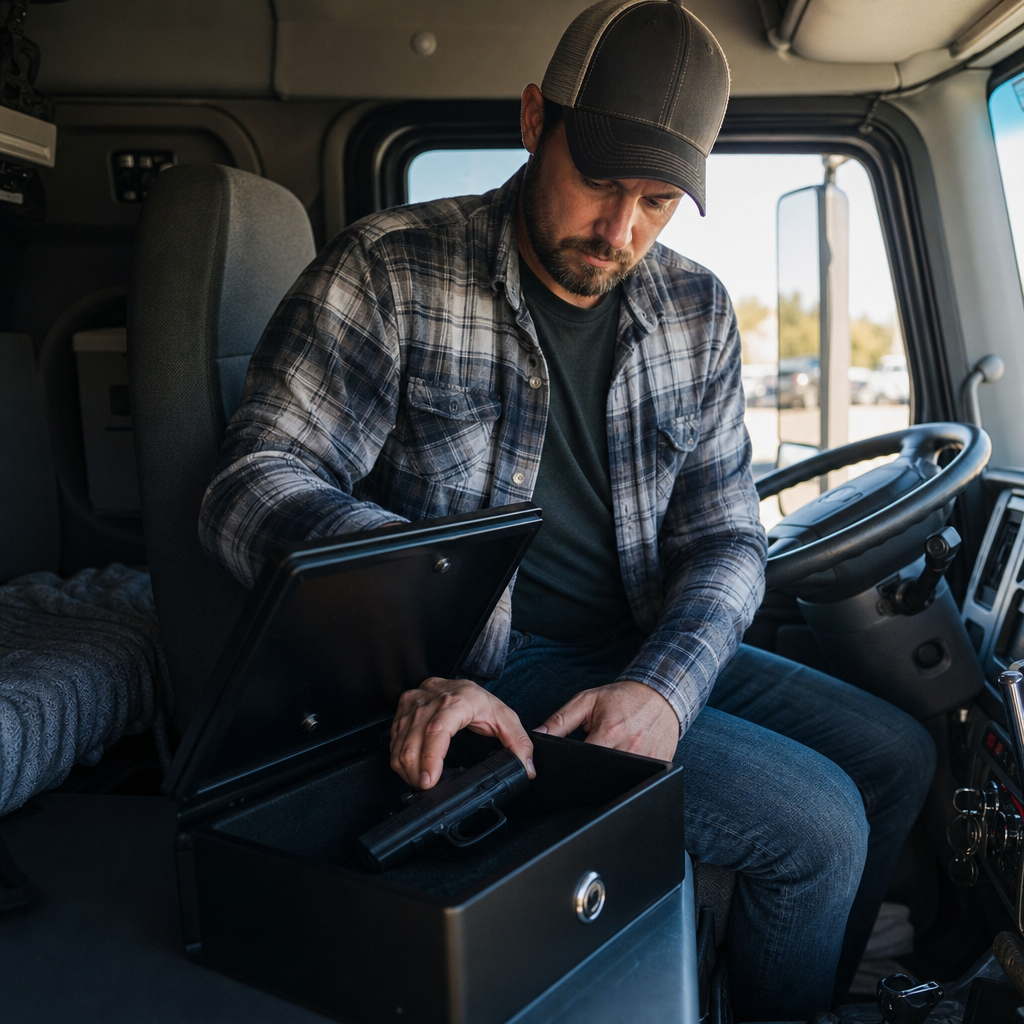
Truck drivers who legally carry a firearm face a security problem that most gun safe guides barely address: how to keep a defensive weapon accessible enough for life on the road, yet secure enough to prevent theft, misuse, and costly legal trouble. The ideal gun safe for truck drivers who carry firearms on the road is not simply a smaller home safe. It is a purpose-built storage solution shaped by hours parked at truck stops, varying state laws, Department of Transportation schedules, sleeper-cab living, and the very real risk of smash-and-grab theft from commercial vehicles.
In my work evaluating firearm storage setups for mobile professionals, I have seen the same mistake repeatedly. Drivers buy a generic lockbox marketed for cars, wedge it under a bunk, and assume they are covered. In practice, that often fails on three fronts: fit, retention, and routine use. If a safe rattles loose, cannot be anchored to the cab structure, or is annoying to open during a fuel stop, it usually ends up unused. A truck gun safe has to work with real driver behavior, not idealized brochure scenarios.
For this buyer persona, several terms matter. A truck gun safe is a lockable firearm container designed to be mounted or secured inside a semi-truck, pickup, service truck, or sleeper cab. Quick-access means the lock can be opened rapidly, often by electronic keypad or simplex-style mechanical push-button entry. Tamper resistance refers to how well the unit resists prying, cutting, or cable defeat. Vehicle integration means the safe can be mounted to existing frame points, seat bases, bunks, cabinets, or reinforced surfaces without compromising safety systems. These details determine whether a product solves the problem or creates new ones.
This topic matters because truck drivers occupy a distinct middle ground between home defense owners and everyday concealed carriers. They live in their vehicle for long stretches, transport valuable cargo, park overnight in unpredictable environments, and may cross multiple jurisdictions in a single run. A safe choice for this group must account for theft deterrence, lawful storage during restricted access points, climate fluctuations inside the cab, and the practical need to secure a firearm before entering a shipper, receiver, or regulated facility. As a hub page for gun safe buyer personas, this article explains what truck drivers need, how those needs differ from other buyers, and what standards should guide a purchase.
Why truck drivers need a different kind of gun safe
The best gun safe for truck drivers solves a mobile security problem, not a residential one. A home safe can rely on weight, concrete anchors, and fixed room placement. A truck safe cannot. Every pound affects space, every inch competes with gear, and every mounting choice must survive vibration, braking, temperature swings, and attempted theft during unattended parking. That makes design priorities very different.
Truck drivers also face a unique exposure profile. A local commuter may leave a pistol in a vehicle for an hour. An over-the-road driver may leave a firearm in the cab while showering, checking in at a warehouse, eating, or sleeping in a rest area. Commercial vehicles are frequently targeted because thieves expect cash, electronics, tools, and freight documents. An unsecured handgun adds both criminal risk and liability. If a stolen firearm is later used in a crime, the consequences can extend far beyond replacement cost.
Another difference is routine transitions. Drivers often need to secure their handgun quickly before entering customer sites, ports, military installations, company yards, or states and municipalities with stricter carry rules. In those moments, the safe must be easy to reach without becoming visible from outside the cab. A low-profile under-bunk or seat-base installation usually performs better than a portable box tossed in a duffel. Good concealment is not a substitute for strong construction, but it meaningfully reduces opportunistic theft.
For buyers researching gun safe personas, truck drivers stand out because they combine the concerns of several groups at once: vehicle owners, travelers, defensive handgun carriers, and people effectively living in compact quarters. That overlap is why generic advice misses the mark. The right answer starts with how the truck is used, where it is parked, and how often the firearm must be stored and retrieved.
Core features that define the ideal truck gun safe
If you want a direct answer, the ideal truck gun safe for most drivers is a compact handgun safe made from welded steel, using a fast and reliable lock, mounted to the truck structure with hardened hardware, and sized for one primary defensive firearm plus a spare magazine. Simplicity wins. A huge interior sounds appealing but often increases visibility, installation difficulty, and dead space. In a cab, efficient dimensions matter more than advertised capacity.
Steel thickness is one of the first things I check. Many low-cost lockboxes use thin sheet metal that bends under pry pressure. Serious options generally use heavier-gauge steel, reinforced doors, protected hinges, and anti-pry lips. No small vehicle safe is theft-proof, but stronger bodies and better door geometry dramatically increase attack time and noise. For a thief working fast in a parking lot, delay is often enough to force abandonment.
Lock choice matters just as much. Electronic keypads are fast and convenient, especially in awkward cab positions or low light. Their weakness is battery dependence and potential failure from poor-quality electronics. Mechanical simplex locks avoid batteries and have an excellent reputation for durability, but they are usually more expensive and bulkier. Tubular key locks are common on cheap units and are generally the least desirable primary option because keys are slower, easier to lose, and inconvenient during constant entry and exit cycles.
Mounting is the make-or-break feature. A lockbox secured only by a cable is better than nothing, but not ideal for regular truck use. Cables can be cut, and portable units invite removal. Hard mounting to a seat pedestal, sleeper frame member, cabinet base, or other reinforced point is the better approach when the truck layout allows it. Before drilling, drivers should confirm they are not interfering with wiring harnesses, air lines, safety systems, or lease restrictions.
| Feature | Best choice for most truck drivers | Why it matters on the road |
|---|---|---|
| Construction | Welded steel body with reinforced door | Resists quick pry attacks during unattended stops |
| Lock type | Mechanical push-button or quality electronic keypad | Balances quick access with dependable daily use |
| Mounting | Bolted installation to structural point | Prevents whole-safe theft better than cable-only setups |
| Size | Handgun plus spare magazine fit | Saves cab space and keeps installation discreet |
| Interior | Foam-lined, low-abrasion surface | Protects finish and reduces rattle from vibration |
| Backup entry | Emergency override with secure protocol | Provides access if batteries or primary method fail |
Interior protection is not cosmetic. Trucks vibrate constantly, and an unpadded steel box can mar sights, optics, and finishes over time. Closed-cell foam or well-fitted liners help. Moisture control also matters. Cab interiors can cycle from heat to cold rapidly, creating condensation risk. Corrosion-resistant finishes, desiccant packs, and periodic wipe-downs are practical safeguards, especially for drivers in humid regions.
Matching safe types to driver personas on the road
Not every truck driver should buy the same product. This is where buyer personas become useful. Over-the-road owner-operators usually need the strongest blend of concealment, mount security, and daily convenience because the truck is both workplace and living space. They benefit most from a hard-mounted handgun safe near the bunk or driver seat, where the firearm can be secured before sleep, showers, and customer check-ins.
Company drivers often have an added constraint: policy. Some carriers prohibit firearms entirely, and some lease agreements restrict modifications to the cab. For them, legal compliance and employment risk may outweigh every hardware consideration. If firearms are permitted, a non-invasive but robust setup may be necessary, such as a bracket-mounted safe using existing seat bolts or approved attachment points. Drivers should verify both company rules and equipment lease terms before buying anything.
Regional and local drivers have different patterns. They may make many stops each day, enter customer facilities more often, and spend less time sleeping in the truck. Speed of secure storage becomes critical. A compact quick-access safe mounted within arm’s reach can make repeated disarm-and-store cycles realistic. If it takes too long, the process breaks down, and the firearm may end up hidden loosely in the cab, which is the opposite of safe storage.
Pickup-based contractors and hotshot drivers form another related persona. Their vehicles are smaller, more exposed, and often used for both family and work life. Under-seat safes designed for specific truck models can be excellent here because they preserve interior space and appear factory integrated. The tradeoff is that model-specific products may limit firearm size, particularly if the driver carries a full-size pistol with optic or weapon light.
Team drivers face an overlooked challenge: shared access. If two people use the same cab, the safe placement and lock method must fit both users while preserving authorized access boundaries. A single-user biometric unit may be a poor fit unless it supports multiple reliable profiles and has a dependable backup method. In practice, mechanical push-button safes are often easier to manage in shared-use environments.
Legal, operational, and installation realities drivers cannot ignore
A truck gun safe is not a substitute for understanding the law. Firearm possession rules differ by state, and crossing state lines can change what is lawful regarding carry method, magazine capacity, ammunition type, storage requirements, and access in commercial settings. Some states recognize permits broadly; others do not. Certain locations, including ports, federal facilities, posted private property, and specific shipper or receiver sites, may prohibit possession entirely. Drivers should plan routes with those restrictions in mind instead of relying on assumptions.
There is also a practical compliance issue. A safe should allow a driver to transition cleanly from carry to secured storage before arriving at a restricted property. That means placement matters operationally, not just tactically. If a driver has to exit the cab, open a side compartment, and handle the firearm in public view, the setup is flawed. The safe should support discreet, safe unloading or storage inside the cab before entry.
Installation quality determines whether even a good safe performs well. I strongly recommend test-fitting with seat travel, bunk movement, and door clearance checked before drilling a single hole. On modern trucks, hidden wiring and air components can turn a careless install into an expensive repair. Use backing plates where appropriate, torque hardware correctly, and apply threadlocker if the manufacturer allows it. Vibration loosens shortcuts.
Brand reputation should be evaluated with discipline. Marketing terms like tamper-proof, military grade, or DOJ approved are often used loosely. What matters is verifiable construction, lock reliability, mounting design, and user feedback from actual vehicle installations. Recognized names in quick-access and vehicle storage categories include Fort Knox, V-Line, Console Vault, Hornady, and GunVault, but suitability depends on model design, not logo alone. Read dimensions carefully, especially if the handgun has an optic, extended magazine, or light.
How to choose well and avoid common buying mistakes
The smartest way to buy is to start with a use case, not a catalog. Ask four questions. Where in the truck can the safe be mounted without interfering with operation? How quickly must the firearm be accessed or secured during a normal workday? What exact handgun setup must fit inside? What laws and company policies apply across the routes you run most often? Those answers narrow the field fast.
The most common mistake is prioritizing low price over installation security. A cheap lockbox with a cable may feel economical, but if it can be stolen in seconds, it fails the core mission. The second mistake is choosing a safe too small for the actual firearm configuration. Red-dot optics, suppressor-height sights, and weapon lights frequently turn “fits most handguns” into a false promise. Measure your setup and compare it to usable interior dimensions, not exterior dimensions.
Another mistake is overvaluing biometrics. Fingerprint access sounds ideal, but in trucking conditions, dry skin, dirt, vibration, and battery issues can reduce consistency on lower-end units. Some biometric safes are excellent, but they should be tested repeatedly before being trusted on the road. A fast mechanical or keypad model with a proven backup method is often the safer long-term choice.
As a hub within gun safes and safety, the main takeaway is clear: buyer personas matter because context changes the right answer. The ideal gun safe for truck drivers who carry firearms on the road is compact, durable, discreet, and firmly mounted, but the exact model depends on whether the driver is over-the-road, regional, company-employed, team-based, or operating a pickup platform. Match the safe to the route, the truck, the firearm, and the rules you actually live under.
Choose a safe that you can mount correctly, open reliably, and use every single day without shortcuts. Review your truck layout, verify legal and employer requirements, measure your handgun setup, and compare proven models before you buy. If you do that carefully, you will end up with storage that protects your firearm, reduces theft risk, and makes life on the road safer and simpler.
Frequently Asked Questions
What makes a gun safe for truck drivers different from a standard home safe?
A gun safe for a truck driver has to solve a very different problem than a safe designed for a house. A home safe usually stays in one place, benefits from a stable environment, and is built around long-term storage. A truck safe has to work inside a moving vehicle, in a compact cab or sleeper, under constant vibration, changing temperatures, humidity swings, and long periods of time away from the truck. It also has to account for the reality that a commercial driver may need to secure a defensive handgun quickly before entering a restricted area, crossing into a more restrictive jurisdiction, or leaving the truck unattended at a truck stop or shipper.
The ideal truck gun safe is usually smaller, more discreet, and easier to anchor than a residential safe. It should be made from solid steel, resist prying, and use a locking system that balances speed with reliability. For many drivers, that means a high-quality mechanical or electronic lockbox rather than a bulky safe. The safe should also fit the truck’s layout without interfering with driving, sleeping, inspections, or daily routines. Under-bunk compartments, bolted floor locations, dedicated cabinets, and hidden mounting points are often more practical than anything that simply sits loose in the cab.
Another major difference is theft risk. A firearm left in a truck can become a prime target if the vehicle is parked overnight or left unattended in a high-traffic area. That means concealment matters almost as much as steel thickness. A visible lockbox can invite attention, while a properly installed, low-profile safe reduces the chance of both opportunistic theft and unauthorized access. In short, the best gun safe for truck drivers is purpose-built for mobility, discretion, legal compliance, and fast everyday use on the road.
Where should a truck driver install a gun safe for the best balance of access and security?
The best installation point depends on the truck’s cab design, whether the driver runs local or over-the-road routes, and how quickly the firearm may need to be secured or retrieved. In general, the safest approach is to place the safe in a location that is close enough for controlled access but hidden enough to avoid drawing attention. Common options include under the bunk in a sleeper cab, inside a lockable compartment, behind a panel, or mounted to the cab floor or a reinforced interior structure. The safe should never be loose or casually placed where it can be grabbed, shifted, or stolen in seconds.
Accessibility matters, but it should be defined realistically. While some drivers focus on instant reach, the better standard is secure access during predictable transition points, such as stopping for the night, entering customer facilities, or preparing for rest periods. A safe mounted near the bunk may work well for a driver who wants the firearm secured but reasonably available during overnight stops. A location closer to the driver’s seat may be practical in some setups, but it must not interfere with vehicle controls, seat movement, emergency egress, or company safety expectations. It also should not create the appearance of careless storage during roadside inspections or after an accident.
Mounting strength is critical. A quality truck gun safe should be bolted to metal, not simply tethered with a cable unless there is no better option. Cable-secured lockboxes are better than leaving a firearm unsecured, but they are generally a compromise, not the ideal long-term solution. If possible, installation should use hardened hardware, reinforced backing, and tamper-resistant fasteners. Drivers should also think about visibility during routine cab access. If a valet, mechanic, roadside service technician, or law enforcement officer can immediately spot the safe, that may defeat part of its purpose. The ideal location combines concealment, stability, lawful transport practices, and a routine that the driver can follow consistently without shortcuts.
What features should truck drivers prioritize when choosing the ideal gun safe for life on the road?
The first priority is secure construction. Look for heavy-gauge steel, reinforced doors, strong hinges, and a design that resists prying. Because trucks are frequently parked in places where thieves may have time and privacy, a flimsy lockbox is not enough. A good truck gun safe should also have a reliable locking system. Many drivers prefer electronic keypad or biometric options for speed, but those should be evaluated carefully. Biometric locks can be convenient, yet dirt, dry skin, vibration, and temperature changes can affect performance. Electronic keypads can work very well if they are from reputable manufacturers and have dependable battery systems. Mechanical simplex-style locks remain popular because they are fast, durable, and not dependent on electronics.
Size is another major consideration. The safe should be large enough to store the firearm securely, and ideally a spare magazine, permit documents, or other essentials if that fits the legal environment. At the same time, oversized safes are harder to conceal, mount, and use efficiently in a truck cab. Interior protection matters too. A padded interior can reduce wear on the firearm during movement. Weather resistance is helpful because truck interiors can face moisture, condensation, heat, and cold over long hauls. A rust-resistant finish and good sealing can add long-term durability.
Drivers should also prioritize mounting flexibility and low-profile design. A safe built specifically for vehicle use will often have better anchoring options than a generic pistol box. Quiet operation can be valuable as well, especially for sleeper cabs. If opening the safe creates obvious noise, that may not be ideal in shared parking environments. Finally, choose a model from a reputable manufacturer with a track record in vehicle safes rather than selecting solely on price. In this context, the safe is not just an accessory. It is part of a driver’s personal security plan, theft prevention strategy, and legal risk management system.
How do state laws and transportation rules affect how a truck driver should store a firearm?
This is one of the most important issues truck drivers face, because carrying a firearm legally in one state does not guarantee the same legal treatment in another. A driver may cross several jurisdictions in a single trip, each with different rules about possession, vehicle carry, magazine capacity, ammunition types, duty to disclose, and where firearms must be stored. On top of that, company policy, customer site rules, and restricted locations such as ports, military facilities, certain warehouses, and border-related checkpoints can create additional complications. That is why the ideal gun safe is not just about theft protection. It also supports lawful storage when immediate carry is restricted or prohibited.
In practical terms, a secure truck safe gives the driver a way to separate the firearm from casual access when needed and to demonstrate responsible storage if a legal question arises. Depending on the route, a driver may need to unload the firearm, lock it in a container, store ammunition separately, or follow specific transport standards under state law or reciprocity limitations. Federal safe-passage concepts are often mentioned in discussions of interstate travel, but drivers should never assume broad protection without carefully understanding how those rules apply to their exact circumstances. Commercial driving adds complexity, and misunderstandings can lead to criminal charges, job consequences, firearm seizure, or major delays.
The safest approach is to research every state on the route, review employer policies, and verify whether any loads, terminals, or facilities impose firearm restrictions. Many drivers also benefit from consulting an attorney familiar with firearms law and interstate transport issues, especially if they run multistate routes regularly. A well-mounted, locking truck safe helps support compliance, but it does not replace legal knowledge. Responsible carry on the road means combining the right equipment with up-to-date legal awareness and disciplined storage habits.
Can a truck gun safe really reduce theft risk and legal trouble, or is it mainly for convenience?
A properly chosen and installed truck gun safe can absolutely reduce both theft risk and legal exposure, and that makes it far more than a convenience item. Firearms stolen from vehicles are a major concern because trucks are often parked for long hours in public or semi-public places. An unsecured gun in a cab, backpack, center console, or duffel bag is easy for a thief to find and remove quickly. Even a brief stop can create an opportunity. A bolted, concealed, purpose-built safe adds time, noise, and difficulty for a thief, which is often enough to make the attempt fail or push the criminal toward an easier target.
From a legal standpoint, secure storage can matter just as much. If a firearm is accessed by an unauthorized person, discovered during an incident in a way that suggests careless handling, or stolen after being left unsecured, the consequences can go beyond property loss. A driver may face legal scrutiny, insurance problems, employment issues, and serious questions about negligence. In some jurisdictions, improper storage itself can create liability, especially if the firearm is later used in a crime. A secure safe shows that the driver took reasonable, proactive steps to control access and handle the firearm responsibly in a commercial vehicle environment.
Convenience still matters, but it should be understood correctly. The right safe makes it easier for a driver to follow the law consistently, secure the firearm during restricted situations, and maintain a repeatable routine without cutting corners. That kind of convenience is valuable because it supports better decisions under fatigue, time pressure, and the unpredictability of life on the road. So yes, a truck gun safe can be convenient, but its real value lies in security, compliance, and peace of mind. For drivers who legally carry, it is one of the most