
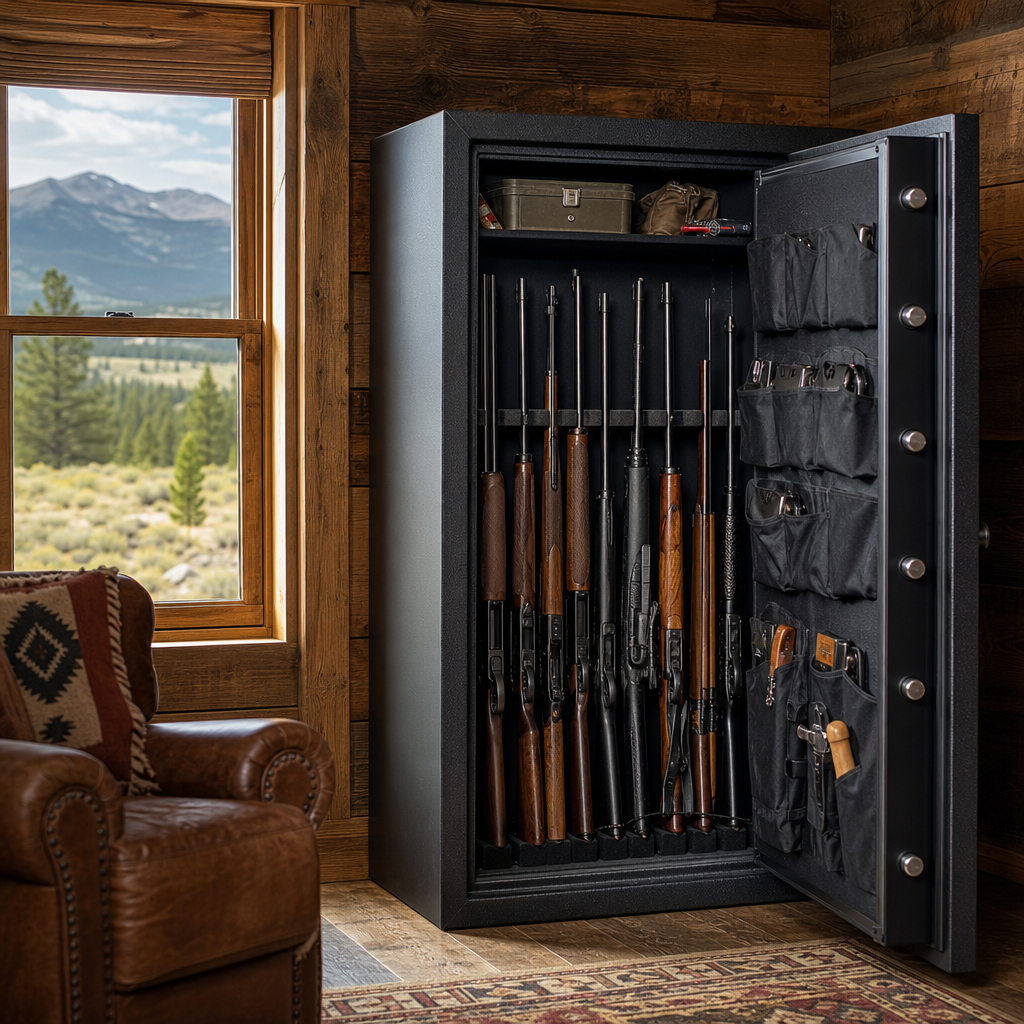
Choosing the best gun safes for off-grid and remote property owners starts with understanding how location changes the threat model. A cabin at the end of a forest road faces different risks than a suburban home: delayed law enforcement response, seasonal vacancy, humidity swings, generator power limits, and fewer nearby service providers. In practical terms, that means a safe cannot be judged on price or fire rating alone. It must match the owner’s routines, collection size, climate, power setup, and security priorities. This article serves as a buyer-persona hub for gun safes and safety, helping remote landowners identify which safe features matter most, where compromises are acceptable, and how to choose a model that protects firearms reliably when help is far away.
When I evaluate safes for rural clients, I define a few terms early because they shape every buying decision. Burglary protection refers to resistance against forced entry through the door, body, lock, and boltwork. Fire protection refers to tested endurance against external heat for a stated time at a stated temperature, though manufacturers do not all use the same testing method. Environmental protection covers moisture, condensation, dust, and temperature cycling, all common in barns, workshops, hunting camps, and unconditioned utility rooms. Access control includes locks, relockers, lighting, and organization systems that determine who gets in and how quickly. For off-grid owners, power dependence also matters. A safe with an electronic lock, dehumidifier rod, interior lighting, and networked monitoring may perform well in a grid-connected house but become inconvenient in a solar-powered cabin.
The best approach is to buy by persona rather than by marketing tier. A retired couple living full time on acreage, a hunter who visits a remote lodge on weekends, a ranch owner storing long guns in a machine shed office, and a preparedness-minded family with layered security do not need the same safe. Some need heavier steel and anchor systems above all else. Others need humidity control, compact dimensions, or fast-access storage for one defensive firearm while keeping the larger collection secured elsewhere. If you treat every remote property owner as the same buyer, you either overspend on features that solve the wrong problem or underspecify the safe and regret it later. The sections below break the market into practical buyer personas and connect each one to the features, tradeoffs, and installation choices that actually matter.
The full-time off-grid homeowner persona
The full-time off-grid homeowner usually lives on rural acreage year-round and wants one primary safe that handles daily use. This buyer often has mixed firearms: hunting rifles, a defensive shotgun, one or two handguns, optics, paperwork, and spare magazines. The priority is balanced protection. In my experience, the best fit is typically a mid- to high-capacity safe with a mechanical dial or a proven electronic lock backed by easy battery access, at least 10-gauge to 12-gauge steel in the body, a reinforced door, internal shelving flexibility, and a meaningful anchoring plan. If the home runs on solar with limited inverter capacity, low-power accessories are preferable to always-on devices.
Why this persona matters: the safe becomes part of everyday life. That means convenience matters almost as much as resistance. If the owner finds the lock tedious, firearms stay out. If shelves are poorly laid out, valuables end up stacked and scratched. Brands such as Liberty, Browning, Fort Knox, American Security, and Hollon all offer models suitable for this profile, but specifications vary widely even within a single lineup. Focus on steel thickness, lock reputation, active bolts, hard plate protection, and real internal dimensions rather than “gun count” claims, which are almost always optimistic once scopes and slings are involved.
For a full-time remote homeowner, placement is critical. A safe in a climate-controlled interior room is better than one in an outbuilding, even if the outbuilding seems less visible. Remote response times mean a burglar who reaches the safe may have more uninterrupted time than in town. Putting the safe on a concrete slab, away from obvious sight lines, and anchored with expansion anchors or epoxy-set anchors materially improves performance. Add motion lighting, door contacts, and a camera that stores locally if internet service is unreliable. The safe is one layer, not the whole plan.
The seasonal cabin and hunting property owner persona
The seasonal owner is one of the most misunderstood gun safe buyer personas. This person may leave a property empty for weeks or months, then arrive during deer season or holidays. Vacancy changes everything. The risk is not only theft but also moisture buildup, mold on stocks, rust on blued steel, battery failure in locks, and unnoticed water intrusion. For this buyer, environmental control and low-maintenance operation outrank decorative finishes and high-end interiors. A safe in this setting should have strong door seals, desiccant support or a low-draw dehumidifier if power is available, and a lock system that is dependable after long idle periods.
A common mistake is buying a Residential Security Container with a glossy finish because it looks substantial on a showroom floor. At a seasonal property, heavier construction and simpler serviceability usually win. Mechanical dials remain attractive here because they are less dependent on battery condition, though some modern UL-listed electronic locks are excellent if the owner replaces batteries on a fixed schedule. I often recommend limiting stored firearms at seasonal sites unless the building envelope, concealment, anchoring, and monitoring are especially strong. In many cases, storing a smaller working set onsite and keeping the broader collection at the primary residence is the safer policy.
Seasonal buyers should also think about concealment beyond the safe itself. A delivery route, maintenance contractor, or occasional guest who learns there are firearms at the property can unintentionally widen exposure. A safe hidden in a closet, utility room, or built-in enclosure is preferable to one displayed prominently in a trophy room. If wildfire risk is part of the regional profile, compare not just stated minutes but also how the manufacturer defines the fire rating, whether door seals expand, and how heat-sensitive contents like optics, documents, and electronics will be protected in practice.
The rancher, farmer, and working landowner persona
Ranchers and farmers often need faster access and more rugged placement options than other buyers. Firearms may be used for predator control, livestock protection, or routine pest management, and the property may include multiple structures. This buyer persona often benefits from a two-safe strategy: one main safe in the residence for long-term storage and one smaller, hard-mounted rapid-access unit in a secure office, mudroom, or interior utility space. The main mistake I see is relying on a gun cabinet in a shop. Cabinets can organize firearms, but they are not a substitute for a real safe when theft resistance matters.
Dust, mud, temperature swings, and vibration from nearby equipment all affect safe performance in agricultural settings. That makes fit and finish less important than lock durability, corrosion resistance, and interior protection for optics and wood stocks. Powder-coated finishes hold up well. Door organizers help with handguns and documents, but avoid overloading the door if the hinge system feels light. If the owner stores a scoped varmint rifle and a defensive shotgun for practical work, verify actual interior depth before buying. Many published capacity numbers assume bare rifles placed tightly side by side, which is unrealistic on a working property.
This persona should also plan around employee and contractor access. A foreman, family member, ranch hand, or mechanic may have legitimate reasons to enter work areas, which increases the value of strict key and code control. An electronic lock with multiple user codes can be useful, but only if the owner has a disciplined process for deleting old credentials immediately. Mechanical locks avoid that issue but slow access. The right choice depends on whether the firearms are truly emergency tools or primarily stored assets.
The preparedness-focused family persona
The preparedness-focused family usually thinks in layers: perimeter awareness, redundancy, self-sufficiency, and controlled access under stress. This persona often owns more than one firearm type and may want secure storage that still permits rapid retrieval of a defensive firearm. The best gun safes for this group are rarely a single do-everything unit. A common and effective setup is one larger long-gun safe for the collection plus a separate quick-access handgun safe in the bedroom. That arrangement reduces the temptation to leave a defensive firearm unsecured while preserving accountability for the broader inventory.
This buyer tends to compare hard features closely, which is good, but can get distracted by marketing language like “military style,” “tactical,” or inflated steel equivalencies. Better signals are UL-listed locks, genuine hard plate, robust relockers, formed door jamb strength, and enough mass that removal is difficult even before anchoring. If children or frequent guests are part of the household, reliable locking and repeatable daily routines matter more than niche accessories. I have seen excellent safes undermined by poor placement, unchanged factory codes, or keys hidden in obvious places nearby.
| Buyer persona | Top priority | Best safe type | Key caution |
|---|---|---|---|
| Full-time off-grid homeowner | Balanced burglary and fire protection | Mid- or large-capacity anchored safe in conditioned space | Avoid oversized capacity claims |
| Seasonal cabin owner | Moisture control and low-maintenance reliability | Heavier safe with simple lock and concealed placement | Do not overstore during long vacancy |
| Rancher or farmer | Durability and practical access | Main residence safe plus smaller rapid-access unit | Cabinets are not safes |
| Preparedness-focused family | Layered access control | Large collection safe plus quick-access handgun safe | Routine failures defeat good hardware |
For this persona, inventory discipline is also central. Record model and serial numbers, photograph accessories, and store copies of records offsite. If insurance is involved, review whether the policy distinguishes between firearms, optics, and collectibles. A safe protects property, but documentation protects recovery and claims. On remote properties, that administrative layer is often overlooked until after a loss.
The collector and heirloom owner persona
Collectors and owners of heirloom firearms need more than basic theft deterrence. Their priorities include finish preservation, stock protection, organized separation, and often stronger insurance documentation. A rare Winchester, a family double gun, or a custom precision rifle with premium optics justifies better environmental management and gentler storage spacing than a typical entry-level rack provides. For this persona, interior layout matters almost as much as shell strength. Adjustable shelving, scoped-rifle standoffs, soft-lined supports, and humidity control are worth paying for because they reduce long-term wear.
Collectors should be especially skeptical of broad fire claims. Heat that may not visibly destroy a safe can still damage wood, adhesives, optics, and paper records. If the collection includes high-value pieces, consider separate document protection for provenance, appraisal letters, and transfer records. In some cases, a dedicated vault room or modular vault door makes more sense than an oversized freestanding safe, especially if the remote property is a primary residence and the owner expects the collection to grow. Vault rooms also solve the problem of tight interior clearances for long barrels, hard cases, and accessory bins.
Another factor is serviceability. Remote owners may be hours from a locksmith familiar with gun safe locks. Choosing a lock type and brand with broad service support is smart risk management. Sargent and Greenleaf, SecuRam, and La Gard are commonly seen in reputable models. The best choice is not universal, but avoiding obscure lock systems reduces downtime if a failure occurs.
Features that matter most on remote properties
Across all buyer personas, a few features repeatedly separate a good remote-property safe from a disappointing one. First is steel thickness. More steel generally means more delay against pry attacks and cutting attempts. Second is anchoring. Even a heavy safe can be tipped, moved, or attacked more easily if it is not anchored. Third is lock quality. A weak lock undermines an otherwise solid safe. Fourth is environment control, especially where buildings are unconditioned or occupied intermittently. Fifth is realistic capacity. Buy larger than your current count suggests, because accessories and future purchases consume space quickly.
Fire ratings require nuance. Some manufacturers use independent labs; others use proprietary testing. Compare duration and temperature, but also ask what was protected, whether the safe was heated from all sides, and whether the test included a drop. Burglary claims also need context. Many consumer gun safes are not true commercial burglary safes, and buyers should understand that distinction clearly. For most remote owners, the objective is strong delay and denial, supported by concealment, anchoring, alarms, and disciplined storage habits.
If you are deciding what to prioritize first, start with use case, then building conditions, then collection type, then budget. That order keeps the purchase practical. A safe that matches the property and your routines will outperform a more expensive model chosen for brochure appeal alone.
The best gun safes for off-grid and remote property owners are the ones selected for a real operating environment, not a showroom fantasy. Remote living changes the equation: response times are longer, vacancy may be common, and climate control is often inconsistent. That is why buyer personas are so useful. They turn a crowded product category into a practical decision. The full-time off-grid homeowner needs balanced protection and daily usability. The seasonal cabin owner needs reliability during long absences and stronger moisture management. The rancher or farmer needs durable storage that supports practical access without mistaking a cabinet for a safe. The preparedness-focused family benefits from layered storage, and the collector needs preservation as much as theft resistance.
Across every persona, the fundamentals remain consistent. Buy more capacity than the label suggests. Prioritize steel, lock quality, anchoring, and placement over cosmetic extras. Treat fire ratings carefully and compare how they were earned. Keep the safe in the most secure, stable interior location available whenever possible. Support it with lighting, cameras, local alarm storage, code discipline, and an up-to-date inventory. On a remote property, those surrounding decisions often matter as much as the safe’s brand badge.
If you are building out your gun safes and safety plan, use this hub to identify your buyer persona first, then match features to your property’s actual risks. A well-chosen safe protects firearms, supports responsible access, and gives you one less vulnerability to worry about when you live far from immediate help.
Frequently Asked Questions
What features matter most in a gun safe for an off-grid cabin or remote property?
For off-grid and remote properties, the most important safe features are the ones that address delayed emergency response, long periods of vacancy, and unpredictable environmental conditions. Security starts with solid steel construction, a reliable locking system, reinforced door edges, hard plate protection around the lock, and robust boltwork that resists pry attacks. On a remote property, a thief may have more time and privacy than they would in a neighborhood setting, so thin metal cabinets or lightly built “security safes” are usually not enough for owners storing valuable firearms, optics, ammunition, or important documents.
Just as important is how the safe performs without constant utility support. Many off-grid owners prefer mechanical dial locks because they are not dependent on batteries or keypad electronics, while others choose high-quality electronic locks for faster access and then keep fresh batteries on a set maintenance schedule. Interior humidity control is also critical. Remote cabins often see major swings in temperature and moisture, so a safe should either support passive moisture control, like desiccants, or active dehumidification if the property’s power setup allows it. Fire protection still matters, but it should be weighed realistically. A good fire rating is valuable, yet on remote land the bigger day-to-day threat may be theft, corrosion, or unauthorized access during extended absences. In short, the best safe is one that balances burglary resistance, climate protection, lock reliability, and practical use within an off-grid lifestyle rather than focusing on a single advertised feature.
Are electronic locks a bad choice for off-grid gun safes?
Not necessarily. Electronic locks are not automatically a poor choice for off-grid living, but they do require more planning. Their biggest advantage is convenience. If you access your safe regularly, an electronic lock can be faster and easier to use than a dial, especially in low light or when you need quick access. Many modern electronic locks are dependable and have low battery demands, and most are powered by internal or easily replaceable batteries rather than by your cabin’s main electrical system. That means they can work perfectly well even when the property has no grid connection.
The issue is not whether the lock is electronic; it is whether the owner has a realistic maintenance routine. On a remote property, you do not want to discover a weak battery after a long drive to the cabin or during an urgent situation. If you choose an electronic lock, replace batteries on a schedule rather than waiting for a low-battery warning, use quality batteries recommended by the manufacturer, and test the keypad during regular visits. Some owners keep backup batteries on site in a sealed container. Others prefer redundant peace of mind and choose a mechanical dial specifically because it removes battery dependency entirely. The better answer depends on your habits. If you value simplicity and minimal failure points, a dial lock is hard to argue against. If you want speed and are willing to manage maintenance, a reputable electronic lock can still be an excellent fit for an off-grid safe setup.
How important is humidity control in a gun safe on remote property?
Humidity control is extremely important, and for many remote owners it is one of the most overlooked parts of safe selection. Firearms stored in cabins, barns, workshops, and seasonal homes are often exposed to conditions that change quickly: cold nights, warm days, coastal moisture, mountain condensation, and long periods with little airflow. Even a high-quality gun safe is not a climate-control device by itself. If moisture is trapped inside, rust can form on blued steel, optics can suffer, wood stocks can swell or warp, and ammunition can degrade over time.
The right approach depends on the building and power situation. If your off-grid system can support it reliably, an electric dehumidifier rod inside the safe can help reduce condensation by keeping air slightly warmer and drier. If power is limited, passive solutions like rechargeable desiccant packs are often more practical. The key is consistency. A remote property owner should inspect the safe’s interior periodically, monitor signs of condensation, and avoid storing firearms in soft cases inside the safe for long-term storage because those materials can trap moisture. It is also wise to consider where the safe is placed. A climate-stable interior wall is generally better than an uninsulated shed, damp basement corner, or exterior wall prone to temperature swings. On remote land, corrosion is often a slow, quiet threat, and humidity planning is what keeps a safe from becoming a sealed box full of damaged equipment.
Should a remote property owner prioritize fire rating or burglary protection?
In most cases, burglary protection should come first, but the right answer depends on the property’s actual risk profile. Remote owners often assume fire is the biggest danger because wildfire, wood stoves, backup heating, generators, and long emergency response times are real concerns. Those risks absolutely matter. However, many advertised fire ratings can distract buyers from the more immediate issue: whether the safe can withstand a determined break-in attempt from someone who has time, tools, and privacy. A safe with an impressive fire label but lighter steel and weaker anti-pry design may not be the best overall choice for a cabin that sits empty for part of the year.
That does not mean fire protection should be ignored. It means it should be evaluated alongside the safe’s body thickness, door construction, lock protection, relockers, anchor capability, and overall build quality. For many remote property owners, the ideal purchase is a heavier safe with credible burglary resistance and a solid, well-documented fire rating rather than an entry-level model marketed mainly around fire minutes. Think in layers. If the safe is in a building with defensible space, smoke detection, careful fuel storage, and sensible heating practices, you may be able to reduce fire risk through site planning. Theft risk, on the other hand, often requires the safe itself to do the hard work. The smartest buying strategy is to match the safe to the most likely threat while still respecting both. A remote property with seasonal vacancy usually benefits most from prioritizing anti-theft strength first and then choosing the best fire protection available within that stronger category.
What size and installation approach is best for a gun safe on an off-grid property?
The best size is usually larger than you think you need, especially for remote owners who store more than just firearms. On an off-grid or rural property, the safe often becomes the central secure storage point for handguns, long guns, suppressors where legal, optics, ammunition, hard drives, cash, documents, radios, and emergency gear. Manufacturers’ gun counts are often optimistic, based on tightly packed rifles without accessories. If your collection includes scoped rifles, slings, pistol racks, or shelves for valuables, real capacity drops quickly. Buying too small is one of the most common mistakes because it leads to overcrowding, harder access, and eventually insecure overflow storage elsewhere on the property.
Installation matters just as much as size. A heavy safe is helpful, but it should still be anchored whenever possible. A thief with time, leverage, and no nearby witnesses may try to tip, pry, or remove even a large safe. Bolting it to a solid concrete slab is ideal. If that is not possible, reinforcement strategies may be needed depending on floor construction. Placement should also be deliberate. Avoid obvious locations visible from windows or easy exterior access points. Choose a spot that limits pry angles, preferably with restricted side access and enough surrounding structure to make attack more difficult. Also think about environmental stability and logistics. Can the floor support the weight? Will the route into the building handle delivery? Is the safe in a dry, insulated part of the property? For remote owners, the right setup is not just “buy a big safe.” It is buying enough capacity for long-term use, then installing it in a way that supports security, climate control, and practical daily access.