
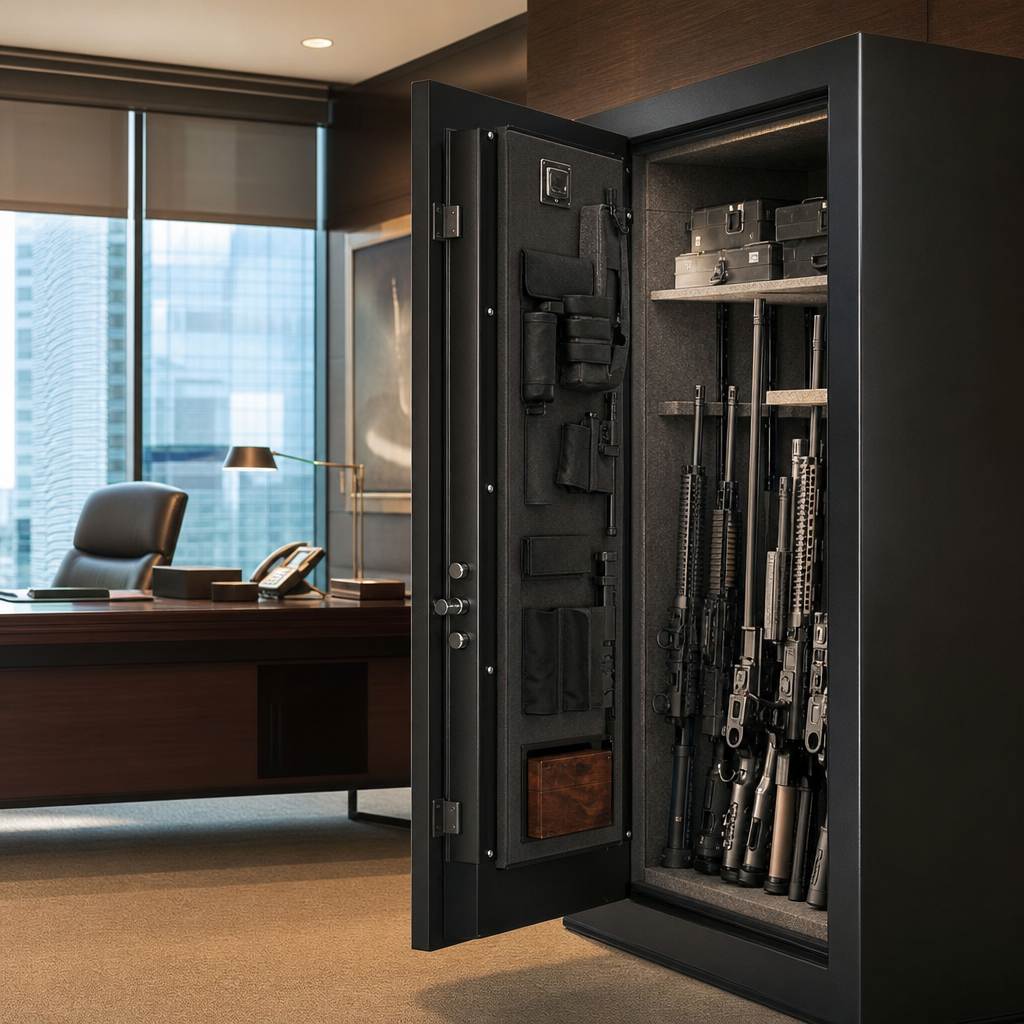
Business executives who carry firearms for protection face a storage problem that looks simple on the surface but becomes complex the moment travel schedules, office routines, family access, and legal exposure enter the picture. A gun safe for an executive is not just a metal box. It is a risk-control system that protects life, limits unauthorized access, supports fast retrieval under stress, and preserves discretion in high-visibility environments. In the broader world of gun safes and safety, buyer personas matter because the right safe depends on who uses it, where it lives, and what threats it must address. Executives are a distinct gun safe buyer persona: they often split time between home, vehicle, office, and hotels; they may carry premium handguns with optics; and they usually want security that does not advertise itself.
From experience helping professionals choose storage, the most common mistake is buying for the firearm alone instead of the lifestyle around it. A compact bedside safe may work for a single concealed-carry pistol, but a chief executive with a home office, frequent road travel, staff in and out of the residence, and children or visiting grandchildren needs layered storage. Key terms clarify the decision. A quick-access safe is designed for defensive retrieval in seconds. A burglary-rated safe focuses on resisting pry attacks, drilling, and brute force. Fire protection is measured separately from burglary resistance, usually by time and temperature claims. Access control includes lock type, user permissions, audit trails, and backup entry methods. When executives understand these distinctions, they can buy a safe that matches real-world use instead of marketing language.
This topic matters because executives are exposed to a unique blend of personal security and reputational risk. A firearm stolen from an office credenza, found unsecured in a vehicle, or accessed by an unauthorized person can trigger criminal liability, civil claims, employment consequences, and severe public scrutiny. The right gun safe reduces those risks while supporting lawful carry. It also serves as the hub for related buyer personas in this subtopic: traveling professionals, home-office owners, parents who carry, collectors who also keep a defensive handgun, and managers responsible for workplace policies. Understanding the executive persona creates a practical framework for comparing all of those readers, because each one balances speed, concealment, capacity, and compliance differently.
What makes the executive buyer persona different
The executive buyer persona is defined by movement, visibility, and layered responsibility. Unlike a recreational owner who stores firearms mainly at home, an executive may transition from residence to garage, vehicle, parking structure, corporate office, client meeting, restaurant, and hotel in one day. Every transition creates a temporary storage problem. In practice, that means one safe rarely solves everything. The most effective setups usually combine a primary home safe, a quick-access bedroom or office safe, and a vehicle lockbox secured by a steel cable or bolted mounting plate. For executives who use a home office, a discreet furniture-style safe or a small under-desk unit often becomes the most used device because it bridges daytime control and after-hours access.
Privacy is another differentiator. Executives often want security without visual signals that suggest valuables are present. That rules out many bulky, obvious gun cabinets for primary living areas. Instead, they tend to favor compact safes hidden in closets, millwork, or nightstands, along with full-size safes installed in controlled spaces. Biometric entry is appealing because it speeds access, but fingerprint readers vary widely in reliability. I usually recommend treating biometrics as a convenience feature, not the sole standard, and pairing it with a proven electronic keypad. Brands such as Fort Knox, Vaultek, V-Line, Liberty, American Security, and Hornady each serve different parts of this market, from portable handgun security to heavier residential security containers.
The executive persona also overlaps with corporate governance. Some companies prohibit firearms on premises; others allow lawful carry but restrict storage. Some states protect locked vehicle storage in employer parking areas, while private-property rules and posted notices may still complicate choices. Because laws differ, the safe decision must include policy review, not just product specs. This is why the executive hub page matters inside the gun safe buyer personas category: it connects tactical needs, legal obligations, household safety, and professional image in one decision path.
How to choose the right gun safe for executive use
The best gun safe for a business executive starts with a use-case map. Ask four direct questions: Where will the firearm be when it is not on body? Who could physically access that location? How fast might retrieval be needed? What level of theft resistance is realistic for that environment? At home, the answer may be a heavier safe anchored to concrete with organized handgun storage, interior lighting, and dehumidification. In a bedroom, it may be a quick-access safe with a spring-assisted lid and simplex or electronic entry. In a vehicle, it should be a dedicated lockbox rather than a glove compartment, because factory compartments are not designed as serious anti-theft devices.
Construction details matter more than brochure adjectives. Look for steel thickness, weld quality, pry-resistant door design, robust locking lugs, and a hard plate that helps protect the lock area from drill attacks. For quick-access handgun safes, attention should go to hinge protection, latch design, and whether the unit can be bolted down. A secure safe that can be carried away is only partially secure. For larger home safes, anchoring is non-negotiable. Fire ratings deserve careful reading because many are manufacturer tests, not independent laboratory certifications. A claimed sixty-minute fire rating may be meaningful, but only if the company explains the test temperature, internal temperature threshold, and whether the safe was opened hot.
| Executive scenario | Best safe type | Priority features | Main tradeoff |
|---|---|---|---|
| Home bedroom for nightly carry pistol | Quick-access handgun safe | Fast keypad or simplex lock, bolted installation, interior light | Lower burglary resistance than a full-size safe |
| Home office with regular daytime access | Under-desk or furniture-concealed safe | Discreet placement, silent entry, child resistance, cable management | Usually limited capacity |
| Frequent vehicle storage during meetings | Vehicle lockbox | Steel body, tether or bracket mount, compact footprint | Vulnerable if left in car for long periods |
| Primary residence with multiple firearms | Full-size anchored safe | Thicker steel, shelving flexibility, humidity control, fire lining | Higher cost and complex installation |
| Extended business travel | Portable travel safe for temporary use | TSA-compliant transport method, cable attachment, discreet bag fit | Not a substitute for permanent secure storage |
Lock choice deserves special attention because executives often prioritize speed. Mechanical simplex locks are valued for reliability, battery-free operation, and muscle-memory entry in darkness. Electronic keypads allow fast access and easy code changes, which is useful when household staffing changes. Biometric locks have improved, especially on premium models, but finger condition, angle, moisture, and sensor quality still affect consistency. The practical rule is simple: choose the fastest method you can operate accurately under stress, then verify it repeatedly. Run retrieval drills in low light, from bed, from a desk chair, and after physical movement. A safe that opens quickly in a showroom but fumbles in real conditions is the wrong safe.
Matching safe setups to executive lifestyles and related buyer personas
As the hub for gun safe buyer personas, this topic should help readers see where they fit and what adjacent needs may apply. The traveling executive is the closest related persona. This buyer needs a home base safe plus secure temporary storage during flights, road trips, and hotel stays. The answer is usually not to leave a firearm loose in luggage or hidden in a hotel room. Instead, the firearm should move according to applicable law in a locked hard case for transport, and when local rules allow possession, temporary storage should use a portable lockbox attached to a fixed object when possible. Even then, hotel storage is a compromise, not an ideal.
The executive parent is another critical persona. Here, speed of access must coexist with strict child resistance. A bedside drawer is not acceptable storage, and neither is a closet shelf behind clothing. Parents who carry often benefit from two layers: a fast-access safe for the current defensive pistol and a separate larger safe for backup firearms, documents, magazines, and ammunition. If teenagers are in the house, code discipline becomes essential. Do not share combinations casually, and do not rely on hidden backup keys stored nearby. I have seen excellent safes defeated by poor key management more often than by lock failure.
The collector-executive has a different pattern. This buyer may own several handguns and long guns but carries one specific firearm daily. The mistake is storing the carry gun deep inside a high-capacity safe that slows retrieval, then leaving it unsecured overnight out of frustration. The better approach is a tiered system: full-size safe for collection storage, quick-access unit for the carry pistol, and perhaps a dedicated office safe if the firearm is removed during work-from-home video calls or meetings with staff. For this persona, organization matters. Door panels, labeled shelves, rechargeable task lighting, and a dehumidifier rod can make the difference between consistent secure storage and daily shortcuts.
The workplace-policy buyer persona includes executives who oversee offices and want personal protection without creating inconsistent standards for employees. In those cases, the safe decision intersects with human resources, insurance, and landlord obligations. A private office safe may sound straightforward, but if cleaning staff, IT technicians, assistants, or contractors enter the space, access assumptions change. A lockable drawer is not a gun safe. A real office installation should be concealed, bolted, and governed by written policy. That policy should define whether firearms are allowed, who may possess them, what training is expected, and how incidents are reported. Executives who think beyond the product and address procedure usually avoid the problems that become headlines.
Installation, maintenance, and mistakes that create risk
A high-quality gun safe fails when it is badly installed or poorly maintained. The first installation rule is anchoring. For home safes, concrete slab anchoring is best; on framed floors, proper lag hardware and joist placement matter. A safe hidden in cabinetry should still allow door swing, ventilation, and battery replacement. For vehicle lockboxes, use the manufacturer mounting system or a tested steel tether routed to a structural point, not a seat adjuster bar that can be cut or removed. Position also matters. If a safe can be seen easily through a window, theft risk rises. Discretion is a security feature.
Maintenance is straightforward but often neglected. Replace batteries on a schedule rather than after failure. Test lock operation monthly. Update biometric enrollments if the safe supports multiple scans of the same finger; many systems work better when one finger is enrolled from slightly different angles. Keep desiccant or an electric dehumidifier in larger safes, especially in humid regions, because corrosion affects both firearms and documents. Review mounting bolts annually. If the safe stores a handgun with a weapon light or red-dot optic, verify the fit after any equipment change. More than once, I have watched a pistol stop fitting cleanly after an optic upgrade, leading the owner to leave it unsecured until a foam insert was modified.
The biggest executive mistakes are predictable. First, overvaluing fire rating while underestimating theft risk. For most handguns used for protection, unauthorized access and smash-and-grab theft are the primary concerns. Second, choosing a safe too small for realistic use. A unit that barely fits the gun, spare magazine, passport, and watch often becomes cluttered and inconvenient. Third, relying on a vehicle as routine storage. Cars are transitional spaces, not secure armories. Fourth, skipping practice. If you carry for protection, opening the safe safely and consistently is part of the skill set. Finally, ignoring legal nuance. State storage laws, employer policies, and interstate transport rules can all shape what “best” means. The safest purchase is the one that fits your threat model, your daily routine, and your compliance obligations.
Gun safes for business executives who carry firearms for protection should be chosen as part of a complete security plan, not as an afterthought purchase driven by appearance or brand familiarity. The executive buyer persona stands out because daily life creates repeated transitions between public and private spaces, each with different risks and storage constraints. That is why the strongest solutions are layered: a full-size anchored safe for primary home storage, a quick-access safe for immediate defensive use, and a vehicle or travel option only when genuinely necessary. When those layers are selected well, they reduce theft risk, prevent unauthorized access, preserve discretion, and support lawful, practical carry.
Across the broader gun safe buyer personas category, the same principle holds: the right safe depends on lifestyle, environment, and access needs. Traveling professionals need temporary storage that acknowledges legal limits. Parents need fast access without compromising child safety. Collectors need organization that separates display interests from defensive readiness. Workplace decision-makers need policy and installation discipline, not improvised storage. In every case, construction quality, lock reliability, anchoring, and realistic use testing matter more than marketing slogans. The best safe is the one you will use correctly every single time.
If you are evaluating gun safes and safety options as an executive, start by mapping your day, identifying each point where your firearm leaves your person, and matching those moments to specific safe types. Then compare steel construction, lock method, anchoring options, and fit for your actual firearm setup. Make the choice based on routine, risk, and compliance, and you will end up with a system that protects both people and reputation.
Frequently Asked Questions
What should a business executive look for in a gun safe when carrying a firearm for personal protection?
A business executive usually needs more than a standard home gun cabinet or a basic lockbox. The right safe should match how, where, and when the firearm is actually carried and stored. For many executives, that means balancing fast access with strict access control. A good safe should allow rapid retrieval in a genuine emergency, but it should also prevent unauthorized access by children, visitors, household staff, coworkers, or anyone else who should never be able to reach the firearm.
Look first at the intended use case. If the firearm is stored at home overnight, a quick-access handgun safe in a bedroom, dressing area, or other secure but discreet location may make sense. If the executive spends long hours in a private office, a compact office safe anchored inside furniture or built into a secure compartment may be more appropriate. If travel is frequent, a vehicle safe or portable travel-safe solution may also be necessary, though it should still meet legal and practical security standards. In many cases, executives end up needing a layered setup rather than one single product.
Locking method matters. Biometric safes are attractive because they can be opened quickly, but they should be tested regularly and chosen from reputable manufacturers. Fingerprint readers can be affected by dirty hands, dry skin, minor cuts, or inconsistent sensor quality. Many experienced buyers prefer safes that combine biometric access with a keypad or mechanical backup. Reliability under stress is more important than novelty. A safe that looks impressive but fails when the user is tired, rushed, or under pressure is the wrong safe for a defensive firearm.
Construction quality is also essential. Executives often operate in high-visibility settings where discretion and liability exposure matter. Thin metal boxes with weak hinges or poor anchoring options may satisfy a minimal storage need, but they do not offer meaningful protection against theft or tampering. A quality safe should have solid steel construction, concealed or reinforced hinges, pry-resistant design features, and secure mounting capability. If a safe can simply be picked up and removed, much of its protective value disappears.
Finally, the best gun safe for an executive supports a complete risk-management strategy. It should fit daily routines, preserve privacy, reduce legal risk, and make safe handling easier rather than harder. A safe that is too slow, too awkward, too visible, or too difficult to use consistently will eventually be bypassed. The best choice is the one that encourages disciplined, repeatable storage every single day.
Is a quick-access safe really secure enough for executives who need both speed and discretion?
Yes, if it is well made, properly installed, and chosen for the right environment. Quick-access safes are often the best fit for executives who carry firearms for protection because they address the central challenge of defensive storage: keeping the firearm inaccessible to unauthorized people while still allowing immediate access for the authorized user. That said, not all quick-access safes are equally secure, and some are built more for marketing than for serious defensive use.
The first issue is understanding what “secure enough” means in context. A quick-access safe beside a bed or inside a private office does not need to perform the same role as a large burglary-rated vault designed to store multiple long guns and valuables. Its purpose is typically controlled short-term storage with rapid retrieval. For that role, a quality quick-access safe can be highly effective, especially when it is bolted to a permanent surface and placed in a location that reduces visibility and tampering opportunities.
Discretion is another major concern for executives. In many professional settings, the goal is not simply to hide the firearm, but to avoid drawing attention to the fact that one is present at all. A compact safe installed inside a desk pedestal, credenza, closet structure, or other enclosed area can help maintain privacy while preserving accessibility. The safe should open smoothly and predictably, without complicated motions that are difficult under stress. If it requires too much manipulation, users may begin leaving the firearm unsecured “just for a minute,” which is where many avoidable risks begin.
However, executives should be realistic about limitations. A quick-access safe is not a substitute for broader physical security. If it is left unattached in a hotel room, stored in a vehicle without thought to theft risk, or installed where many people can observe and potentially target it, the security benefit drops sharply. The right safe must be paired with smart placement, routine maintenance, and a clear storage protocol. That includes checking batteries, testing backup entry methods, and practicing access in realistic conditions.
In short, a quick-access safe can absolutely be secure enough, but only when it is part of a disciplined system. For executives, that system should account for threat level, household composition, office privacy, legal obligations, and the practical realities of a demanding schedule. Speed matters, but reliable control matters even more.
How should executives handle firearm storage between home, office, vehicle, and travel?
This is where firearm storage becomes significantly more complex. The executive who carries for protection rarely moves through only one environment. A typical day may involve home departure, vehicle transit, office arrival, client meetings, social events, and late return. Add business travel, hotels, and family access at home, and the storage issue becomes less about a single safe and more about continuity of control across multiple locations.
At home, the priority is often a mix of accessibility and unauthorized-access prevention. If the executive has children, teenagers, guests, domestic employees, or extended family members in the home, unsecured or casually stored firearms create substantial safety and liability risks. A dedicated quick-access handgun safe in the bedroom or personal dressing area is often the minimum standard. Some executives also use a second secure location for off-body storage during routine transitions, such as changing clothes or preparing for bed.
At the office, the right solution depends heavily on the work environment. A private executive suite with controlled access creates different options than a shared office with support staff, janitorial personnel, or regular visitor traffic. If a firearm may need to be removed temporarily, it should go into a securely anchored, discreet safe rather than a desk drawer, briefcase, or cabinet. The safe should be positioned so that opening it does not create unnecessary visibility to others. Office firearm storage should also be reviewed in light of company policy, building rules, lease restrictions, and local law.
Vehicle storage deserves special caution. Cars and trucks are common theft targets, and a firearm left unsecured in a vehicle can quickly become both a legal and public-relations problem. If vehicle storage is ever necessary, it should involve a dedicated vehicle safe or lockbox designed for secure attachment to the frame or another robust anchor point. Even then, vehicle storage should generally be temporary rather than routine. A gun left in a car overnight or on a regular basis invites avoidable risk.
Travel adds another layer. Executives should not assume that the same storage practices are lawful or practical across jurisdictions. State and local firearm laws differ, and hotels introduce questions about room security, housekeeping access, and transportation rules. Before traveling, it is wise to review applicable laws, airline procedures if flying, and the security realities of the destination. In many cases, a portable safe with approved locking features is useful, but it should still be treated as one part of a broader compliance plan.
The best approach is to map the firearm’s chain of custody throughout the day. Every transition point should answer one question: if the firearm is not physically on the executive’s person, exactly where is it, who can access it, and how quickly can control be reestablished? That mindset prevents casual decisions and creates a safer, more defensible storage routine.
Why is proper gun safe selection important for liability, family safety, and professional reputation?
For a business executive, improper firearm storage can create consequences far beyond theft or accidental access. It can trigger legal claims, insurance complications, employment issues, reputational damage, and serious personal harm. That is why gun safe selection should be viewed as a governance issue as much as a security purchase. The safe is not merely a convenience item. It is evidence that the owner took reasonable steps to control a potentially lethal tool.
Family safety is the most immediate concern. Even highly responsible firearm owners can underestimate the unpredictability of children, teens, and guests. Curiosity, overconfidence, and momentary lapses in supervision are common realities, not rare exceptions. A quality safe creates a hard barrier between a firearm and an unauthorized hand. It also helps prevent situations in which a family member, friend, or visitor discovers a firearm during what seemed like an ordinary moment, such as opening a drawer, entering a closet, or searching a bag.
Liability exposure follows closely behind. If a firearm is stolen because it was left unsecured in an office, vehicle, or residence, the owner may face intense scrutiny about whether reasonable precautions were taken. If an unauthorized person gains access and causes injury, the financial and legal fallout can be severe. In a business context, those consequences can spread outward to include employer relationships, board expectations, shareholder perceptions, or media attention, especially if the executive is publicly known.
Professional reputation matters because executives operate under a different visibility standard than many private citizens. Their judgment is often evaluated not only by family and law enforcement, but also by colleagues, clients, investors, and the public. A firearm incident tied to careless storage can