
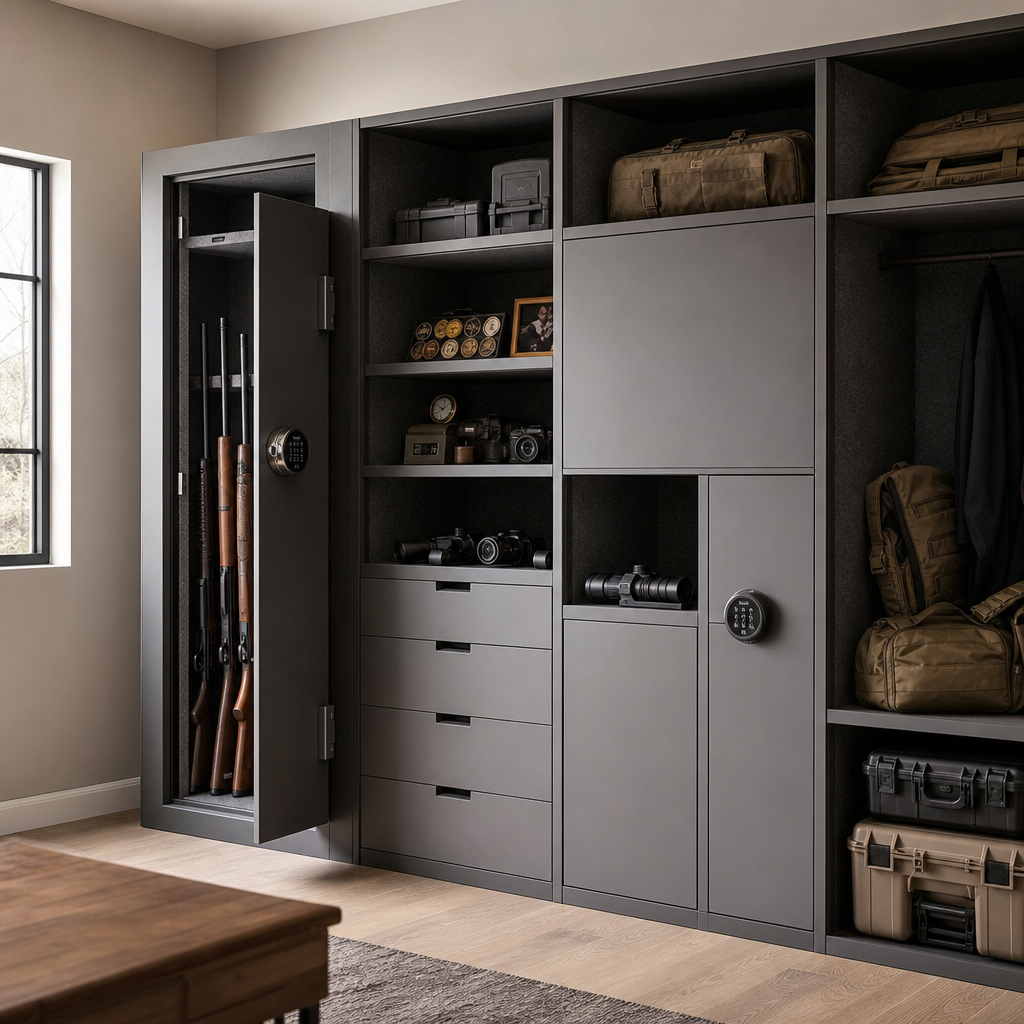
Modular gun safes solve a problem that traditional welded safes often create: getting real security into places where stairs, narrow hallways, apartments, and weight limits make one-piece safes impractical. A modular gun safe ships in panels, assembles inside the room where it will live, and can usually be disassembled if you move. For buyers researching gun safe comparisons and brand spotlights, that difference matters because access, installation, fire protection, theft resistance, interior flexibility, and long-term value all change once a safe is no longer a single welded box. I have helped buyers evaluate both styles, and the pattern is consistent. The best choice is not the one with the biggest exterior dimensions or the loudest marketing claims. It is the one that fits the building, the firearm collection, the risk profile, and the owner’s willingness to anchor, organize, and maintain it properly.
In practical terms, a modular gun safe uses interlocking steel panels, reinforced corners, and a separate door unit to create a secure enclosure after delivery. Traditional gun safes usually arrive fully welded and ready to place, often by a specialty mover. The appeal of modular construction is obvious if you have ever tried to get a 900-pound safe into a second-floor bonus room or a basement with a tight turn. The questions buyers ask are also predictable: Are modular gun safes as secure as welded models? Which brands are best? What compromises come with easier installation? This hub article answers those core questions and sets up the broader landscape of gun safe comparisons by explaining how to compare brands, what specifications actually matter, and where modular safes fit among premium, midrange, and entry-level options.
This topic matters because a gun safe is not just a furniture purchase. It is part security device, part life-safety tool, and part long-term storage environment for firearms, optics, documents, and valuables. A poor comparison process leads buyers to focus on glossy paint, oversized gun counts, or vague fire labels while ignoring steel thickness, boltwork, relocker design, humidity control, and anchoring options. Modular safes deserve especially careful analysis because their biggest advantage, installability, can distract from harder questions about pry resistance, seams, lock quality, and total cost after freight and assembly. If you want the best brand for your use case, compare engineering first, then capacity, then convenience.
What makes a modular gun safe different from a traditional safe
The defining feature of a modular gun safe is field assembly. Panels arrive separately, are moved by one or two people, and are bolted or keyed together inside the home. This approach dramatically widens placement options. In older homes, condos, upstairs offices, and finished basements, modular designs often make the difference between owning a real safe and settling for a lightweight cabinet. The best modular models use thick formed steel, recessed door frames, internal hardware that cannot be accessed when locked, and designs that minimize exposed seams. In use, a good modular safe should feel rigid, square, and substantial, not like a storage locker assembled from sheet metal.
The tradeoff is equally clear. A welded safe has no assembly joints across the body, so buyers naturally see it as the benchmark for structural integrity. A modular safe must compensate with clever engineering around panel engagement and corner reinforcement. That does not automatically make modular inferior, but it does mean the design details matter more. If a manufacturer cannot clearly explain panel thickness, seam design, lock protection, and anchoring method, move on. The best brands publish meaningful specifications and show how the safe resists pry attacks, not just how fast it goes together.
How to compare modular gun safe brands the right way
Start with steel, because steel thickness remains the simplest predictor of body strength. Many buyers get lost in gauge numbers, so convert them mentally into a hierarchy: lower gauge means thicker steel. A body built from 12-gauge steel is materially stronger than one built from 14- or 16-gauge panels, assuming similar reinforcement. Next, inspect the door system. A thick body paired with a weak door frame still fails under attack. Look for a door with a recessed fit, multiple locking bolts, hard plate protection for the lock, and a relocker that triggers if the lock is punched or drilled.
Then evaluate fire protection with skepticism. Fire ratings vary because there is no single universal consumer labeling method across the gun safe market. Some brands cite internal testing, some use third-party standards, and some provide little detail beyond minutes and temperature. Better comparisons ask what material creates the fire barrier, how door seals expand under heat, and whether the body design leaves potential pathways at seams. Finally, consider practical ownership factors: assembly time, whether the safe can be disassembled after years in place, lock options, interior adjustability, replacement part support, and how the company handles freight damage or lock service.
| Brand | Main Strength | Best For | Potential Drawback |
|---|---|---|---|
| SnapSafe | Broad availability and easy residential installation | Buyers needing practical access in tight spaces | Specifications vary by line, so model-by-model review is essential |
| Zanotti Armor | Long-standing modular design with proven assembly system | Owners prioritizing disassembly and repeated moves | Style and retail visibility are less mainstream |
| SecureIt | Fast access and highly configurable interior organization | Users focused on readiness and modern rifle storage | Different security philosophy than heavy traditional safes |
| Traditional welded brands | Monolithic construction and broad size selection | Ground-floor installs where weight is not a barrier | Delivery, placement, and relocation can be difficult and expensive |
Best-known modular brands and how they compare
SnapSafe is the brand many buyers encounter first, largely because it is widely distributed and easy to understand. Its modular safes target the practical homeowner who needs a real safe in a location that cannot accept a welded unit. In my experience, SnapSafe’s main advantage is accessibility: straightforward assembly, common lock options, and broad dealer support. The caution is that buyers should not assume every SnapSafe product shares identical construction standards. The company sells different safe categories, and the modular line should be evaluated on its own specifications rather than brand halo alone.
Zanotti Armor has a stronger specialist reputation among modular-safe shoppers who have done deeper research. Zanotti built its identity around knockdown safes before many larger companies gave the category serious attention. That history matters because the company’s engineering centers on repeated assembly, transport practicality, and straightforward serviceability. Buyers who move frequently or need to place a safe in a structurally sensitive location often find Zanotti compelling. The design language is less retail-polished than some mainstream brands, but the underlying appeal is functional durability and a purpose-built modular system rather than a marketing adaptation of a welded-safe concept.
SecureIt deserves inclusion in any serious hub on gun safe comparisons and brand spotlights because it represents a different answer to the same storage problem. While some of its products are better described as agile security cabinets than classic heavy safes, the brand has influenced how owners think about access, configuration, and modern sporting rifle storage. Its CradleGrid system is particularly effective for maximizing useful capacity. Buyers deciding between SecureIt and a modular gun safe should be honest about priorities. If the goal is heavier theft resistance and more traditional safe architecture, modular safes from SnapSafe or Zanotti fit better. If rapid access, lightweight installation, and highly flexible organization lead the list, SecureIt becomes a serious contender.
Where modular safes outperform welded safes
Modular safes win decisively in installation logistics. If your safe must pass through a narrow staircase, a turn at the bottom of basement steps, or a second-floor room with load concerns, modular construction is often the only realistic path. Freight costs can also be easier to manage because delivery does not always require the same level of specialized equipment. For renters, military families, and professionals who relocate every few years, the ability to disassemble the safe later is not a minor convenience. It is a meaningful financial advantage because it preserves the usefulness of the purchase through multiple homes.
They also outperform many welded safes in placement precision. A modular safe can be assembled inside closets, offices, storage rooms, or alcoves where a prebuilt safe could never fit through the opening. That matters for security because concealment and controlled access still reduce risk. A safe tucked into a less obvious location and anchored correctly is harder for a thief to attack comfortably than one displayed in an exposed garage. For some owners, modularity indirectly improves security simply by making better placement possible.
Where modular safes still have limits
The biggest limitation is psychological and structural at the same time: buyers must accept seams. Well-designed seams can be strong, protected, and difficult to exploit, but they still require engineering that a welded shell does not. For high-risk environments where long, noisy attacks with heavy prying tools are plausible, many buyers will still prefer a premium welded safe or even a true burglary-rated safe. That is not a criticism of modular products; it is an acknowledgment that not every threat model is the same. A suburban homeowner trying to keep children out, deter smash-and-grab theft, and protect firearms from casual attack has different needs from a collector storing six figures in firearms in an isolated property.
Fire performance can also be more variable than buyers expect. Some modular designs emphasize transportability and practical assembly, which may constrain how much insulating material can be built in. Others offer respectable fire features but still need careful review of independent data, seal design, and warranty language. Weight is another clue. If a safe is remarkably easy to move, that convenience usually reflects lighter construction. There is no free lunch in secure storage. Better installation can coexist with excellent protection, but every gain should be measured against steel, lockwork, and anchoring reality.
Features that separate the best modular gun safes from mediocre ones
The top modular gun safes share a few traits. First, they use body panels thick enough to inspire confidence before assembly even begins. Second, the door is not treated as an afterthought; it includes reinforced edges, robust hinges or hinge-side protections, quality boltwork, and a lock from a reputable manufacturer such as Sargent and Greenleaf or SecuRam. Third, the interior supports real use. Shelves adjust without flexing, long guns fit with optics attached, and the layout does not rely on inflated capacity claims that count every slot as if guns have no scopes, slings, or bipods.
Anchoring provisions are equally important. A modular safe should have clear anchor points and a base design that lets it sit flat and rigid before bolts are tightened into concrete or substantial framing. Add dehumidification support, either through a pass-through or accessory compatibility, and the ownership experience improves significantly. In humid climates, a GoldenRod-style heater, silica packs, or a monitored hygrometer is not optional if you care about corrosion. The best brands design for these realities instead of assuming the safe ends at the steel shell.
How this hub fits the wider gun safe comparison landscape
As a sub-pillar hub under Gun Safes and Safety, this page should guide readers to the right next comparison rather than pretend one article can settle every buying decision. Modular gun safes intersect with several adjacent topics: mechanical versus electronic locks, fire-rated versus burglary-focused designs, rifle-safe interiors for scoped firearms, safe placement on wood floors, humidity management, and budget tiers from entry-level cabinets to premium American-made safes. A strong comparison process starts here with brand frameworks, then narrows into model-level analysis based on collection size, installation path, and expected threat.
The clearest takeaway is that modular gun safes are often a better choice when access and relocation are real constraints, not hypothetical ones. The best brands prove their value through engineering, transparent specifications, and practical ownership support, not slogans. Compare SnapSafe, Zanotti Armor, SecureIt, and leading welded-safe alternatives by steel, door design, lock quality, fire methodology, anchoring, and interior usability. If you are building out your gun safe comparisons and brand spotlights research, use this page as the starting point, then move to brand-specific and model-specific reviews before you buy. Measure your space, define your risks, and choose the safe that protects firearms effectively in the place you can actually install it.
Frequently Asked Questions
Are modular gun safes actually as secure as traditional welded gun safes?
Modular gun safes can be very secure, but the answer depends on the brand, steel thickness, locking system, panel design, and how the safe is installed. A well-built modular safe is designed so its individual panels interlock tightly and are fastened from the inside, which means the seams are not easy to attack once the unit is assembled and locked. In practical terms, that gives many modular models a level of theft resistance that is far beyond a lightweight cabinet and competitive with many residential security containers. For most homeowners, that is the real comparison: not whether a modular safe is identical to a commercial vault, but whether it provides meaningful protection against smash-and-grab theft, unauthorized access, and everyday storage risks. In many cases, the answer is yes.
That said, not all modular safes are equal, and buyers should avoid assuming every panel-built safe offers the same protection. Some of the best brands use heavier steel, reinforced door frames, quality locking bolts, and tamper-resistant designs that make the assembled safe feel extremely rigid. Others may prioritize portability or lower cost, which can mean thinner steel or simpler construction. Anchoring also matters a great deal. A modular safe that is properly assembled and bolted down can be significantly harder to defeat than an unanchored traditional safe. So if you are comparing brands, focus on construction details, lock quality, internal reinforcement, and independent security credentials rather than the modular concept alone.
What are the biggest advantages of a modular gun safe over a one-piece welded safe?
The biggest advantage is access. Traditional welded safes are often extremely difficult to move into upstairs rooms, basements, older homes, apartments, and any space with tight corners, narrow hallways, or weight-sensitive flooring. A modular gun safe solves that problem by arriving in separate panels that can be carried piece by piece and assembled exactly where the safe will live. That is a major benefit for buyers who want real firearm security but simply cannot get a conventional safe into the desired room without professional rigging, structural concerns, or damage to the home.
Another major advantage is flexibility over time. If you move, remodel, or need to relocate the safe within the house, many modular models can be disassembled and reassembled rather than forcing you to hire movers to wrestle a massive welded box through doorways. That portability is especially appealing for military families, renters who later buy a home, and anyone who expects a future move. Modular safes can also offer better interior setup options depending on the brand, including configurable shelving, rifle racks, accessory storage, and layouts that support both long guns and valuables. In short, modular construction addresses a practical ownership problem that many people do not think about until delivery day: a safe is only useful if you can actually get it into place.
Do modular gun safes offer good fire protection, or is that a weak point compared to traditional safes?
Fire protection is one of the most important areas to compare carefully, because performance varies significantly by brand and model. Some modular gun safes include robust fire-resistant materials, heat-expanding seals, and tested fire ratings that place them in the same conversation as many conventional residential gun safes. Others provide more limited fire resistance or treat fire protection as a secondary feature behind portability and assembly convenience. That means buyers should never assume that “modular” automatically means weak fire protection, but they also should not assume every model is equally prepared for high-heat events.
When comparing the best brands, look beyond the marketing headline and study how the fire protection is achieved. Pay attention to fire rating duration, test temperature, door seal design, panel insulation, and whether the rating comes from the manufacturer alone or from a recognized third-party process. Also think realistically about your needs. A buyer in a low-risk apartment building may prioritize access and theft resistance, while a homeowner in a wildfire-prone area may place much more value on higher-end fire protection. The strongest modular brands understand that buyers want both convenience and meaningful protection, so they design systems that balance panel-based construction with layered fire-resistant materials. The key is to compare real specifications, not just broad product categories.
Which features matter most when comparing the best modular gun safe brands?
Start with the fundamentals: steel thickness, door construction, locking mechanism, boltwork, and how the panels connect once assembled. Those features tell you more about real-world performance than branding language alone. A high-quality modular safe should feel engineered, not improvised. Look for secure internal fasteners, strong corner and seam design, a reinforced door opening, and locks from reputable manufacturers. Electronic locks can be convenient, while mechanical locks remain popular for long-term durability and simplicity. Neither is automatically better for every buyer, but both should come from proven suppliers and be supported by the safe maker.
After the core security features, consider usability. Interior flexibility matters because many gun owners are storing more than rifles alone. Shelving for handguns, documents, optics, magazines, and valuables can make a major difference in how efficiently the safe works day to day. Also review fire ratings, warranty terms, available sizes, delivery logistics, assembly difficulty, and whether the brand offers accessories or upgrade paths. Customer support is another overlooked factor. Since modular safes require assembly, responsive service and clear instructions can turn a stressful install into a smooth one. The best brands tend to stand out not just on one headline feature, but on the complete package: security, fire protection, layout, ease of installation, and support after the sale.
Who is the best candidate for a modular gun safe, and when might a traditional safe still make more sense?
A modular gun safe is often the best choice for buyers who need strong firearm storage in spaces where a welded safe is simply impractical. That includes people in apartments, condos, townhouses, older homes with narrow staircases, second-floor rooms, basements with difficult access, and homes where floor loading is a concern during delivery. It is also a smart choice for anyone who expects to move in the future and does not want to abandon a heavy safe or pay for expensive specialty movers. For those buyers, modular construction is not a compromise for its own sake; it is the solution that makes secure storage possible in the first place.
A traditional one-piece welded safe may still make more sense if access is easy, permanent placement is certain, and maximum mass is a top priority. Some buyers prefer the simplicity of a factory-built welded body with no assembly required, especially when they have a ground-floor installation area and enough space to receive it. Others may be shopping for very large-capacity storage, higher-end fire performance, or a specific commercial-style security profile. The right answer comes down to your home, your storage goals, and your practical constraints. For many households, the modular safe is the better and more realistic purchase because it brings genuine protection to locations where traditional safes fail before ownership even begins.