
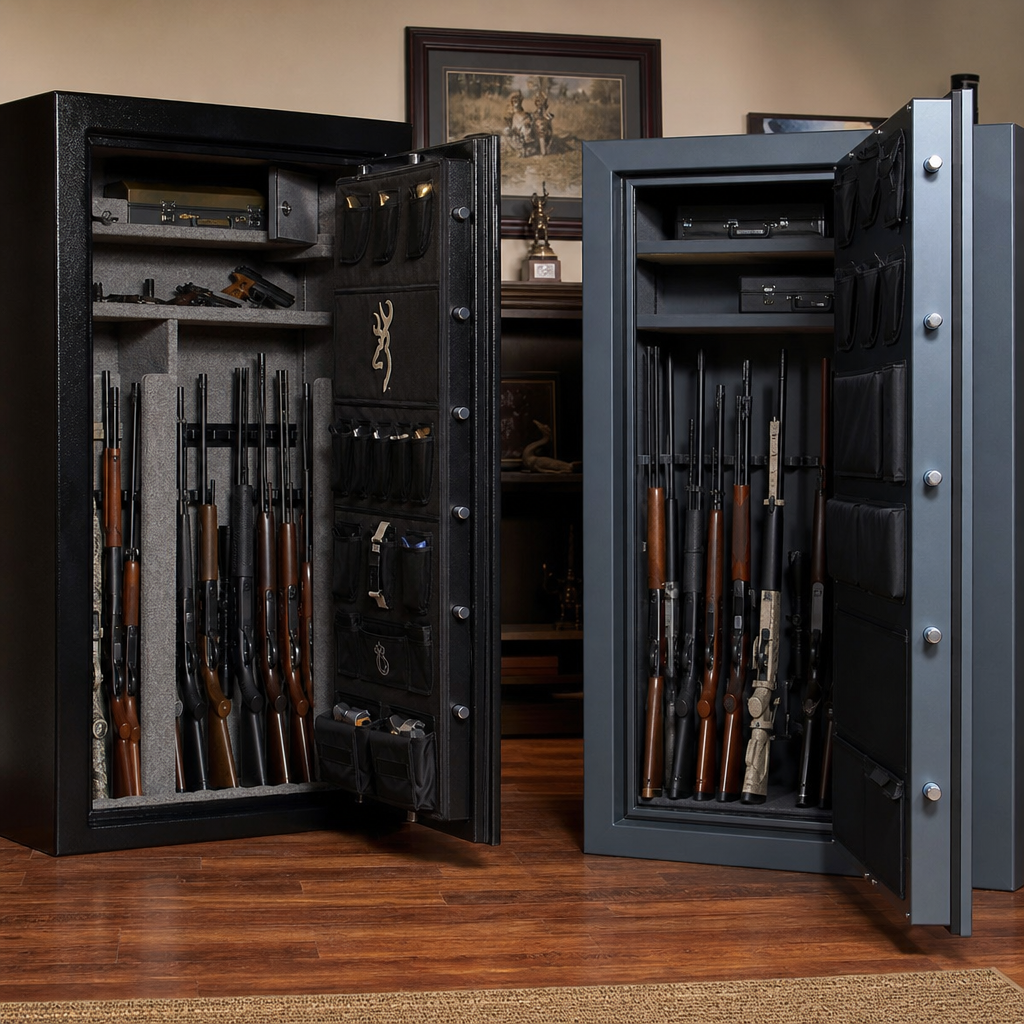
Choosing between Browning and American Security for a large gun collection is not a simple brand preference; it is a decision about capacity, fire protection, burglary resistance, interior flexibility, long-term service, and how your collection will grow over time. In the gun safes and safety category, these two names appear constantly because both serve serious owners, yet they approach the problem differently. Browning is widely known for maximizing storage efficiency through modular interiors and high stated gun counts, while American Security, often shortened to AMSEC, has built its reputation on steel thickness, composite construction options, and commercial-grade security engineering. For collectors with dozens of long guns, optics, heirloom firearms, and supporting valuables, the differences matter.
When I help buyers compare large safes, I start by defining the terms that marketing often blurs. Capacity refers not only to the listed number of guns, but to usable real-world storage once scopes, bipods, slings, and hard cases enter the equation. Fire protection means tested resistance over time at specific temperatures, but test methods vary by manufacturer. Burglary resistance includes door construction, body steel, bolt work, relockers, and lock protection, not simply weight or size. Interior flexibility covers shelving, door storage, adjustable racks, and the ability to store documents, handguns, and accessories without wasting long-gun space. A large collection usually needs all four categories balanced, not optimized in isolation.
This comparison also matters because the cost of a mistake is high. A premium gun safe can weigh more than 1,000 pounds, require specialized delivery, and remain in place for decades. Replacing one because it is too small, too lightly built, or poorly configured is expensive and frustrating. Collectors often underestimate future growth, especially if they buy historical firearms, competition rifles, suppressor-ready carbines, or inherited pieces. They also underestimate how quickly shelves fill with optics boxes, magazines, important papers, and jewelry that migrate into the same safe. The better brand for a large collection is the one that fits your threat model, floor plan, and inventory today while still working five to ten years from now.
As a hub guide for gun safe comparisons and brand spotlights, this article focuses on the big questions buyers ask first: Which brand gives more usable room? Which has stronger security construction? Which offers better fire protection? Which is easier to organize? Which line delivers the best value at premium sizes? The answer is not universally Browning or universally American Security. Browning often wins for interior efficiency and collector-friendly organization. American Security often wins for security engineering, steel options, and high-end build quality. For large collections, the better choice depends on whether your priority is maximum organized storage per cubic foot or the highest level of structural resistance within your budget.
Brand Positioning and What Each Company Does Best
Browning and American Security serve overlapping buyers, but their design priorities are distinct. Browning’s large safes, especially in expanded-capacity lines, lean heavily into practical storage innovation. The company’s Axis Adjustable Shelving and DPX-style door systems are meant to solve a real collector problem: modern rifles and shotguns do not stack neatly like slim iron-sighted hunting guns from decades past. Scoped rifles, pistol grips, raised combs, and soft cases consume volume quickly. Browning’s answer is to make the interior more adaptable so more of the safe’s cubic footage remains usable.
American Security comes from a broader security background that includes commercial safes, TL-rated products, and serious burglary-resistant designs. Even within its residential gun safe lineup, that heritage shows up in thicker steel options, robust door structures, hardplate protection, relockers, and composite fire-insulated construction in some models. If Browning often starts with the question “How can we store more firearms intelligently?” AMSEC often starts with “How can we make forced entry materially harder?” That distinction is why security-focused buyers and owners in higher-risk locations frequently put AMSEC at the top of their list.
In practical terms, this means Browning tends to appeal to hunters, sport shooters, and multi-generation collectors who want high capacity and orderly interiors without moving into vault-level pricing. American Security tends to appeal to buyers willing to spend more for heavier bodies, stronger doors, and premium burglary resistance, especially when the safe will also protect watches, documents, cash, or NFA items. Neither positioning is superficial marketing. It affects steel gauges, insulation systems, lock choices, interior geometry, and final weight.
Capacity for Large Collections: Advertised Numbers Versus Real Use
If you are comparing Browning vs. American Security for large collections, capacity is usually the first headline metric and the first place buyers get misled. Manufacturer gun counts are based on tightly packed configurations using slim firearms with minimal accessories. In real homes, a “49-gun” safe may hold 24 to 32 long guns comfortably if half wear optics and several have wide fore-ends or chassis stocks. This is where Browning has an advantage. Its rack layout and modular shelving typically allow more realistic accommodation of mixed long-gun profiles.
I have seen collectors move from a nominal 40-gun safe to a large Browning and gain usable space not because the safe was dramatically wider, but because the interior reduced dead zones. Door-mounted handgun storage frees upper shelves. Adjustable barrel racks help separate scoped rifles. Convertible shelving lets one side remain dedicated to long guns while the other handles ammunition, binders, and handguns. For a collection with hunting rifles, AR-platform rifles, over-under shotguns, and family heirlooms, that flexibility adds up fast.
AMSEC large safes can absolutely handle sizable collections, but many buyers choose them despite slightly less storage efficiency because they prioritize structural build over squeezing in the last few guns. In other words, if two safes have similar exterior dimensions, Browning often feels more optimized inside, while AMSEC may devote more mass and engineering to the shell and door. That tradeoff is neither hidden nor trivial.
| Comparison Factor | Browning | American Security |
|---|---|---|
| Real-world long-gun capacity | Usually stronger due to flexible racks and door storage | Good, but often less space-efficient in similar footprints |
| Interior configurability | Excellent on many collector-oriented models | Good to very good, depending on series |
| Burglary-focused construction | Solid in upper lines, less emphasized as brand identity | Major strength, especially in premium models |
| Weight for comparable size | Often lighter | Often heavier due to steel and composite build choices |
| Best fit | Owners maximizing organized firearm storage | Owners prioritizing higher resistance and dual-use valuables protection |
The safest buying rule is simple: divide the advertised gun count by roughly 1.5 to 2 if you own modern long guns with optics and accessories. Then compare interior layouts carefully. For most large collections, that method produces a much more honest estimate than brochure numbers.
Security Construction: Steel, Doors, Locks, and Forced-Entry Resistance
Security construction is the category where American Security usually leads. AMSEC has long been respected for using meaningful steel thickness, reinforced door edges, hardplate over the lock, active bolts, and relocking mechanisms that engage if an attack targets the lock body. On higher-end models, the company also offers composite construction concepts that exceed what many mainstream residential gun safes provide. That matters because most residential safe attacks are not cinematic torch jobs; they are fast pry attacks, side-body breaches with tools, and attempts to compromise the lock area.
Browning safes are not lightly made by default, and upper-tier models are substantial, but the brand is more variable across price points. Buyers need to compare exact specifications rather than assume every Browning offers the same resistance profile as a premium AMSEC. Steel gauge differences that look minor on paper can be significant in practice, especially across large body panels. Door construction matters just as much. A thick, well-supported door with strong bolt engagement and minimal flex is a major defense against pry attacks.
Lock selection also deserves attention. Both brands commonly offer electronic and mechanical lock options from recognized manufacturers such as Sargent and Greenleaf or SecuRam, depending on model and configuration. Electronic locks are faster and easier for frequent access, but quality matters. Mechanical dial locks remain valued for simplicity and long service life. For a large collection, I usually advise buyers to pick the lock format they will use consistently and maintain properly. The most secure safe still fails functionally if the owner avoids opening it because the interface is inconvenient.
If burglary resistance is your primary concern, especially in a detached home, rural property, or location with delayed police response, American Security generally has the edge. If your risk profile is moderate and you want solid protection combined with superior storage efficiency, Browning remains highly competitive. Installation can narrow the gap too. A bolted-down safe in a constrained corner with limited pry clearance is materially harder to attack than the same safe left freestanding in an open garage.
Fire Protection Claims and How to Judge Them
Fire protection is one of the hardest specifications to compare because testing standards are not uniform across the residential gun safe market. Both Browning and American Security publish temperature and duration ratings, but the informed buyer should ask how those numbers were developed. Some manufacturers use independent labs, some rely on internal protocols, and some emphasize peak temperatures without enough context about seal performance, insulation type, and cool-down phases. A house fire is not just a single temperature spike; it is heat exposure over time followed by prolonged residual heat.
American Security often gets strong marks here because several of its models use well-developed insulation systems and robust door seals paired with heavier construction. Browning also offers competitive fire ratings, and in many mainstream buying scenarios the difference is less dramatic than the security gap. Still, if your collection includes irreplaceable paper records, vintage wood stocks, or high-value optics, you should examine the exact line rather than the brand headline. The best fire-rated model from one brand may outperform an entry or mid-tier model from the other.
One practical lesson from field experience is that fire protection is inseparable from placement. A safe in a climate-controlled interior room generally faces different conditions than one in a garage with accelerants, vehicles, and higher ambient temperature swings. Concrete slabs help with load-bearing, but garages can be harsher fire environments. Large collectors should also remember that no gun safe replaces insurance documentation. Photograph serial numbers, store records off-site, and review policy limits for firearms and accessories. A strong safe reduces loss probability; it does not eliminate catastrophic risk.
Interior Design, Access, and Daily Use
For people with large collections, interior design is not a cosmetic issue. It determines whether the safe is easy to live with for years. This is where Browning consistently impresses buyers. The modular shelving systems in many Browning models make it easier to separate categories: deer rifles on one side, tactical carbines on the other, shotguns in a center section, handguns and magazines on the door, and documents up high. That arrangement reduces the domino effect where retrieving one firearm requires moving three others.
American Security interiors are generally well made and functional, especially in higher-end lines, but they tend to feel more conventional unless you select configurations carefully. Some collectors actually prefer that simplicity. A straightforward, sturdy interior can be easier to adapt with aftermarket organizers or custom shelf layouts. But out of the box, Browning often offers a more collector-centric experience for mixed inventories.
Door swing and handle clearance matter too. Large safes need room to open fully, especially if you use door storage. Before buying either brand, map the footprint, door arc, and access path into the house. I have seen buyers choose a 60-inch-class safe only to discover the final room layout prevented full shelving use. For anyone building a sub-pillar resource on gun safe comparisons and brand spotlights, this point deserves emphasis: measurements on the product page are only the beginning. Usable ownership starts with installation logistics and daily access habits.
Price, Value, and Which Brand Is Better for Different Buyers
Price differences between Browning and American Security can be substantial at larger sizes, particularly when you move into AMSEC models with heavier steel or premium fire and security construction. Browning often delivers more apparent value on a cost-per-gun-stored basis, assuming you evaluate capacity realistically. For a collector whose main challenge is organizing 25 to 40 long guns plus handguns and gear, Browning can be the smarter economic choice because the interior works harder for the money.
American Security becomes the better value when the collection itself is expensive enough that stronger construction justifies the premium. A safe holding custom rifles, engraved shotguns, high-end optics, suppressors, and important documents is protecting more than a count of firearms. In that case, spending more on thicker steel, better lock protection, and stronger anti-pry design is rational, not indulgent. Value should be measured against replacement cost, theft risk, and peace of mind.
My bottom-line recommendation is clear. Choose Browning if your top priority is maximizing organized storage for a large and varied collection in a residential safe format. Choose American Security if your top priority is stronger burglary resistance and higher-end construction, even if that means paying more and accepting slightly less interior efficiency for the same footprint. If you are on the fence, compare specific models side by side, inspect steel and fire specs, and think in terms of your next ten purchases, not your current inventory.
For most buyers, Browning is better for large collections when space management and accessibility matter most. American Security is better when protection quality outweighs sheer storage optimization. Both are credible brands, but the better brand is the one aligned with your risk level, room constraints, and collection value. Use this guide as your starting hub for gun safe comparisons and brand spotlights, then narrow your shortlist by model series, not brand reputation alone. Measure your space, audit your collection honestly, and buy the safe you will not outgrow. That is the decision you are least likely to regret.
Frequently Asked Questions
1. Is Browning or American Security better for a large gun collection?
Neither brand is automatically better for every owner with a large collection, because the right choice depends on what “better” means in your situation. If your main priority is fitting more long guns, optics, and mixed gear into a given footprint, Browning often stands out because its interior systems are designed to maximize usable space. Many owners appreciate the modular layouts, door storage, and shelving flexibility because large collections rarely stay uniform. Once you add scoped rifles, tactical firearms, handguns, documents, and accessories, interior efficiency becomes just as important as exterior size.
American Security, often called AMSEC, is frequently the stronger choice when the decision leans more heavily toward security construction and a broader range of protection tiers. For large collections, that matters because the more valuable your firearms become, the more important burglary resistance, steel thickness, lock options, and overall build quality tend to be. AMSEC has a strong reputation for offering models that appeal to buyers who want to move beyond basic residential security and into more serious protection categories.
For many buyers, the real comparison is this: Browning tends to be very attractive for storage efficiency and interior organization, while American Security often gets the edge from buyers who prioritize robust security engineering and heavier-duty safe construction. If you have a large but practical collection and want to optimize access and capacity, Browning may feel like the smarter fit. If you have a large and especially high-value collection where anti-theft performance is a top concern, American Security may be the better long-term investment.
2. Which brand offers more usable storage capacity for growing collections?
When people compare safes for large collections, they often focus too much on the advertised gun count. In reality, quoted capacities are usually optimistic and based on tightly packed long guns without large optics, slings, bipods, or nonstandard stocks. That is why usable storage capacity matters more than the number printed on the door. Browning is especially well known for addressing this issue with interior designs intended to make real-world storage more efficient, not just theoretically spacious.
Browning’s modular interior approach is a major reason it is frequently recommended for collectors whose holdings continue to grow and diversify. Adjustable shelving, configurable gun racks, and organized door systems can make a noticeable difference when you are trying to store a mix of hunting rifles, AR-style platforms, shotguns, pistols, and gear in one safe. For owners who expect their collection to evolve over time, that flexibility can delay the need to buy a second safe.
American Security also offers large-capacity models and well-designed interiors, but the brand is often selected less for squeezing the highest possible number of firearms into a given interior and more for balancing storage with stronger protective construction. In practical terms, some AMSEC models may devote more of the overall design emphasis to security performance, which can make them very appealing for collectors who are willing to sacrifice a bit of packing efficiency in exchange for peace of mind.
If your goal is to maximize organization, visibility, and day-to-day usability as the collection expands, Browning often has the advantage. If your goal is to store a large collection in a safe where capacity is important but secondary to stronger physical protection, American Security can be the smarter fit. For either brand, it is wise to buy significantly larger than your current needs suggest, because large collections almost always outgrow a safe faster than expected.
3. How do Browning and American Security compare on burglary resistance and overall security?
This is one of the most important questions in the entire comparison, especially for serious collectors. While both brands operate in the gun safe and security market, they are not always chosen for exactly the same reasons. Browning is respected and popular, but American Security has long built a reputation that strongly appeals to buyers who place above-average emphasis on anti-theft construction, heavier steel, reinforced doors, and more security-focused engineering across multiple product tiers.
That does not mean every American Security safe is automatically more secure than every Browning safe, because security varies by specific model, body thickness, door construction, bolt design, lock type, relocker setup, and certification level. However, AMSEC is often a leading brand in conversations about stepping up from basic gun safe protection toward safes with more robust burglary credentials. For a large collection with substantial financial or sentimental value, that can be a decisive factor.
Browning remains a strong contender, particularly for owners who want quality protection in a highly usable package. But if your concern is the possibility of a determined break-in attempt, many buyers will compare American Security more favorably because of its reputation for serious safe construction. That is especially true if your collection includes high-end rifles, collectible firearms, NFA items, premium optics, or other contents that would be difficult or impossible to replace.
The smartest way to judge this category is not by brand name alone. Compare the exact models you are considering, review steel specifications, fire and burglary ratings if available, lock quality, hinge design, anchor options, and overall weight. For large collections, overall security should be evaluated as part of the total plan, including proper installation, bolting the safe down, placement inside the home, and whether the safe room itself adds another layer of delay against theft.
4. Which brand is better for fire protection and long-term protection of valuable firearms?
Fire protection is often treated like a simple number on a sales sheet, but that can be misleading. For owners of large gun collections, fire protection should be viewed as part of a broader preservation strategy. The questions are not just how long the safe is rated for, but how the safe is constructed, what temperature threshold is referenced, how consistent the seal system is, and whether the interior environment will help protect wood stocks, finishes, optics, and important paperwork over the long term.
Both Browning and American Security offer models with meaningful fire protection features, but the stronger option depends on the exact safe and your overall priorities. Browning may appeal to buyers who want a practical combination of good fire protection and excellent interior storage utility. American Security often appeals to those who want to pair fire protection with heavier-duty construction and a more security-centered design philosophy. For many serious owners, the ideal safe is not simply the one with the highest advertised fire number, but the one that delivers the best balance of heat resistance, theft protection, and interior fit for the collection.
For long-term firearm protection, it is also important to look beyond the fire rating itself. A large collection creates challenges related to crowding, airflow, humidity, and handling. A safe that is too tightly packed can increase the likelihood of dings, finish wear, and difficult access. In that sense, Browning’s emphasis on interior organization can indirectly support long-term preservation by making storage less cramped and more manageable. On the other hand, collectors who view catastrophic loss prevention as the top priority may place greater value on American Security’s reputation for stronger overall safe construction.
In practical terms, whichever brand you choose, add moisture control, avoid overpacking, and store the most sensitive or irreplaceable items with extra care. Fire protection is not a single-feature decision, and for a large collection, the best answer usually comes from weighing fire resistance together with security, capacity, and how well the safe will serve your collection for many years.
5. How should I decide between Browning and American Security if I expect my collection to keep growing?
If your collection is actively growing, the most important mindset is to shop for your future collection rather than your current inventory. This is where the Browning versus American Security decision becomes less about logos and more about strategy. A growing collection usually means more variation in firearm types, more accessories, more optics, and potentially more value concentrated in one place. That forces you to think carefully about capacity, flexibility, and the level of protection you may need five or ten years from now.
Browning is often the easier recommendation for buyers who know they need adaptable storage. If you expect to add different firearm categories over time and want a safe interior that can be reconfigured as your needs change, Browning’s modular storage philosophy is very compelling. It is especially appealing if you value easy access, efficient use of space, and cleaner organization as the collection expands.
American Security is often the better recommendation for buyers who expect not only growth in quantity, but growth in value and risk exposure. As collections become larger and more expensive, many owners become less concerned with squeezing in the next few firearms and more concerned with whether the safe itself is substantial enough to justify what is being stored inside. In that stage, buyers often lean toward American Security because the conversation shifts from convenience to protective strength.
A smart decision framework is this: choose Browning if interior flexibility and storage efficiency are your highest priorities, especially if your collection is broad and still evolving. Choose American Security if you want to emphasize stronger physical security and are willing to trade some storage optimization for a more protection-first approach. In either case, buy more safe than you think you need, compare specific models instead of brand reputations alone, and think in terms of a long-term collection plan rather than a short-term purchase.