
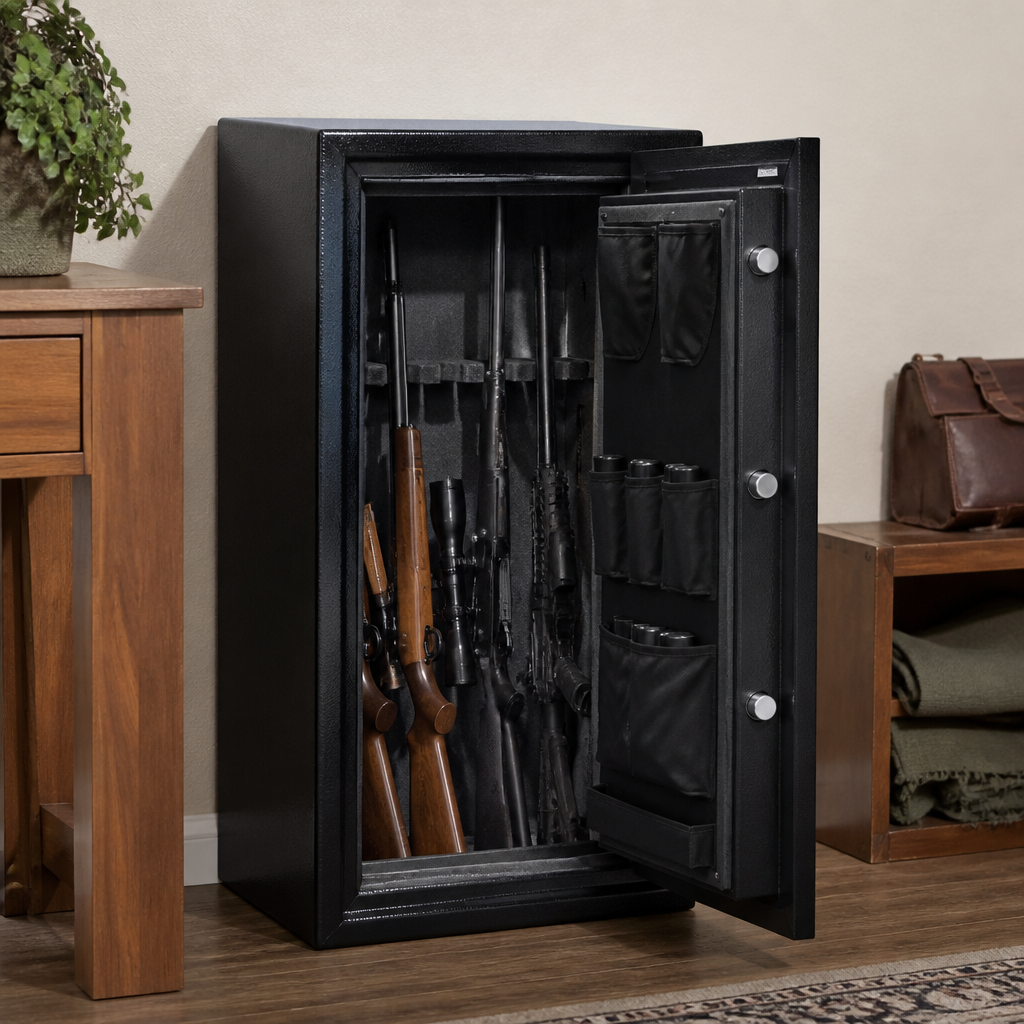
The Barska Fire Vault Safe sits in a useful niche within the gun safes and safety market: it is a gun safe designed to protect firearms not only from unauthorized access, but also from heat, smoke, and the chaos that follows a house fire. For buyers researching product reviews under the broader Gun Safes & Safety category, that combination matters because burglary and fire are the two loss events that most often drive safe purchases. A cabinet with a lock may slow down a curious child or casual thief, yet it does little when temperatures spike, drywall fails, and documents, optics, and ammunition are exposed to extreme heat. A fire-protective gun safe aims to address both problems in one enclosure.
When I evaluate a safe like the Barska Fire Vault, I look at four core criteria: construction, fire resistance, locking system, and interior usability. Construction covers steel thickness, door fit, hinges, and boltwork. Fire resistance refers to the insulating materials and the certified or stated rating, usually expressed as minutes at a target temperature. Locking system includes biometric readers, keypads, backup keys, and relocking features. Interior usability means whether the safe actually works for the firearms and valuables people own, including scoped rifles, handguns, passports, external hard drives, cash, and legal documents. A product review that ignores any one of those areas misses how buyers use a safe in real homes.
Barska is best known for optics, biometric safes, and entry- to mid-tier security products, so the Fire Vault line naturally attracts shoppers who want a recognizable brand without moving immediately into the price range of heavy commercial safes. That positioning makes this review hub important. Many consumers start by searching one model name, then quickly realize they need guidance on how all fire-rated gun safes compare. This article is built to answer those questions directly, explain where the Barska Fire Vault Safe performs well, where buyers should be cautious, and what criteria should guide any product review in this category.
A key definition helps frame the rest of the discussion. A gun safe is not the same thing as a Residential Security Container, and a fire rating is not the same thing as burglary certification. The industry often separates burglary resistance standards, such as UL Residential Security Container classifications, from fire endurance claims. Some manufacturers rely on independent testing, while others publish factory ratings based on internal protocols. That difference affects buyer confidence. In practice, a safe can be very convenient, offer moderate fire protection, and still fall short of the expectations someone might have if they hear the word vault. Understanding that distinction is the foundation of any honest Barska Fire Vault Safe review.
What the Barska Fire Vault Safe Is Designed to Do
The Barska Fire Vault Safe is meant to provide residential storage for firearms and valuables with an added layer of fire protection. In plain terms, it is built for homeowners who want one locking container for long guns, handguns, documents, and electronics rather than separate products for each category. That combination is attractive because many gun owners already keep titles, insurance papers, spare cash, and passports near their firearms storage area. A fire-protective safe simplifies that setup and reduces the number of vulnerable locations in the house.
From the product reviews I have worked through over the years, this type of safe usually appeals to three groups. First are first-time gun safe buyers who want a meaningful upgrade from a steel cabinet. Second are families prioritizing child access prevention and emergency document protection. Third are value-driven shoppers replacing a basic biometric safe with something larger and more durable. The Barska Fire Vault generally meets those needs best when buyers are realistic about what “fire protection” means in a residential product. It can preserve contents during many common fire scenarios, but no small consumer safe should be treated as invulnerable in a fully involved structure fire.
What makes the Fire Vault line stand out in search results is the pairing of gun storage language with fire-rated positioning. Many low-cost safes offer electronic locks and adjustable interiors but no verified heat endurance. By contrast, a fire-oriented model signals insulation, heat-expanding seals, and a body built to reduce internal temperature rise for a stated period. For anyone comparing product reviews in this sub-pillar, that is the first meaningful sorting factor: does the safe merely lock, or does it also buy time when the home itself is under stress?
Construction Quality, Locking Features, and Interior Practicality
Construction quality determines whether a safe feels substantial on delivery or disappointing after installation. In this category, buyers should examine body steel, door design, live locking bolts, and anchor provisions. Barska safes generally target practical residential use rather than elite burglary resistance, so the expectation should be a competent security enclosure, not a commercial-grade TL-rated safe. Still, details matter. Tight door tolerances reduce prying opportunities. Multiple locking bolts distribute resistance more effectively than a simple cam lock. Pre-drilled mounting holes matter because anchoring is one of the most effective theft deterrents in any home installation.
The locking system is another area where Barska has long experience. Depending on model configuration, shoppers may see digital keypads, biometric components, or backup key access. In real use, reliability matters more than novelty. I always recommend evaluating lock responsiveness in dry runs before a safe is trusted with defensive firearms. A biometric reader is only useful if enrolled fingerprints are captured correctly, the sensor stays clean, and household members understand how to place the finger consistently. A keypad lock can be slower, but it is often less finicky. Backup access is essential. Batteries fail, electronics age, and lockouts always happen at the worst possible time.
Interior practicality often gets too little attention in product reviews. Manufacturer capacity numbers can be optimistic because they assume unscoped long guns placed tightly together. In actual homes, AR-platform rifles with optics, shotguns with side saddles, and bolt guns with larger scopes consume more space than brochure photos suggest. Shelving flexibility therefore matters. A Barska Fire Vault Safe is more useful when its interior allows a mixed loadout: a few long guns, several handguns, suppressor paperwork, spare magazines, and document folders. Soft interior lining also matters because optics and wood stocks are easily scratched during hurried access.
| Evaluation Area | What to Check | Why It Matters |
|---|---|---|
| Fire protection | Stated minutes, temperature threshold, door seal design | Determines how long contents may survive rising heat |
| Security | Steel body, locking bolts, hinge protection, anchor holes | Slows theft and prevents easy removal of the safe |
| Access | Keypad or biometric consistency, backup entry method | Controls daily usability and emergency reliability |
| Storage fit | Real rifle spacing, shelf adjustment, document room | Prevents disappointment after moving firearms inside |
| Placement | Weight, footprint, floor strength, humidity conditions | Affects performance, safety, and long-term durability |
How Fire Protection in a Gun Safe Really Works
Fire protection in a gun safe is usually achieved through layers of insulating material inside the walls and door, combined with seals that expand under heat to block smoke and hot gases. The goal is not to keep the exterior cool. The goal is to slow heat transfer enough that the interior stays below damage thresholds for paper, polymer components, electronics, and wood for the rated duration. Paper begins to char around 451 degrees Fahrenheit, which is why many document safes are tested around that benchmark. Firearm accessories and electronic media can be damaged at much lower temperatures, so buyers should treat any rating as helpful, not absolute.
In practical terms, a Barska Fire Vault Safe offers meaningful value when installed in a lower-risk location such as a climate-controlled interior room on the ground floor, anchored properly, and not overloaded. Placement matters because garages can see more temperature swings, moisture, and in some cases more intense fuel loads. Fire ratings also depend on the test method. Some tests expose the safe to external temperatures for a set time, while others include cooldown phases or drop tests. A manufacturer-stated rating gives direction, but independent certification always carries more weight than marketing language alone.
Real-world fire performance also depends on what is stored. Paper records inside folders may survive when exposed directly to interior heat spikes that would still ruin plastic cards, backup drives, and glued photo albums. Ammunition creates another nuance. SAAMI guidance and firefighter experience indicate that loose cartridges in a fire do not behave the same way as ammunition fired from a chamber, but heat can still damage packaging, create hazard for cleanup, and destroy primers and powder. For that reason, many owners store large ammunition quantities separately from firearms and documents, even when the main gun safe offers fire protection.
Where the Barska Fire Vault Safe Fits in Product Reviews
As a product review hub, this page should position the Barska Fire Vault Safe against the broader market rather than treat it in isolation. In that comparison set, Barska usually competes with entry-level and lower mid-range fire-rated gun safes from brands sold through sporting goods stores, warehouse clubs, and online marketplaces. Its strongest appeal is convenience: recognizable branding, accessible pricing, and straightforward features that answer the needs of a typical household. For many buyers, that is enough. They need a better solution than a cabinet, but they are not ready to spend several thousand dollars on a heavy, high-end safe.
The tradeoff is that shoppers should not confuse “good residential protection” with “maximum forced-entry resistance.” If your primary concern is a determined burglar with time, pry tools, and privacy, then door thickness, hard plate protection, relockers, and true burglary ratings become more important than a moderate fire claim. If your main concern is keeping children out, limiting smash-and-grab theft, and giving documents and firearms a fighting chance during a house fire, the Barska Fire Vault category makes more sense. The best product reviews say this clearly because the right safe depends on the threat model, not the label.
Compared with simple gun cabinets, a Fire Vault style safe is decisively better for family safety and loss prevention. Compared with premium American-made safes using heavier steel, more robust boltwork, and longer independently validated fire ratings, it is a value option. That is not criticism; it is accurate market placement. Buyers benefit most when reviews define the lane a product occupies. The Barska Fire Vault Safe succeeds when judged as a practical residential gun safe that adds fire protection at a price many households can justify.
Best Use Cases, Limitations, and Buying Advice
The best use case for a Barska Fire Vault Safe is a homeowner storing several firearms plus everyday valuables who wants a single, lockable, fire-protective unit in a bedroom, office, or closet. It works especially well for mixed storage: a defensive handgun, a few long guns, tax records, passports, jewelry, cash, and digital backups placed in secondary protective pouches. Renters can also benefit if building rules and floor loading allow, though anchoring options may be more limited. For households with children, the main benefit is immediate: unauthorized access is sharply reduced when guns are locked consistently and keys or codes are controlled responsibly.
Limitations are equally important. First, capacity claims are often optimistic, so buy larger than your current inventory suggests. Second, no fire safe eliminates the need for insurance documentation, serial number records, and photographed contents stored off-site or in encrypted cloud storage. Third, humidity control still matters. Fire insulation and tight seals can trap moisture, so a dehumidifier rod or rechargeable desiccant is a smart accessory, especially in humid regions. Fourth, electronic locks require maintenance. Replace batteries on schedule, test the lock monthly, and keep backup access methods secured but available.
My practical buying advice is simple. Measure your tallest scoped rifle, your intended installation space, and the route into the home before ordering. Verify whether the published fire rating is independently tested or manufacturer stated. Look for anchor hardware compatibility, adjustable shelving, and a lock type you trust under stress. Review return policies, freight delivery terms, and warranty support. Finally, think beyond the purchase day. A gun safe is part of a larger safety system that includes secure firearm handling, separate ammunition planning, humidity management, and documentation for insurance claims. The Barska Fire Vault Safe can be a solid anchor for that system when selected with realistic expectations.
The Barska Fire Vault Safe earns attention because it addresses the two questions most buyers ask first: will it keep unauthorized people out, and will it help protect my firearms and valuables in a fire? For many households, the answer is yes, within the limits of a residential product designed for convenience and value. It is not the last word in burglary resistance, and it should not be marketed that way. But as part of the Gun Safes & Safety landscape, it fills an important role between a light cabinet and a far more expensive premium safe.
The most useful takeaway from this product review hub is that fire protection should never be treated as a bonus feature or marketing afterthought. It changes how a safe is built, where it should be installed, and what owners can reasonably expect after an emergency. When evaluating the Barska Fire Vault Safe or any competing model, focus on construction, lock reliability, real storage capacity, published fire testing details, and installation quality. Those factors determine satisfaction far more than polished product photos or inflated capacity numbers.
If you are building out your research under Product Reviews in the Gun Safes & Safety category, use this page as your starting point and compare models by threat level, not brand name alone. Choose the safe that matches your firearms, your home, and your actual risks, then install it correctly and maintain it routinely. That is how a Barska Fire Vault Safe delivers its real benefit: better firearm security with meaningful fire protection when it matters most.
Frequently Asked Questions
What makes the Barska Fire Vault Safe different from a standard gun cabinet or basic locking safe?
The biggest difference is that the Barska Fire Vault Safe is built to address two major risks at the same time: unauthorized access and fire-related damage. A standard gun cabinet may provide basic storage and a simple lock, but it typically offers little to no meaningful protection against extreme heat, smoke exposure, or the structural stress that can happen during a house fire. By contrast, a fire-rated gun safe is designed with reinforced construction and insulating materials intended to slow heat transfer and help protect the contents during a fire event.
That distinction matters because many firearm owners are not just trying to keep guns out of the wrong hands. They are also trying to protect valuable rifles, handguns, optics, documents, and other gear from catastrophic loss. In real-world buying decisions, burglary and fire are often the two most important reasons people invest in a safe. The Barska Fire Vault Safe sits in that practical middle ground where it offers more than a thin metal cabinet, but is still focused on accessible, purpose-built firearm storage.
Another important difference is overall containment. After a fire, the danger is not limited to flames alone. Heat, smoke, water from firefighting efforts, and collapse-related debris can all damage firearms and accessories. A safe designed with fire protection in mind helps create an added layer between your valuables and that post-fire environment. While no consumer safe can guarantee perfect protection in every disaster scenario, the Barska Fire Vault Safe is appealing because it is meant to provide broader protection than a simple lockbox or entry-level cabinet.
How does fire protection in the Barska Fire Vault Safe actually help protect firearms and other valuables?
Fire protection in a gun safe works by slowing the rate at which outside heat reaches the interior. In practical terms, that means the safe’s body and door are designed to resist rapid temperature transfer long enough to improve the chances that firearms, paper records, ammunition-related accessories, and other stored items will avoid immediate catastrophic damage. In a house fire, temperatures can rise quickly, and even if flames never directly enter the safe, prolonged heat exposure can still ruin wood stocks, damage finishes, affect optics, warp components, and degrade sensitive items stored inside.
For firearm owners, this matters because guns are made from multiple materials that respond differently under stress. Metal components may withstand more direct heat than paper or polymer items, but they can still suffer from heat-related discoloration, corrosion risk afterward, lubricant breakdown, or damage to mounted accessories. Smoke is another often-overlooked hazard. Even if flames do not reach the contents, smoke and superheated air can create residue and contamination that affect both firearms and important documents. A fire-protective safe helps reduce that exposure by creating a more controlled interior environment during the event.
It is also common for owners to store more than firearms in a safe like this. Passports, deeds, cash, hard drives, backup media, jewelry, and family records are often kept alongside guns. That makes fire resistance even more valuable. The Barska Fire Vault Safe is attractive for buyers who want one secure storage solution instead of separating firearm security from household document protection. As always, buyers should review the specific fire rating, test conditions, and manufacturer guidance for the exact model they are considering, because actual performance depends on duration, temperature, and installation conditions.
Is the Barska Fire Vault Safe a good choice for home security if my main concern is both theft and fire?
Yes, for many households that is exactly the type of use case where a product like the Barska Fire Vault Safe makes sense. If your concern is limited only to keeping a firearm away from children or casual access, a lighter-duty cabinet might seem adequate at first. But if you are also thinking about smash-and-grab burglary, forced entry attempts, and the possibility of a residential fire, then a fire-rated gun safe becomes a much more sensible investment. It addresses multiple risks instead of only one.
From a security perspective, the value of the safe comes from layering. The lock helps prevent unauthorized access. The steel body and door construction help resist quick tampering. The added fire-protective design helps protect the contents if the home suffers a serious fire. That combination is why safes in this category appeal to gun owners who want something more substantial than a cabinet but do not necessarily need a commercial-grade vault room. In other words, it is often a practical balance of protection, size, and intended residential use.
That said, buyers should keep expectations realistic. No safe should be viewed as absolutely theft-proof or disaster-proof. A determined attacker with time, tools, and privacy can defeat many residential safes, and severe fire conditions can exceed the limits of any manufacturer rating. That is why placement and installation matter. Bolting the safe down, placing it in a lower-visibility location, and integrating it into a broader home security plan can significantly improve real-world protection. For most buyers in the Gun Safes & Safety market, the Barska Fire Vault Safe stands out because it addresses the two biggest concerns driving purchase decisions in the first place.
What should I look for when comparing the Barska Fire Vault Safe to other fire-rated gun safes?
Start with the fire rating and the details behind it. A fire rating by itself is only truly useful if you understand what it means. Look at how long the safe is rated to protect contents and at what temperature that rating applies. Compare those numbers carefully across competing models, because fire protection claims can vary significantly. Also consider whether the safe is marketed primarily as a gun safe with fire resistance, or as a document safe adapted for firearm storage, since that can affect interior layout, long-gun capacity, and overall usability.
Next, evaluate build quality and security features. Pay attention to steel thickness, door design, locking mechanism, pry resistance, hinge construction, and internal locking bolts if applicable. A safe that offers fire protection but is weak against physical attack may not be the right fit if burglary prevention is your top priority. Likewise, a very secure safe with poor interior organization can become frustrating to use every day. Good shelves, barrel rests, soft interior surfaces, and space for accessories all matter if you plan to store multiple firearms, optics, and documents together.
You should also compare capacity honestly. Safe capacity numbers are often optimistic, especially for modern rifles with scopes, slings, bipods, and other attachments. A safe advertised for a certain number of guns may hold fewer in practical use if you own larger firearms or want room for paperwork and valuables. Finally, consider where the safe will be installed, whether it can be bolted down, how much it weighs, and whether the dimensions work for your home. The best choice is not just the one with impressive specifications on paper, but the one that fits your security goals, your fire-protection priorities, and the realities of your living space.
Can the Barska Fire Vault Safe be used to store documents, jewelry, and other valuables in addition to firearms?
Absolutely. In fact, that is one of the most practical reasons many people are drawn to a fire-rated gun safe in the first place. A product like the Barska Fire Vault Safe is often used as a multi-purpose security solution, not just a firearm container. Because it is designed to provide both access control and a degree of fire protection, it can be a smart place to store passports, legal papers, insurance records, cash, external drives, heirlooms, watches, jewelry, and other items you would want protected from both theft and household disaster.
This dual-purpose use is especially helpful for homeowners who do not want to buy one safe for guns and another for family records. It centralizes protection and can simplify emergency planning, since your most important items are in one secure location. That said, organization becomes important. Firearms should be stored safely and in a way that prevents damage to documents or delicate valuables. Using shelves, document pouches, interior bins, and dedicated compartments can help keep everything protected and easy to access without overcrowding the interior.
It is also wise to think about the sensitivity of specific items. Fire-resistant gun safes are helpful for many valuables, but some media, electronics, and highly heat-sensitive materials may require specialized storage if maximum protection is needed. The same goes for humidity management, especially with firearms. Owners should consider dehumidification or moisture-control products when appropriate to help prevent rust and preserve interior contents over time. Used thoughtfully, the Barska Fire Vault Safe can serve as more than a gun safe; it can function as a central home protection hub for firearms and the valuables that matter most.