
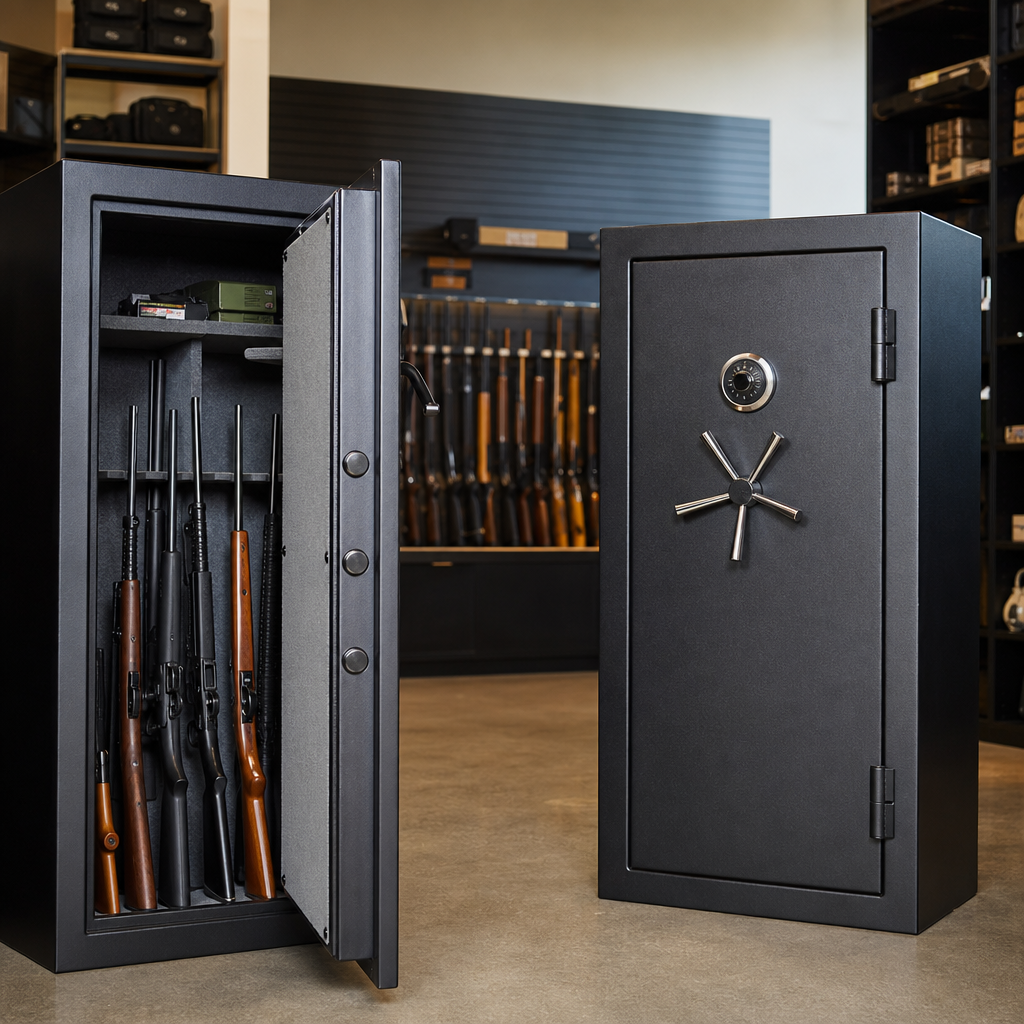
Gun owners often ask whether a cheap gun safe is just as secure as an expensive one, and the honest answer is no, not in every situation, though the gap is often misunderstood. Price affects steel thickness, lock quality, fire protection, fit and finish, warranty support, and resistance to forced entry, but a higher price tag does not automatically guarantee meaningful security. In real buying decisions, the better question is not “cheap versus expensive” in the abstract. It is which safe matches the actual threat: children in the home, smash-and-grab burglars, organized theft, fire, humidity, or the need for quick defensive access.
That distinction matters because the term gun safe is used loosely across the market. Some products sold as safes are technically residential security containers, or RSCs, a rating recognized by UL for basic attack resistance. Others are gun cabinets made from thin sheet metal with simple locks. At the upper end are heavier safes with thicker plate or composite construction, relockers, hard plates, upgraded boltwork, and independently verified fire ratings. I have worked with homeowners comparing failed lockboxes, bargain big-box models, and premium American-made safes, and the same pattern keeps appearing: people do not regret paying for the protections they truly needed, but they often regret paying for features they never understood.
This article serves as a practical hub for common gun safe myths and misconceptions. It explains what you really buy at different price levels, when inexpensive safes are sufficient, where budget models fall short, and how to judge value using objective criteria instead of marketing language. If you are choosing between a low-cost safe and a premium model, the goal is simple: separate reassuring labels from real security performance.
Why the “cheap versus expensive” debate is usually framed the wrong way
The biggest misconception is that all gun safes solve the same problem. They do not. A basic locker may deter casual access by children and keep firearms organized. A midrange safe may slow a burglar long enough for an alarm response. A premium safe may offer better pry resistance, lock protection, and fire endurance, but even expensive residential safes are not vaults and should not be treated as impenetrable. Security is layered. Safe quality matters, but so do anchoring, location, surveillance, lighting, and whether the burglar has privacy and time.
In home security assessments, I have seen owners focus almost entirely on door bolts and ignore the body of the safe, even though many attacks target sidewalls with pry bars, grinders, or by tipping the unit onto its back. I have also seen buyers dismiss a budget safe that would have been perfectly adequate for apartment storage where the main risk was unauthorized family access, not a prolonged tool attack. The real evaluation starts with a threat model. If the purpose is child access prevention and compliance with household safety rules, a less expensive container can be a responsible choice. If the purpose is protecting a large firearm collection from theft in a detached garage, cheap construction becomes a serious weakness.
Another framing error is assuming that price scales neatly with security. In practice, price also reflects branding, interior upgrades, glossy finishes, size, import costs, retailer markups, and decorative options. Two safes with similar dimensions can differ by hundreds or thousands of dollars because one has thicker steel and a better lock, while another spends more of its budget on shelving, door organizers, or cosmetic details. Reading specifications matters far more than comparing sticker prices alone.
What expensive gun safes usually provide that cheap ones do not
More expensive gun safes generally improve security in five areas: steel thickness, lock and boltwork design, protection around the lock, fire resistance, and long-term durability. Steel thickness is one of the clearest differences. Many entry-level gun safes use 14- or 16-gauge steel bodies, which can be breached more quickly with prying or cutting than 10-gauge or thicker bodies. Door construction matters too. Some budget models advertise thick doors, but the thickness may come from drywall-based fire lining and panel construction rather than a solid steel plate. A thicker-looking door is not automatically a stronger door.
Lock systems also separate price tiers. Budget safes may use basic electronic locks with modest quality control or simpler mechanical dial assemblies. Better safes often use UL-listed locks from established manufacturers such as Sargent and Greenleaf or SecuRam, along with relockers and hard plates that make punch or drill attacks more difficult. The lock itself is only part of the equation. Boltwork alignment, cam strength, hinge support, and how the door fits the frame determine whether force on the handle or door edge translates into failure.
Fire protection is another area where expensive safes often justify their cost, though buyers should read the fine print. Marketing claims like “60 minutes at 1,400 degrees” may be based on internal tests rather than independent certification. Higher-end safes are more likely to explain the testing protocol, door seals, insulation type, and the temperature threshold for protecting contents. That matters because paper, wood stocks, optics adhesives, ammunition packaging, and electronic accessories all tolerate heat differently. A fire liner that protects documents is not necessarily optimized for every firearm-related item stored inside.
Durability and service support also improve with price. Better hinges, door seals, powder coating, dehumidifier ports, adjustable interiors, and replacement parts availability become important over a decade or more of ownership. A safe is not a casual purchase. If a lock fails, a keypad dies, or warranty service is needed after a house move, manufacturer support becomes part of the value equation.
Where cheap gun safes can be good enough
Cheap gun safes are not useless, and saying otherwise creates confusion. A modestly priced safe can be good enough when the threat is limited, the owner uses other security layers, and expectations are realistic. For many households, the primary safety requirement is preventing unsupervised child access. In that role, a budget safe or even a lockable steel cabinet can represent a major safety upgrade over closet storage, under-bed cases, or a nightstand drawer. If the unit is anchored properly and the lock is reliable, it meaningfully reduces accidental access risk.
Budget safes can also work for first-time gun owners who need immediate secure storage but cannot afford a premium model yet. I generally advise these buyers to prioritize a reputable lock, enough size for current needs plus some growth, and anchor capability over cosmetic features. A basic safe installed in a closet corner, bolted into concrete or floor joists, and backed by a monitored alarm is much harder to exploit than an unanchored “better” safe sitting visibly in a garage.
Another scenario where inexpensive safes make sense is secondary storage. A premium main safe may hold the collection, while a lower-cost quick-access unit secures one handgun in a bedroom or office. In that setup, the buyer is not relying on the cheaper product for full theft resistance. They are using it for controlled access, speed, and convenience. Matching the tool to the use case is what separates sensible buying from false economy.
Common gun safe myths and misconceptions buyers should ignore
Most confusion in this category comes from repeated myths. The table below breaks down the most common ones and the reality behind each claim.
| Myth | Reality | What buyers should check |
|---|---|---|
| All gun safes are basically the same | Construction varies widely, from thin cabinets to heavier RSC-style safes with stronger doors and lock protection | Body steel gauge, door design, lock listing, weight, anchoring points |
| More weight always means more security | Weight can come from fireboard, size, or interior materials, not only thicker steel | Actual steel specs, composite structure, total design |
| An expensive safe cannot be broken into | Any residential safe can be attacked with enough time, tools, and privacy | Attack resistance, placement, alarm coverage, concealment |
| Fire ratings are standardized | Many ratings are manufacturer-tested and not directly comparable | Who performed the test, duration, temperature, pass criteria |
| Electronic locks are inferior to mechanical dials | Quality matters more than type; both can be reliable or problematic depending on manufacturer and maintenance | UL listing, brand reputation, battery access, serviceability |
| Big-box store safes are always junk | Some are entry-level but useful for basic needs; others are poor values with inflated capacity claims | Specifications, independent reviews, warranty, dealer support |
| Gun capacity labels are accurate | Advertised capacity often assumes slim rifles with no optics, slings, or accessories | Usable interior layout, shelf flexibility, realistic spacing |
One myth deserves special emphasis: capacity claims are routinely overstated. A “24-gun safe” may hold far fewer firearms once optics, bipods, magazine-fed platforms, and padded socks enter the picture. In practical planning, I tell buyers to assume they will use roughly half to two-thirds of the advertised long-gun capacity if they own modern sporting rifles or scoped hunting rifles. That simple adjustment prevents one of the most common upgrade regrets.
How to evaluate a gun safe intelligently before you buy
Start with steel, lock, and anchoring. Those three factors drive real-world theft resistance more than velvet interiors or LED lighting. Look for clear disclosure of body gauge and door construction. If a manufacturer avoids specifics, treat that as a warning sign. Check whether the lock is UL listed and whether replacement parts and locksmith service are available. Confirm that the safe includes predrilled anchor holes and hardware guidance. An unanchored safe, especially under roughly 750 pounds, can be tipped, pried, or removed entirely.
Next, evaluate the fire claim critically. Ask what maximum internal temperature was maintained, for how long, and under what test method. Consider where the safe will be installed. A first-floor interior closet presents a different fire and humidity profile than a garage or basement. Add a dehumidifier rod or desiccant if needed, because rust prevention is part of safe performance too.
Finally, examine fit for your household. Do you need rapid access for one defensive firearm, or secure storage for ten long guns and important documents? Is noise during entry acceptable? Will elderly family members use the lock reliably in the dark? A safe that is technically stronger but frustrating to operate can encourage unsafe workarounds. The best buying decision balances protection, usability, and realistic risk.
Which buyers should spend more, and which can safely spend less
You should spend more if you own a valuable collection, store NFA-regulated items where lawful, live in an area with longer police response times, or need stronger burglary and fire resistance because the safe will be visible or installed in a detached structure. You should also spend more if you plan to keep the safe for decades, move houses, or want dependable service support and parts availability. Higher initial cost is often justified when replacement value, legal risk, or sentimental value is high.
You can safely spend less if your main goal is preventing unauthorized household access, you have only a few firearms, you supplement storage with alarms and good placement, and you understand the limits of entry-level construction. The key is honesty about what the safe can and cannot do. Cheap gun safes are not just as secure as expensive ones, but they can still be secure enough for specific jobs. That is the conclusion most buyers need. Choose based on threat, not ego or marketing, then install the safe correctly and review your setup regularly. If you are building out your broader firearm storage plan, start by comparing construction details, anchoring requirements, and fire-rating evidence across the models on your shortlist.
Frequently Asked Questions
Are cheap gun safes just as secure as expensive ones?
No, not in a direct one-to-one sense. Cheap gun safes can provide useful protection, but they usually do not match the overall security, construction quality, and durability of more expensive models. In most cases, the price difference reflects real differences in steel thickness, lock quality, door design, bolt work, pry resistance, fire insulation, interior finish, and long-term reliability. That said, the gap is often misunderstood. A budget safe can still be a major improvement over leaving firearms unsecured in a closet, cabinet, or under a bed, and for many owners it may provide enough protection for their actual risk level.
The better way to think about it is not whether all cheap safes are bad or all expensive safes are automatically superior. It is whether a specific safe is appropriate for your situation. If your main goal is preventing access by children, visitors, or a casual thief looking for an easy grab, a lower-cost safe may do the job well enough when it is properly installed and used. If you are storing a larger firearm collection, high-value optics, heirloom guns, important documents, or if you live in an area where burglary response times are slow, the stronger construction of a higher-end safe starts to matter more. So the honest answer is that cheap safes are not usually just as secure, but they can still be practical and worthwhile depending on what you need them to defend against.
What are the biggest differences between a cheap gun safe and an expensive one?
The biggest differences usually come down to materials, engineering, and performance under stress. One of the most important factors is steel thickness. Many budget safes use thinner steel bodies and doors, which helps keep cost and weight down but also makes them easier to bend, cut, or pry open with common tools. More expensive safes often use thicker steel, reinforced doors, better hinges, and stronger internal bolt systems that make forced entry more difficult and time-consuming. In security products, buying time matters, because even a determined thief often gives up when the job gets loud, slow, and frustrating.
Lock quality is another major separator. Lower-priced safes may use basic electronic locks or simpler locking mechanisms that work fine for ordinary use but may not hold up as well over years of repeated operation. Higher-end models often feature more reliable lock options, better quality control, and stronger relocking systems. Fire protection is also commonly different. Many inexpensive safes advertise fire ratings, but those ratings may not be tested to the same standard or may reflect limited protection under ideal conditions. More expensive safes tend to offer better insulation, better door seals, and more credible fire resistance claims.
There are also differences that affect ownership over time rather than just break-in resistance. Expensive safes often have better fit and finish, smoother door operation, better shelving, more flexible interiors, stronger warranties, and better customer service. None of those details alone make a safe “secure,” but together they can make a meaningful difference in long-term value. The key point is that the added cost is often paying for tangible upgrades, not just branding. Still, shoppers should evaluate the actual specifications and construction rather than assuming the highest price always equals the highest protection.
When is a cheap gun safe good enough?
A cheap gun safe can be good enough when your needs are modest and realistic. For many gun owners, the primary purpose of a safe is to keep firearms away from children, houseguests, roommates, or opportunistic thieves who want to get in and out quickly. In those situations, a basic safe can provide a meaningful level of access control and deterrence, especially if it is bolted to the floor, placed in a discreet location, and used consistently. Even a lower-cost safe is usually far better than no safe at all.
It can also be a reasonable choice for first-time buyers, apartment dwellers, or people with a small collection who cannot justify spending several thousand dollars. If you only need to store one or two defensive firearms, a hunting rifle, or a handful of valuables, a compact or entry-level safe may fit both your budget and your actual threat profile. The mistake is not buying a budget safe. The mistake is expecting a budget safe to perform like a premium burglary-resistant or fire-rated unit under more severe conditions.
To decide whether a cheap safe is enough, ask practical questions. What are you protecting against: curious kids, smash-and-grab theft, extended burglary attempts, fire, or all of the above? How valuable is the collection? How long would a thief likely have in your home? Will the safe be anchored properly? The more risk, value, and exposure involved, the less acceptable the compromises of a low-cost model become. In short, a cheap gun safe is good enough when it matches the level of protection you truly need, not when you are simply hoping it will cover risks it was never built to handle.
Does paying more automatically mean a gun safe is more secure?
No. A higher price can indicate better construction and more protective features, but it does not automatically guarantee meaningful security. Some safes cost more because of brand reputation, cosmetic upgrades, larger size, deluxe interiors, or added convenience features rather than substantial improvements in burglary resistance. A bigger safe with a nicer finish is not necessarily a tougher safe. That is why comparing specifications matters more than comparing price tags alone.
What you want to look for is evidence of real security value: thicker steel, stronger door construction, better locking systems, quality welds, credible fire testing, solid anchor points, anti-pry design, and a reputation for dependable performance. If those features are present, the higher cost may be justified. If they are not, the price premium may have less to do with protection than with marketing or appearance. This is especially important because some products marketed as “gun safes” are closer in practice to residential security containers designed for light deterrence rather than serious resistance to a determined attack.
The smartest buyers focus on use case and build quality. For example, someone protecting a few defensive firearms in a low-risk environment may get excellent value from a modestly priced safe, while someone storing collectible rifles and high-end optics may need to move well beyond entry-level products. Paying more can absolutely buy better security, but only if the money is going toward features that improve resistance to theft, fire, and failure. Price is a clue, not proof.
What should you look for when choosing between a cheap and expensive gun safe?
Start with your threat model, because that determines everything else. Think about who you are trying to keep out, how long they might have access, whether fire protection matters, and how valuable your firearms and accessories really are. Once you know that, evaluate the safe based on construction rather than marketing language. Pay close attention to steel thickness in both the body and the door, the type and quality of the lock, the strength of the locking bolts and bolt work, the hinge design, and whether the safe can be anchored securely. These are the features that affect real-world resistance to forced entry.
You should also examine fire protection claims carefully. Look for details about temperature, duration, testing conditions, and whether the rating appears credible rather than vague. Consider interior capacity realistically as well, since many safes hold fewer long guns than the advertised number once you add optics, slings, or accessories. Ease of organization, shelf adjustability, door storage, and humidity control all matter if you plan to use the safe for years. Warranty support and the manufacturer’s reputation are also worth checking, especially for electronic locks and parts availability.
Finally, remember that installation can dramatically affect performance. A lower-cost safe that is properly bolted down and placed in a less visible area may outperform an unanchored expensive safe in a garage corner where thieves can work on it easily. The best buying decision is usually not the cheapest safe or the most expensive safe. It is the one that aligns with your risks, your collection, your home setup, and your budget without paying for features you do not need or skipping protections you absolutely do.