
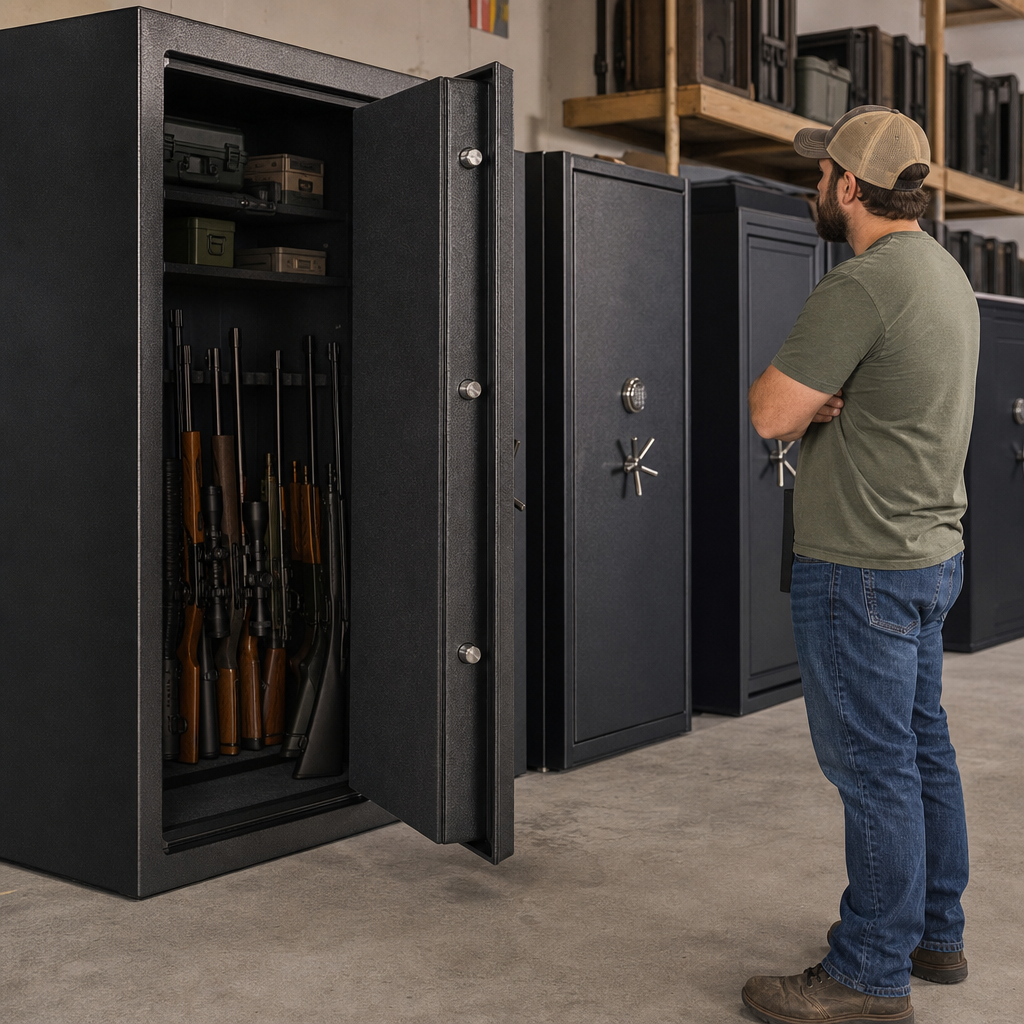
Does a bigger gun safe mean it is more secure? Not necessarily, and that misconception leads many buyers to spend more money while protecting their firearms less effectively. In my work reviewing residential security setups, I have repeatedly seen homeowners assume that sheer size equals stronger steel, better locks, and higher burglary resistance. A large safe can hold more rifles, ammunition, documents, and valuables, but capacity and security are different specifications. Security depends on construction details such as steel gauge, door design, lock quality, bolt work, anchoring, fire sealing, and independent testing. Size matters for storage planning, yet it is only one variable in the total protection equation.
This question matters because gun safes serve several overlapping purposes: theft deterrence, child access prevention, fire protection, organization, and compliance with household safety goals. A “gun safe” can describe everything from a thin metal cabinet to a heavy burglary-rated safe, which is why confusion is common. Marketing often amplifies the problem by emphasizing external dimensions, total gun count, or dramatic weight figures without explaining how those features translate into real resistance. Buyers then compare a seventy-two-gun safe to a smaller model and conclude the larger unit must be safer. In practice, a smaller safe built with thicker steel and a better lock may outperform a much larger safe during a pry attack.
This hub article addresses the broader category of gun safe myths and misconceptions, with the bigger-means-safer claim as the starting point. Along the way, it clarifies other common misunderstandings: that all fire ratings are equivalent, that any digital lock is unreliable, that heavier always means stronger, that advertised gun capacity reflects real-world storage, and that location inside the home does not significantly affect security. If you are building a complete gun safe buying plan, this page should connect your thinking across safe sizing, safe placement, lock selection, anchoring, humidity control, and realistic threat assessment. The core principle is simple: evaluate a safe by tested performance and construction, not by assumptions attached to size alone.
Why Bigger Does Not Automatically Mean Stronger
A larger gun safe often gives the impression of greater security because it occupies more space, weighs more, and looks imposing. Those cues matter psychologically, but criminals attack materials and weak points, not appearances. If a manufacturer builds a large safe body from 14-gauge steel and a smaller premium model from 10-gauge or 7-gauge steel, the smaller unit is materially harder to cut, bend, or pry. Steel thickness is one of the clearest examples of why dimensions do not equal resistance. Many mass-market safes gain weight through expanded sheet metal, shelving, drywall-based fire lining, and decorative door panels rather than through thicker plate steel where it counts most.
Door construction also changes the picture. I have inspected safes with oversized doors that looked formidable but had shallow door returns, flexible skins, and bolt systems that offered less real pry resistance than a compact plate-door unit. Attackers usually target door gaps, hinges, lock areas, and corners. A well-designed smaller safe with tight tolerances, hard plates, relockers, and robust bolt engagement can present fewer exploitable weaknesses than a larger, lightly built model. Larger footprint can even create more leverage opportunities if the unit is not anchored properly, especially when thieves use pry bars on side gaps or attempt to tip the safe to attack a seam.
Interior volume can indirectly weaken value if it encourages overbuying the wrong class of product. Many shoppers choose a bigger safe to “future-proof” storage, then compromise on steel and lock quality to stay within budget. That tradeoff is common and usually backwards. It is better to buy a smaller, better-built safe and manage capacity carefully than to buy a larger, lower-grade safe that creates a false sense of security. Security first, capacity second, aesthetics third is the priority order I recommend to most homeowners.
What Actually Determines Gun Safe Security
Real gun safe security is determined by a combination of barrier strength, lock integrity, attack resistance, installation quality, and time. The body and door steel establish the primary barrier. Locking bolts help keep the door engaged, but they do not compensate for a weak door edge or thin frame. Hard plates protect the lock from drilling. Relockers trigger if tampering occurs. Continuous welds are generally preferable to sparse stitch welds on critical seams. Internal hinge systems can reduce exposed attack points, though external hinges are not automatically insecure if the door has full dead-bar support.
Independent ratings are also important, even though many consumer gun safes are not burglary rated in the same way as commercial safes. Standards from Underwriters Laboratories remain the most recognizable benchmark for lock and safe testing. UL-listed locks indicate a baseline of performance. Burglary labels such as RSC, or Residential Security Container, provide a limited but meaningful signal: the product resisted a defined tool attack for a set period under test conditions. That does not make it equivalent to a TL-rated commercial safe, but it does separate tested products from purely cosmetic storage boxes.
Placement and anchoring can be as decisive as the safe itself. A lighter or midsize safe bolted into concrete, positioned in a corner, and partially enclosed by framing can become much harder to pry open than a larger free-standing safe left unanchored in an open garage. Attackers prefer working space and time. Reduce both and you increase effective security dramatically. Alarm coverage, cameras, lighting, and restricted visibility from windows contribute to the same outcome. Safe security is therefore never just a product feature list; it is a system.
Common Gun Safe Myths Buyers Still Believe
The bigger-safe myth sits inside a wider set of misconceptions that affect buying decisions. Some are harmless, but several result in lower protection or wasted money. The most persistent myths are easy to summarize and even easier to spot once you know what to examine.
| Myth | Reality | Why It Matters |
|---|---|---|
| Bigger safe is more secure | Construction and testing determine resistance more than size | Prevents overspending on capacity while underbuying protection |
| Heavier always means stronger | Weight may come from fire board, shelving, or size rather than thicker steel | Forces buyers to compare steel gauge and door design instead of shipping weight |
| All fire ratings are equal | Manufacturers use different temperatures, durations, and test methods | Helps buyers read fire claims critically and compare like for like |
| More locking bolts means better security | Door edge strength and frame integrity matter more than bolt count alone | Stops shoppers from being misled by flashy marketing details |
| Digital locks are unreliable | Quality electronic locks from established brands are dependable when installed correctly | Allows buyers to choose based on access needs rather than fear |
| Advertised gun capacity is realistic | Stated counts often assume bare rifles without optics, slings, or spacing needs | Encourages buying for actual usable interior volume |
One myth often creates another. For example, buyers who think all heavy safes are secure may also assume any large showroom model offers serious burglary protection. In reality, some entry-level units are designed primarily for organized storage and basic unauthorized access prevention. They can still be useful, especially for keeping children away from firearms, but they should not be confused with high-security containers. Clarity about intended use is essential.
Fire Ratings, Lock Types, and Capacity Claims Explained
Fire protection is one of the most misunderstood parts of gun safe marketing. A label that says “60 minutes at 1400 degrees” does not tell the whole story unless you know who performed the test, whether the test included a cool-down phase, and what internal temperature threshold was used. Paper chars around 451 degrees Fahrenheit, but plastics, optics components, adhesives, and electronic accessories may fail at lower temperatures. If you are storing passports, cash, hard drives, suppressor paperwork, or heirloom photos, ask for the test protocol instead of relying on a single headline number.
Lock selection is another area where simple narratives fail. Mechanical dial locks are durable, time-tested, and immune to battery failure. They are also slower to open and less convenient under stress. Electronic keypad locks provide speed and easy code changes, which many owners prefer for daily access. Their weak points are usually poor installation, cheap components, or neglected batteries, not the technology itself. Trusted names such as Sargent and Greenleaf, SecuRam, and La Gard have long track records. Biometric locks can be useful, but fingerprint readers vary widely in quality, and I advise treating them as a convenience feature rather than the sole reason to buy a safe.
Capacity claims deserve special skepticism. A safe marketed for forty-eight guns rarely holds forty-eight modern long guns in practical use. Scoped rifles, pistol grips, adjustable stocks, bipods, and slings consume space quickly. Interior organizers can help, but they do not eliminate geometry. When clients ask how much room they need, I tell them to cut manufacturer long-gun capacity claims by roughly one-third to one-half if they own optics-equipped firearms. That rule is imperfect, yet it produces much more realistic planning than brochure numbers.
How to Choose the Right Safe for Your Risk Level
The best gun safe is the one that matches your threat profile, collection size, access needs, and home layout. Start by defining what you are protecting against. If the primary concern is preventing child access and deterring casual theft, a solid entry-level safe or security container may be sufficient when anchored correctly. If you own collectible firearms, NFA items, expensive optics, or irreplaceable family documents, you should move up in steel thickness, lock protection, and tested burglary resistance. Urban burglary patterns, rural response times, and whether your home sits isolated or in a dense neighborhood all affect this calculation.
Budgeting should follow the value at risk, not the emotional impact of the showroom floor. I have seen owners place ten thousand dollars in firearms into bargain safes with thin bodies because the safe looked large and impressive. I have also seen modest collections protected intelligently in smaller, higher-quality safes installed in hardened closets with dehumidification and alarm contacts. The second setup was usually the stronger one. A practical approach is to list firearm replacement cost, accessory value, document value, and likely growth over five years, then compare those numbers against the cost difference between construction classes.
Measure your space carefully and think about access paths before you buy. Stair loads, flooring, doorway widths, and final placement constraints can limit what is realistic. Bigger safes introduce delivery complexity, and difficult moves sometimes pressure owners into poor placement choices such as exposed garages. Whenever possible, place the safe on a ground-level slab, out of sight from visitors, away from obvious moisture sources, and anchored according to manufacturer instructions. If fire risk is a major concern, avoid the hottest likely zones such as directly adjacent to fuel storage areas.
Hub Topics Every Gun Safe Buyer Should Explore Next
As a hub for gun safe myths and misconceptions, this page should lead you into several related topics that deserve deeper study. First is steel gauge and construction quality, because material thickness and reinforcement are the foundation of burglary resistance. Second is lock type comparison, including mechanical versus electronic reliability, battery management, and emergency override policies. Third is safe placement and anchoring, which often produces the biggest real-world security gain per dollar spent. Fourth is fire rating interpretation, especially the difference between manufacturer claims and third-party tested performance. Fifth is interior organization and humidity control, since rust prevention and efficient layout affect both firearm condition and usable capacity.
You should also explore the difference between gun cabinets, residential security containers, and true burglary safes. These categories are often blended together in casual conversation, but they represent very different protection levels. Another valuable topic is how to estimate actual gun capacity with optics, magazines, and accessories in mind. Finally, many owners benefit from guidance on layering security around the safe itself: monitored alarms, closet reinforcement, camera placement, and inventory documentation. Those subjects turn a single purchase into a complete firearm security plan.
The central lesson is straightforward. A bigger gun safe does not automatically mean a more secure gun safe. Size improves storage flexibility, but true security comes from stronger materials, better engineering, credible testing, thoughtful placement, and proper anchoring. Once you stop using size as a shortcut for quality, safer buying decisions become much easier. Compare steel thickness, lock pedigree, fire test details, bolt work, and installation conditions before you compare exterior dimensions. Then choose the model that fits your realistic threats, not the myth. Use this hub as your starting point, and build out the rest of your gun safe knowledge with the related topics that matter most to your home and collection.
Frequently Asked Questions
Does a bigger gun safe automatically provide better security?
No. A bigger gun safe does not automatically provide better security, and that is one of the most common mistakes buyers make. Size tells you how much the safe can store, not how well it can resist burglary, tampering, or forced entry. A large safe may offer more room for rifles, handguns, documents, and valuables, but if it uses thinner steel, weak door construction, basic locking components, or poor bolt work, it can be less secure than a smaller, better-built model. In practical terms, a compact safe made from thicker steel with a stronger lock and better anti-pry features can outperform a much larger unit built to hit a lower price point.
When evaluating security, focus on construction details instead of exterior dimensions. Look at steel thickness in the body and door, the quality of the locking mechanism, internal relockers, hard plates that protect against drilling, pry-resistant door gaps, and whether the safe is designed to be anchored securely to the floor. Weight also matters, but only as one piece of the overall picture. A heavier safe may be harder to remove, yet if its door or lock area is vulnerable, determined burglars may still attack the weakest point. In other words, capacity and security are separate specifications, and smart buyers treat them that way.
What features matter more than size when comparing gun safe security?
The most important security features usually have nothing to do with how tall or wide the safe is. Start with steel thickness. Thicker steel in the body and especially the door generally offers better resistance to cutting, prying, and blunt-force attacks. Many residential gun safes look substantial from the outside, but construction quality can vary dramatically. A safe with a reinforced door, stronger frame, and tighter tolerances around the opening is typically more resistant than a larger safe built with lighter materials.
The lock is another major factor. High-quality mechanical dial locks and well-made electronic locks from reputable manufacturers are generally preferable to low-end lock systems. Beyond the lock itself, pay attention to relockers, hard plates, anti-drill protection, and the overall bolt design. These features make it harder for an intruder to defeat the locking area quickly. Door fit and pry resistance are also critical. A door with minimal exposed gap and robust internal structure is usually better able to withstand pry attacks than a larger door with weaker reinforcement.
Finally, installation matters just as much as construction. A safe that is properly anchored into concrete or another suitable structural surface is significantly harder to tip over, move, or attack with leverage. Location matters too. A safe installed in a concealed, low-visibility area with limited working room around it can reduce a burglar’s ability to use tools effectively. If you want stronger real-world protection, prioritize steel, lock quality, anti-attack features, anchoring, and placement before you think about interior capacity.
Can a large gun safe actually be less secure than a smaller one?
Yes, absolutely. A large gun safe can be less secure than a smaller one if its construction is compromised to keep the price competitive. This happens often in the residential market. Manufacturers know that many buyers are attracted to impressive dimensions and high advertised gun counts, so some models emphasize storage space and appearance more than burglary resistance. That can result in larger safes built with thinner steel, weaker door frames, simpler locks, or less robust internal reinforcement than smaller, higher-quality safes.
There is also a practical issue: larger safes can create larger attack surfaces. Bigger doors and wider body panels may require stronger engineering to maintain the same level of rigidity and pry resistance. If the design does not scale up properly, the extra size can become a disadvantage rather than a strength. In addition, a very large safe that is not anchored well may be easier for a crew to tip, shift, or manipulate with tools than a smaller safe tightly installed in a constrained location.
That does not mean large safes are inherently insecure. It means buyers should avoid assuming that more volume equals more protection. A large, well-constructed safe can be excellent. A large, lightly built safe can be disappointing. The right question is not “How big is it?” but “How well is it built, how is it secured in place, and how much time and effort would it take to break into?” Those are the questions that reveal real security.
How should I choose the right gun safe if I need both storage space and strong protection?
The best approach is to start with an honest inventory of what you need to protect today and what you are likely to add in the future. Many people outgrow safes faster than expected, so planning for additional firearms, optics, important documents, and valuables is smart. However, once you determine the capacity you need, do not stop there. Use that size requirement as your starting point, then compare safes within that category based on build quality and security features. That keeps you from buying a larger but weaker model simply because it offers more shelves or a higher advertised gun count.
As you compare options, pay close attention to body steel thickness, door construction, lock reputation, bolt design, anti-drill features, and fire protection if that matters for your use. Also remember that manufacturer gun-capacity ratings are often optimistic. A safe advertised for a certain number of long guns may hold fewer once you account for scopes, slings, adjustable stocks, and other accessories. Choosing a slightly larger safe for organizational flexibility can make sense, but it should still meet your security standards first.
It is also wise to think about where the safe will be installed. Measure the space carefully, confirm floor load concerns if applicable, and choose a location that allows for anchoring and limits visibility. In many homes, a medium-size, high-quality safe installed properly is a better security solution than an oversized unit squeezed into a convenient but exposed spot. The goal is balance: enough room to store your firearms responsibly, with construction and installation strong enough to make unauthorized access far more difficult.
What is the biggest mistake people make when buying a larger gun safe?
The biggest mistake is confusing storage capacity with burglary protection. Buyers often see a large exterior, a high gun-count label, and a heavy overall appearance and assume they are getting a more secure product. In reality, they may just be paying for additional volume. That can lead to overspending on a safe that holds more items but does not provide the level of steel strength, lock protection, or pry resistance they expected. In the worst cases, people end up with a safe that looks imposing but offers only modest resistance to a determined intruder.
Another common mistake is ignoring installation. Even a well-made safe can underperform if it is not anchored properly. Large safes are sometimes treated as immovable simply because they are bulky, but burglars routinely take advantage of unanchored safes by tipping them, relocating them, or attacking them from weaker angles. Buyers also sometimes place oversized safes in highly visible or easy-access locations because that is where they fit best, unintentionally making the burglar’s job easier.
A better approach is to buy based on verified construction details and realistic use. Look beyond size, ask about steel gauge, inspect lock options, confirm anti-drill and relocking features, and make a plan for secure anchoring. If you need more room, choose more room, but do not let that be your definition of security. The safest purchase is the one that matches your storage needs without sacrificing the structural and locking features that actually protect your firearms.