
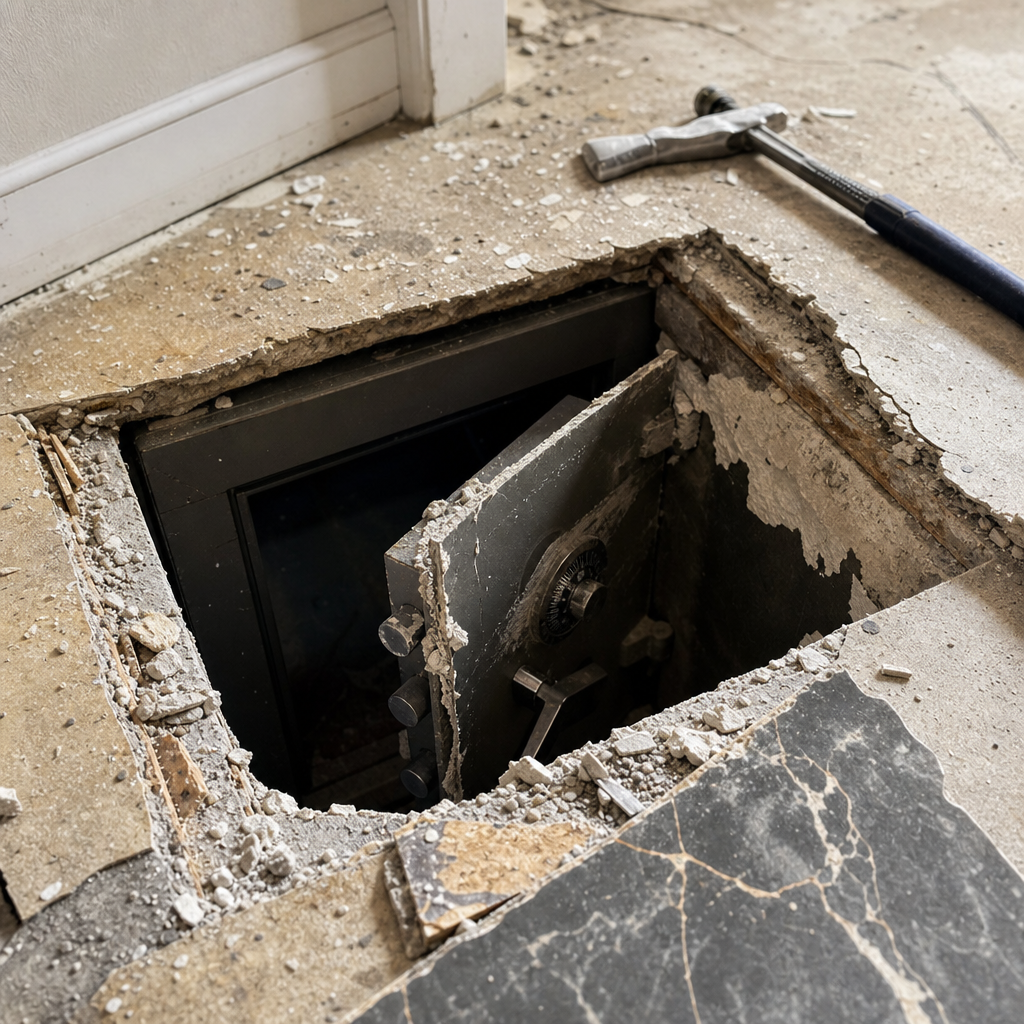
Floor safes are often sold with an aura of invincibility, but the belief that they are impossible to break into is one of the most persistent and dangerous myths in physical security. In real installations, every safe is a delay device, not an impenetrable box, and that distinction matters even more when firearms, ammunition, cash, legal documents, and controlled valuables are involved. A floor safe can be a smart part of a broader protection plan, yet it should never be treated as absolute protection against burglary, fire, moisture, or unauthorized access.
Within the broader conversation about gun safes and safety, myths create bad decisions. I have seen owners choose a floor safe because they believed concealment alone would defeat criminals, then ignore anchoring, lock quality, humidity control, and response time. I have also seen people dismiss all floor safes after hearing about one cheap unit pried open in minutes. Both reactions miss the point. Security is about resistance, layers, detection, and realistic risk assessment. Understanding where floor safes excel, where they fail, and how they compare with other gun safe options helps owners protect firearms responsibly and store them in ways that reduce theft, misuse, and liability.
A floor safe is a recessed safe installed below floor level, usually into concrete, so the door sits flush or nearly flush with the finished floor. That placement gives it two practical advantages: concealment and support from surrounding material. However, those advantages do not erase vulnerabilities. The door, lock, relocker, boltwork, body steel, and installation quality still determine how well the unit resists prying, punching, drilling, cutting, and lock manipulation. For gun owners, the issue is especially important because many floor safes are designed for documents, jewelry, or cash, not long-gun storage, rapid defensive access, or child-resistant firearm organization.
This article serves as a hub for the larger topic of gun safe myths and misconceptions. The central myth is that floor safes cannot be broken into, but several related myths branch from it: that heavier always means safer, that all fire ratings are equivalent, that digital locks are less secure than mechanical locks, that hidden safes do not need alarms, that any safe can store guns safely, and that safe ownership alone satisfies responsible firearm storage. Each misconception can lead to preventable mistakes. The goal here is to replace marketing language and forum folklore with practical standards, real attack methods, and grounded guidance you can use when evaluating storage for handguns, documents, and other valuables.
Why the “Impossible to Break Into” Claim Fails
No commercially available floor safe is impossible to break into. That statement is not alarmist; it is simply how burglary protection is measured. Industry testing focuses on resistance time, attack types, and tool categories, not magical immunity. Underwriters Laboratories burglary classifications, such as TL-15 and TL-30, exist because determined attackers with tools can defeat safes given enough opportunity. Many residential floor safes are not even in that class. Some are basic B-rate or unclassified units with steel bodies and doors that deter smash-and-grab theft but are not built to withstand professional attack for long periods.
The reason the myth survives is simple. Most burglars are opportunists. If a floor safe is concealed well, anchored properly in concrete, and found late in the intrusion, it may survive because the thief runs out of time, not because the safe is undefeatable. In incident reviews, time on site is often the deciding factor. According to FBI burglary patterns discussed in security industry training, many residential break-ins are brief, with offenders targeting visible, portable valuables first. A hidden floor safe exploits that behavior effectively. But if a burglar knows the safe is there, arrives with tools, and works without interruption, the safe’s true construction quality becomes the deciding factor.
Attack methods are straightforward. A burglar may pry at the door gap, punch or drill the lock area, attack the hinges if the design exposes weakness, grind the door, chip surrounding concrete, or use leverage against an improperly installed frame. Electronic locks may be attacked through the keypad area or by brute force against the boltwork if the unit is cheaply built. Mechanical dial locks resist some electronic failure points, but poor lock placement and thin steel can still make the container vulnerable. In short, concealment buys time; steel, lock engineering, and installation determine how much time.
How Floor Safes Actually Protect Firearms and Valuables
Floor safes provide value through layered security, not invulnerability. Their main strength is concealment. A safe under carpet, beneath furniture, inside a closet, or under a removable cover is less likely to be discovered quickly than a freestanding cabinet in a garage. The second strength is anchoring. When embedded in concrete, a floor safe is much harder to carry away than a light gun cabinet or poorly bolted residential safe. This matters because many gun thefts happen when criminals remove the entire container and open it elsewhere using more time and heavier tools.
For handgun owners, a floor safe can work well for secondary storage of unloaded firearms, magazines, and paperwork, especially where a larger upright gun safe is impractical. It can also be effective for storing serialized components, suppressor tax documents, or backup valuables. However, most floor safes are poor choices for long guns because of depth, orientation, and access speed. Even for handguns, internal organization matters. A loose handgun sitting beside metal objects can suffer finish wear, and poor humidity control can promote corrosion. In below-grade or slab environments, moisture risk is real and often underestimated.
Another practical consideration is access under stress. In homes where a firearm is staged for lawful defensive use, a floor safe is usually slower than a bedside handgun safe with a quality simplex, biometric, or fast electronic lock. Bending down, clearing a rug, opening a cover, and retrieving a pistol from a recessed compartment is not ideal in an emergency. Responsible gun storage balances unauthorized access prevention with legitimate access needs. That is why many experienced owners use more than one container: a heavier main safe for bulk storage and a quick-access safe for a defensive handgun.
Common Gun Safe Myths That Connect to Floor Safe Buying Decisions
The floor safe myth rarely stands alone. It is usually supported by other misconceptions that skew buying decisions across the entire gun safe category. The table below summarizes the most common myths and the reality behind them.
| Myth | Reality | Why It Matters for Floor Safes |
|---|---|---|
| Heavier always means more secure | Weight can indicate thicker steel or fire lining, but design, lock quality, relockers, and anchoring matter just as much. | A compact floor safe may outperform a heavier but poorly built portable container if installation is superior. |
| Hidden safes do not need alarms | Concealment reduces discovery odds but does not replace intrusion detection or camera coverage. | If a burglar has uninterrupted time, even a good floor safe can be attacked methodically. |
| All fire ratings mean the same thing | Manufacturer ratings vary widely; independent testing standards are more meaningful. | Many floor safes have limited fire performance, especially at the door seal and in direct heat. |
| Digital locks are inherently insecure | Quality electronic locks from trusted brands can be reliable and secure; cheap imports often are not. | Lock quality matters more than lock type when paired with strong boltwork and proper use. |
| Any safe can store guns safely | Gun storage requires attention to size, orientation, corrosion control, unauthorized access, and retrieval needs. | A document-oriented floor safe may not be suitable for firearm storage without careful planning. |
| Buying a safe solves responsible storage | Safe ownership is only one part of security, along with placement, maintenance, training, and key or code control. | A floor safe installed badly or used carelessly can create false confidence rather than real protection. |
These myths matter because they influence product choice, installation budgets, and daily habits. I regularly advise owners to stop thinking in absolutes and start thinking in layers: deterrence, delay, detection, and response. A concealed floor safe delays and sometimes deters. An alarm system and cameras improve detection. Reinforced doors, lighting, dogs, and neighborhood awareness shape response time. When people understand that framework, they make better storage decisions and stop expecting any single safe to do every job.
Real Weak Points: Installation, Moisture, Fire, and Human Error
The most important weakness in many floor safe setups is not the safe body itself but the installation. A floor safe performs best when properly embedded in sound concrete with the correct depth, leveling, and surrounding support. Retrofits into weak slabs, wood subfloors, or poorly reinforced openings can create pry points and structural weakness. If installers leave gaps, use inadequate grout, or fail to account for door clearance and flooring thickness, the unit can become easier to attack and harder to use. Professional installation is not optional on high-value setups; it is part of the safe’s security rating in practical terms.
Moisture is another common problem. Because floor safes sit low and often contact concrete, they are vulnerable to condensation, minor water intrusion, and ambient humidity swings. Firearms stored in them should be protected with desiccant, vapor corrosion inhibitors, or dehumidifying solutions appropriate to the compartment size. Stainless steel handguns are not immune to corrosion, and blued finishes can deteriorate quickly in damp conditions. Important documents should be placed in sealed pouches or secondary containers. In basements or slab-on-grade homes in humid climates, neglecting moisture control can damage the very items the safe was meant to protect.
Fire performance is frequently misunderstood. Concrete can provide some thermal mass, and being below floor level can help in certain fire scenarios, but many floor safes are not true fire safes. Heat transfer through the door is a common failure point, especially if intumescent seals and tested insulation are absent. Water from firefighting can also penetrate after the event. If the goal is protection of paper records, digital media, or NFA paperwork, look for independently tested fire ratings and understand the difference between paper, data, and media survival thresholds. Firearm owners should also remember that ammunition and lubricants react differently under high heat, so a vague “fireproof” label is not enough.
Finally, human error defeats expensive hardware every day. Default codes, shared combinations, keys hidden nearby, open doors during routine access, and social media posts showing safe locations all undermine security. Children and guests observe more than owners think. Contractors notice floor modifications. Burglars learn routines. Good safe use includes code hygiene, discreet placement, controlled access, and periodic inspection of locks, bolts, and seals.
What to Look for in a Floor Safe for Gun-Related Storage
If you are evaluating a floor safe as part of a gun safety plan, start with use case. For defensive access, choose a dedicated quick-access handgun safe in the bedroom and treat the floor safe as secondary storage. For theft resistance, prioritize solid steel door construction, recessed door design, hardplate protection over the lock, relockers, and a reputable lock from brands commonly specified in commercial security, such as Sargent and Greenleaf, La Gard, or AMSEC-equipped systems. Avoid thin imported boxes marketed with dramatic language but little technical detail.
Next, verify dimensions and interior layout. Many owners buy a floor safe assuming it will fit a pistol, spare magazines, passports, suppressor paperwork, and cash, then discover awkward access or poor organization. Use padded trays, magazine separators, and rust-prevention materials. If the compartment is deep, plan retrieval so a handgun is not buried beneath unrelated items. For households with children, ensure the opening method is consistent and secure, and rehearse access procedures without exposing the combination.
Finally, view the floor safe as one node in a complete storage strategy. A monitored alarm, visible exterior security, documented serial numbers, insurance riders, and compliance with local firearm storage laws matter as much as the safe itself. If you want better decisions across this subtopic, continue into related guides on fire ratings, lock types, safe placement, child access prevention, humidity control, and the difference between true safes and residential security containers. The main takeaway is simple: floor safes are useful, but they are not impossible to break into. Choose them for concealment and anchoring advantages, install them correctly, and build your firearm storage plan in layers. Review your setup today and fix the weak point before someone else finds it.
Frequently Asked Questions
Are floor safes really impossible to break into?
No. That is the core myth, and it is a dangerous one. A floor safe is not an impenetrable container; it is a delay device designed to slow down unauthorized access and make theft more difficult, noisy, and time-consuming. That distinction matters because many buyers assume that once a safe is installed in concrete, their valuables are automatically beyond reach. In reality, a determined intruder with enough time, tools, and privacy can attack almost any safe. The real security value of a floor safe comes from layering: concealment, strong installation, quality construction, controlled access, alarms, surveillance, and realistic expectations about response time. If a homeowner stores firearms, ammunition, cash, legal records, or other sensitive property in a floor safe, the goal should be to reduce risk significantly, not to assume the safe cannot be breached under any circumstances.
Why do so many people believe floor safes are more secure than other types of safes?
Floor safes often benefit from perception as much as from engineering. Because they are embedded in the floor, hidden under rugs or furniture, and physically anchored into surrounding material, they appear more permanent and more resistant than freestanding containers. That can make them an excellent option in the right setting, but it can also create overconfidence. Marketing language sometimes reinforces this by emphasizing words like “buried,” “concealed,” or “tamper-resistant,” which are true in a limited sense but easy to misinterpret as “unbreakable.” People also tend to confuse concealment with invulnerability. A hidden safe is harder to find, but once it is found, it still becomes a target that can be attacked through its lock, door, frame, body, or surrounding installation. A well-installed floor safe can be a very strong part of a physical security plan, but its effectiveness depends on burglary resistance, site conditions, and how much time an attacker has to work without interruption.
What are the most common ways floor safes are actually compromised?
Floor safes are usually compromised through practical weaknesses rather than dramatic movie-style cracking. In some cases, the problem is poor installation: insufficient concrete support, weak surrounding material, bad placement, or exposure that gives an intruder room to work. In other cases, the lock is the target, especially if it is low quality, poorly maintained, or vulnerable to manipulation or forced attack. Some breaches involve prying, drilling, cutting, or attacking the door and frame interface. Others are far simpler, such as unauthorized users knowing the combination, keys being copied, codes being shared, or the safe being left unsecured due to convenience. Environmental issues can also matter. Floor safes may be exposed to moisture, dust, and corrosion, which can degrade components over time if the unit is not appropriate for the location. The biggest lesson is that a safe is only as strong as its design, installation, access control, and the environment around it. Weaknesses usually emerge at the margins, not just in the steel itself.
Are floor safes a good choice for storing firearms, cash, and important documents?
They can be, but only if the choice matches the item being protected and the risks involved. For cash, jewelry, legal documents, backup media, and compact valuables, a quality floor safe may offer useful concealment and burglary resistance. For firearms, the conversation is more nuanced. A floor safe may work for a handgun or small controlled item, but owners should think carefully about access speed, legal responsibilities, child safety, unauthorized handling, and moisture control. Firearms and ammunition create a higher-stakes security scenario because the consequences of theft or misuse can extend far beyond property loss. Important documents present another concern: many floor safes are not automatically fireproof or waterproof in the way buyers assume, especially in flood-prone areas or slab environments where water intrusion is possible. The safest approach is to evaluate the safe’s burglary rating, environmental protection, lock type, internal capacity, and suitability for the specific contents rather than relying on the generic label “floor safe.”
How should homeowners think about floor safes as part of a real security plan?
Homeowners should view a floor safe as one layer in a broader protection strategy, not as a standalone answer. Start by identifying what is being protected, who needs access, and what the likely threats are: smash-and-grab burglary, targeted theft, insider access, fire, water damage, or accidental discovery. Then choose a safe with credible construction and a lock system appropriate for the risk level. Placement matters too. A floor safe should be installed where it is difficult to discover, difficult to work on, and difficult to access without creating noise or attracting attention. Beyond the safe itself, strong security includes intrusion alarms, cameras, exterior lighting, controlled key or code management, and habits that prevent predictable routines from exposing the location. If highly sensitive items such as firearms, controlled valuables, or critical records are involved, professional guidance is often worth it. The smartest mindset is not “This safe cannot be broken into,” but “This safe increases the time, effort, and risk for an intruder while buying me the protection that other security layers reinforce.”