
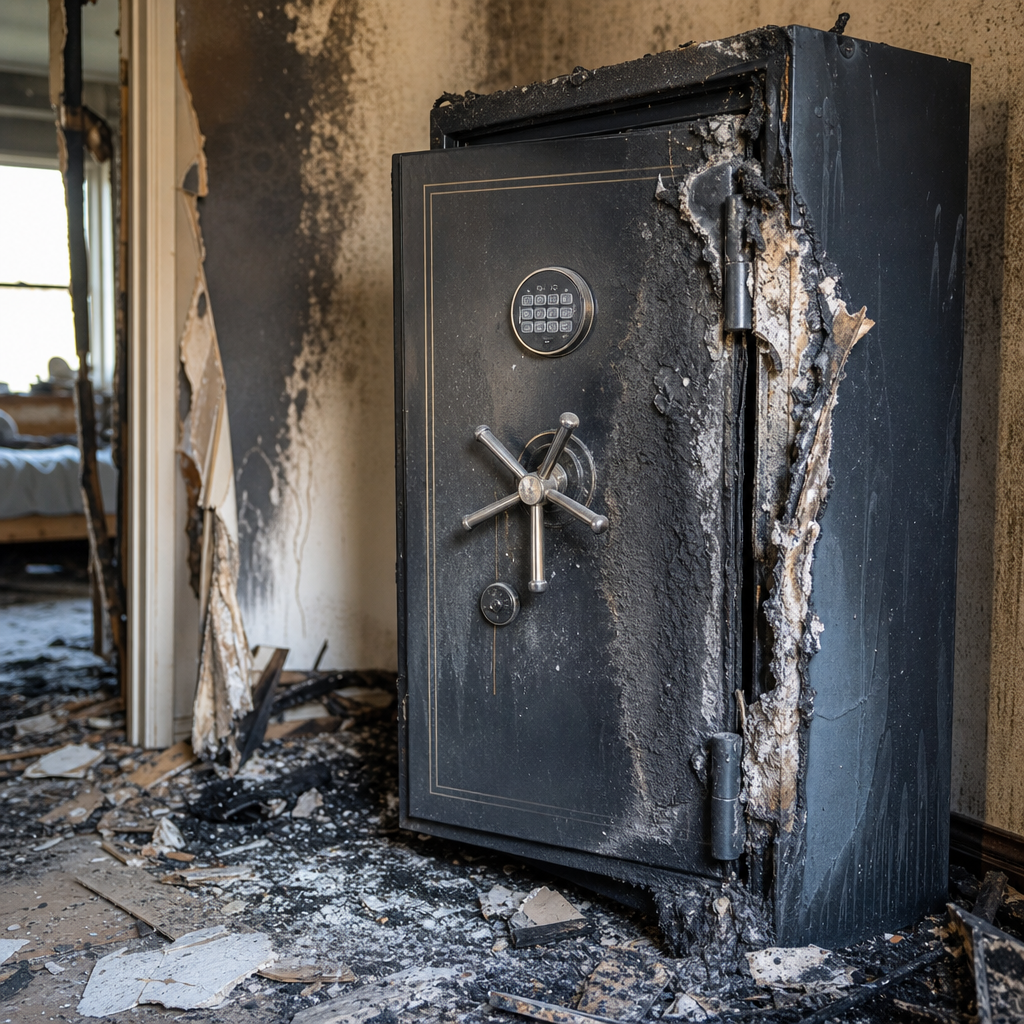
A house fire can absolutely destroy a gun safe’s locking mechanism, but the real answer depends on fire temperature, burn duration, lock type, seal failure, and how well the safe was engineered in the first place. In the field, I have seen safes that looked solid from the outside yet opened to reveal warped boltwork, failed electronic keypads, and dial locks jammed by heat damage. I have also seen better-built safes survive enough to keep the door shut and protect part of the contents. That contrast explains why this question matters for anyone researching gun safes and safety, especially under the wider topic of gun safe myths and misconceptions.
A gun safe locking mechanism is the system that actually keeps the door secured. It includes the lock itself, relockers, hardplate, spindle, handle assembly, linkages, locking bolts, and internal boltwork. In a fire, damage may come from direct heat, conductive heat through steel, expanding and contracting metal, smoke residue, moisture from firefighting, or impact if the structure collapses. Fire resistance ratings, meanwhile, usually refer to internal temperature performance for a stated time, not a guarantee that every mechanical or electronic component will remain usable after the event.
Many buyers assume a “fireproof gun safe” means total survival. That term is one of the most persistent myths in this category. Most residential security containers and many entry-level gun safes are better described as fire resistant for limited conditions. Ratings may be based on manufacturer testing rather than an independent laboratory such as UL, and test methods vary widely. A safe advertised at 1,200 degrees Fahrenheit for 60 minutes may have performed under a controlled furnace curve, but a real house fire can create uneven exposure, rapid spikes, prolonged smoldering, and debris loads the test never reproduced.
This hub article addresses the core question directly while also correcting the misconceptions that surround it: whether thicker steel automatically means better fire protection, whether electronic locks always fail first, whether a locked safe will inevitably seal out heat and smoke, and whether surviving the fire means the safe is still trustworthy afterward. Understanding these points helps you choose a safe more intelligently, place it better in the home, and know what to inspect after an incident. The most important takeaway is simple: fire can ruin a gun safe lock, and your purchase decision should assume that possibility rather than ignore it.
How Fire Damages a Gun Safe Locking Mechanism
Heat affects a safe in layers. Exterior steel absorbs thermal energy first, then conducts it inward. If the fire lasts long enough, internal temperatures rise to levels that damage lubricants, springs, polymers, wire insulation, circuit boards, and precisely machined tolerances. On mechanical locks, prolonged heat can bake out grease, warp small components, and leave soot or corrosion that later binds the movement. On electronic locks, membrane keypads, battery contacts, solenoids, and control boards are especially vulnerable. Even when the lock technically survives, the boltwork linked to it may no longer travel correctly because the door and frame shifted.
Another overlooked issue is differential expansion. Steel, brass, cast parts, and fasteners do not all react to heat the same way. In one post-fire inspection I assisted with, the keypad was dead, but the larger problem was that the door edge had distorted just enough to preload the bolts. Even after drilling and bypassing the lock, opening the door required controlled force because the body had twisted during the burn and cooldown. This is why answering “can fire destroy the lock?” requires looking beyond the keypad or dial and treating the locking mechanism as a complete assembly.
Moisture makes matters worse. Fire suppression introduces water, steam, and dissolved contaminants. Once the safe cools, that moisture condenses on internal metal surfaces. If the gypsum or composite fire lining was breached, corrosive residue may settle into the lock cavity and relockers. A lock that worked on the day of the fire may seize days later. That delayed failure surprises owners, but it is common enough that any safe exposed to significant heat and suppression should be treated as compromised until inspected by a qualified safe technician.
Mechanical Locks vs Electronic Locks in a Fire
The common myth is that mechanical dial locks are fireproof while electronic locks are disposable. The reality is narrower. A quality mechanical lock generally tolerates heat better than a consumer-grade electronic lock because it has fewer heat-sensitive electronic parts. However, it still depends on springs, wheel packs, fences, spindles, and lubrication that can be affected by thermal stress and contamination. If enough heat reaches the lock case or the door warps, a mechanical lock can fail closed just as effectively as an electronic one.
Electronic locks usually lose function sooner because batteries, screens, keypads, and boards are inherently vulnerable. Some better units from brands such as Sargent and Greenleaf, SecuRam, and La Gard are robust in normal service, but they are not designed to operate after intense structural fire exposure. Their benefit is convenience, audit features, and fast entry, not post-fire survivability. If your priority is maximizing the odds of opening the safe after a moderate fire, a proven mechanical lock still has an edge, but that edge is not immunity.
There is also a false belief that an electronic lock failure means contents are lost forever. In practice, experienced safe technicians can often open damaged safes using drilling patterns, scoping, manipulation alternatives, or manufacturer procedures. The problem is cost and time. Post-fire openings are frequently more complex because identifying the original fault is harder when both lock and boltwork may be damaged. For owners, the practical lesson is not that one lock type is perfect, but that lock selection should match risk tolerance, access needs, and the quality of the safe surrounding it.
What Fire Ratings Really Mean and What They Do Not
Fire ratings are among the most misunderstood claims in the gun safe market. A stated rating usually means the manufacturer believes the safe can keep interior temperatures below a target threshold for a specified period in a test. For paper documents, 350 degrees Fahrenheit is a common benchmark because paper chars around that range. Firearms, optics, ammunition, plastics, wood stocks, and electronics have different heat tolerances, so a rating aimed at documents does not automatically mean ideal protection for gun-related contents.
Independent testing matters because methods vary. UL 72 is a recognized fire test standard for record protection, but many gun safes are not tested to that standard. Some manufacturers use in-house furnace tests with proprietary criteria. That does not automatically make the rating useless, but it does mean buyers should ask specific questions: What was the furnace temperature curve? Was there a hose-stream test? Was the safe preheated? How many sides were exposed? Was the rating for the whole safe model or extrapolated from another design? Those details separate engineering from marketing.
Another misconception is that a longer rating always means a safer lock. Fire rating and lock survivability overlap, but they are not the same. A safe may maintain acceptable interior temperature for a period while the outer door skin and lock area still suffer enough damage to impair operation. Conversely, a lock may remain operable after a short fire while the contents are damaged by humidity or temperature. The best way to read a fire rating is as one input in a broader decision that includes steel thickness, door construction, seal design, boltwork quality, and verified burglary resistance.
Common Gun Safe Myths and the Reality Behind Them
Because this page serves as a hub for gun safe myths and misconceptions, it helps to state the biggest myths plainly. First, no consumer gun safe should be treated as literally fireproof. Second, heavier does not always mean better; added weight may come from fireboard rather than thicker steel. Third, a glowing online review does not replace independent testing or a serious lock pedigree. Fourth, placing a safe in the garage is not automatically smart; garages can intensify heat, expose the safe to water runoff, and invite theft if the door is open. Fifth, a surviving exterior finish does not prove the lock or contents are undamaged.
Another myth is that all gun safes use the same locking mechanism with different branding. In reality, lock quality, boltwork layout, relocker count, hardplate design, and door fit vary dramatically between big-box imports and higher-end American-made models. Some lower-cost safes use thinner bodies, lighter hinge-side protection, and simpler linkages that are more vulnerable to distortion under heat. Better safes typically show tighter manufacturing tolerances, more substantial bolt carriages, and thoughtfully placed relockers intended to engage if the lock area is attacked or catastrophically disturbed.
Finally, many owners think insurance makes safe quality less important. Insurance is essential, but it does not restore family documents, irreplaceable firearms, inherited accessories, or serialized records without friction. Claims after fires can involve proof-of-ownership gaps, depreciation, policy sublimits, and delays. A safe is not a substitute for insurance, and insurance is not a substitute for choosing a safe that can realistically protect contents long enough for firefighters to intervene.
How to Evaluate a Safe for Fire and Lock Protection
The best evaluation starts with plain questions and documented answers. Ask who made the lock, whether the fire rating was independently verified, what material forms the fire barrier, how the door seals are arranged, and whether replacement lock service is straightforward. Look for continuous welds, substantial door reinforcements, hardplate protecting the lock area, and an established service network. If a manufacturer cannot explain its rating method or avoids naming the lock brand, that is useful information.
| Feature | What to Look For | Why It Matters in a Fire |
|---|---|---|
| Lock type | UL-listed mechanical or reputable electronic lock | Higher build quality improves reliability and serviceability |
| Fire rating source | Independent testing or transparent manufacturer protocol | Reduces reliance on vague marketing claims |
| Door construction | Reinforced door, robust bolt carriage, hardplate | Helps prevent distortion from disabling the mechanism |
| Seal system | Expandable heat seals around the door perimeter | Limits smoke and heat intrusion during early fire stages |
| Body steel | Clearly stated gauge or thickness | Improves rigidity and reduces warping risk |
| Placement support | Anchoring guidance and installation recommendations | Better location can reduce heat exposure and structural impact |
Placement matters more than many people realize. A safe against an exterior wall on a concrete slab often fares better than one above a basement, under a room with high fuel load, or in a garage packed with solvents and vehicles. Anchoring is still important because collapse, hose impact, and post-fire theft are real concerns. If the safe includes humidity control, understand that dehumidifier rods, power cords, and interior outlets may become failure points in severe heat. Good setup balances theft resistance, fire exposure, and practical access.
What to Do After a House Fire Involving a Gun Safe
Do not rush to force the safe open. Document the condition first with photos of the room, the safe exterior, the lock face, and any visible warping. Notify your insurer, and if firearms are inside, follow local legal requirements and carrier guidance for handling damaged guns. A post-fire safe can contain hot spots, sharp distorted metal, and moisture-driven corrosion already beginning inside. If ammunition cooked off, fragments may also be present. Safety comes first.
Next, contact the safe manufacturer and a qualified safe technician, ideally one experienced with fire openings rather than general locksmith work alone. Provide model details, lock type, photos, and a timeline of the incident. Manufacturers may have drill templates or relocker information that speeds nondestructive or minimally destructive entry. In my experience, early communication can save hours of exploratory work and reduce unnecessary damage to the door.
Once opened, assume the lock and boltwork need full inspection or replacement. Firearms should be evaluated by a competent gunsmith before use because heat can affect temper, optics, finishes, adhesives, polymers, and ammunition. Important papers should be separated and dried using archival best practices if salvageable. The safe itself may not be worth reusing even if it opens. Hidden warping, compromised insulation, and corrosion can leave it weaker and less reliable than it appears.
Buying Guidance for a Gun Safe Myths and Misconceptions Hub
If you are using this article as your starting point within gun safe myths and misconceptions, focus on evidence over slogans. Compare rated temperature and duration claims, lock brands, steel thickness, service support, and independent reviews from technicians who actually open and repair safes. Prioritize a safe that is honestly described over one that makes dramatic promises. In most homes, the best choice is a balanced unit with credible fire resistance, a proven lock, practical interior layout, and installation in a lower-risk location.
Also think in layers. Store records separately, maintain an updated firearm inventory with serial numbers, photograph valuables, and review policy sublimits with your insurer. If a specific firearm has high sentimental or collector value, consider whether a true burglary-rated or record-protection safe is more appropriate than a typical residential gun safe. The right answer depends on budget, risk, and what loss would actually mean to you.
A house fire can destroy a gun safe’s locking mechanism, and anyone buying a safe should plan around that fact rather than assume marketing language will overcome physics. Heat, smoke, water, and structural distortion can disable mechanical and electronic locks alike, with electronic systems usually failing sooner but mechanical systems far from invulnerable. Fire ratings help, yet they must be interpreted carefully and verified wherever possible. The safest path is to choose a well-built safe, install it intelligently, document your contents, and line up professional support before you ever need it. Use this hub as your baseline, then keep digging into the specific myths that influence how safes are bought, placed, and trusted.
Frequently Asked Questions
Can a house fire really destroy a gun safe’s locking mechanism?
Yes, absolutely. A house fire can destroy or seriously compromise a gun safe’s locking mechanism, and it happens more often than many owners expect. The important thing to understand is that the lock is not judged only by whether the safe still “looks okay” from the outside. Heat can damage the critical internal components long before the exterior shell visibly fails. In real fire conditions, temperatures can rise high enough to warp internal boltwork, deform small moving parts, weaken springs, ruin relockers, melt electronic components, and cause keypads or wiring harnesses to fail completely.
The extent of the damage depends on several factors working together: how hot the fire got, how long the safe was exposed, whether flames were direct or indirect, and how well the safe was built. A lower-grade safe may lose lock function even if the body remains standing, while a better-designed safe may keep the door shut but still suffer enough internal damage that opening it later requires a technician. That is why after a fire, a safe should never be assumed to be fully functional just because the door is still closed. In many cases, the locking mechanism may be partially destroyed, jammed, or dangerously unstable even if the safe appears intact.
Are electronic locks more likely to fail in a fire than mechanical dial locks?
In general, yes. Electronic locks are usually more vulnerable to fire damage than traditional mechanical dial locks because they rely on circuit boards, membranes, wiring, batteries, solder joints, and plastic components that do not tolerate extreme heat well. Even before direct flame reaches the lock, intense heat can deform the keypad, melt insulation, damage the solenoid or motor, and cause total electronic failure. If the safe’s heat seals fail and hot gases penetrate the door area, the odds of keypad and lock failure increase significantly.
That said, mechanical dial locks are not fireproof either. A mechanical lock can jam when lubricants burn off, tiny internal parts expand or distort, or the dial spindle and internal fence components become misaligned from heat. I have seen dial locks survive where electronic locks did not, but I have also seen dial systems become unusable because the boltwork behind them warped or the lock body itself was damaged. So while a mechanical dial generally offers better resilience under heat, neither lock type is immune. The stronger conclusion is that lock survival depends not just on whether it is electronic or mechanical, but on the total quality of the safe, the door construction, insulation, fire seals, and how long the safe sat in severe fire conditions.
If the outside of the safe still looks solid after a fire, does that mean the lock still works?
No, and this is one of the most common misconceptions after a structure fire. A gun safe can look surprisingly normal on the outside while the inside of the door has suffered major damage. Exterior steel can conceal internal problems such as heat-distorted linkage, expanded or seized boltwork, failed relocking devices, moisture damage from fire suppression, and lock components that have become brittle, corroded, or fused in place. A keypad may light up and still not actuate the lock, or a dial may turn without properly engaging the mechanism behind the door panel.
Another issue is that house fires often involve both heat and rapid cooling from firefighting efforts. That combination can create thermal shock, which stresses parts in ways that are not immediately visible. Add in smoke, soot, steam, and corrosive residues, and a safe that appears structurally sound can still have a severely compromised locking assembly. The practical takeaway is simple: visual appearance alone is not a reliable indicator. After a fire, the safe should be treated as potentially damaged until it is professionally assessed. Forcing the lock or repeatedly trying to open it can sometimes worsen the problem, especially if internal parts are already warped or partially collapsed.
What factors determine whether a gun safe’s locking mechanism survives a house fire?
Five factors matter most: fire temperature, burn duration, lock type, seal failure, and overall engineering quality. Temperature is the obvious one. The hotter the environment, the greater the chance that internal lock parts, linkages, and bolt systems will deform or fail. Duration is just as important. A safe that experiences extreme heat for a short period may fare much better than one exposed to sustained heat for an hour or more. Prolonged exposure gives heat time to soak through the door and reach the lock body, hardplate area, and internal boltwork.
Lock type also matters because electronic systems usually have more heat-sensitive components than mechanical locks. Seal performance is another major factor. Many fire-rated safes rely on expanding door seals to slow heat and smoke intrusion. If those seals fail, or if the safe was poorly fitted to begin with, heat and combustion gases can enter the door gap and attack the locking mechanism directly. Finally, engineering quality often makes the biggest real-world difference. Better safes tend to have thicker steel, more robust bolt systems, superior internal protection around the lock, and more credible fire design. Lower-end models may advertise a fire rating yet still have vulnerable lock cavities, thin doors, and construction shortcuts that allow the mechanism to fail early. In other words, survival is not about one feature alone. It is the combination of design, materials, and the actual fire conditions that decides the outcome.
What should you do if your gun safe has been through a house fire and the lock will not open?
Start by assuming the safe and its locking mechanism have been compromised, even if you are not sure how badly. Do not drill, pry, strike, or aggressively manipulate the lock unless you are trained to do that kind of work. Post-fire safes can be unstable internally, and forcing the issue can damage contents, trigger additional relockers, or turn a recoverable opening into a much more destructive one. If the safe contains firearms, documents, or valuables, preserving what remains should be the priority.
The best next step is to contact a qualified safe technician or locksmith with actual safe-opening experience, ideally someone familiar with fire-damaged gun safes. They can evaluate whether the failure is likely in the keypad, lock body, boltwork, door frame, or internal relocking system and choose the least destructive entry method. You should also document the condition of the safe with photos for insurance purposes before any work begins. If the safe eventually opens, do not assume it is serviceable afterward. Fire, smoke, and suppression water can leave hidden corrosion and structural weakness behind, so the lock and safe may need major repair or replacement. In many cases, the real question after a house fire is not just whether the safe can be opened, but whether it can ever be trusted again.