
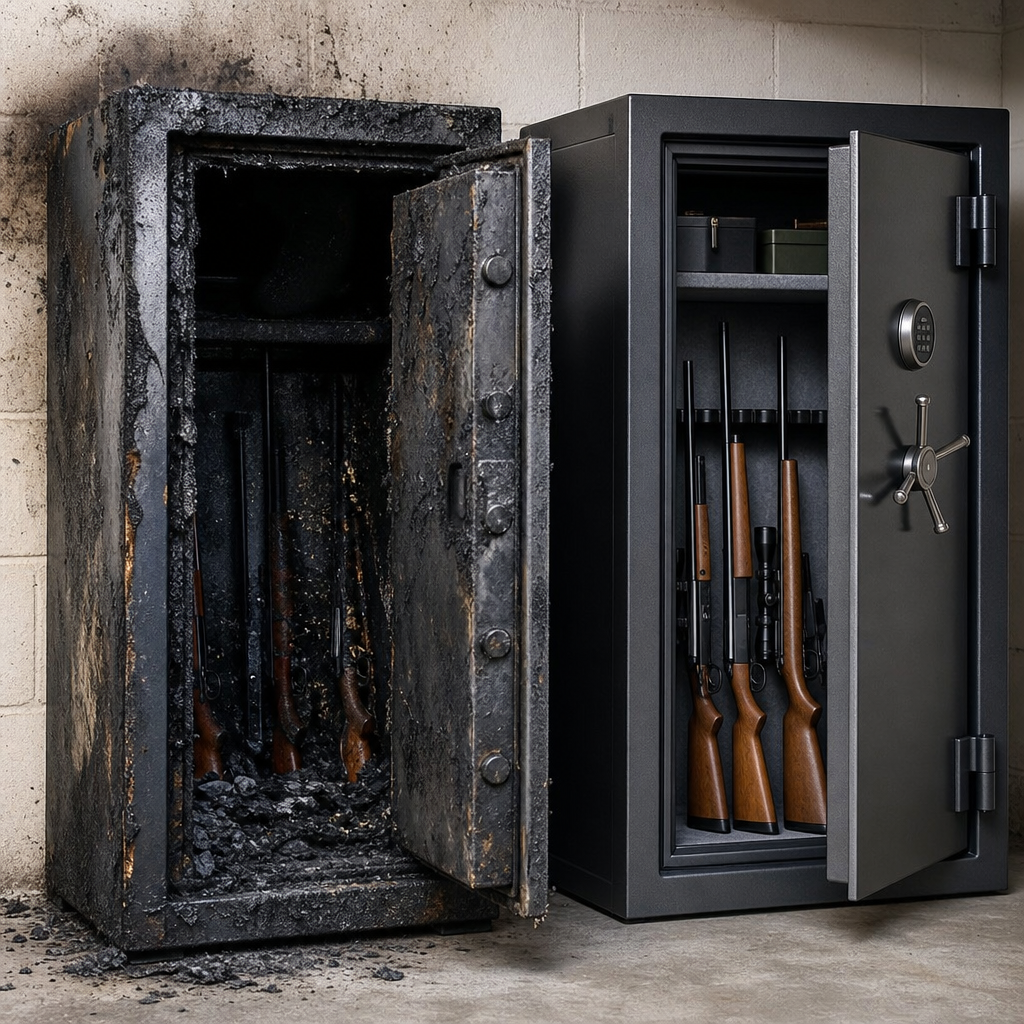
Choosing between a fireproof vs. fire-resistant gun safe starts with one critical fact: no gun safe is truly fireproof in the absolute sense. In the gun storage industry, “fireproof” is usually marketing shorthand for a safe that can withstand heat for a stated period under specific test conditions, while “fire-resistant” is the more technically accurate term. That distinction matters because firearm owners often assume a safe will survive any house fire, wildfire, flood, or structural collapse without damage. In practice, performance depends on temperature, duration, seal quality, wall construction, insulation type, and where the safe is installed.
I have reviewed safes in showrooms, compared manufacturer test sheets, and helped buyers replace units after real fire losses, and the pattern is consistent: most purchasing mistakes happen because shoppers focus on a bold minute rating on the door tag instead of understanding how that rating was earned. A 30-minute rating at 1,200 degrees Fahrenheit is not equivalent to a 90-minute rating under an independent UL test, and neither says much about what happens if the safe sits in a garage during a fast-moving wildfire and then gets drenched by thousands of gallons of suppression water.
For firearm owners, the issue goes beyond protecting a metal object from flame. Stocks, optics, documents, ammunition packaging, suppressor paperwork, and electronic accessories are all vulnerable to heat, smoke, humidity, and water intrusion. Even if the receiver and barrel survive, finishes can fail, optics can delaminate, wood can char, and corrosion can begin within hours after a fire event. That is why disaster-resistant storage should be evaluated as a system, not just a box with a lock.
This hub explains the real difference between fireproof and fire-resistant gun safes, how fire ratings work, what materials and certifications matter, and how to choose storage for broader hazards such as water, smoke, and impact. If you are comparing models, planning a gun room, or building a layered emergency protection strategy, this guide gives you the plain-language framework to make a defensible decision.
What “Fireproof” and “Fire-Resistant” Actually Mean
The simplest answer is this: “fireproof” suggests complete immunity to fire, while “fire-resistant” means the safe delays heat transfer long enough to protect contents under defined conditions. In engineering and testing language, resistance is measurable; proof is absolute. Because no consumer gun safe can guarantee survival in every fire scenario, fire-resistant is the better term.
Manufacturers still use “fireproof gun safe” because it matches how people search. The problem is that the word can blur important differences between tested performance and advertising language. A safe may use gypsum board, ceramic wool, or proprietary composite insulation to slow heat penetration, but every insulation system has a failure point. Once interior temperatures rise above thresholds for paper, polymers, adhesives, wood finishes, or electronics, damage begins even if flames never enter the safe.
Real-world examples make the distinction clear. A safe exposed to a brief kitchen fire on the opposite side of a wall may emerge with contents intact. The same safe in a flashover event, where room temperatures can exceed 1,100 degrees Fahrenheit and remain elevated, may suffer interior heat soak long after visible flames are controlled. Steel itself conducts heat, so door edges, bolt openings, and thinner walls become weak points. That is why reputable brands specify both temperature and time, not just one or the other.
For practical shopping purposes, treat any “fireproof” claim as a prompt to ask better questions: Who performed the test? At what temperature? For how long? What was the maximum internal temperature? Was the whole safe tested or only a similar body design? Clear answers separate credible protection from decorative labeling.
How Fire Ratings for Gun Safes Work
A fire rating states how long a safe is expected to resist heat at a given external temperature while keeping the interior below a target threshold. For paper documents, the common benchmark is 350 degrees Fahrenheit because paper chars around 405 degrees. Firearm storage is more complicated. Guns can tolerate higher temperatures than paper, but optics, lubricants, polymer frames, wood stocks, and adhesive-mounted components often cannot. If you store tax stamps, deeds, passports, or cash in the same safe, document standards become highly relevant.
Independent testing carries more weight than in-house testing. UL 72 is one of the best-known fire endurance standards for record protection, with classes such as 350, 150, and 125 tied to interior temperature limits for paper, magnetic media, and digital media. Most residential gun safes do not carry full UL 72 record-protection certification because that level of construction is expensive and heavy. Instead, many brands use manufacturer-designed furnace tests, sometimes with useful data and sometimes with very little detail.
Look closely at the test methodology. Was the safe heated in a controlled furnace or only with exterior torch application? Was there a cool-down period inside the furnace, which matters because heat continues to migrate inward after flames stop? Was the door sealed with an expanding intumescent gasket? Were thermocouples placed inside the safe to verify internal temperatures? Without these details, minute ratings are hard to compare.
| Claim Type | What It Usually Means | What to Verify |
|---|---|---|
| 30 minutes at 1,200°F | Entry-level resistance under manufacturer test conditions | Internal temp reached, insulation thickness, gasket type |
| 60 minutes at 1,400°F | Mid-tier residential fire protection | Independent lab involvement, cool-down protocol, full safe test |
| UL classified fire rating | Tested to a recognized third-party standard | Exact UL class, label authenticity, model coverage |
| “Fireproof” with no details | Marketing claim only | Ask for written test report and exclusions |
As a rule, compare safes only when their tests are described in similar terms. Otherwise, the numbers can create a false sense of precision.
What Makes a Safe Fire-Resistant
Fire resistance comes from design, not from thick steel alone. Security steel helps deter burglary, but insulation and sealing determine thermal performance. In most residential gun safes, the body cavity includes layers of fireboard, often gypsum-based, which release chemically bound water vapor when heated. That phase change absorbs energy and slows interior temperature rise. Better models may add multiple layers, ceramic insulation, or poured composite fill that resists voids and creates more uniform protection around the shell.
Door construction matters just as much as body insulation. Many failures occur at the gap between the door and frame. Intumescent door seals expand under heat, reducing the path for smoke and hot gases. They are useful, but they are not magic; poor hinge alignment, thin frames, and warped doors can still compromise protection. Continuous welds, tighter tolerances, and reinforced door channels usually perform better than lighter cabinet-style assemblies.
Weight is a useful clue, though not a guarantee. All else equal, a heavier safe often contains more insulation and thicker steel. But some brands add bulk without improving testing rigor, so construction details still matter. Ask whether the fire lining covers the door, side walls, top, bottom, and back. Some lower-cost units advertise fire protection while leaving thinner treatment in less visible areas.
Interior configuration also affects outcomes. I advise owners not to pack rifles tightly against side walls or the top panel because those areas absorb heat first. Use door organizers carefully; added pistols and documents near the outer door skin may experience higher temperatures. For document protection, a separate UL-rated document box inside the gun safe creates an extra thermal buffer and often performs better than relying on the safe interior alone.
Disaster Resistance Beyond Fire
Fire is only one threat in disaster-resistant storage. After most residential fires, water damage becomes the second event. Sprinklers, fire hoses, roof failure, and humid post-fire conditions can ruin contents that escaped direct flame. A gun safe with a heat-expanding seal may still allow water intrusion around bolt holes, cable ports, dehumidifier openings, and imperfect door seams. That is why “fire-rated” does not automatically mean “waterproof.”
Smoke and corrosive residues are another overlooked problem. Combustion byproducts can settle on blued steel, stainless surfaces, optics lenses, and electronic keypads. If a safe interior reaches high humidity during cooling, flash rust can begin quickly, especially on uncoated parts and in foam-lined accessories. Silica gel, electric dehumidifier rods, and vapor corrosion inhibitors help in normal conditions, but after a fire you should inspect, dry, and re-lubricate firearms immediately.
Natural disasters create different design requirements. In wildfire zones, prolonged radiant heat and ember exposure are major concerns, especially for garage-installed safes near fuel sources. In hurricane or flood regions, elevation above slab level matters as much as fire rating. In tornado-prone areas, anchoring is essential because a safe that tips, rolls, or is struck by debris can lose door alignment and sealing performance. Earthquakes add similar concerns, particularly for tall safes with narrow footprints.
The most resilient setup uses layers: a properly rated safe, bolted installation, moisture control, a raised platform in flood-prone spaces, and insurance coverage with documented serial numbers. Storage planning should match the most likely hazards in your region, not a generic national average.
How to Choose the Right Gun Safe for Fire and Disaster Protection
Start with your risk profile and inventory. If you own a few hunting rifles and one handgun, your needs differ from a collector storing optics, NFA paperwork, and heirloom wood-stocked firearms. List the highest-value items, the most heat-sensitive items, and anything legally or financially difficult to replace. That inventory tells you whether you need basic residential protection or a heavier safe with stronger fire performance and better interior environmental controls.
Next, match the safe to the installation location. Basements may offer better ambient temperature stability but can flood. Garages are convenient but often expose safes to higher fire loads, humidity swings, and easier visibility for thieves. Interior first-floor placement on a concrete slab is often a strong compromise. If the safe must sit on a framed floor, confirm load capacity; larger fire-lined safes can weigh 700 to 1,500 pounds before contents.
Then evaluate evidence, not slogans. Look for a documented fire rating, details on insulation type, active door seals, and a recognized lock from UL-listed manufacturers such as Sargent and Greenleaf or SecuRam. Check whether the safe body and door use continuous welds, how many locking bolts are functional versus cosmetic, and whether the hinge design leaves the door vulnerable after a collapse. Brands such as Liberty, Fort Knox, AMSEC, Browning, and Hollon each have models spanning multiple quality tiers, so compare the specific line rather than assuming the badge guarantees performance.
Finally, plan for maintenance and recovery. Bolt the safe down using manufacturer guidance. Use a hygrometer inside. Keep digital photos of firearms, receipts, and serial numbers in secure cloud storage. Review your homeowners policy and consider a rider if values exceed sublimits. A good safe reduces loss severity; it does not eliminate the need for documentation, environmental management, and realistic expectations.
Common Buying Mistakes and Better Alternatives
The most common mistake is treating all long-gun cabinets as safes. Thin steel cabinets may support responsible access control, but they offer limited burglary resistance and minimal fire protection. Another mistake is buying for capacity based on the box label. A “24-gun safe” rarely stores 24 scoped long guns comfortably, and overcrowding increases the chance of finish wear and heat concentration during a fire.
Shoppers also overvalue locking bolt count and undervalue door fit, steel gauge, and insulation coverage. More chrome bolts look impressive on a showroom floor, but if the body steel is thin and the frame flexes, the visual hardware does little. Similarly, biometric locks are convenient, yet they should be chosen from proven platforms and backed by a mechanical override or a dependable battery management routine. After smoke exposure or impact, electronic locks can be less forgiving than quality mechanical dials.
A better approach is to buy slightly larger than your current collection, insist on a transparent fire test description, and use nested protection for documents and small valuables. If your priority is maximum document survival, a dedicated UL-classified document safe inside or adjacent to the gun safe is often smarter than chasing a vague “fireproof” claim on one all-purpose unit. Matching the tool to the risk delivers better outcomes than buying the loudest marketing promise.
The difference between fireproof and fire-resistant gun safes is not semantic; it shapes how you evaluate real protection. Fireproof implies certainty that no consumer safe can honestly promise, while fire-resistant describes measurable performance under stated conditions. Once you understand that, safer buying decisions become straightforward. Look for clear test data, credible construction details, strong door seals, appropriate placement, and a broader disaster plan that accounts for water, smoke, impact, humidity, and insurance documentation.
The central benefit of a well-chosen gun safe is time. Time for insulation to slow heat, time for firefighters to respond, time for a locked door to deter theft, and time for your firearms and records to avoid catastrophic loss. But that protection only works when the rating fits your actual risks and when the safe is installed and maintained correctly. A bargain unit with unclear testing may be better than no locked storage, yet it should never be mistaken for comprehensive disaster protection.
Use this page as your hub for fireproof and disaster-resistant storage decisions within the broader Gun Safes & Safety category. Compare ratings carefully, audit your installation site, and build layered protection around your collection. If you are shopping now, start by narrowing your needs by fire duration, water exposure, and inventory value, then review model-specific test documentation before you buy.
Frequently Asked Questions
Is any gun safe truly fireproof?
No. In practical terms, no gun safe is completely fireproof under every possible real-world condition. In the firearms storage industry, the word “fireproof” is often used as marketing shorthand, but what manufacturers usually mean is that the safe is fire-resistant for a specific amount of time at a specific temperature under controlled testing conditions. That is a very different promise from saying the safe can survive any fire, for any duration, with no damage. Real fires vary widely in intensity, burn time, ventilation, structural collapse, water exposure from firefighting efforts, and post-fire smoldering heat. A safe that performs well in one scenario may fail in another. That is why “fire-resistant” is the more accurate term. When evaluating a safe, focus less on the label and more on the actual fire rating, the testing method used, the temperature threshold, and how long the safe is expected to protect its contents. That approach gives you a much more realistic understanding of what level of protection you are actually buying.
What does a fire rating on a gun safe actually mean?
A fire rating is meant to indicate how long a safe can maintain an internal temperature below a certain level while being exposed to a specified external temperature. For example, a safe might be rated for 30, 60, or 90 minutes at temperatures such as 1,200°F or 1,400°F. The goal is to keep the interior from reaching temperatures that could damage firearms, optics, ammunition packaging, important documents, or other valuables stored inside. However, not all fire ratings are created equal. Some come from independent third-party testing, while others are based on manufacturer tests conducted under their own standards. That difference matters. A rating is only as trustworthy as the testing behind it. It is also important to understand that a fire rating does not guarantee perfect protection in every fire. It reflects performance under a limited set of laboratory conditions, not every possible house fire, garage fire, or wildfire event. For buyers, the key is to look beyond the headline number and ask who tested the safe, what temperature was used, how long the exposure lasted, and whether the test included factors like cool-down time or impact from structural collapse.
Why is “fire-resistant” a more accurate term than “fireproof” for gun safes?
“Fire-resistant” is more accurate because it reflects the reality that safes are designed to resist heat for a limited period, not defeat fire completely. The term “fireproof” suggests absolute protection, which can create unrealistic expectations for gun owners. Someone might assume that if a safe is labeled fireproof, the guns, documents, electronics, and accessories inside will always come out undamaged no matter how severe the fire is. In reality, even a well-built safe has limits. If temperatures exceed the tested range, if the fire burns longer than the rated duration, if the safe is exposed to extreme radiant heat, or if the structure collapses around it, the contents can still be damaged. Fire-resistant is the better term because it describes a measurable level of performance rather than making an all-encompassing promise. It encourages buyers to think in terms of risk reduction, not invincibility. That distinction is especially important for responsible firearm owners who may be storing not just guns, but also legal paperwork, heirlooms, cash, and optics that can be more vulnerable to heat and moisture than the steel shell of the safe itself.
How should I compare fire-resistant gun safes when shopping?
The smartest way to compare fire-resistant gun safes is to evaluate the details behind the claim rather than relying on a simple “fireproof” label. Start with the fire rating itself: how many minutes of protection are claimed, at what external temperature, and under what test conditions. Then look at construction features that support that rating, such as multiple layers of steel, fireboard insulation, door seals that expand under heat, reinforced door edges, and the overall fit and finish of the body and door. Independent testing or certifications should carry more weight than vague marketing language. You should also consider where the safe will be placed. A safe in a climate-controlled interior room on a lower floor may face different fire risks than one in a garage, workshop, or outbuilding. Weight and anchoring matter too, because a safe that tips, shifts, or falls through a weakened floor during a fire may be exposed to different hazards than it was designed for. Finally, think about what you are storing. Firearms themselves may tolerate some heat exposure better than paper records, passports, backup drives, suppressor paperwork, or collectible items. A good buying decision balances burglary protection, fire resistance, interior storage needs, and your specific household risk profile rather than chasing the highest advertised fire number alone.
Will a fire-resistant gun safe also protect against water, smoke, and structural collapse during a fire?
Not necessarily, and that is one of the biggest misconceptions buyers have. A fire-resistant rating primarily addresses heat exposure over time, not every secondary hazard that comes with a serious fire. During an actual fire event, a safe may also be hit with water from sprinklers or fire hoses, exposed to corrosive smoke and soot, or subjected to falling debris and structural collapse. Some safes include door seals that help reduce smoke and water intrusion, but many do not offer true waterproof performance unless that feature is specifically stated. Likewise, a safe may survive a heat test in a controlled setting but still be compromised if a ceiling caves in, the floor gives way, or the safe is buried under burning debris for hours after the main flames are extinguished. For that reason, buyers should treat fire resistance as one part of a broader protection strategy. If your area is prone to wildfires, hurricanes, flooding, or severe structural fire risk, it is worth considering placement, anchoring, elevation, insurance coverage, and off-site or digital backups for critical documents. A gun safe can significantly improve your odds of protecting firearms and valuables, but it should never be viewed as a guarantee against every hazard that accompanies a major fire.