
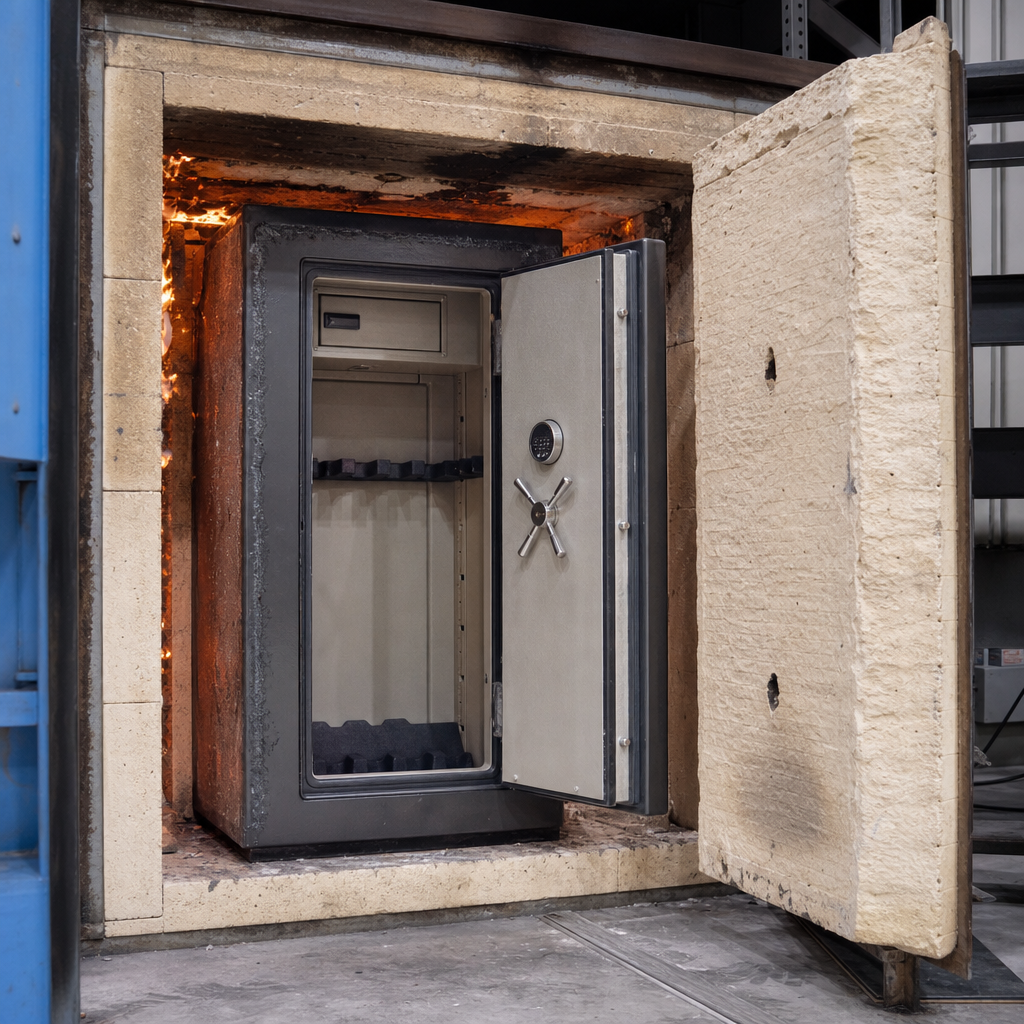
Fireproof gun safes are marketed as the last line of defense when a house fire, garage blaze, or wildfire turns minutes into total loss, but the phrase “fireproof rating” often hides a more technical reality. In practice, gun safes are tested for fire resistance, not absolute fireproofing, and the rating depends on how long the safe keeps its interior below a target temperature while external heat rises to a prescribed level. For gun owners storing rifles, handguns, optics, paper records, and ammunition, understanding that distinction matters because the wrong assumption can destroy both valuables and legal documents even when the safe shell survives.
When I evaluate safes, I treat fire ratings the same way I treat lock ratings or steel thickness: as a specific performance claim that has to be tied to a test method. A credible fire rating answers four questions clearly: what temperature the furnace reached, how long the exposure lasted, what interior temperature limit was allowed, and who witnessed or certified the result. Without those details, a “60-minute fire safe” label is closer to advertising language than engineering evidence.
This matters across the broader topic of fireproof and disaster-resistant storage because most owners are not protecting only firearms. They are also trying to preserve suppressor paperwork, serial-number records, passports, estate documents, hard drives, and irreplaceable photographs. Paper chars around 451 degrees Fahrenheit, many plastics deform earlier, and digital media can fail well below the temperatures that destroy steel. A gun safe that protects long guns may still be a poor choice for data storage unless the interior threshold is low enough or a secondary media container is used.
Fire testing also sits alongside other threats. Real disasters combine heat, smoke, steam, structural collapse, sprinklers, and fire hoses. Wildfire events add prolonged radiant heat; basement fires can expose safes to water after the flames are out; storms can topple a safe onto a compromised floor. That is why this hub page covers not only how gun safes are tested for fireproof ratings, but how to interpret those tests in the context of burglary resistance, water intrusion, safe placement, and the limits of manufacturer claims.
What a Fire Rating on a Gun Safe Actually Means
A fire rating is a time-and-temperature claim, not a blanket guarantee that contents will be unharmed in every fire. The standard concept is simple: a safe is placed in a controlled heating environment, the outside temperature is raised according to a testing schedule, and sensors monitor whether the inside stays below a specified threshold for the stated duration. For gun safes, the most common internal threshold cited for paper protection is 350 degrees Fahrenheit, because paper ignition risk increases rapidly above that point. Some manufacturers instead publish lower thresholds, such as 275 or 250 degrees, to indicate better protection for mixed contents.
The details matter because two safes labeled “90 minutes” can perform very differently. One may be tested at 1,200 degrees Fahrenheit, another at 1,680 degrees, and a third may rely on an internal engineering estimate rather than an independent furnace test. In my experience, consumers routinely compare duration while ignoring heat level, yet higher external temperatures are often the harder part of the test. Duration without the furnace curve is incomplete information.
Another source of confusion is the term fireproof. In the safe industry, fireproof is commonly used in marketing because it is familiar, but no safe is literally proof against every fire. House fires vary by fuel load, ventilation, and suppression response. A kitchen fire stopped in ten minutes is not the same as a garage fire involving fuel, solvents, and a fully involved attic. The best reading of any rating is narrower: under specified test conditions, the safe maintained a survivable interior environment for a defined period.
That is why reputable sellers publish exact test language or link to supporting documentation. If the product page says “tested at 1,400 degrees for 60 minutes with an internal temperature under 350 degrees,” that statement is useful. If it says only “fireproof for one hour,” the buyer still lacks the basic facts needed to compare products intelligently.
How Manufacturers Test Fire Resistance
Most fire testing for gun safes starts with furnace exposure. The safe is fitted with thermocouples inside, then placed in a furnace where temperature rises according to the chosen protocol. The safe may be empty, partially loaded, or configured with shelves and drywall-like insulation as sold. During the run, technicians record internal temperature at multiple points because a tall gun safe can have hot spots near the top, around door seams, or beside boltwork channels.
The insulating materials are central to performance. Many residential gun safes use layers of gypsum board, often called drywall or fireboard, because gypsum contains chemically bound water. As heat drives that water off as steam, the phase change absorbs energy and slows temperature rise inside the safe. Higher-end models may combine multiple layers with ceramic wool, proprietary poured insulation, or tighter door seals that expand when heated. Intumescent seals are especially important around door gaps because smoke and hot gases can penetrate long before the steel body fails.
Some manufacturers add a post-fire drop test to simulate a safe falling through a floor during structural collapse. In those tests, the heated safe is dropped from a specified height and then returned to heat exposure. This matters because fire weakens steel and compromises door alignment. A safe that keeps its seal in a furnace may lose protection if a hot structure collapses around it. Although not every gun safe undergoes this harsher sequence, a published drop test is a meaningful differentiator.
Cooling phase behavior also deserves attention. Many contents are damaged not at peak furnace temperature but during the long soak after the flames are controlled. Thick steel can continue transferring heat inward even after the external source is removed. Better tests account for this by monitoring until internal temperatures stabilize rather than ending the claim the moment the timer stops.
| Test Factor | What It Measures | Why It Matters for Owners |
|---|---|---|
| External furnace temperature | Maximum heat the safe body must withstand | Shows whether a 60-minute claim reflects mild or severe exposure |
| Duration | How long the interior stays under the target threshold | Helps match the safe to likely fire response times in your area |
| Interior temperature limit | Safe conditions for paper, plastics, or mixed contents | Determines whether documents and optics may survive |
| Door seal performance | Resistance to smoke and hot gas penetration | Protects contents before steel failure occurs |
| Drop or impact sequence | Performance after structural collapse stress | Addresses realistic house-fire damage patterns |
| Independent certification | Third-party oversight of the test method and result | Improves confidence that the published rating is credible |
Independent Standards, Certifications, and Common Marketing Gaps
The most trusted fire ratings come from independent laboratories, especially UL. UL 72 is the best-known benchmark for fire-resistive record protection equipment, with classes that correspond to maximum interior temperatures for paper, data, and media. Not every gun safe is tested to UL 72, and many residential security containers are not certified at all, but the closer a manufacturer gets to that level of specificity, the better. ETL fire verification also appears on some products and can provide useful third-party confirmation when the test scope is clearly described.
In the gun safe category, many claims are manufacturer tested rather than laboratory certified. That does not automatically mean they are false. I have seen honest factory testing with documented furnace curves and internal sensor readings. The problem is inconsistency. One brand may test a fully assembled production safe; another may test a prototype with extra insulation; another may estimate performance from insulation thickness and steel mass. To a buyer, those all appear as a simple “90-minute rating.”
Marketing language often compounds the issue. Terms like “up to 1,800 degrees” can mean peak furnace temperature rather than a sustained exposure, while “equivalent to” may indicate modeling instead of direct testing. Some companies cite house fire averages without naming the source. Others combine burglary and fire features into a single headline, encouraging the buyer to assume one strong claim proves the other. It does not.
A careful shopper should look for four pieces of evidence: named test standard or protocol, full temperature and time data, whether the test was third-party witnessed, and whether the result applies to the exact model being sold. If a company cannot supply those details, treat the rating as preliminary and compare accordingly. That approach is especially important for sub-pillar topics like fireproof and disaster-resistant storage, where the safe may be expected to protect regulated paperwork as well as firearms.
Real-World Variables That Change Fire Performance
Even a well-tested safe performs differently depending on where and how it is installed. Location inside the home is one of the biggest variables. A safe on a concrete slab in a first-floor interior closet is generally in a better position than a safe above a garage or in a room with heavy fuel load. Garages often contain gasoline, paint, propane, and vehicles, which can increase intensity. Upper floors add collapse risk. Exterior walls can expose the safe to wildfire radiant heat or firefighting water from broken windows and hoses.
Anchoring matters too. Bolting a safe down is usually discussed as a burglary defense, but it also helps during disasters. An anchored safe is less likely to tip, shift, or land on its back when flooring weakens or when seismic activity accompanies a structure fire. Door orientation after a fall can affect seal integrity and water intrusion. I have inspected post-fire safes where contents survived heat but were soaked because the door gap was compromised after impact.
What you store changes the meaning of the rating. Firearms themselves can often tolerate temperatures that would ruin paper, foam, lubricants, and optics. Scope adhesives, polymer frames, magazine baseplates, and stock finishes may degrade well before steel parts are lost. Ammunition introduces another nuance. Modern cartridges stored in a safe generally pose less danger than loose rounds in open fire, but heat can still damage primers, powder, and packaging. Manufacturers and fire professionals typically recommend storing ammunition separately, both for organization and for better environmental control.
Humidity control devices are another tradeoff. Dehumidifier rods, desiccants, and power pass-throughs are useful for rust prevention, but every opening in the safe body needs to be engineered so it does not become a heat or smoke pathway. Well-designed pass-throughs include protected ports and seals. Poorly finished openings can undermine the very fire performance the buyer is paying for.
How to Choose the Right Fire-Rated Gun Safe for Your Needs
The right safe starts with matching the rating to your risk profile, not buying the highest advertised number. In an urban area with fast fire department response, a verified 60-minute rating at a meaningful temperature may be entirely reasonable. In a rural setting where response can be longer, 90 to 120 minutes may be the prudent baseline. If wildfire exposure is a concern, placement, exterior wall distance, and additional hardening measures become as important as the label on the door.
Next, separate content categories. If you are protecting firearms plus deeds, passports, tax files, and NFA paperwork, look for a safe with a documented interior temperature claim suitable for paper and add a smaller media-rated box inside for drives, SD cards, or backup disks. That layered approach works because digital media is more heat sensitive than paper. It is one of the most practical upgrades I recommend, and it costs far less than replacing unrecoverable records.
Evaluate construction holistically. A good fire-rated gun safe needs adequate steel thickness, a robust door frame, expanding seals, quality lockwork, and insulation that is integrated rather than cosmetic. Ask whether the weight increase comes from steel, fireboard, poured fill, or all three. More weight can indicate more protective mass, but not always. Also confirm warranty terms, especially for fire replacement, locksmith coverage, and freight. Those policies reveal how much confidence a manufacturer has in its own product.
Finally, plan beyond the purchase. Install the safe in the best available location, anchor it correctly, document serial numbers, and review your homeowners or specialty firearms insurance. Fire ratings reduce loss; they do not eliminate it. The strongest disaster-resistant storage strategy combines a credible safe, smart placement, moisture control, records backup, and realistic expectations about what any residential container can survive.
Conclusion
Gun safes are tested for fireproof ratings by exposing them to controlled heat, tracking interior temperatures, and judging whether they keep contents below a defined threshold for a stated time. The most useful ratings specify the furnace temperature, test duration, interior limit, and whether an independent laboratory verified the result. Those details let you compare models on facts instead of slogans.
For the broader subject of fireproof and disaster-resistant storage, the key lesson is that fire resistance is only one part of protection. Safe placement, anchoring, door seals, collapse performance, water exposure, and the type of contents inside all influence the outcome. A safe that is excellent for firearms may still need a secondary container for digital media or especially sensitive documents.
If you are building out your gun storage plan, use this hub as the starting point: compare published test methods, prioritize verified ratings, and choose a safe that fits your actual fire risk rather than the biggest claim on the label. Then take the next step and review your installation, insurance, and document backup strategy so your storage system is ready for more than one kind of disaster.
Frequently Asked Questions
What does a fireproof rating on a gun safe actually mean?
A fireproof rating on a gun safe usually refers to a fire resistance test, not a guarantee that the safe is completely immune to fire under all conditions. In practical terms, the rating is meant to show how long the safe can keep its interior below a specified temperature while the outside is exposed to intense heat. That distinction matters because firearms, optics, ammunition packaging, legal documents, and other valuables can all be damaged at different temperature thresholds. Paper chars around 350°F, many plastics and adhesives fail well below that, and optics or electronic accessories may be even more heat-sensitive.
When manufacturers list a safe as, for example, “60 minutes at 1200°F,” they are saying the safe was designed or tested to maintain internal temperatures below a target limit for that period while the exterior was exposed to that stated temperature. The most important takeaway is that the number is conditional. It depends on the testing method, the target interior temperature, the heat curve, and whether the safe remained sealed and structurally sound throughout the test. So while consumers often use the word “fireproof,” the more accurate term is “fire-rated” or “fire-resistant,” because performance is always tied to specific test conditions rather than unlimited protection.
How are gun safes tested for fire resistance?
Fire-resistant gun safes are typically tested by placing the safe inside a furnace or controlled heat chamber and raising the external temperature according to a defined schedule. During the test, sensors monitor the temperature inside the safe to determine whether it stays below the manufacturer’s or certifier’s stated threshold. The core question is not simply whether the outside gets hot, but whether the insulation, door seal, body construction, and locking area can prevent the interior from reaching a temperature that damages the contents.
Some tests also evaluate what happens after the heating phase. That matters because a real house fire does not always end when visible flames stop. A safe may continue absorbing heat and its interior temperature can keep rising during the cool-down period. More rigorous evaluations may include this extended heat soak, structural integrity checks, or even drop tests that simulate a safe falling through a weakened floor during a fire. If the door warps, seams open, or insulation cracks after impact, the safe can lose its protective ability quickly.
The most meaningful tests are those conducted by an independent third party using a published standard. Internal manufacturer testing is not automatically invalid, but it may use different criteria, shorter durations, or more favorable conditions. That is why shoppers should look beyond the marketing headline and ask how the safe was tested, what interior temperature limit was used, whether a cool-down period was included, and whether the test was independently verified.
Why do interior temperature limits matter so much in fire safe testing?
Interior temperature limits are one of the most important parts of any fire rating because the contents of a gun safe do not all fail at the same heat level. Many fire tests use 350°F as a benchmark because that is the approximate temperature at which paper begins to char. If the safe’s interior stays below that level for the stated test duration, paper documents such as deeds, titles, passports, and tax records have a better chance of surviving. But that threshold may not be low enough for every item a gun owner stores.
Optics, lubricants, polymer-framed handguns, slings, batteries, and electronic accessories can suffer damage at lower temperatures than paper. Adhesives can soften, seals can fail, and delicate coatings or circuitry may degrade long before paper chars. That means a safe rated to protect documents is not necessarily optimized to protect all firearm-related gear equally. The rating may still be useful, but it should be interpreted in light of what is actually being stored inside.
This is why careful buyers should ask not just “How many minutes?” but also “Below what internal temperature?” A longer time rating is not always better if it is tied to a high internal threshold that may still damage valuables. The best way to read a fire rating is as a combination of three variables: external temperature, duration of exposure, and maximum permitted internal temperature. All three need to be understood together before the rating has real meaning.
Are all gun safe fire ratings tested to the same standard?
No, and this is where many buyers get misled. Fire ratings are not always based on the same test protocol, the same heating curve, or the same pass/fail criteria. One manufacturer may use an independent laboratory and follow a recognized standard, while another may rely on in-house testing with different assumptions. Two safes can both advertise a “60-minute fire rating,” yet the actual level of protection may be very different depending on how each one was evaluated.
Differences can include the maximum furnace temperature, how quickly the heat rises, whether temperature is measured at one point or several points inside the safe, whether the test includes a cool-down phase, and whether the safe is tested empty or loaded with contents. Some tests may also examine the integrity of the seal after impact or structural damage, while others focus only on temperature performance during heating. Those variations can materially affect how meaningful the final rating is in a real fire scenario.
For that reason, the most trustworthy fire ratings are the ones backed by transparent documentation and reputable third-party certification. If a manufacturer does not specify the standard used, the interior temperature target, or the test conditions, the rating should be treated cautiously. A legitimate fire label should help you compare products; a vague claim should raise questions. In short, the rating number alone is never enough. The credibility of the testing method is what gives that number value.
What should gun owners look for when evaluating a safe’s fire protection claims?
Start by looking for clear, specific language rather than broad claims like “fireproof” or “guaranteed protection.” A credible safe listing should state the time rating, the external test temperature, and the maximum interior temperature maintained during the test. If possible, verify whether the test was performed by an independent lab and whether it followed a recognized standard. Transparency is a strong sign that the manufacturer is confident in its product, while vague wording often signals marketing first and technical detail second.
It is also smart to evaluate the safe’s construction, because fire performance depends on more than insulation alone. Door gaps, expanding heat seals, steel thickness, hinge design, and the quality of the locking mechanism can all influence whether heat and smoke penetrate the interior. Fireboard or composite insulation materials vary widely, and the way they are installed can affect performance just as much as the material itself. A safe with a solid fire rating on paper but poor fit and finish may not perform as well as expected under severe conditions.
Finally, match the safe to your real risk profile. A gun owner in a wildfire-prone region, a detached garage, or a rural area with longer fire department response times may want a more robust fire rating than someone storing a few firearms in a climate-controlled interior room. Placement matters too. A safe on a concrete slab may face different fire conditions than one installed on an upper floor that could collapse. The best buying decision comes from treating the fire rating as one part of a broader protection strategy that includes burglary resistance, safe location, humidity control, and the specific types of items being stored.