
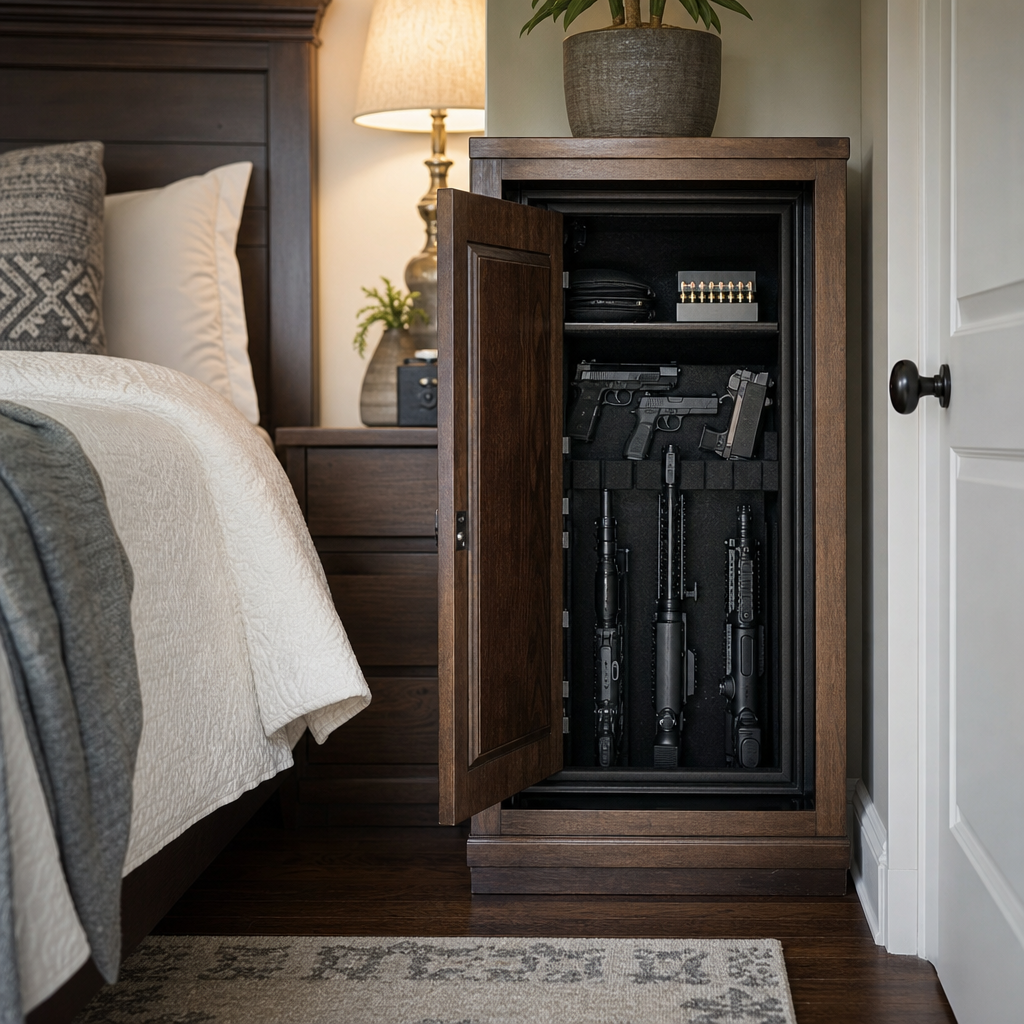
Gun owners who prioritize concealment over size need a different kind of safe than buyers focused on maximum firearm capacity, long-term archival storage, or showroom-grade steel. In this corner of the market, the best gun safe options are the ones that stay out of sight, blend into normal household furniture, and still provide fast, controlled access when needed. Concealment means reducing visual detection by visitors, contractors, babysitters, and opportunistic burglars; size refers to the overall footprint, interior volume, and weight of the container. A concealment-focused safe is usually smaller, easier to place in lived-in spaces, and designed around one to four defensive firearms rather than a broad collection. This matters because most home break-ins are quick, targeted, and opportunistic, and an exposed gun cabinet, large safe, or obvious lockbox can become its own invitation. Over years of evaluating safes for clients with different floor plans, risk profiles, and storage habits, I have seen the same pattern repeatedly: buyers are not just choosing steel thickness and lock types, they are choosing how visible their ownership appears inside their daily environment. That is why understanding gun safe buyer personas is useful. The concealment-first buyer is not one person but several distinct groups, each balancing discretion, accessibility, legal compliance, and interior design in a slightly different way.
The concealment-first buyer persona: what defines this group
The concealment-first buyer persona typically values low visibility, modest dimensions, and room-by-room practicality more than headline capacity. These owners often keep one defensive handgun, a compact rifle, or a shotgun configured for home defense, and they want storage near where they spend time rather than in a basement utility corner. In practical terms, that points toward under-bed safes, nightstand safes, wall safes installed between studs, shelf safes hidden behind decor, mirror safes, bench safes, and furniture safes that conceal a lock compartment inside ordinary-looking pieces. The defining question is simple: if someone walks through the room, will they recognize it as a gun safe?
This persona includes urban apartment dwellers with limited square footage, suburban parents who need to prevent child access without advertising firearm ownership, and privacy-minded homeowners who prefer to keep valuable items off a burglar’s initial checklist. It also includes buyers in neighborhoods where deliveries are visible and where a giant palletized safe arriving at the driveway would attract attention. Their priorities are usually layered. First, they want unauthorized users blocked by a real lock, not just a decorative compartment. Second, they want the safe integrated into normal furniture flow. Third, they want access speed that supports defensive use. The tradeoff is equally clear: a concealment safe often offers less theft resistance than a 700-pound traditional safe bolted to concrete, so selection must match threat level rather than aesthetics alone.
Primary buyer personas within the concealment segment
Within the larger gun safe buyer personas landscape, concealment-focused shoppers break into several predictable profiles. The first is the bedside defender, usually storing one or two handguns with a flashlight, spare magazine, and small valuables. This buyer cares about biometric or simplex-style speed, quiet access at night, and furniture that does not look tactical. The second is the family safety planner, often a parent balancing access and child resistance. This buyer wants hidden placement plus dependable locking and tamper alerts. The third is the apartment minimalist, constrained by lease terms, floor loading, and lack of dedicated gun rooms. This buyer needs non-permanent, compact storage that moves easily during relocation.
A fourth profile is the privacy-maximizing homeowner. This person may own several firearms overall but deliberately disperses access-ready guns in discreet locked locations rather than relying only on one large central safe. A fifth is the design-conscious buyer who refuses to put an industrial steel box in a polished bedroom or living space. For this group, finish quality, wood stain, fabric matching, and visible hardware matter. Finally, there is the retirement-age convenience seeker, who may need an easier opening motion, raised-height access, and lower bending requirements than floor-level lockboxes provide. These distinctions matter because the right gun safe options change with use case. A wall safe behind framed art may suit the privacy-focused homeowner but fail the bedside defender who needs immediate access under stress.
Best gun safe options for concealment-focused owners
The most effective concealment solutions start with matching form factor to room use. Under-bed safes are among the most practical options for owners who need moderate capacity without visible presence. Models from brands such as Vaultek, SnapSafe, and Hornady can hold one long gun or several handguns and slide out on drawer-like tracks. They remain invisible unless someone is specifically inspecting beneath the bed. Nightstand safes and hidden drawer safes work well for handgun access in primary bedrooms; quality versions use steel lockboxes built into real furniture instead of decorative hollow compartments.
Wall safes fit buyers willing to commit to installation. Between-stud units from brands like Hollon and Amsec can disappear behind mirrors, framed art, or shallow cabinets, and they preserve floor space in tight homes. Shelf and mirror safes are effective when the concealment feature looks ordinary from multiple angles, not just head-on. Furniture safes, including coffee tables, benches, and end tables with hidden locking cavities, are strongest when they combine legitimate steel protection with hardware that does not telegraph the secret. For vehicle-adjacent storage, console vaults can serve a related role, though they belong more to in-car security than household concealment. The key buying rule is straightforward: choose concealment that survives casual observation, but never sacrifice core lock integrity for novelty.
How access method changes the right choice
Lock type is often more important than exterior appearance. For concealment buyers, the main options are biometric fingerprint readers, electronic keypads, mechanical push-button locks, tubular or standard key locks, and hybrid systems combining two methods. In my testing, biometric access has improved significantly over the last decade, but performance still depends on sensor quality, enrolled print consistency, and battery maintenance. Better units from Vaultek, Fort Knox, and Hornady can work quickly, but low-cost biometric safes often fail under dry skin, poor finger placement, or rushed use. For defensive storage, I advise buyers to treat biometrics as a convenience layer, not the only trusted method.
Mechanical simplex-style push-button locks remain one of the strongest choices for concealment-first owners because they open in darkness, require no batteries, and tolerate frequent use. Electronic keypads are common and can be reliable when paired with audit trails or tamper lockouts, but they introduce battery dependence and sometimes loud beeps unless muted. Keys are best reserved for backup, not primary emergency access. The practical question is not which technology sounds modern; it is which one opens reliably at 2 a.m. without fumbling. Concealment loses value if the owner cannot access the firearm under stress, and speed loses value if the lock is easy for unauthorized hands to defeat.
Size, capacity, and placement tradeoffs that buyers underestimate
Concealment-oriented buyers routinely underestimate interior depth, accessory bulk, and placement friction. A handgun with a red-dot optic, weapon light, and suppressor-height sights requires more clearance than the bare pistol dimensions suggest. Compact rifles with optics, folded braces, or mounted lights may not fit a “rifle-ready” under-bed safe as expected. Before buying, measure the actual firearm in ready condition, then add room for a holster if the gun will be staged protected from trigger interference. Also account for the opening arc, bedside walking space, carpet thickness, and nearby outlets if the safe uses powered lighting or charging.
Placement creates real security consequences. A closet floor safe hidden behind shoes may sound discreet, but if the closet is the first obvious hiding place a burglar checks, concealment value drops. A false-bottom drawer can be extremely discreet, yet poor if children frequently access the same dresser. Under-bed safes work well only if the bed frame allows smooth extension and if dust, pet hair, or storage bins do not obstruct travel. Wall safes need correct stud spacing, utility checks, and reinforcement around cut openings. Small safes should also be anchored whenever possible. A hidden safe that can be carried away is often defeated later, off-site, where the thief has time and tools.
Comparing concealment-safe options by persona
The best way to evaluate options is to compare them against how real owners live. The table below reflects recommendations I commonly make when clients ask for discreet storage that still supports daily use.
| Buyer persona | Best safe type | Main advantage | Main limitation | Best room |
|---|---|---|---|---|
| Bedside defender | Nightstand safe or drawer safe | Fast access within arm’s reach | Usually handgun-only capacity | Primary bedroom |
| Family safety planner | Anchored furniture safe with keypad or simplex lock | Blends in while restricting child access | Heavier and costlier than basic lockboxes | Bedroom or home office |
| Apartment minimalist | Portable under-bed safe | Low profile and move-friendly | Less theft resistance than full-size safes | Bedroom |
| Privacy-maximizing homeowner | Wall safe behind art or mirror | Very discreet with no floor footprint | Limited capacity and installation required | Hallway, closet, office |
| Design-conscious buyer | High-quality furniture safe | Matches decor and avoids tactical look | Quality varies widely by maker | Living room or bedroom |
| Convenience-focused older owner | Raised-height cabinet or end-table safe | Easier reach and simpler daily use | May be more visible than hidden wall units | Bedroom or sitting room |
Security standards, construction details, and red flags
Concealment should never distract from basic build quality. Buyers should inspect steel gauge, pry resistance around the door, hinge exposure, bolt engagement, anchor points, and lock certification where available. For residential security containers and burglary protection, standards from UL and California Department of Justice handgun safe requirements offer useful baseline signals, even though many concealment products do not pursue every certification. A safe advertised as “tamper proof” without naming steel thickness, lock type, or testing protocol deserves skepticism. Thin-gauge imported boxes with weak welds and generic fingerprint modules often look attractive online yet fail under simple pry attacks.
Watch for products that emphasize secret compartments but avoid describing the actual lock body. If the hidden panel is the only barrier and the interior box is flimsy, the product is furniture first and secure storage second. Better designs use a concealed exterior plus a steel inner safe with real locking bolts. Soft interiors, LED lights, and USB charging are useful, but they are secondary. I also urge buyers to examine warranty language, battery access for override situations, and replacement key policies. When possible, choose makers with established service records such as Amsec, Fort Knox, Hornady, Vaultek, or V-Line, because after-sale support matters when a lock malfunctions or a biometric reader begins rejecting enrolled users.
How this hub fits broader gun safe buyer personas
As a sub-pillar hub under Gun Safes & Safety, this concealment-focused guide sits within a broader map of gun safe buyer personas. Other personas include the high-capacity collector seeking fire resistance and organization, the budget-first first-time owner prioritizing legal storage at minimal cost, the long-gun hunter needing scoped-rifle fit, the mobile traveler needing vehicle and temporary lodging solutions, and the preparedness-minded household building layered home security. Concealment-first buyers overlap with all of them, but their primary decision filter is invisibility inside occupied rooms. That changes every recommendation, from finish style to lock noise to anchor strategy.
The main takeaway is that concealed storage is not a gimmick category; it is a legitimate response to real lifestyle constraints and risk management goals. The best gun safe options for these owners combine discreet placement, dependable locking, and enough theft resistance to prevent easy removal or quick forced entry. Start with your persona: bedside defender, family safety planner, apartment minimalist, privacy-focused homeowner, design-conscious buyer, or convenience seeker. Measure the firearm as configured, choose the room before the model, and verify lock reliability before buying based on appearance alone. If you are building out your gun storage plan, use this page as your starting hub, then evaluate each adjacent buyer profile so your final setup fits how you actually live, not how a catalog assumes you live.
Frequently Asked Questions
What makes a gun safe a good choice for owners who care more about concealment than overall size?
A good concealment-focused gun safe is designed first to stay unnoticed, not to hold the largest possible collection. That usually means a smaller footprint, a form factor that fits inside furniture or architectural dead space, and an exterior that does not immediately signal “gun storage.” In practical terms, the best options are often hidden in nightstands, wall cavities, under beds, inside benches, behind mirrors, or within furniture that looks completely ordinary to guests. For this type of buyer, the goal is not just secure storage, but reduced visual exposure. If a visitor, contractor, babysitter, house cleaner, or opportunistic burglar never identifies the safe in the first place, that adds an important layer of protection.
That said, concealment should never be confused with novelty. A quality hidden safe still needs solid locking hardware, dependable access control, and enough structural strength to resist casual tampering or a quick grab-and-go attempt. Owners who prioritize concealment should look for features like reinforced lock areas, pry-resistant doors, reliable biometric or electronic access, and mounting capability to anchor the unit to framing, flooring, or heavy furniture. Capacity becomes secondary to placement, discretion, and speed. If the safe holds fewer firearms but is better hidden, easier to reach in a defensive moment, and less likely to attract attention, it may be the smarter choice for that household.
Are hidden gun safes in furniture or walls actually secure, or are they mainly for appearance?
They can be secure, but only when buyers understand their role and choose carefully. A hidden safe built into furniture or a wall is not automatically less secure than a traditional visible safe, but it does rely on a different security strategy. Instead of depending only on thick steel and sheer weight, concealment-oriented safes combine moderate physical security with low visibility. That matters because many break-ins are fast, chaotic, and opportunistic. Burglars often search obvious locations first: primary closets, home offices, garages, and visible standalone safes. A well-concealed safe that blends into furniture or architecture may never be discovered during a short intrusion.
However, not every disguised safe is built to the same standard. Some products are essentially hidden boxes with minimal real protection. Better models use stronger steel, internal hinges or protected hinge-side designs, solid locking bolts, and tamper-resistant construction. Wall safes should be installed properly between studs and anchored according to manufacturer guidance. Furniture-style safes should be bolted down whenever possible so they cannot simply be carried away. It is also wise to evaluate the locking method, battery backup plan, and long-term reliability of the access system. In short, hidden safes are not just decorative if they are well made and correctly installed, but buyers should treat concealment as one layer of security, not a substitute for quality construction.
Which types of gun safes work best for concealed placement in a normal home?
The best type depends on where and how you want to access the firearm. For bedside defense, compact biometric handgun safes inside a nightstand, drawer, or low-profile piece of furniture are often the most practical option. They stay out of sight while still allowing fast access. Under-bed safes are also popular because they use space that is normally ignored, can hold more than a single handgun, and remain largely invisible without requiring a major room redesign. For owners who want something even less obvious, furniture-integrated safes built into benches, cabinets, coffee tables, or end tables can blend naturally into a room without looking tactical or industrial.
Wall safes are a strong choice when owners want a truly hidden installation, especially behind framed art, mirrors, or within closets. These can work well for handguns and compact valuables, though stud spacing limits their internal dimensions. In rooms where quick access matters but visibility must stay low, shelf-style concealment safes and hidden compartment furniture can strike a good balance. The key is to choose a format that fits your actual routine. A safe hidden so well that it is awkward to open under stress may not serve its purpose. Likewise, a large visible safe tucked in a corner may offer more steel but less discretion. The most effective concealment-safe is the one that fits the room naturally, matches the firearm size you actually need to store, and provides controlled, repeatable access without drawing attention.
How important is quick access in a small concealed gun safe, and what locking system is best?
Quick access is extremely important because many buyers choosing a concealment-focused safe are doing so for defensive readiness as much as discretion. A hidden safe that disappears into furniture or architecture is only useful if the owner can reliably open it when needed. That means the locking system should be evaluated not just for security, but also for consistency in low light, under stress, and during routine daily use. Biometric locks are attractive because they can provide rapid one-hand entry, but quality varies widely. A good biometric system should read consistently, store multiple authorized fingerprints, and ideally include backup access such as a keypad or mechanical override key.
Electronic keypad locks remain a strong option because they are familiar, usually fast, and less dependent on fingerprint quality, moisture, or sensor cleanliness. Mechanical simplex-style pushbutton locks are also highly respected for reliability, especially on quick-access handgun safes, because they do not rely on batteries or electronics. The best choice depends on the user’s environment and comfort level. In any case, the lock should be tested regularly, batteries should be changed proactively if applicable, and every authorized user should practice opening the safe safely and repeatedly. For concealment-oriented buyers, the ideal system is one that balances hidden placement with immediate, predictable access. Speed matters, but so does avoiding lock failure, false reads, or clumsy operation in an emergency.
Can a smaller concealed gun safe still meet safety and legal responsibilities in a home with children or visitors?
Yes, as long as it is used correctly and selected with those responsibilities in mind. A smaller concealed gun safe can absolutely support responsible firearm ownership, particularly in homes where the main risk is unauthorized discovery rather than the need to store a large collection. In fact, for some households, a discreet, quick-access safe placed close to where the firearm is kept may be safer in practice than a larger safe located farther away and used less consistently. The combination of hidden placement and locked access helps reduce the chance that children, guests, or service workers will encounter the firearm at all.
Still, concealment alone is never enough where children are involved. The safe should have a true locking mechanism, not just a secret compartment or magnetic latch. It should be mounted securely, positioned out of normal reach or sight lines, and used consistently every time the firearm is stored. Owners should also review applicable state and local storage laws, since legal standards vary by jurisdiction and may include child-access prevention requirements. If the safe will hold a defensive firearm, it should also allow authorized adults to retrieve it without delay while preventing curious hands from getting near it. The responsible approach is to treat concealment as an added barrier, then back it up with secure locking, proper installation, safe handling habits, and regular checks to ensure the unit remains functional and inaccessible to unauthorized users.