
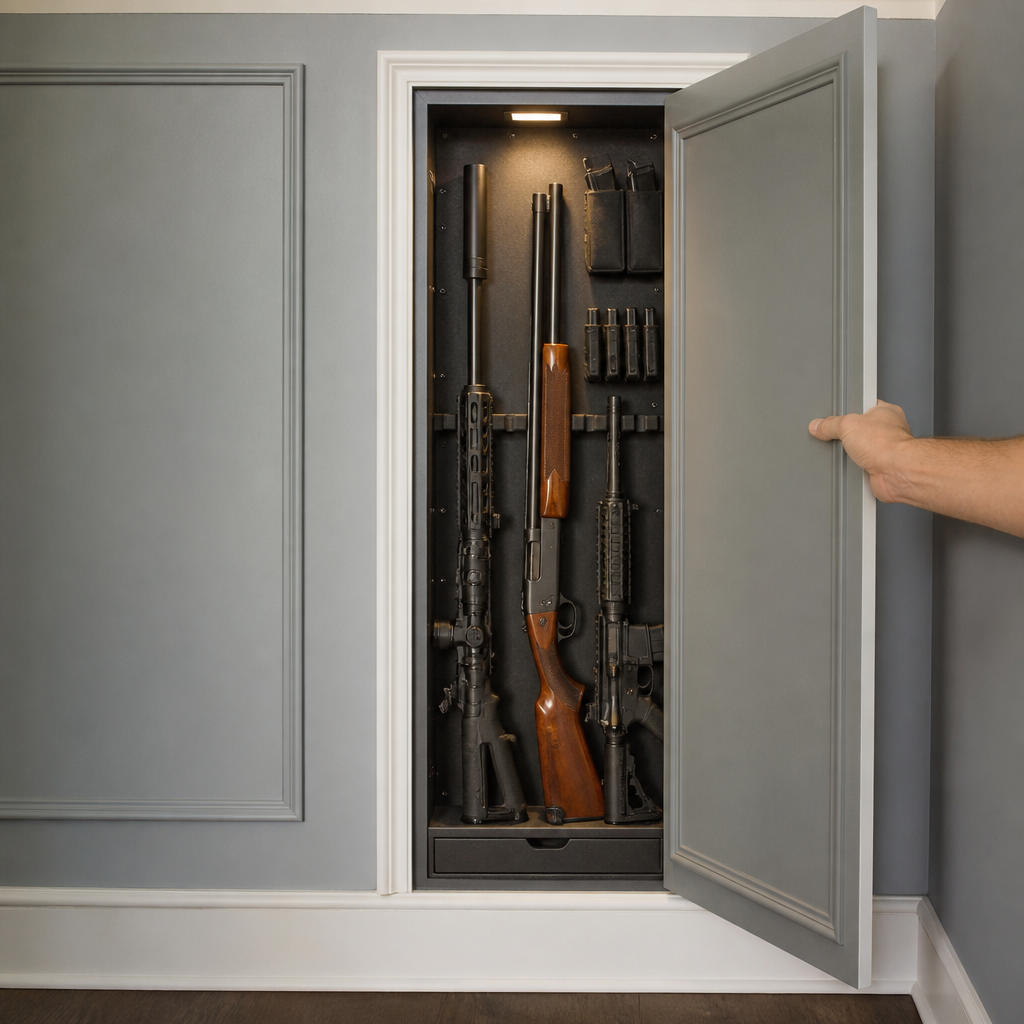
Hidden gun storage solves a practical problem: how to keep firearms secured, quickly accessible to authorized adults, and out of sight from guests, children, and opportunistic thieves. A secret gun safe inside a wall panel is one of the most effective discreet gun storage solutions because it uses dead space between studs, preserves floor area, and can blend into ordinary trim, art, or cabinetry. In the field, I have seen well-built in-wall units protect handguns, documents, and defensive long guns without advertising their presence the way a freestanding safe can. This article serves as a hub for hidden and discreet gun storage solutions, with a specific focus on how to create a secret gun safe inside a wall panel safely, legally, and with durable construction.
Before getting into methods, it helps to define terms clearly. A gun safe is a secure enclosure designed to resist unauthorized access, often using steel construction, a mechanical or electronic lock, and anchored mounting points. Hidden gun storage means the firearm is concealed from plain view; discreet gun storage means it does not obviously look like firearm storage. Those are not the same as true burglary resistance. A decorative wall panel with a latch may hide a firearm, but unless the inner safe body is reinforced and properly anchored, concealment alone will not stop a determined intruder. That distinction matters because many homeowners overestimate the protection of “secret” compartments and underestimate the need for lock strength, stud attachment, and access control.
This topic matters because firearm safety depends on layers, not a single product claim. The National Shooting Sports Foundation and many law enforcement agencies consistently emphasize storing guns unloaded when appropriate, locking firearms to prevent unauthorized access, and storing ammunition according to household needs and local law. In a home-defense context, families often need a balance between speed and security, especially with children in the house. In apartments or smaller homes, a large floor safe may be impractical, while a hidden wall safe can fit into a bedroom, closet, office, or hallway. When designed correctly, a secret wall-panel safe adds concealment, preserves room aesthetics, and keeps daily-carry pistols or compact rifles in a predictable, controlled location.
As a sub-pillar hub under gun safes and safety, this guide also frames the wider category of hidden and discreet gun storage solutions. The same principles used for wall-panel safes apply to mirror safes, picture-frame concealment units, headboard compartments, false HVAC-return designs, closet-panel storage, and built-in cabinetry. The core questions are always the same: what are you storing, who must be kept out, how quickly do you need access, what wall type are you working with, and what level of burglary resistance is realistic? Once those variables are understood, you can build or buy a concealed storage system that supports actual safe storage rather than just visual camouflage.
Plan the safe around access, wall structure, and legal compliance
The first step in creating a secret gun safe inside a wall panel is planning for the firearm, the room, and the people in the home. Start by defining the storage role. A bedside concealed handgun safe has different requirements than a hidden long-gun cabinet in a study. Handguns fit standard stud bays more easily, especially in 2×4 walls with roughly 3.5 inches of cavity depth before drywall. AR-pattern carbines, pistol-caliber carbines, or takedown rifles may fit vertically if barrel length and optic height are accounted for, but many full-size shotguns and rifles require taller wall sections, deeper custom framing, or an adjoining closet cavity. Measure exact overall length, grip projection, optic profile, and magazine storage needs before selecting a bay.
Placement matters as much as dimensions. In my experience, the best locations are low-traffic areas that still allow instinctive access under stress: inside a primary bedroom, in a walk-in closet behind hanging clothes, or in a home office wall that naturally supports framed art or paneling. Avoid exterior walls when possible because insulation, vapor barriers, wiring density, and temperature swings complicate installation. Stay away from plumbing walls, shared walls where sound may reveal operation, and walls that already carry HVAC runs. Use a quality stud finder with AC wire detection, then verify with a borescope through a small inspection hole before cutting. A concealed safe installed blindly can intersect Romex, low-voltage cable, drain lines, or fire blocking.
Legal compliance is not optional. State and local laws vary on storage requirements, child access prevention, loaded firearms in the home, and landlord restrictions for tenants. Some jurisdictions impose criminal penalties if a minor or prohibited person gains access through negligent storage. If the safe will hold National Firearms Act items or if you are making structural changes in a multifamily building, consult an attorney and local code requirements. Fire separation may also matter. A wall between a garage and living space, for example, often has specific fire-rating rules, and cutting into it without proper restoration can create code issues. Hidden gun storage solutions must work within both firearm law and building safety standards.
Choose the right construction method and security level
There are three practical ways to build a secret wall-panel gun safe: install a manufactured in-wall safe behind a concealment cover, build a framed recess and insert a fabricated steel box, or create a full custom cabinet between studs with a hidden front panel and an internal locking safe. The first option is easiest and often best for handguns. Brands such as Stack-On, V-Line, and specialized in-wall safe makers offer steel bodies sized for standard stud spacing. The second option gives more flexibility for dimensions and lock choice. The third option can create the cleanest aesthetic, but it only counts as secure storage if the inner compartment is steel-reinforced and lockable. A decorative cavity alone is not a safe.
Security level should be matched to threat level. Concealment deters casual discovery, but a thief who searches methodically can still find hinges, seam lines, or shifted artwork. Real protection comes from steel thickness, pry resistance, robust lock hardware, and anchor points into framing. For quick-access pistol storage, 12- to 14-gauge steel with a reliable simplex mechanical lock or reputable electronic lock is common. For larger hidden compartments, welded seams, anti-pry door returns, and through-bolting into king studs or doubled framing make a noticeable difference. Fire resistance in shallow wall safes is often limited, so if documents, optics, or ammunition are part of the plan, think of the wall unit as an access safe and use a separate rated safe for broader protection.
| Option | Best Use | Main Advantage | Main Limitation |
|---|---|---|---|
| Manufactured in-wall safe | Handguns, documents, spare magazines | Fast installation, tested locksets | Limited depth and interior volume |
| Custom steel box between studs | Pistols, valuables, compact firearms | Flexible sizing and stronger anchoring | Requires fabrication and precise framing |
| Hidden wall cabinet with inner safe | Mixed storage in finished rooms | Best visual concealment | Complex build; concealment alone is not security |
Lock choice deserves careful attention because it controls real-world usability. Mechanical push-button locks, such as simplex-style systems, are dependable, battery-free, and excellent for dark-room access. Electronic keypad locks can be fast and intuitive, but buy from established manufacturers and maintain fresh batteries on a schedule instead of waiting for low-power warnings. RFID and biometric systems look appealing, yet fingerprint readers can fail with sweat, dirt, or rushed finger placement. In homes where the safe may be opened under stress at night, I usually recommend a proven mechanical lock or a high-quality electronic keypad with mechanical override. Secret storage should not force guesswork when seconds matter.
Build the wall opening, reinforce the cavity, and conceal it cleanly
Once you confirm location and method, build the opening as if you were installing a permanent architectural feature, not a novelty compartment. Mark the stud bay, cut drywall neatly, and inspect the cavity again before enlarging anything. If the wall is load bearing, do not cut studs without a structural plan from a qualified carpenter or engineer. Most hidden in-wall gun safe projects avoid cutting studs by using the space between them. If you need more width for a larger compartment, frame the opening with a proper header and trimmers the same way you would frame a niche or small recessed cabinet, then restore structural capacity. Sloppy framing leads to cracked drywall, visible seams, and easier detection.
Reinforcement should support both weight and attempted prying. Add solid blocking at the top, bottom, and sides of the cavity using construction screws, not just finish nails. If you are installing a steel safe body, through-bolt it into framing members or heavy blocking with grade-appropriate hardware and large washers or backing plates. I prefer fastening that cannot be removed from the front once the door is closed. Inside the compartment, line contact points with closed-cell foam, felt, or rubberized rack material to protect finishes and reduce noise. Include dedicated retention such as pistol pegs, magazine shelves, barrel saddles, or hook-and-loop restraints so guns do not shift when the panel opens.
The outer concealment layer is where craftsmanship separates effective hidden gun storage from obvious DIY work. Common cover methods include a hinged mirror, framed artwork on a French cleat with hidden release, millwork paneling with touch-latch hardware, or a shallow bookcase front. The cover should match the room naturally. In a modern bedroom, a full-length mirror is believable; in a study, a framed map or artwork makes more sense. Gaps must be even, reveal lines should mimic other trim details, and hardware noise should be minimized with soft-close or felt bumpers. Magnetic catches alone are not enough if children are present. The concealment door should hide the safe, but the safe itself must remain locked independently.
Good concealment also means avoiding predictable “secret compartment” clichés. Oversized patriotic art in a sparse room, oddly placed wainscoting, or one decorative panel in an otherwise plain hallway can attract attention. Blend the installation into existing design language. If the home uses shaker trim, match it. If the walls feature several frames, add the safe behind one of a group rather than a lone picture. In projects I have evaluated after break-ins, the least discovered hidden safes were not the most elaborate; they were the most contextually ordinary. A secret wall panel works best when it looks boring.
Equip, maintain, and use hidden gun storage safely
After installation, organize the interior for consistent access and strict safety. Store firearms in a stable orientation, typically grip-forward for handguns or muzzle-down/vertical for compact long guns when the rack supports that layout securely. If the firearm is intended for defensive use, define in advance whether it will be stored loaded or unloaded based on household risk, training level, and applicable law, then keep the condition consistent. Add a low-profile motion light so contents are visible in darkness without fumbling. A small desiccant pack or rechargeable dehumidifier helps control moisture, especially on exterior-adjacent walls or in humid climates. Rust prevention is part of safe storage, not an afterthought.
Maintenance is where many hidden setups fail. Test the lock weekly at first, then monthly, and verify that hinges, latches, and mounting bolts remain tight. Replace keypad batteries on a calendar basis, not after a warning tone. Practice opening the concealment panel and inner safe from normal sleeping positions and under low light. Time the process. If the design requires moving furniture, removing multiple objects, or remembering a finicky release sequence, it is too complicated. Hidden gun storage solutions succeed when authorized adults can operate them reliably and unauthorized people cannot. That standard should be tested, not assumed. Also revisit the setup whenever children age, guests visit frequently, or the firearm collection changes in size.
As a hub for discreet gun storage, the bigger lesson is to choose the right hidden method for each room and use case. A wall-panel safe is excellent for everyday defensive access and low-profile storage, but it is not the universal answer. Closet corner safes, under-stair compartments, hidden drawer safes, bed-frame vaults, and furniture-integrated lockboxes each solve different space and access problems. Build your plan around layers: concealed location, locked steel enclosure, secure anchoring, controlled keys or codes, and routine maintenance. If you are creating a secret gun safe inside a wall panel, prioritize structural integrity, proven locking hardware, and a believable concealment design, then review the rest of your home for places where discreet storage can support the same safety standard. Measure carefully, build deliberately, and upgrade weak points before trusting the system.
Frequently Asked Questions
Is a secret gun safe inside a wall panel actually secure, or is it mostly for concealment?
A secret gun safe inside a wall panel should be viewed as both a concealment strategy and a real layer of security, but it works best when those two goals are balanced correctly. Concealment matters because most opportunistic theft happens fast. Thieves typically search closets, under beds, dressers, and obvious lockboxes first. An in-wall gun safe hidden behind a panel, framed artwork, mirror, or trim detail is far less likely to be discovered during a quick search. That alone makes it a strong discreet gun storage option.
That said, concealment by itself is not enough for responsible firearm storage. The safe itself should include a hardened locking compartment, not just a hollow wall cavity with a decorative cover. If the interior box is made from solid steel, anchored directly to framing members, and fitted with a quality lock, it becomes significantly harder to pry out or force open. Ideally, the unit should be secured to the wall studs with tamper-resistant hardware and designed so the surrounding panel cannot simply be popped off without first unlocking the mechanism.
True security also depends on choosing the right lock for how the firearms will be used. For a defensive handgun, fast access may be a priority, so a mechanical push-button or quality electronic lock may make sense. For longer-term storage of less frequently used firearms or important documents, a slower but more robust locking system may be acceptable. In homes with children, the safe must be child-resistant, not merely hidden. A hidden location reduces attention, but the locking compartment is what prevents unauthorized access.
In practical terms, a well-built in-wall hidden safe is not the same as a full-size freestanding vault that can withstand prolonged attack with tools. However, it is far more effective than leaving firearms in a drawer, closet shelf, or basic furniture compartment. When properly installed, hidden, and locked, an in-wall gun safe provides meaningful protection against casual discovery, smash-and-grab theft, and unauthorized household access while preserving fast access for authorized adults.
What is the best location in a home for a hidden in-wall gun safe?
The best location is the one that balances accessibility, structural suitability, concealment, and legal responsibility. In most homes, the ideal wall is an interior wall with standard stud spacing, no major plumbing, no HVAC ducts, and no complex electrical runs where the safe will be installed. Interior walls are often easier to work with because they are less likely to contain insulation, vapor barriers, or exterior weather concerns, and they usually provide a cleaner cavity for a recessed safe.
From a practical standpoint, place the safe where authorized adults can reach it quickly but where visitors, service workers, and children are unlikely to have any reason to interact with the wall feature concealing it. Common choices include home offices, bedrooms, closets, hallways with decorative paneling, or behind furniture and framed wall pieces that do not attract attention. A hidden safe near a primary sleeping area may make sense for defensive access, while one in a study or private room may be better for storing documents, handguns, and accessories.
You also need to think beyond just the wall cavity. The surrounding area should allow the hidden panel or door to open smoothly without hitting furniture, shelving, or trim. If you plan to store a defensive long gun, measure the internal height carefully and account for optics, sling mounts, and padding. A cavity between studs can work extremely well for compact rifles or shotguns in some configurations, but dimensions should be verified before any cutting begins.
Another important consideration is visibility patterns inside the home. A concealment feature works best when it blends naturally into the room. A panel hidden behind ordinary wainscoting, a recessed medicine-cabinet-style trim piece, a mirror, or a shallow built-in can be very effective because it looks intentional and unremarkable. By contrast, a single unusual decorative object placed in an otherwise plain room can draw attention. The strongest locations are structurally simple, easy for you to access, and visually boring to everyone else.
How do you avoid cutting into electrical wiring, plumbing, or other utilities when building an in-wall safe?
This is one of the most important parts of the project, because the wall cavity that looks empty from the outside may contain wiring, pipes, low-voltage lines, ductwork, fire blocking, or other hidden obstacles. Before you cut a finished wall, you should inspect it as thoroughly as possible. Start by identifying whether the wall is likely to be load-bearing and whether it is interior or exterior. Then use a quality stud finder with wire-detection capability, and scan the wall multiple times from different heights and angles.
Next, look for clues on both sides of the wall and in adjacent spaces. Nearby outlets, switches, thermostats, plumbing fixtures, vent registers, and return air grilles can indicate what may be running through the cavity. If the wall backs up to a bathroom, kitchen, laundry room, or utility area, there is a higher chance that plumbing or electrical lines are present. If you have basement, crawlspace, or attic access, inspect where the wall runs vertically and horizontally. In many cases, you can learn a lot by tracing how utilities enter and travel through the house.
A safe approach is to begin with a very small inspection opening rather than immediately cutting the full opening for the safe. A small hole placed in a discreet location can allow you to use a flashlight, inspection mirror, or borescope camera to look inside the cavity before making larger cuts. This extra step can prevent expensive mistakes. If you encounter fire blocking between studs, you will need to account for it in the design rather than simply assuming the cavity is open from top to bottom.
If there is any doubt, consult a qualified contractor, electrician, or plumber before proceeding. That is especially true if you suspect the wall may be load-bearing, or if the project will require modifying framing, rerouting utilities, or installing a heavier steel unit. A hidden gun safe should be discreet, but it should also be built safely and legally. Careful inspection upfront is what separates a clean, professional installation from a damaged wall and a costly repair.
What features should I look for when designing or choosing a hidden wall gun safe?
The best hidden wall gun safe combines a secure steel enclosure, reliable locking hardware, smart interior organization, and a concealment method that does not look suspicious. Start with the safe body itself. It should be made from sturdy steel with a reinforced door or face frame, solid mounting points, and enough depth and height for the firearms and valuables you plan to store. If the unit sits between standard studs, interior dimensions become especially important, so measure around grips, magazines, optics, and any quick-access accessories.
Lock choice is a major decision. Electronic locks can provide very fast access and are popular for defensive use, but quality matters. Mechanical push-button locks are also well suited to hidden wall safes because they can be quick, durable, and independent of batteries. Traditional keyed locks are less ideal for rapid access unless the safe is primarily for secondary storage. In any case, choose a lock from a reputable manufacturer and avoid cheap hardware that undermines the rest of the build.
The concealment layer deserves just as much thought as the steel box. A panel that looks natural in the room is better than one that appears overly clever. Hidden access behind framed art, mirrors, shallow shelving, trim panels, cabinetry faces, or integrated millwork can work well, provided the mechanism is smooth and dependable. Some owners prefer a magnetic release or touch-latch approach for the outer concealment panel, but the actual firearm compartment should still remain locked independently. Concealment should never replace secure firearm retention.
Inside the safe, organize the space so firearms are stable and accessible. Foam supports, barrel rests, magazine holders, document sleeves, LED lighting, and soft liners can make the unit more useful and safer to operate under stress. If humidity is a concern, especially in certain climates or older homes, include rust-prevention measures such as desiccants or low-profile dehumidification solutions appropriate to the enclosure. A well-designed hidden in-wall safe is not just a box in a wall; it is a purpose-built storage system that protects firearms, supports responsible access, and stays visually unnoticed in everyday life.
Are there legal or safety issues to consider before installing a secret gun safe inside a wall panel?
Yes, and they are just as important as the construction details. Firearm storage laws vary by state and local jurisdiction, especially where children, prohibited persons, or unauthorized access are concerns. In some areas, safe storage laws may require firearms to be secured with a locking device or stored in a locked container when not under the direct control of the owner. Before building or using a hidden wall safe, review the laws that apply where you live and make sure your design meets or exceeds them.
Safety inside the home matters even more than the legal baseline. A hidden compartment is not automatically child-safe. If there are children in the home or frequent young visitors, the firearm compartment itself must be locked and resistant to tampering. It should not rely solely on secrecy, decorative camouflage, or a latch that can be discovered accidentally. Responsible owners should also think through loaded versus unloaded storage, magazine placement, and whether rapid-access needs can be met without compromising control and